The SSA Says Call Back Monday. The VA Denied Your Claim for Missing Paperwork. The State Pension Office Mailed a Form You Don't Understand. And Nobody Has Told You About the $100,000 First Responder Benefit With a One-Year Deadline.
Someone has died, and now you are the person responsible for figuring out what the surviving family is owed. You called Social Security and spent forty-five minutes on hold before learning that the lump-sum death payment is $255 --- a figure that has not changed in decades and will not cover a single day of funeral expenses. You called the VA and were told to submit Form 21P-534EZ, but the representative could not confirm whether you need the DD-214 or if a discharge summary would suffice. You called the Retirement Systems of Alabama and learned that the deceased chose "Option 3" at retirement, which means only one named beneficiary receives the survivor pension --- and you are not sure if that beneficiary is you.
Meanwhile, benefits are expiring. The Alabama Crime Victims Compensation Commission has a one-year filing deadline. The State Board of Adjustment's $100,000 first responder death benefit has a one-year deadline. Your employer's COBRA notification must go out within 30 days. SNAP and Medicaid reporting is due within 10 days. Every agency has its own clock, its own forms, and its own rejection criteria --- and none of them will tell you about the other agencies you should also be contacting.
The Alabama Survivor Benefits Navigator is a Cross-Agency Benefits Tracker for every federal payment, state pension, county program, and statutory entitlement available to surviving families in Alabama --- from the Social Security call on day one through unclaimed property recovery months later. Not a grief resource. Not a blog post written by a funeral home or an insurance company trying to sell you a policy. A plain-English, Alabama-specific administrative reference that tells you which benefits exist, who qualifies, what forms to file, what documents to bring, and which deadlines will permanently disqualify you if you miss them.
What's Inside the Cross-Agency Benefits Tracker
A 19-chapter guide, a quick-start checklist, and 4 reference matrices --- covering every survivor benefit, application process, and statutory deadline that Alabama families face after a death:
Chapter 1: Immediate Administrative Triage
The first-call sequence that prevents cascading problems. Who to contact first and in what order: financial institutions (notify the bank but do not close the account --- the SSA and RSA issue payments in the month of death that must be legally reversed), public assistance agencies (SNAP and Medicaid reporting within 10 days), employer HR (final paycheck, COBRA, and 401(k) death-year waivers), credit bureaus (obituary-driven identity theft is pervasive), and county veterans service offices. Plus the critical distinction between non-probate assets that pass directly to named beneficiaries and probate assets that require court involvement --- because the beneficiary designations on a life insurance policy override the will, even if the named beneficiary is an ex-spouse.
Chapter 2: Document Consolidation
Every agency demands certified originals and every agency has different requirements. The master document checklist tells you exactly what to gather before you file anything: 10-15 certified death certificates ($15 for the first, $6 each additional), marriage certificate, divorce decree, DD-214, Social Security numbers, birth certificates, W-2s, the Application for Survivor Benefit form, and the specific tax forms the RSA requires. Having the full package ready when you walk into an office eliminates the most common cause of delay and rejection.
Chapter 3: Social Security Survivor Benefits
The $255 lump-sum death payment, ongoing survivor annuities, and every age rule and eligibility exception the SSA applies. Full retirement age benefits vs. reduced benefits starting at age 60 (or age 50 with a qualifying disability). The child-in-care exception that lets a surviving spouse of any age collect benefits. The divorced spouse rule requiring 10+ years of marriage. Why the Government Pension Offset and Windfall Elimination Provision no longer reduce benefits for public employees — both were repealed for benefits payable January 2024 onward — plus how to tell whether either ever applied to an RSA or municipal pension, how to check the SSA paid the retroactive catch-up it owes you, and why anyone who never applied because of the offset has to file now. The forms: SSA-10 for widow/widower claims, SSA-5 for child-in-care, SSA-3368 and SSA-827 for disability-based applications.
Chapter 4: VA Burial Allowances and Alabama Veterans Benefits
Federal VA burial benefits, Dependency and Indemnity Compensation, the Fully Developed Claim program that cuts processing time, and every Alabama-specific veteran entitlement. The service-connected burial allowance, the non-service-connected burial allowance, the plot interment allowance. The Alabama G.I. Dependent Scholarship Program --- free tuition and books at state institutions for dependents of veterans who died in the line of duty or held a 40%+ disability rating, with a 36-month training period and an age-26 application deadline. Property tax exemptions for surviving spouses of 100% disabled veterans: full ad valorem exemption on a single-family home and up to 160 acres. The county VSO system and how to use it.
Chapter 5: RSA Pension Survivor Benefits
The Retirement Systems of Alabama administers pensions for state employees, public school teachers, and judicial officers. The guide covers the Tier 1 vs. Tier 2 structure, the permanent consequences of the retirement option the member chose at enrollment (Option 2 vs. Option 3 vs. Option 4), the single-beneficiary trap under Option 3 (only one person can receive the survivor annuity --- and the designation is irrevocable), the 180-day marriage rule, lump-sum vs. monthly annuity calculations, and the DROP account distribution process with its required Form W-4R.
Chapter 6: Municipal Pension Survivor Benefits
Birmingham and Mobile operate independent pension systems outside of the RSA. Each has its own survivor benefit structure, its own forms, and its own eligibility rules. The guide covers both systems so families of municipal employees know exactly where to file.
Chapters 7-9: Employer Benefits, Unpaid Wages, and Tax Refunds
Alabama Code section 43-8-115 lets a surviving spouse collect unpaid wages directly from the employer without probate. The guide covers the safe harbor statute, COBRA continuation (the 30-day employer notification deadline and the 60-day election window), 401(k) death-year Required Minimum Distribution waivers, the Alabama Department of Labor's process for recovering unpaid wages, and IRS Form 1310 for claiming a federal tax refund owed to the deceased.
Chapter 10: Workers' Compensation Death Benefits
When death results from a workplace injury, Alabama's workers' compensation system provides income replacement calculated at 50% of average weekly wages for one dependent or 66.67% for two or more, capped at $1,172/week maximum (effective July 2025), paid for up to 500 weeks. Plus a burial allowance of up to $6,500 that the employer must pay regardless of whether the deceased carried private burial insurance. And the $7,500 lump-sum estate payment when there are no dependents.
Chapter 11: First Responder Line-of-Duty Death Benefits
Alabama pays a $100,000 death benefit to families of peace officers, firefighters, volunteer firefighters, coroners, and medical examiners killed in the line of duty. The claim goes to the State Board of Adjustment. The deadline is strictly one year from the date of death --- and neither the state nor any agency will proactively notify you that this benefit exists or that the clock is running.
Chapter 12: Crime Victims Compensation
The Alabama Crime Victims Compensation Commission provides up to $15,000 for deaths caused by criminally injurious conduct, with strict sub-caps: $5,000 maximum for funeral expenses, $1,000 for headstone, $250 for flowers, $200 for burial clothes, and $400/week for lost wages up to 26 weeks. The ACVCC is a payer of last resort --- it only covers expenses not paid by insurance or other sources. Filing deadline: one year.
Chapters 13-14: Public Assistance and Medicaid Estate Recovery
If the deceased received SNAP, TANF, or Medicaid, the surviving household faces mandatory reporting deadlines and potential benefit termination. The guide covers the 10-day reporting window, the consequences of using a deceased person's EBT card, the Medicaid estate recovery program (Act 2019-489 requires formal notice within 30 days of opening probate), the four statutory exemptions, and the undue hardship waiver process.
Chapter 15: The Small Estates Act
If the estate contains no real property and the total value falls under approximately $47,000 (the combined homestead, exempt property, and family allowances as of 2025-2026), you can avoid formal probate entirely using summary distribution. The guide covers the exact threshold calculation, the 30-day waiting period, the mandatory Medicaid Agency notification, the newspaper publication requirement, and the conditions that disqualify an estate from using this streamlined process.
Chapters 16-19: Unclaimed Property, Life Insurance, Indigent Burial, and Fraud Protection
How to search for unclaimed property through the Alabama Treasurer (including the $3,000 intestate bypass for surviving children). How to locate lost life insurance policies using the free NAIC Policy Locator. County indigent burial programs for families who meet federal poverty guidelines. And a complete fraud protection chapter covering obituary-driven identity theft, the deceased's credit freeze process, and the IRS identity protection PIN.
4 Reference Matrices
Printable tools designed to be used independently: the Alabama Survivor Benefit Eligibility Map (every benefit matched to every persona type), the Form Index and Application Tracker (every form number, agency, and submission method in one table), the Deadline Calendar (every time-sensitive filing organized chronologically), and the Denial Management and Appeal Pathways (what to do when a claim is rejected).
Who This Guide Is For
- The surviving spouse who just lost the household's primary income --- who needs to know how to file for Social Security survivor benefits, whether the RSA pension continues, how to collect the final paycheck without probate, and what happens to the health insurance. The guide maps the entire income replacement sequence from the first phone call through monthly benefit activation.
- The adult child who just became an accidental estate administrator --- who needs to figure out which benefits to claim, which forms to file, and which deadlines are running. The guide gives you the chronological action plan, the document checklist, and the cross-agency filing sequence so you can process everything systematically instead of discovering benefits after their deadlines have passed.
- The veteran family dealing with a VA denial --- who filed for DIC or burial benefits, received a rejection for missing documentation, and does not know what to do next. The guide covers the Fully Developed Claim program, the specific paperwork the VA requires, the county VSO system that provides free advocacy, and the denial management pathways for each benefit type.
- The family of a first responder or crime victim --- who may not know that Alabama provides a $100,000 line-of-duty death benefit with a one-year deadline, or that the Crime Victims Compensation Commission provides up to $15,000 with strict sub-caps and its own one-year deadline. The guide covers both programs in detail, including the forms, the eligibility criteria, and the filing process.
- The executor trying to settle a small estate without hiring an attorney --- who needs to know whether the estate qualifies for summary distribution under the Small Estates Act, how to handle Medicaid estate recovery, and how to search for unclaimed property. The guide covers the threshold calculations, the procedural requirements, and the exact steps to avoid probate for qualifying estates.
Why Free Resources Leave Money on the Table
Survivor benefit information exists. It is spread across the Social Security Administration in one set of forms, the VA in another, the Retirement Systems of Alabama in a third, the Alabama Department of Labor in a fourth, the State Treasurer in a fifth, the Crime Victims Compensation Commission in a sixth, and county offices that maintain no websites at all. Here is what happens when you try to navigate all of this yourself:
- The SSA website covers Social Security benefits. It does not mention the RSA pension, the G.I. Dependent Scholarship, the first responder death benefit, or the crime victims fund. Every federal agency covers only its own programs. If you stop at Social Security, you miss everything Alabama provides at the state and county level.
- The VA covers veterans benefits. It does not cross-reference Alabama property tax exemptions. A surviving spouse of a 100% disabled veteran can receive a complete ad valorem tax exemption on their home and up to 160 acres of land. This benefit is administered by county tax assessors, not the VA. The VA will never tell you it exists.
- Benefits.gov provides a broad overview of national programs. It lacks the Alabama-specific procedural details. It will not tell you about the RSA's single-beneficiary trap, the 180-day marriage rule, the $7,500 no-dependent workers' compensation payment, or the Small Estates Act's CPI-adjusted threshold. When you need to file an actual claim in Alabama, you need Alabama statute numbers and Alabama forms --- not a national overview.
- County Veterans Service Offices provide excellent free advocacy --- for veterans benefits only. CVSOs cannot help you file for Social Security, process a workers' compensation death claim, recover unclaimed property, or navigate Medicaid estate recovery. For everything outside the VA's jurisdiction, you are on your own.
- Hiring a probate attorney for straightforward benefit claims is the most expensive possible solution. An Alabama probate attorney charges $150-$300 per hour. For a surviving spouse who simply needs to know which forms to file with which agencies in which order, a legal retainer is a disproportionate expense for what is fundamentally an organizational problem --- not a legal one.
Free resources give you one agency at a time, with no sequencing, no cross-referencing, and no way to know what you are missing. The Cross-Agency Benefits Tracker maps every benefit to every persona, organizes every form by deadline, and tells you exactly which agencies to contact in which order --- so you can claim everything your family is owed without spending weeks navigating portals that were never designed to talk to each other.
--- Less Than One Hour of a Probate Attorney's Time
Alabama families leave thousands of dollars in unclaimed survivor benefits every year --- not because they are ineligible, but because no one told them the benefit existed. A Social Security survivor annuity worth hundreds of dollars per month goes unclaimed because the surviving spouse did not know about the divorced spouse rule. A $100,000 first responder death benefit expires because the family did not know about the one-year deadline. A property tax exemption worth thousands over the surviving spouse's lifetime goes unclaimed because the VA never mentions state-level tax benefits. This guide costs less than any of those lost benefits and tells you where to find every one of them.
Your download includes the complete 19-chapter guide, the Alabama Survivor Benefits Quick-Start Checklist, and 4 printable reference matrices --- the Survivor Benefit Eligibility Map (every benefit matched to every persona), the Form Index and Application Tracker (every form number and agency in one table), the Deadline Calendar (every time-sensitive filing organized chronologically), and the Denial Management and Appeal Pathways (what to do when a claim is rejected). Print the ones you need. Use them independently or alongside the full guide.
Money-back guarantee, no time limit. If the guide does not give you a clear map of every survivor benefit available to your family, every form you need to file, and every deadline you need to meet --- email us for a full refund. No questions asked.
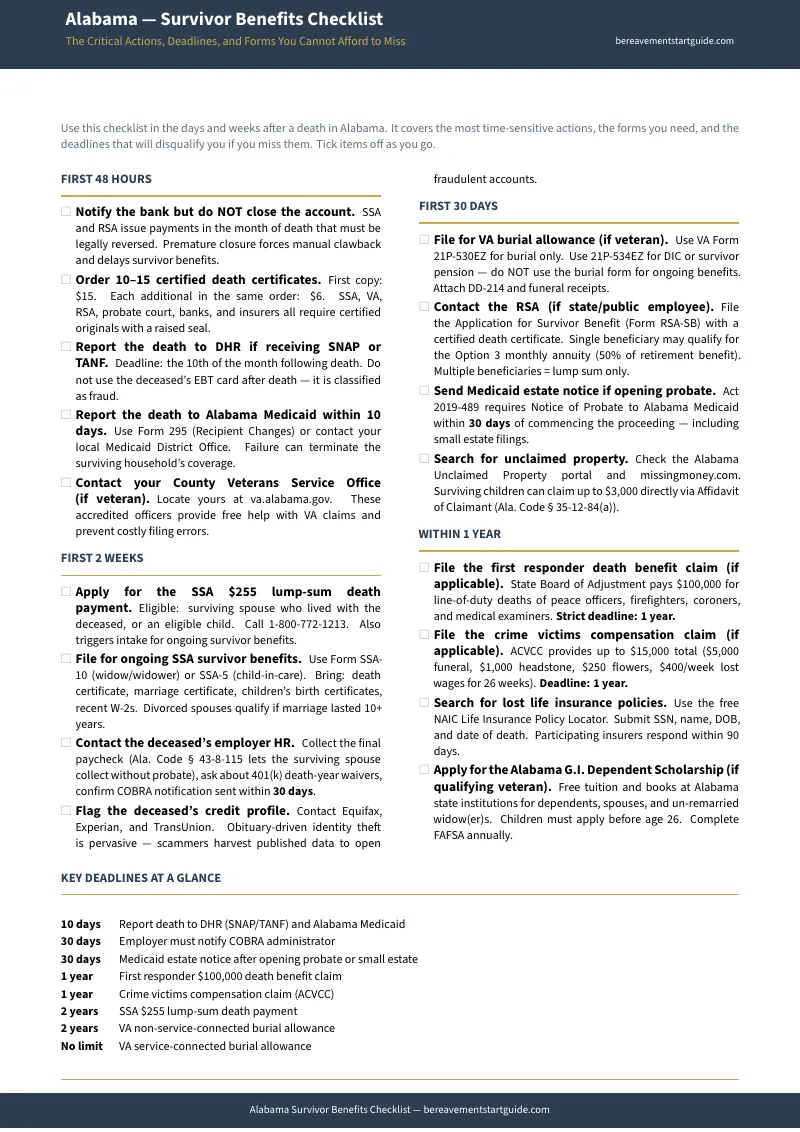
Not ready for the full guide? Download the free Alabama Survivor Benefits Checklist --- a summary of the most time-sensitive actions, deadlines, and forms that most families do not discover until it is too late. Enough to start contacting the right agencies in the right order.
You did not plan for this. But you can plan what happens next. The guide gives you the benefits, the forms, the deadlines, and the filing sequence --- so the next six months are spent claiming what your family is owed, not discovering what you missed.
Frequently Asked Questions
What if the rules change after I buy?
We update the guide when the rules change. Email us any time, even years later, and we'll send you the current edition free.