Your Parent Is Medevaced from the Village to Anchorage. The Receiving Hospital Asks Who Has Authority to Make Medical Decisions. Nobody Does. And the Paperwork That Could Have Answered That Question Is Still in a Kitchen Drawer 400 Miles Away.
This is how most Alaska families encounter advance care planning. Not during a quiet conversation. During a medevac — when a parent is airlifted from a remote village to the Alaska Native Medical Center or Providence, and the receiving team needs to know who can authorize treatment, what the patient wants regarding life support, and whether any legal documents exist. The answer, in most cases, is "we're not sure" — because nobody completed the five-part statutory form, or somebody filled out a generic national template that doesn't address the parts of Alaska's Health Care Decisions Act that matter most.
Alaska is not like other states. The statutory Advance Health Care Directive under AS 13.52 combines five distinct legal functions into one document: healthcare proxy, living will, mental health treatment declaration, organ donation, and primary physician designation. The mental health section has separate, stricter activation rules than the rest. Body disposition requires notarization even when the healthcare directive does not. And the state's signature HIPAA gap means your spouse may be legally unable to access your medical records or retirement health benefits during an emergency — regardless of how long you have been married.
The Alaska Advance Directive & Living Will Kit is a Medevac-Ready Planning System — not a blank form download, but a structured walkthrough of every decision, every signing requirement, and every Alaska-specific rule between opening the AS 13.52 statutory form and having a legally binding, hospital-accessible document that works when the flight crew lands in Anchorage at 2 a.m.
What's Inside the Medevac-Ready Planning System
A comprehensive 13-chapter guide with 2 appendices, an Advance Directive Quick-Start Checklist, and standalone printable tools — covering every step from understanding Alaska's five-part AHCD through distributing and storing your completed documents, built specifically for AS 13.52 and the geographic reality that makes advance care planning here different from any other state:
The Five-Part AHCD: One Document, Five Legal Functions
Alaska's statutory form does more than most states' advance directives. Part I appoints your healthcare agent and alternates. Part II records your living will instructions on life-sustaining treatment, artificial nutrition, and comfort care. Part III handles organ and tissue donation. Part IV — unique to Alaska — documents your mental health treatment preferences, including psychotropic medications and ECT decisions. Part V designates your primary physician. The guide walks you through each section with plain-language explanations of what each choice means in practice and what happens if you skip it.
The Two-Witness Rural Path
Finding a notary in bush Alaska ranges from difficult to impossible. Under AS 13.52.010, you can execute the healthcare directive with two qualified adult witnesses instead of a notary. But the witness eligibility rules are strict — your named agent cannot witness, treating providers cannot witness, facility employees generally cannot witness, and at least one witness must be entirely independent (no blood, marriage, or adoption relation and no inheritance claim). The kit includes a witness screening checklist that translates every statutory disqualification into plain yes-or-no questions so you can identify eligible witnesses before assembling everyone for signing.
The Mental Health Declaration (Part IV)
Most generic templates either skip psychiatric planning entirely or treat it as an afterthought. Alaska is one of few states that integrates mental health treatment planning directly into the statutory form. Part IV lets you document preferences about psychotropic medications, electroconvulsive therapy, and psychiatric facility admission. The activation rules are stricter than for standard healthcare decisions — your agent's mental health authority only becomes effective through court determination or emergency clinical assessment. And once a clinical panel determines incompetence, the revocation rules change entirely. The guide devotes a full chapter to Part IV so you understand exactly what you are signing.
The HIPAA Spouse Gap
Marriage does not give your spouse automatic access to your medical records in Alaska. The Division of Retirement and Benefits (DRB) and self-funded plans like AlaskaCare enforce HIPAA strictly — they require a completed Authorization for Use and Disclosure of Protected Health Information (DRB Form BEN043) or a notarized Health Care Power of Attorney before releasing records to a spouse. Families discover this gap during the worst possible moment: when a spouse is hospitalized and the other spouse is told they have no legal right to treatment information. The kit addresses this directly with the supplementary authorization forms and instructions.
The Comfort One to POLST Transition
Thousands of older Alaskans still carry Comfort One cards from the state's legacy out-of-hospital DNR program. The state transitioned to POLST (Physician Orders for Life-Sustaining Treatment) in May 2021 and stopped issuing Comfort One forms in June 2022. Existing cards remain valid if signed before the transition — but a POLST is a clinician-signed medical order, not the same document as an advance directive. The guide explains how the Comfort One, POLST, and advance directive fit together and includes a transition checklist for families holding legacy documents.
Body Disposition and the Notarization Requirement
If you want legally binding instructions about burial, cremation, or alternative arrangements, the Disposition of Human Remains Act (AS 13.75) requires notarization — even if you used the two-witness method for the rest of your directive. The guide explains when notarization is mandatory, when it is optional, and how to coordinate disposition planning with Alaska Native corporation land considerations for families with allotment burial preferences.
Storage, Distribution, and Medevac Readiness
A completed directive that sits in a filing cabinet fails the moment a medevac arrives. The guide covers how to register the document with your physician's office, how to get it scanned into tribal health EHR systems for access by any provider across the network, how to prepare wallet cards for emergency responders, and how to ensure the receiving hospital in Anchorage or Fairbanks has your directive on file before the emergency happens — not after.
Who This Kit Is For
- The out-of-state adult child managing aging parents in Alaska — who needs clear legal authority to communicate with doctors, access medical records, and direct treatment from thousands of miles away without waiting for a court-appointed conservator
- The Alaska "snowbird" splitting time between the state and the Lower 48 — who needs a directive that works at Providence in Anchorage and at a hospital in Arizona, with the portability instructions to ensure both facilities recognize it
- The rural caregiver in a village without notary access — who needs to know exactly how to execute a legally valid document using the two-witness method without traveling to an urban hub
- The spouse discovering the HIPAA gap — who just learned that marriage does not grant automatic access to a partner's health records, retirement benefits, or care decisions under Alaska and federal law
- The patient facing a diagnosis or upcoming surgery — who needs a completed, hospital-ready directive before admission to Alaska Regional, Providence, or ANMC
- The Alaska Native family coordinating with tribal health — who wants the directive scanned into the tribal EHR system and aligned with cultural preferences for end-of-life care, ceremonial arrangements, and allotment land burial considerations
Why Free Alaska Forms and Generic Templates Leave Families Exposed
The Alaska Court System and tribal health organizations distribute the statutory advance directive form at no cost. The legal text is there. Here is what is missing:
- No execution guidance. The free form gives you blank signature lines but does not explain the witness disqualification rules that can invalidate the entire document. Rural families assemble their neighbors for a signing and discover afterward that the witnesses did not meet the statutory independence requirement.
- No mental health section walkthrough. Part IV of the Alaska form has stricter activation rules, different triggering mechanisms, and irrevocable consent provisions that do not apply to any other section. Free forms present it as another checkbox. The consequences of misunderstanding this section — losing the ability to revoke your psychiatric treatment preferences — are severe.
- No HIPAA gap coverage. Standard forms appoint a healthcare agent but do not include the supplementary authorization forms that Alaska benefit plans and HIPAA-covered entities actually require before releasing information to a spouse. Families discover this gap at the hospital admissions desk.
- No medevac distribution strategy. Free forms do not explain how to get the document into the right systems — tribal health EHR, hospital record portals, wallet cards, provider office files — so it is accessible during an air transport from a village to a regional hub.
- No Comfort One transition help. Generic national templates have no concept of Alaska's Comfort One program, the POLST replacement, or the confusion thousands of families face about whether their legacy DNR cards still work and what to do next.
Online platforms like FreeWill, Rocket Lawyer, and LegalZoom generate documents but do not address Alaska's unique five-part structure, the mental health declaration's separate legal framework, or the geographic logistics that determine whether your directive is accessible during a crisis that starts in a roadless village.
Your Purchase Is Protected
If the kit does not help you complete a legally sound Alaska advance directive, email hello@bereavementstartguide.com for a full refund. No time limit, no questions, no hassle.
Start Planning Today
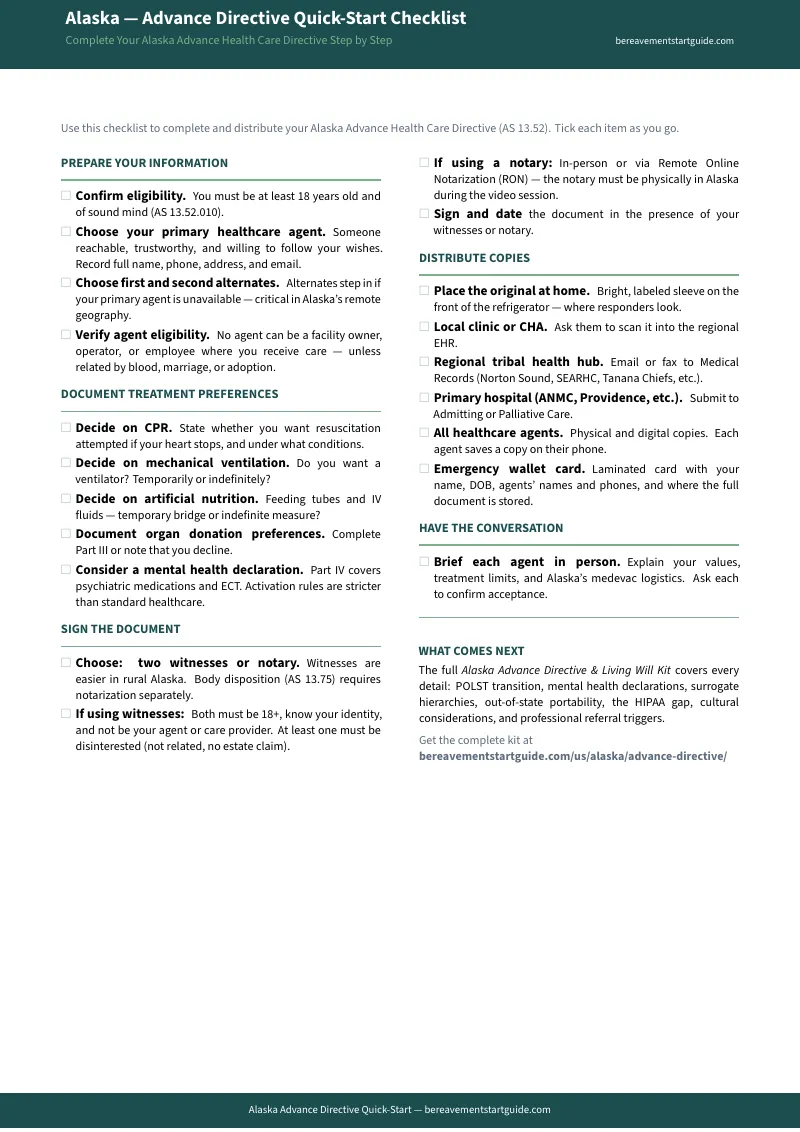
Download the free Alaska Advance Directive Quick-Start Checklist to see what goes into proper execution under Alaska law. When you are ready for the complete system — the full 13-chapter guide, 6 standalone printable tools (Witness Screening Checklist, Healthcare Agent Briefing Packet, Treatment Decisions Worksheet, Conversation Starters, Directive Distribution Tracker, Key Contacts Card), plus the checklist — the full kit is . Less than a single hour of consultation with an Alaska elder-law attorney, who typically charges $250 to $450 per hour.
Frequently Asked Questions
What if the rules change after I buy?
We update the guide when the rules change. Email us any time, even years later, and we'll send you the current edition free.