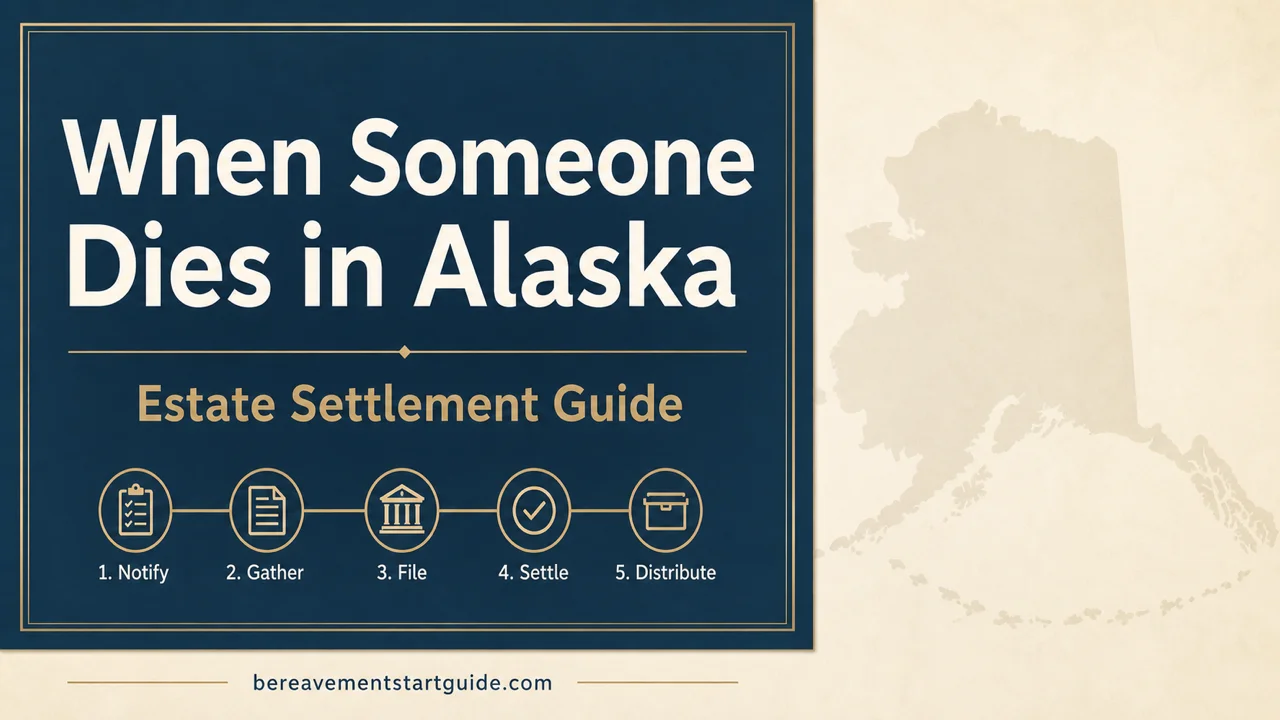
Someone You Love Just Died in Alaska. The Bank Froze Their Accounts. The Funeral Director Is Asking How Many Death Certificates You Need. The PFD Application Deadline Is March 31. You Have No Idea What Happens Next.
You are standing in the middle of chaos that nobody prepared you for. Maybe you were named personal representative in a will you barely remember reading, and now the funeral home is asking you to sign forms you have never seen. Maybe there was no will at all, and because you are the eldest child or the surviving spouse, everyone in the family is looking at you for answers you do not have. Maybe the bank just told you that the checking account is frozen and you cannot access a single dollar to pay the electric bill, the mortgage, or the funeral deposit — and the person who would have known what to do is the one who just died.
You are grieving and sleep-deprived, but the paperwork does not wait. The funeral director needs a number for death certificates by tomorrow. Social Security will claw back any benefits deposited for the month of death if you do not act. The Permanent Fund Dividend office has a rigid March 31 deadline for estate applications, and missing it means forfeiting a check worth over a thousand dollars. If the deceased held Alaska Native Corporation shares, those follow federal law — not state probate — and the corporation needs a Testamentary Disposition on file or the shares transfer according to rules you have never heard of. And somewhere in the back of your mind, a terrifying question keeps circling: if I pay the wrong bill, or sign the wrong form, or miss a deadline I don't even know about — am I personally liable?
The short answer: you are not personally responsible for the deceased's debts. But the long answer — the one that involves Alaska's four-month creditor window, a $100,000 vehicle threshold for the P-110 Small Estate Affidavit, a $50,000 personal property threshold that creates an entirely separate process, a burial transit permit that must be filed within 72 hours, ANCSA shares that bypass the entire state court system, and a PFD application deadline that the state will not extend for any reason — that answer is what separates families who settle an estate in months from families who spend years and thousands of dollars untangling mistakes they did not know they were making.
The When Someone Dies in Alaska — Estate Settlement Guide is a Calm Sequencing System for every legal, financial, and administrative step between the funeral home and final distribution. Not a law textbook. Not a generic checklist you found on a national website that does not know Alaska from Alabama. A structured, Alaska-specific manual that separates what must be done in the first 48 hours from what can legally wait four months — so you stop guessing, stop panicking, and start working through this in the right order.
What's Inside the Calm Sequencing System
A 10-chapter guide, the First 48 Hours Checklist, and 2 appendices — covering every stage from the moment of death through final asset distribution, built specifically for Alaska statutes, Superior Court probate procedures, and the state-specific rules that make settling an estate here different from any other state:
Chapter 1: The First 48 Hours — Burial Transit Permits, Medical Examiner, and Death Certificates
Alaska requires a burial transit permit within 72 hours — and if the death occurred in a remote area, you may be dealing with a subregistrar rather than a municipal office, and bush plane transport rather than a hearse. The State Medical Examiner in Anchorage handles cases involving unattended deaths, and transport logistics from rural Alaska add complexity that no other state matches. The funeral director is going to ask you how many certified death certificates to order, and most families guess wrong. You need originals for every bank, every insurance company, the Superior Court, the DMV for vehicle transfers, and every recording district where the deceased owned property. This chapter tells you the exact calculation based on the deceased's assets, covers what to do today, what to do tomorrow, and what to absolutely not do — including the single most important rule in this entire guide: do not pay any of the deceased's bills with your own money.
Chapter 2: Identifying Your Estate Pathway — P-110 Affidavit vs. Informal Probate
Not every estate needs to go through Superior Court. Alaska's P-110 Small Estate Affidavit lets families transfer vehicles worth up to $100,000 and other personal property worth up to $50,000 without opening probate — but only if the estate holds no real property and you have waited the required period after death. The guide includes a decision tree that walks you through the exact criteria: Does the estate own real property? What is the total value of personal property? Do any vehicles exceed the threshold? If your family qualifies, the P-110 path saves months of court proceedings and potentially thousands in attorney fees. If you do not qualify, the guide tells you exactly why and what the informal probate process requires instead.
Chapter 3: Defending the Estate — Statutory Allowances Worth Up to $55,000
Alaska law protects surviving spouses and families with three statutory allowances that sit at the top of the creditor hierarchy — they must be paid before almost any debt. The $27,000 Homestead Allowance, the $18,000 Family Allowance, and the $10,000 Exempt Property Allowance. These apply regardless of what the will says. Together, they total up to $55,000 in protected assets. The guide explains how to claim each one, how they interact with each other, and how they can effectively consume an entire small estate — leaving nothing for unsecured creditors and everything for the surviving family.
Chapter 4: The Alaska Permanent Fund Dividend — The March 31 Deadline
If the deceased was eligible for a PFD in the year of death, the estate can claim it — but only if you file by March 31. The state will not grant extensions. If the death occurs in February and you are still figuring out who the personal representative is, the deadline does not wait. This chapter covers the estate PFD application process, the eligibility requirements, what documentation you need, and the exact steps to file before the deadline passes. For many Alaska families, the PFD represents over a thousand dollars that simply disappears if you miss the date.
Chapter 5: Alaska Native Corporation Shares and BIA Land
This is the chapter that does not exist in any other state's estate guide. Alaska Native Corporation shares — created under the Alaska Native Claims Settlement Act — follow federal law, not state probate. They cannot be sold on the open market. They transfer through Testamentary Dispositions filed with the corporation, and if no Testamentary Disposition exists, they follow ANCSA's own descent and distribution rules, which differ from Alaska's state intestacy statutes. Life estate shares add another layer of complexity. If the deceased also held restricted allotments through the Bureau of Indian Affairs, those follow yet another set of federal rules. The guide maps the entire process for both ANCSA shares and BIA allotments — who to contact, what forms to file, and how these assets interact with the rest of the estate.
Chapter 6: Step-by-Step Alaska Superior Court Probate
If the estate requires probate, this chapter walks you through every step: the $250 filing fee, Form P-341 Notice to Creditors, Form P-370 Inventory, the four-month creditor claim window, and the milestone sequence from petition through final distribution. Alaska has four judicial districts — First through Fourth — and filing procedures vary. The guide covers what to expect in each district and how to navigate the Superior Court process whether you are in Anchorage, Fairbanks, Juneau, or a smaller community.
Chapter 7: Transferring Specific Assets — Banks, Vehicles, Real Property, Aircraft
Each asset type has its own transfer process. Banks may release accounts with a P-110 affidavit for small estates, or require Letters Testamentary for larger ones. Vehicles transfer through DMV Form 827 for estates under $150,000 — a different threshold than the P-110 affidavit. Real property requires recording a new deed in the appropriate recording district. And because this is Alaska, the guide also covers aircraft transfers through the FAA — a step that most estate guides never mention because most states do not have one aircraft for every 58 residents. This chapter maps every asset type, what unlocks it, and what paperwork you need.
Chapter 8: Taxes and Final Returns
Alaska has no state estate tax, no state inheritance tax, and no state income tax. That eliminates three entire categories of tax filings that families in other states must deal with. But federal obligations remain: the deceased's final Form 1040 must be filed, and estates above the federal exemption threshold require Form 706. This chapter explains exactly what you owe, what you do not, and the federal deadlines that apply.
Chapter 9: Closing the Estate
Form P-350 closes a small estate. Form P-301 closes a standard probate. This chapter covers the final accounting, the petition for discharge, and the steps to formally close the estate with the Superior Court — including what happens if a beneficiary or creditor objects to the final distribution.
Chapter 10: Rural Alaska Considerations
No other state has a chapter like this. Bush logistics — getting a burial transit permit filed when the nearest registrar is a subregistrar in a village with limited office hours. Transport — moving remains by bush plane when there are no roads. Community Justice Workers who assist with legal paperwork in communities without attorneys. The State Medical Examiner's role in transporting remains from remote areas. If you are settling an estate from rural Alaska, this chapter addresses the practical realities that no generic probate guide covers.
Who This Guide Is For
- The surviving spouse whose partner just died and whose bank accounts were frozen this morning — who needs to know which accounts stay accessible, which ones require court paperwork, and how to claim the statutory protections — including the $27,000 Homestead Allowance, the $18,000 Family Allowance, and the $10,000 Exempt Property Allowance — that Alaska law guarantees before any creditor gets paid
- The adult child named as personal representative who has never been through probate, lives out of state, and is terrified of making a mistake that triggers personal liability — who needs the complete sequence of fiduciary duties, court deadlines, and filing requirements in one document
- The family with Alaska Native Corporation shares who just learned that ANCSA shares follow federal law, not state probate — who needs to understand Testamentary Dispositions, life estate shares, and the difference between corporation shares and BIA restricted allotments
- The family with no will who just learned that Alaska's intestate succession laws will decide everything — who needs to understand exactly who inherits what, whether the house must go through probate, and whether the P-110 Small Estate Affidavit applies to their situation
- The person settling an estate from rural Alaska who is dealing with bush logistics, subregistrars, limited court access, and the practical reality that the nearest Superior Court may be hours away by plane — who needs guidance that accounts for Alaska's geography, not just its statutes
- The executor racing the PFD deadline who just realized the March 31 Permanent Fund Dividend application deadline is approaching — who needs to know exactly what to file, what documentation the PFD Division requires, and how to submit the estate application before the deadline passes
Why Free Resources Will Not Get You Through This
The information exists. It is scattered across Alaska Superior Court websites, the Alaska Bar Association's pamphlet library, funeral home bereavement pages, Alaska Native Corporation shareholder offices, and a dozen federal agency portals that do not talk to each other. Here is what you actually encounter when you try to settle an estate using free sources alone:
- The Alaska Court System gives you forms and tells you to hire a lawyer. The court website publishes P-110, P-341, P-370, and P-301 forms with basic instructions. But every page explicitly states the court "cannot provide legal advice" and directs you to retain counsel. If you are dealing with a $40,000 estate and the attorney quotes $327 per hour, the math does not work — but the court offers no alternative path.
- Alaska Legal Services targets pre-death planning, not post-death crisis management. Legal aid programs provide free pamphlets on creating wills and basic estate planning overviews. They do not provide sequential, step-by-step guidance for the person standing in the funeral home parking lot who needs to know what to do in the next 48 hours.
- Funeral homes give you surface-level advice designed to sell services. Bereavement pages from Alaska funeral homes tell you to order death certificates and notify the bank. They do not explain the P-110 affidavit thresholds, the PFD estate application deadline, ANCSA share transfers, or the creditor priority hierarchy. Their advice ends where the hard questions begin.
- Alaska Native Corporation shareholder offices handle shares but not the rest of the estate. Each regional corporation has its own process for Testamentary Dispositions and share transfers, but they do not explain how those shares interact with the rest of the estate, the Superior Court probate process, or the P-110 affidavit. You get one piece of a puzzle that spans federal law, state probate, and corporation bylaws.
- National platforms miss Alaska-specific details and charge recurring fees. Nolo, Trust & Will, and similar platforms offer estate administration tools for $149 per year or more. They cover probate in general terms. They do not cover the P-110 thresholds, the DMV Form 827 vehicle transfer process, the PFD estate application, ANCSA share transfers, BIA restricted allotments, or bush logistics. Alaska is not a footnote — it is a state with rules that exist nowhere else, and generic tools miss them entirely.
Free resources give you fragments from a dozen different sources that do not reference each other. The Calm Sequencing System puts every Alaska-specific statute, form, deadline, and procedure into one document, in the order you actually need them.
— Less Than One Hour With an Alaska Estate Attorney
A single consultation with an Alaska probate attorney costs $327 per hour on average, and specialists charge $330 to $500 per hour. Standard probate representation runs significantly more. National estate software platforms charge $149 per year in recurring subscription fees. This guide costs less than one hour of professional legal time and gives you the complete Alaska-specific roadmap — every statute, every deadline, every form, every court procedure, and the decision tree that tells you whether you even need an attorney at all.
Your download includes 8 printable PDFs — the complete 10-chapter guide with two appendices, plus 7 standalone tools you can print individually and bring to the funeral home, the bank, the courthouse, or pin above your desk:
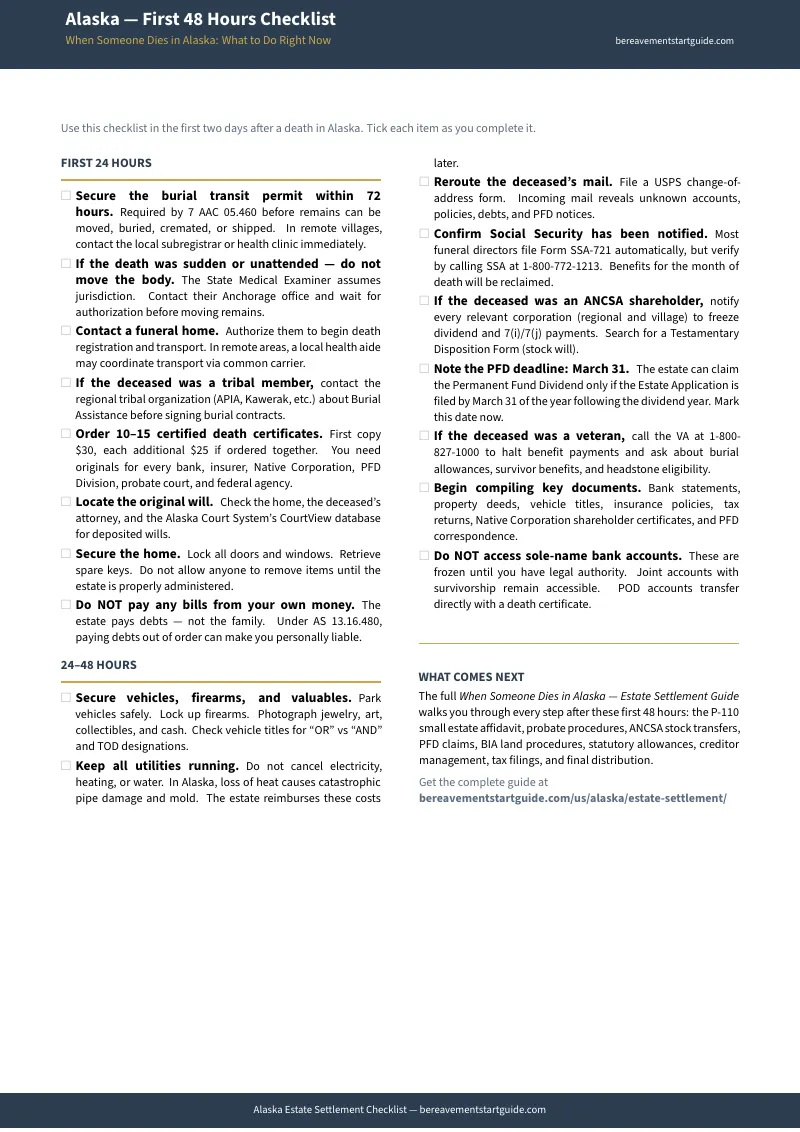
- Alaska First 48 Hours Checklist — 19-item print-and-pin reference for everything that must happen in the first two days
- Estate Pathway Decision Tree — work through the P-110 vs. Probate questions step by step, with a side-by-side comparison of all three pathways
- Creditor Priority Reference — the 9-level debt hierarchy and $55,000 statutory allowance shield on one page
- Death Certificate Calculator — count exactly how many certified copies to order, with costs and ordering instructions
- Statutory Deadline Calendar — every deadline from Day 1 through estate closing, with a fillable "Your Date" column
- Forms and Fees Reference — every court form number, agency form, and fee amount in one place
- ANCSA Share Transfer Reference — all 12 regional corporation contacts, Testamentary Disposition vs. intestate transfer paths, and BIA restricted land procedures
Instant download, no account required.
Money-back guarantee, no time limit. If the guide does not give you clarity on what to do next and confidence that you are doing it in the right order, email us for a full refund. No questions asked.
Not ready for the full guide? Download the free Alaska First 48 Hours Checklist — 19 items covering everything that must happen in the first two days after a death in Alaska: burial transit permits, death certificates, securing the home, notifying Social Security, the PFD deadline, Native Corporation notification, and what to gather. It is enough to get through tonight and tomorrow.
You did not ask for this job. But you can do it. The guide shows you how, one step at a time.
Frequently Asked Questions
What if the rules change after I buy?
We update the guide when the rules change. Email us any time, even years later, and we'll send you the current edition free.