The PFD Estate Application Deadline Is March 31. The Portability Election Is Worth $15 Million. The Community Property Double Step-Up Could Erase Six Figures in Capital Gains. And You Are Trying to Figure Out Form 1310 Without a Court Appointment.
Someone has died in Alaska, and you are now responsible for the taxes. You called the IRS and spent forty-five minutes on hold before learning that the deceased's final Form 1040 is due by April 15 --- but the agent could not tell you how to report the Permanent Fund Dividend on Schedule 1 when the payment went to the estate. You searched the Alaska Court System website and found probate forms but no tax guidance. You tried TurboTax and discovered it cannot file a return for a deceased person unless you already know which forms to attach and which boxes to check. You called a CPA and were quoted $995 for a basic Form 1041 --- for an estate that might only have $800 in income.
Meanwhile, deadlines are approaching. The PFD estate application must be filed by March 31 --- no extensions, no late filings, and the PFD Division will not remind you. The estate is generating income from bank interest, a rental property, and an ANCSA corporation dividend, which means Form 1041 is required --- but you do not know whether to elect a calendar year or a fiscal year, and the difference affects when taxes are due for the next twelve months. The deceased's spouse is asking whether they can sell the house without owing capital gains, and you have heard something about a "community property double step-up" but cannot find a straight answer about whether it applies. And Form 706 --- the federal estate tax return --- may not be required for tax purposes, but filing it could preserve $15 million in portability that the surviving spouse will permanently lose if nobody acts within five years.
The Alaska Federal Tax Compliance Roadmap is a 15-chapter guide that puts every federal tax obligation, Alaska-specific filing, and basis optimization strategy in one place, in plain English, in the order you need to act. Not a blog post summarizing "Alaska has no state estate tax." Not a generic national guide that skips the PFD, ignores ANCSA stock, and has never heard of a CFEC fishing permit. A step-by-step reference built specifically for the tax realities that Alaska executors, surviving spouses, and beneficiaries actually face after a death.
What's Inside the Federal Tax Compliance Roadmap
A 15-chapter guide and a quick-start checklist --- covering every tax filing, form, deadline, and basis strategy that applies when someone dies in Alaska:
Chapter 1: The Alaska Tax Landscape After Death
Why "no state tax" is the most dangerous assumption an executor can make. Alaska has no state income tax, no state estate tax, and no inheritance tax --- but the federal obligations are extensive, and the absence of a state-level system is precisely why executors assume no action is needed at all. The 2026 federal estate tax threshold under the One Big Beautiful Bill Act: $15 million per individual, $30 million for married couples with portability. What that means for your estate --- and what it does not excuse you from filing.
Chapter 2: First Steps --- EIN, Form 56, and Getting Organized
Apply for the estate's EIN (Form SS-4) online in ten minutes --- free, instant, and required before you can open an estate bank account, file any tax return, or receive payments owed to the estate. File Form 56 (Notice of Fiduciary Relationship) so the IRS sends all correspondence to you instead of the deceased's last address. Order 10-15 certified death certificates ($30 first copy, $25 each additional). Open the estate bank account. The complete document gathering checklist: W-2s, 1099s, bank statements, brokerage accounts, PFD records, ANCSA dividend statements, CFEC permits, real estate deeds, and gift tax returns.
Chapter 3: The Final Federal Income Tax Return (Form 1040)
The return covers income from January 1 through the exact date of death. How to write "DECEASED" across the top of a paper return. When a surviving spouse should file jointly (almost always --- highest standard deduction, widest brackets). Qualifying Surviving Spouse status for the two years following death. How to claim the refund: Form 1310 for non-spouse executors without formal court appointment. The specific income items Alaska decedents encounter: PFD reporting on Schedule 1, ANCSA dividends, workers' compensation (not taxable), Social Security (up to 85% taxable), and the $255 lump-sum death payment (not taxable).
Chapter 4: The Alaska Permanent Fund Dividend (PFD)
The estate may be owed a dividend worth over $1,000. The personal representative must file an Estate Application by March 31 of the year following the dividend year --- absolute deadline, no exceptions, no late filings. Eligibility rules: 180-day residency requirement, death timing windows, prior-year PFD receipt. How to report the PFD on the correct return: final Form 1040 (Schedule 1, Line 8g) if received before death, Form 1041 if paid to the estate after death, beneficiary's own 1040 if collected via small estate affidavit. The state's federal payer EIN (92-6001185) and the 1099-MISC that triggers IRS matching.
Chapter 5: Estate Income Tax (Form 1041)
Required if the estate earns $600 or more in gross income --- and in Alaska, a single quarter of bank interest plus one ANCSA dividend can exceed that threshold. The fiscal year election: how choosing the right year-end date can defer your filing deadline by months. Schedule K-1 distributions to beneficiaries --- why distributing income avoids the compressed estate tax brackets that hit 37% at just $15,200. Estimated tax payments (Form 1041-ES) when the estate expects to owe $1,000 or more.
Chapter 6: Federal Estate Tax and Portability (Form 706)
The $15 million threshold and the 40% rate on the excess. When Form 706 is required (gross estate plus adjusted taxable gifts over $15 million). When to file it anyway: the portability election (DSUE) that lets the surviving spouse inherit the deceased's unused exemption. Why Alaska executors miss this more than any other state --- because the absence of a state estate tax makes them assume no federal filing is needed. The 5-year late-filing safety net under Revenue Procedure 2022-32: the exact statement to write at the top of Form 706, the qualifying conditions, and why waiting too long means permanently forfeiting millions in future tax protection.
Chapter 7: Step-Up in Basis and the Alaska Community Property Act
The standard step-up: inherited assets receive a new basis equal to fair market value on the date of death, erasing a lifetime of unrealized capital gains. The standard joint-property rule: only the deceased's 50% gets stepped up. The Alaska Community Property double step-up under IRC 1014(b)(6): both halves receive a full step-up, potentially saving the surviving spouse six figures in capital gains tax. How Alaska's opt-in community property system works --- Community Property Agreements, Alaska Community Property Trusts, the AS 34.77.100 nexus requirements. What the executor must do: identify community property assets, order date-of-death appraisals, document the new stepped-up basis. The critical fact: this election must have been made during the couple's lifetimes --- an executor cannot create community property status after death.
Chapter 8: Alaska Native Corporation (ANCSA) Stock
ANCSA shares are inalienable under federal law --- they cannot be sold, pledged, or used to pay estate debts, period. Transfer upon death: stock wills (Testamentary Dispositions), general wills, and Alaska intestate succession rules. How to contact the shareholder records department of each Native Corporation (Sealaska, CIRI, Calista, Ahtna, Arctic Slope, village corporations). Which documents to provide: death certificate, Affidavit of Heirship, stock will or Letters of Administration. Tax treatment: standard dividends (taxable), resource revenue payments under Section 7(i) and 7(j) (generally taxable), settlement trust distributions (generally tax-free), Elder benefits and memorial distributions (varies by corporation). How to read the 1099-DIV correctly.
Chapter 9: Commercial Fishing Permits and IFQs
CFEC entry permits survive death and can be transferred to heirs. The beneficiary designation process, the temporary transfer that prevents losing a fishing season during probate, and the rules for minor heirs (age of presumptive ability: 10 for set net, 16 for most other gear). Federal IFQ/QS transfers through NMFS. Valuation using CFEC Permit Value Reports and Quartile Tables for the probate inventory and stepped-up basis. Why an arbitrary number on the inventory form can cost the heirs thousands in capital gains when the permit is eventually sold.
Chapter 10: Alaska Probate Basics for Tax Purposes
The small estate affidavit (Form P-110): vehicles under $100,000, other personal property under $50,000, no real property, 30-day waiting period. When probate is required: filing fee ($250), the 3-month inventory deadline (Form P-370), the creditor notice publication schedule, the 4-month creditor claim period, and the 6-month safe-distribution window. The $55,000 in statutory family allowances that are protected from all general creditors: Homestead ($27,000) + Family ($18,000) + Exempt Property ($10,000). The rule that protects you: do not distribute assets before the creditor period closes, or you are personally liable.
Chapter 11: Medicaid Estate Recovery
If the deceased received Medicaid long-term care after age 55, the state files a claim against the estate under AS 47.07.055. Exemptions that block recovery: surviving spouse in the home, child under 21, blind or permanently disabled child, sibling with equity interest who lived there 1+ year. The caregiver child exemption: 2 years of continuous residence plus documented care that delayed institutionalization. Hardship waivers for income-producing property and modest-value homes. ANCSA and Native land exemptions for property on or near federally recognized reservations.
Chapter 12: Selling Inherited Property --- Capital Gains Tax
The formula: Sale Price minus Stepped-Up Basis minus Selling Costs equals Taxable Gain. Worked examples: a Talkeetna cabin, an Anchorage home with and without community property treatment. Why inherited property is automatically treated as long-term (qualifying for 0%, 15%, or 20% rates regardless of holding period). Reporting on Form 8949 and Schedule D. Why you must keep basis documentation permanently --- the IRS has no statute of limitations on basis challenges if no return was filed.
Chapter 13: Critical Deadlines Calendar
Every deadline in chronological order, from "immediately" through five years after death. The master table: EIN application, Form 56, death certificates, Day 30 small estate eligibility, 3-month inventory, 4-month creditor period, 6-month safe distribution, March 31 PFD deadline, April 15 final 1040, Form 1041 due dates, 9-month Form 706 deadline, 15-month extended deadline, and the 5-year portability cutoff. Print it, post it, check items off.
Chapter 14: When to Hire a Professional
When a CPA or enrolled agent pays for themselves: Form 1041 with multiple income sources, fiscal year elections, IRD calculations, estimated tax payments. When an estate planning attorney is essential: Form 706 filings, community property trust documentation, contested wills, multi-state property, Medicaid recovery disputes. When to contact the Native Corporation directly versus when to involve an attorney. The fee reality: $327/hour for an Alaska probate attorney, $995-$1,400 for basic Form 1041 preparation, $2,500+ for Form 706 preparation. And the clear line between what this guide handles and what requires professional help.
Chapter 15: Common Mistakes to Avoid
The ten errors Alaska executors make most often: distributing assets before the creditor period closes (personal liability). Missing the March 31 PFD deadline (permanent forfeiture). Forgetting the PFD is federally taxable (IRS notice). Forfeiting portability by not filing Form 706 (losing $15 million in exemption). Losing the double step-up by not documenting community property basis (six-figure capital gains). Trying to sell ANCSA stock (federal law violation). Confusing taxable dividends with tax-free settlement trust distributions. Ignoring Medicaid recovery exemptions. Assuming "no state tax" means "no tax work." Not keeping records.
Who This Guide Is For
- The executor who just discovered that "no state tax" does not mean "no tax work" --- who needs to file a final Form 1040, figure out whether Form 1041 is required, decide whether to elect a fiscal year, and determine if a Form 706 portability election is worth the filing cost. The guide walks you through every return in order, with form numbers, due dates, and the specific Alaska income items that national guides skip.
- The surviving spouse trying to protect the family home and retirement assets --- who needs to know whether a community property double step-up applies, how to document the basis before selling, how portability works, and what Qualifying Surviving Spouse filing status means for the next two years. The guide maps every tax decision that affects your long-term financial security.
- The out-of-state heir who inherited Alaska property --- who is projecting their home state's tax rules onto Alaska assets and panicking about inheritance taxes that do not exist. The guide explains exactly what you owe (federal capital gains on the sale, if anything), what you do not owe (state estate or inheritance tax), and how to calculate your stepped-up basis correctly.
- The family dealing with ANCSA stock, PFD claims, and fishing permits for the first time --- who has never heard of a Testamentary Disposition, does not know that settlement trust distributions are generally tax-free, and needs to value a CFEC permit for the probate inventory without guessing. The guide covers every Alaska-specific asset class and its unique tax treatment.
- The executor who got a $995+ CPA quote and a $327/hour attorney quote --- who knows the estate is too small to justify those fees but too complex to ignore. The guide handles the 80% of tax administration that does not require professional help and tells you exactly when the remaining 20% does.
Why Free Resources Leave You Guessing
Tax information exists. It is scattered across IRS.gov in one direction, the Alaska Court System in another, the PFD Division in a third, and a dozen Native Corporation shareholder relations departments that each only cover their own stock. Here is what happens when you try to assemble a tax plan from these sources:
- IRS.gov tells you how to file Form 1040 and Form 1041. It does not tell you how to report a deceased person's Permanent Fund Dividend on Schedule 1. The IRS has no Alaska-specific instructions. It does not mention the March 31 PFD estate application, the 1099-MISC from the state, or the difference between reporting the PFD on the final 1040 versus the estate's 1041. You have to figure out which return it belongs on yourself.
- TurboTax processes whatever numbers you type in. It does not remind you to apply for the PFD by March 31 or advise you to document the community property double step-up before selling the house. Tax software is reactive. It cannot tell you what you forgot to enter. It cannot warn you that skipping Form 706 means the surviving spouse permanently loses $15 million in portability. It files what you give it and nothing more.
- SmartAsset and Nolo publish state-by-state estate tax overviews. They say "Alaska has no estate tax" and move on. No ANCSA stock taxation. No PFD estate application deadlines. No community property opt-in mechanics. No CFEC permit valuation. These are national aggregators running the same template for fifty states, and Alaska's complications do not fit the template.
- A CPA will handle your Form 1041 for $995-$1,400 and your Form 706 for $2,500+. A probate attorney charges $327 per hour. For a large, complex estate, that is money well spent. For a straightforward estate where the surviving spouse needs to file a final 1040, claim the PFD, document the step-up, and decide whether portability is worth the Form 706 cost --- those professional fees can consume more than they save.
The guide consolidates every federal tax filing, Alaska-specific deadline, basis strategy, and form instruction into one reference --- so you spend hours on administration instead of weeks, and you know exactly which decisions require a professional and which ones you can handle yourself.
--- Less Than One Hour of a CPA's Time
The mistakes this guide prevents are not hypothetical. A surviving spouse who sells an $800,000 home without documenting the community property double step-up pays capital gains on $300,000 of appreciation that should have been erased. An executor who misses the March 31 PFD deadline forfeits over $1,000 that the estate was entitled to. A family that never files Form 706 for portability permanently loses $15 million in estate tax exemption that the surviving spouse could have used decades later. A personal representative who distributes assets before the creditor period closes becomes personally liable for debts the estate can no longer pay. Every one of these errors costs more than this guide.
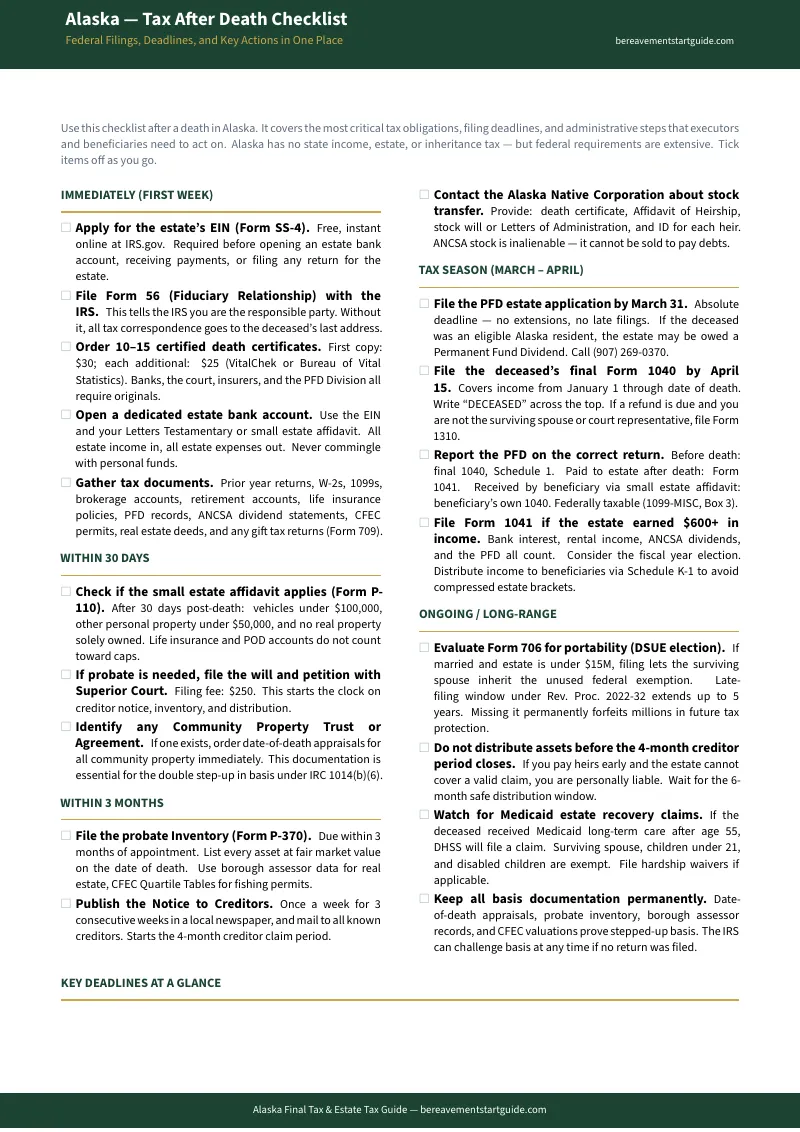
Your download includes four PDFs: the complete 15-chapter guide, the Alaska --- Tax After Death Checklist (a quick-start reference with every urgent filing and deadline), the Critical Deadlines Calendar (a one-page printable timeline from day one through five years after death), and the Forms Reference Card (every IRS and Alaska form you may need, with filing deadlines). Start with the checklist to identify what is time-sensitive. Then read the relevant chapters for the full instructions, form-by-form walkthroughs, and worked examples.
Money-back guarantee, no time limit. If this guide does not save you at least three hours of IRS research or prevent a $327 attorney consultation just to learn that Alaska has no state estate tax --- email us for a full refund. No questions asked. You have enough to worry about; your purchase should not be one of them.
Not ready for the full guide? Download the free Alaska --- Tax After Death Checklist --- the critical deadlines, required forms, and immediate actions that most executors do not discover until a deadline has already passed. Enough to start filing correctly tonight.
You did not ask for this responsibility. But the IRS does not care who asked for it --- it cares that the returns are filed correctly, on time, and with every dollar accounted for. The guide gives you the filings, the deadlines, the basis strategies, and the form-by-form instructions --- so the next six months are spent closing the estate, not untangling tax mistakes.
Frequently Asked Questions
What if the rules change after I buy?
We update the guide when the rules change. Email us any time, even years later, and we'll send you the current edition free.