The Funeral Home Says Embalming Is Required. The Airline Says Only a "Known Shipper" Can Send Remains. The Medical Examiner Has the Body in Anchorage and You Have 10 Days Before They Release It to a Stranger. None of That Is the Full Story — but You Will Not Find the Full Story on Any Free Website.
Someone you love just died in Alaska. Within hours, the machinery started moving. The State Medical Examiner's office took the body to Anchorage for investigation. The funeral home quoted you $8,000 for a traditional burial and told you that embalming is mandatory. You called Alaska Airlines Cargo about shipping the remains to a family member in the lower 48, and they said they only accept shipments from "Known Shippers" — which means you need a licensed funeral home to handle the paperwork, at whatever price they set. Someone mentioned a 24-hour refrigeration rule, a 72-hour burial transit permit requirement, and a 10-day window at the Medical Examiner's office before the body is classified as unclaimed and released to whatever funeral home is next in the rotation. You have no idea which of these rules are real, which are exaggerated, and which are being used to pressure you into services you do not legally need.
So you went online. The Alaska Department of Health has forms. The FTC has a page about the Funeral Rule. A funeral home in Anchorage has an FAQ that somehow never mentions that Alaska law allows families to handle disposition without hiring a funeral director at all. A national legal website has a state overview that skips the Medical Examiner's 10-day release protocol, the bush flight cargo rules, permafrost burial logistics, and the BIA burial assistance program that covers up to $3,500 for eligible Alaska Natives. You found pieces of the picture spread across fifteen different government sites, funeral home marketing pages, and attorney blogs that all end with "call our office for a consultation." You are grieving, you are running out of time, and no single source puts the whole picture together.
The Alaska Funeral Laws & Consumer Rights Guide is The Alaska Funeral Defense Manual — a plain-English consumer protection roadmap that does what scattered free sources cannot: it consolidates FTC Funeral Rule rights, Alaska Title 13 statutes, State Medical Examiner protocols, Bureau of Vital Statistics procedures, airline cargo rules, BIA and state financial assistance programs, and the family-directed funeral laws into one structured document. Not a funeral home's FAQ designed to funnel you toward their chapel. Not a national overview that treats Alaska like every other state. A step-by-step manual built on the specific statutes, timelines, and logistical realities that make arranging a funeral in the Last Frontier unlike anywhere else in the country.
What's Inside The Alaska Funeral Defense Manual
A comprehensive guide, a Funeral Consumer Rights Checklist, and standalone reference sheets — covering every phase of funeral arrangement in Alaska, from the moment of death through final disposition, built on the FTC Funeral Rule, Alaska Statutes Title 13, and the Alaska-specific rules that exist nowhere else:
Your FTC Funeral Rule Rights in Alaska: The Laws the Funeral Home Will Not Volunteer
Federal law requires every funeral home to give you an itemized General Price List before you discuss any arrangements. You have the legal right to buy a casket from a third-party retailer and the funeral home cannot charge a handling fee. You can decline embalming in most circumstances. You cannot be required to purchase a package — every service must be available a la carte. The guide details every FTC protection, how to enforce them during an arrangement conference, and the specific ways Alaska funeral providers routinely steer families toward expensive services they do not legally need. This chapter alone can prevent thousands of dollars in unnecessary purchases.
The 24-Hour, 72-Hour, and 10-Day Rules: Alaska's Legal Clocks Explained
Alaska law mandates refrigeration or embalming within 24 hours of death. A Burial Transit Permit must be obtained within 72 hours if you are storing or moving the body. The State Medical Examiner holds remains for a maximum of 10 days — if nobody submits a Release Authorization within that window, the body is classified as unclaimed and released to a rotational funeral home, stripping the family of any choice in the matter. The death certificate must be completed within three days. The guide maps every countdown, what triggers each one, what happens if you miss it, and exactly how to meet each deadline — including the specific forms and offices involved.
Family-Directed Funerals: You Do Not Need a Funeral Director in Alaska
Alaska is one of the states that permits families to handle the entire disposition process without hiring a licensed funeral director. Under AS 08.42.020(c), an unlicensed person can apply for a Care and Disposal of Human Remains Permit through the Department of Commerce. This means you can legally wash the body, hold a home vigil, transport the remains yourself within the state, and arrange burial or cremation — provided no embalming is required. The guide walks through the permit application, the legal boundaries, and the specific situations where a licensed mortician is still required by law. For families who want a personal, hands-on farewell without a $4,000 professional service fee, this chapter provides the complete legal framework.
Shipping Remains Out of Alaska: Airline Cargo Rules and the "Known Shipper" Workaround
Alaska Airlines Cargo requires human remains to be shipped in tightly closed, leak-proof containers inside a rigid outer shipping box. TSA regulations mean only "Known Shippers" — typically licensed funeral homes — can send packages over one pound via commercial airline. This effectively forces families to pay a funeral home for forwarding services even when they are handling everything else independently. The guide teaches you how to strategically engage a funeral home strictly for "forwarding remains" at the regulated FTC rate rather than buying a full-service package, and explains the alternative: a local direct cremation followed by carrying the cremated ashes as personal luggage, bypassing the Known Shipper requirement entirely.
Who Decides: The Legal Priority for Disposition Under AS 13.75.020
When a new spouse wants cremation in Anchorage and the adult children insist on a traditional burial in the Mat-Su Valley, the funeral home will not proceed until the dispute is resolved — leaving the body in costly refrigerated limbo. Alaska law establishes a strict priority hierarchy: a designated agent named in a disposition document comes first, then a personal representative acting on written will instructions, then the surviving spouse, then the majority of surviving competent adult children. If the person with authority fails to act within 48 hours of notification, the right passes to the next person on the list. The guide translates the full statutory hierarchy into plain English so you know exactly who holds the legal authority and how to resolve a standoff before it becomes a court matter.
Home Burial and Private Property Interment
No Alaska state statute prohibits burial on private land. However, municipal zoning rules vary dramatically — Anchorage strictly requires approved cemeteries, while rural homesteads often have no restrictions. Where permitted, grave sites must be at least 200 feet from any stream, lake, or potable water supply, dug to a depth of 3.5 to 4 feet, and formally recorded on the property deed. The guide covers Department of Environmental Conservation guidelines, municipal zoning lookups, and the specific steps for establishing a lawful private burial site — including the permafrost realities that can delay a winter burial by months and require receiving vault storage or community-assisted ground thawing.
Financial Assistance: BIA Burial Aid and State General Relief
The Bureau of Indian Affairs provides up to $3,500 in burial assistance for eligible Alaska Natives and American Indians, administered through regional tribal organizations — Bristol Bay Native Association, Kawerak, AVCP, Native Village of Kotzebue, and others. Applications must typically be submitted within 30 days of death, and the deceased must have resided in the specific service area for at least six months. The State of Alaska General Relief Assistance program covers essential burial costs for indigent residents who do not qualify for other programs. The guide details both programs: eligibility criteria, application procedures, required documentation, which regional organization to contact, and the strict deadlines that cause families to miss thousands of dollars in available aid every year.
Death Certificates: The Bureau of Vital Statistics Process
Every financial institution, insurance company, and government agency requires a certified death certificate before releasing assets or processing claims. The attending physician must complete the medical certification within 24 hours. The full document must be filed with the local registrar or subregistrar within three days. Certified copies are obtained through the Bureau of Vital Statistics or VitalChek. Corrections and amendments can take up to three months. The guide covers the complete process — how many copies to order, who to contact in each judicial district, how subregistrars work in remote communities, and the expedited options for out-of-state family members who need certified copies quickly to unlock frozen accounts.
The State Medical Examiner: What Happens When Anchorage Has the Body
The State Medical Examiner's Office in Anchorage investigates a large proportion of Alaska deaths — especially those occurring in rural villages, unexplained deaths, and deaths involving the Alaska State Troopers. The state covers the cost of transporting the body to Anchorage for examination, but the family is responsible for the cost of returning the remains to the community of origin. The 10-day release window is the critical deadline: within 10 days, a legal next-of-kin must submit a Release Authorization or the body is classified as unclaimed. The guide covers the communication protocols with the SMEO, the release authorization process, the timeline for autopsies, and how to coordinate with the office when you are hundreds of miles away or managing the situation from outside Alaska.
Who This Guide Is For
- The family member who just received a phone quote and the number does not match what they were told in person — who was quoted $2,000 for a direct cremation over the phone and received a final statement approaching $2,800, padded with transit permit fees, alternative container charges, and cash advance items that were never mentioned. You need to know which charges are legally required and which are optional upsells you can refuse under the FTC Funeral Rule.
- The out-of-state next-of-kin managing a funeral from the lower 48 — who was notified by the Alaska State Troopers, has never dealt with the State Medical Examiner's office, does not understand the 10-day release window, and needs to coordinate the transport of remains across state lines using an airline cargo system designed to exclude private individuals.
- The rural village family whose relative was flown to Anchorage — who needs the body returned for traditional ceremonies, cannot afford the thousands in funeral home forwarding fees, and does not know how to apply for BIA burial assistance or navigate the cargo logistics from Anchorage back to a community off the road system.
- The surviving spouse facing a family dispute over disposition — who needs to know exactly where they stand in the legal priority hierarchy under AS 13.75.020, how to assert their authority before the 48-hour pass-down triggers, and what to do when the funeral home refuses to proceed until the conflict is resolved.
- The family considering a home funeral or private land burial — who wants to handle disposition without a funeral director, needs the Care and Disposal Permit application process, wants to know the DEC guidelines for private burial, and needs to understand permafrost realities for winter burial planning.
- The price-sensitive planner in Anchorage, Fairbanks, or Juneau — who is comparing direct cremation to traditional burial, wants to understand exactly what the law requires versus what the industry pressures, and needs the cost-mitigation strategies that come from knowing your FTC rights cold before you walk into an arrangement conference.
Why Free Resources Leave You Exposed
Alaska funeral information exists. It is scattered across the Department of Health, the Bureau of Vital Statistics, the State Medical Examiner's FAQ page, the Department of Commerce licensing portal, the FTC website, regional tribal organization offices, airline cargo guidelines, and funeral home marketing sites. Here is what you actually find when you try to navigate a funeral using free sources:
- Funeral home websites provide useful logistics — and systematically omit your consumer rights. The top-ranking funeral providers in Anchorage and Fairbanks publish helpful FAQs about cremation timelines and service options. What they do not mention: that Alaska law does not require you to use a funeral director for most dispositions, that you can legally purchase caskets from third-party retailers, that embalming is not mandatory for local burial, and that their "required" alternative container charge for direct cremation is a line item you can question. The information is accurate as far as it goes. It just never goes far enough to cost them revenue.
- Government agencies publish the rules in bureaucratic language and cannot help you apply them. The Department of Health has the transit permit forms. The Bureau of Vital Statistics has the death certificate procedures. The Department of Commerce has the Care and Disposal Permit application. None of them connect these pieces into a sequence. None of them tell you which applies to your situation. And the offices that answer the phone will tell you they cannot provide guidance on individual cases.
- National legal platforms skip everything that makes Alaska different. Nolo, Ever Loved, Funeralocity, and similar sites cover funeral law in state-by-state overviews. They miss the 10-day Medical Examiner release window, the permafrost burial reality, the bush flight cargo logistics, the subregistrar system in remote communities, the BIA burial assistance program, and the family-directed funeral permit. These sites rank well on Google because they have strong domains — not because they have the information an Alaskan family actually needs.
- Consumer advocacy groups provide good principles but outdated delivery. The Funeral Consumers Alliance and the Alaska End-of-Life Alliance offer legitimate, objective information on consumer rights. Their websites are structurally outdated, poorly indexed, and organized as general education rather than step-by-step action plans. The information is reliable. Finding the specific answer you need during a 72-hour deadline is another matter.
- Tribal organizations serve their communities — not the broader public. The Bristol Bay Native Association, Kawerak, AVCP, and other regional organizations provide vital burial assistance and grief support for eligible Alaska Natives. Their resources are geographically restricted, focused on financial assistance rather than comprehensive consumer rights, and not designed for families who fall outside their service areas or who need the broader legal framework alongside tribal programs.
Free resources give you the FTC Funeral Rule without explaining how it applies when a "Known Shipper" monopoly controls your only transport option. They give you the transit permit form without explaining the 72-hour clock or the subregistrar system. They give you a state-by-state cremation overview that never mentions the Medical Examiner's 10-day unclaimed release protocol. The Alaska Funeral Defense Manual puts every statute, every deadline, every consumer right, and every logistical workaround into one document, in the order you need them.
— Less Than a Single Line Item on a Funeral Invoice
The average traditional burial in Alaska exceeds $8,000. A direct cremation that was quoted at $1,500 can arrive at $2,800 after transit permits, container charges, and cash advance items are added. A funeral home's basic "forwarding of remains" service for shipping a body out of state runs $1,500 to $3,000 before the airline cargo fee. A single unnecessary embalming costs $700 or more. This guide costs less than the alternative container surcharge that most families do not realize they can decline — and it gives you the complete consumer protection framework for every decision point from the moment of death through final disposition.
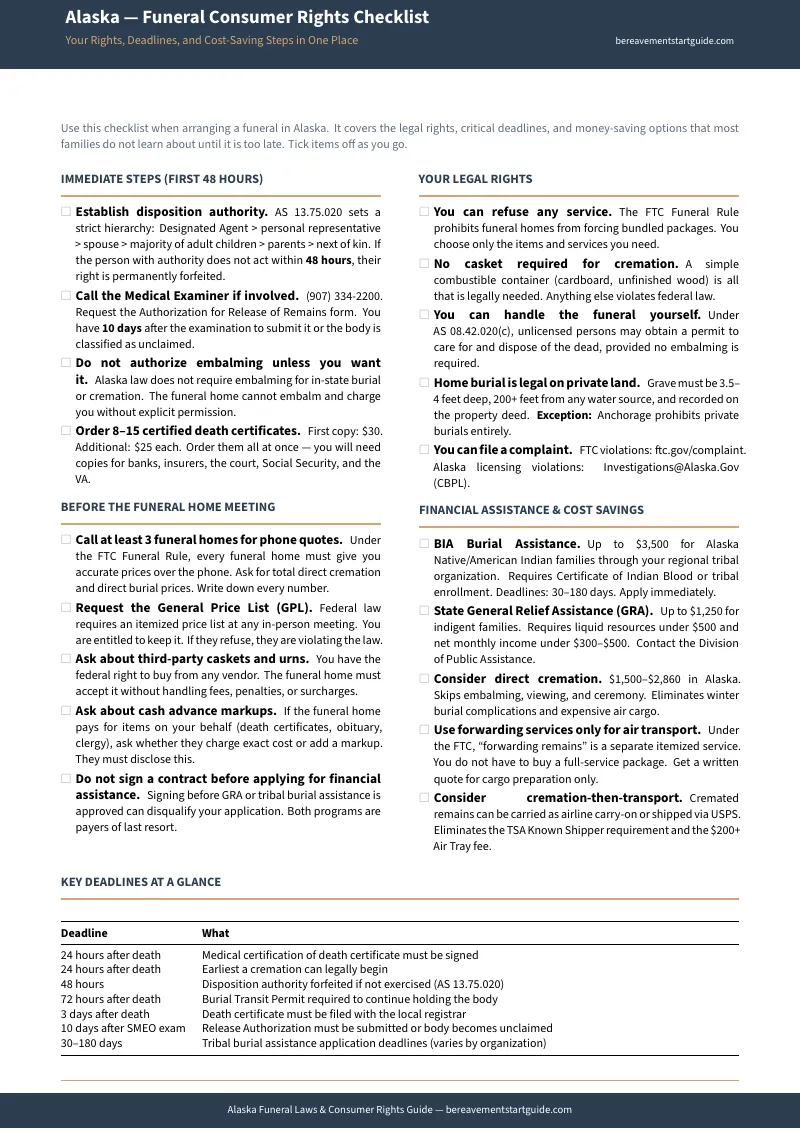
Your download includes the complete step-by-step guide, the standalone Alaska Funeral Consumer Rights Checklist, and printable reference sheets: the FTC Funeral Rule Quick Reference (every right itemized and explained), the Alaska Legal Timeline (24-hour, 72-hour, 3-day, and 10-day deadlines mapped), the Disposition Priority Hierarchy (AS 13.75.020 translated into plain English), the Family-Directed Funeral Permit Guide (the Care and Disposal application process), the Financial Assistance Roadmap (BIA burial aid and State General Relief with eligibility criteria and contacts), the Shipping and Transport Reference (airline cargo rules, Known Shipper workarounds, and cremated remains travel options), and the Death Certificate Process Guide (Bureau of Vital Statistics, subregistrars, VitalChek, and amendment procedures). Instant download, no account required.
Money-back guarantee, no time limit. If the guide does not help you understand your consumer rights, control funeral costs, or navigate Alaska's disposition rules — email us for a full refund. No questions asked.
Not ready for the full guide? Download the free Alaska Funeral Consumer Rights Checklist — a one-page summary of your FTC protections, the key statutory deadlines, and the questions to ask before you sign any funeral service contract. Enough to walk into an arrangement conference knowing what you can and cannot be charged for.
Funeral homes are experienced negotiators who do this every day. You are doing this for the first time, during the worst week of your life. The guide puts you on equal footing — so the decisions you make are informed ones, not pressured ones.
Frequently Asked Questions
What if the rules change after I buy?
We update the guide when the rules change. Email us any time, even years later, and we'll send you the current edition free.