The Alaska Court System Gives You the Forms. It Cannot Tell You Which Ones to File, in What Order, or What Happens If You Get It Wrong. And During the TrueFiling Transition, Even the Self-Help Pages Admit They May Be Outdated.
You went to the Alaska Court System website to figure out how to probate the estate. You found forty-plus P-series forms. You found a self-help section with a banner warning that resources may be outdated during the TrueFiling electronic filing transition. You found a notice that court staff cannot tell you which forms apply to your situation, cannot advise you on the order of filing, and cannot review your paperwork before submission. You found a list of the four judicial districts but no clear explanation of which one handles your case if the deceased lived in one community and owned property in another. You left the website knowing less than when you arrived.
So you called a probate attorney. The receptionist quoted $373 per hour. The estate planning specialist charges $500. A standard retainer starts at $3,000 to $5,000 before a single form is filed. For a modest estate — maybe a truck, a checking account, the last Permanent Fund Dividend, and a house that needs to transfer — the attorney's retainer could consume a third of everything the deceased left behind. You are now stuck between a court system that hands you blank forms without instructions and a legal profession that charges more per hour than many Alaskans earn in a day.
Meanwhile, deadlines are running. The estate's PFD application must be filed by March 31 or that money is gone forever. The four-month creditor claim window starts only after you publish the Notice to Creditors (Form P-341) in a newspaper in the correct judicial district — and every week you delay publication is another week before you can distribute a single asset. If the deceased held Alaska Native Corporation shares, those follow federal law and bypass the state court entirely — but nobody at the Superior Court is going to tell you that, because those shares are not their jurisdiction. If the estate has vehicles worth under $100,000 and other personal property under $50,000, you might not need probate at all — but the bifurcated thresholds in the small estate affidavit trip up families who look at the total and assume they qualify when they do not.
The Alaska Probate Process Guide is The Alaska Probate Sequencer — a plain-English manual that does what the court system explicitly cannot: it tells you which forms to file, in what order, with what attachments, at which courthouse, by which deadlines, and what happens at each stage from the initial petition through final estate closing. Not a national overview that treats Alaska like every other state. Not an attorney blog post designed to convince you that probate is too dangerous to attempt without a $5,000 retainer. A structured, Alaska-specific procedural manual built on AS Title 13 and the specific Superior Court rules, form numbers, and filing procedures that make probating an estate here unlike anywhere else in the country.
What's Inside The Alaska Probate Sequencer
A step-by-step guide, a Probate Quick-Start Checklist, and standalone reference sheets — covering every phase of probate in Alaska from the threshold decision through estate closing, built on Alaska Statutes Title 13, Superior Court probate procedures, and the state-specific rules that exist nowhere else:
Before You File: Does the Estate Actually Need Probate?
This is the decision that determines whether you spend months in Superior Court or weeks completing a simplified transfer. Alaska's small estate affidavit lets families bypass probate entirely — but the thresholds are bifurcated and families routinely misread them. Vehicles must total $100,000 or less. All other personal property must total $50,000 or less. These are separate caps, not a combined total. An estate with a $60,000 bank account and a $10,000 truck appears to be well under the $150,000 combined limit — but it actually fails because the personal property exceeds the $50,000 sub-cap. And for the Sworn Statement (Form P-350) to close a small estate, the net value must not exceed the combined statutory allowances plus probate, funeral, and final medical costs. The guide includes the decision tree and the exact math so you do not open a formal probate case for an estate that qualifies for the shortcut — and do not attempt the shortcut on an estate that fails the sub-thresholds.
Alaska's Three Statutory Allowances: Up to $55,000 Shielded from Creditors
Before any unsecured creditor gets paid, Alaska law guarantees three allowances that sit at the top of the priority hierarchy. The $27,000 Homestead Allowance. The $18,000 Family Allowance. The $10,000 Exempt Property Allowance. Together they protect up to $55,000 — and for small estates, these allowances can consume the entire estate, leaving nothing for unsecured creditors and everything for the surviving family. The allowances apply regardless of what the will says. The guide explains how to claim each one, how they interact with the small estate threshold math, and how they can effectively shield a modest estate from every creditor claim filed.
Opening Probate: Informal vs. Formal Proceedings
Alaska offers two tracks for probating a will. Informal probate is an administrative process — you file a petition (Form P-315 for testate, P-325 for intestate), the registrar reviews it without a hearing, and if everything checks out, you receive your Letters (Form P-335 for testamentary, P-336 for administration). Formal probate requires a judicial hearing before a Superior Court judge — necessary when the will is contested, when there are questions about the will's validity, or when the court needs to resolve disputes among heirs. The guide covers both tracks end to end: the petition requirements, the supporting documents, what triggers a hearing, what the registrar checks during informal review, and the specific circumstances where informal probate is not available and formal proceedings are mandatory.
Letters Testamentary and Letters of Administration: What They Unlock
Letters are the court-issued document that gives you legal authority over the estate. Without them, every bank, insurance company, brokerage, and government agency will refuse to release assets or process transfers. Form P-335 grants Letters Testamentary when there is a will. Form P-336 grants Letters of Administration for intestate estates. The guide covers the prerequisites for obtaining Letters, the bond requirement (and how to get it waived when the will includes a waiver clause), and what to do when the court requires additional documentation or a formal hearing before issuance.
The Four-Month Creditor Window: Publication, Claims, and Your 60-Day Disallowance Deadline
Within the first weeks of appointment, you must publish a Notice to Creditors (Form P-341) once a week for three successive weeks in a newspaper of general circulation in the judicial district where the case is filed. This triggers the four-month creditor claim window. Any creditor who does not file a claim within four months of the first publication is permanently barred. But here is the deadline most executors miss: when a creditor does file a claim, you have exactly 60 days to disallow it. If you do not respond within 60 days, the claim is deemed accepted and the estate must pay it. The guide maps the publication requirements, the claim response timeline, and the specific procedures for disallowing claims you believe are invalid — including the court hearing process if the creditor contests your disallowance.
The Inventory: Form P-370 and the Three-Month Deadline
Within three months of appointment, you must file an Inventory of Property (Form P-370) with the court listing every asset the deceased owned at death, valued at fair market value, along with any liens and encumbrances. This is not optional. Miss the deadline, and the court has grounds to remove you as personal representative. The guide covers asset categorization, valuation methods, how to handle assets with uncertain market value, and the specific formatting the Superior Court expects on the inventory form.
Transferring Specific Assets: Banks, Vehicles, Real Property
Each asset type follows its own transfer procedure. Banks release accounts upon presentation of Letters — or with the small estate affidavit for qualifying estates. Vehicles follow a different path: DMV Form 827 handles estates under $150,000 (a different threshold than the small estate affidavit for court purposes), but you must first title the vehicle in your name using the Vehicle Transaction Application (Form V1) before you can sell it, and the "OR" versus "AND" on a joint title determines whether probate is needed at all. Real property requires recording a Personal Representative Deed in the specific recording district where the property is located — Fairbanks North Star Borough, Kvichak, Kodiak, or whichever district applies. The guide maps every asset type, what unlocks it, what forms you need, and the specific pitfalls that delay transfers.
The Permanent Fund Dividend: The March 31 Deadline
If the deceased was eligible for a PFD in the year of death, the estate can claim it — but only if the personal representative files the estate application by March 31 of the following year. The state will not grant extensions. The PFD Division requires proof that the deceased resided in Alaska for at least 180 days during the qualifying year and that the estate has a court-appointed representative. For many Alaska families, the PFD represents over a thousand dollars that permanently disappears if you miss the filing date. The guide covers the eligibility criteria, the documentation requirements, and the exact filing procedure.
Alaska Native Corporation Shares and BIA Restricted Allotments
This is the chapter that does not exist in any other state's probate guide. ANCSA shares — Ahtna, CIRI, Doyon, Calista, Sealaska, and the other regional and village corporations — are federally exempt from state probate under AS 13.16.705. Their value is not counted in the estate for threshold calculations. They cannot be sold on the open market or pledged as collateral. They transfer through a Testamentary Disposition (Stock Will) filed with the corporation, or under ANCSA's own intestate succession rules, which differ from Alaska state law. If the deceased also held BIA restricted allotments, those follow yet another set of federal regulations through the Bureau of Indian Affairs. The guide covers the complete process for both — who to contact at each regional corporation, what forms to file, and how these assets interact with the rest of the estate.
Filing Logistics: Judicial Districts, TrueFiling, and Out-of-State Executors
Alaska has four judicial districts, and the correct filing venue depends on where the deceased was domiciled — not where they died, not where the assets are located. The court system is transitioning to mandatory TrueFiling electronic filing, but exemptions exist under Administrative Bulletin 92 for people without safe computer access, those in correctional facilities, and those with qualifying disabilities. Paper filing by mail remains available for exempted filers. If you are an out-of-state executor, you face additional logistics: you may need a resident agent, you need to determine the correct judicial district from a complex matrix of community names, and TrueFiling registration requires specific steps. The guide covers venue determination, filing methods for each district, the TrueFiling exemption process, and the specific procedures for executors managing Alaska probate from outside the state.
Closing the Estate: Final Accounting and Discharge
Form P-380 is the Final Accounting and Proposed Distribution. Form P-385 is the Closing Statement. Together they close the probate case — but only after the creditor window has expired, all valid claims have been satisfied, all assets have been distributed according to the will or intestacy statutes, and the court is satisfied with your accounting. The guide covers the accounting format, what the court examines during review, the petition for discharge, and what happens if a beneficiary or creditor objects to the final distribution. Until the court formally discharges you, your fiduciary liability as personal representative does not end.
Who This Guide Is For
- The personal representative named in the will who has never been through probate, is terrified of personal liability, and needs to know exactly which forms to file, in what order, with what attachments — because the court gave them Form P-315 and told them to figure the rest out on their own
- The surviving spouse whose bank accounts were frozen — who needs Letters Testamentary to unlock financial accounts, needs to claim the three statutory allowances worth up to $55,000 before any creditor gets paid, and cannot afford to wait months because the petition was filed in the wrong judicial district or the wrong form was submitted
- The adult child managing probate from outside Alaska — who lives in the lower 48, is unfamiliar with AS Title 13 and the four judicial districts, does not know which community names map to which district, and needs the complete filing sequence including TrueFiling registration and the resident agent requirement
- The family trying to determine whether probate is even necessary — who needs the decision tree that maps the bifurcated small estate thresholds ($100,000 vehicles, $50,000 other personal property), the real estate disqualifier, and the specific criteria that separate a court proceeding from a simplified affidavit
- The family with Alaska Native Corporation shares — who just learned that ANCSA shares follow federal law, bypass state probate entirely, and transfer through the issuing corporation rather than the Superior Court, and who needs to know how to handle those shares alongside the rest of the estate
- The executor racing the PFD deadline — who realized the March 31 filing deadline for the estate's Permanent Fund Dividend application is approaching and needs to know exactly what the PFD Division requires, how to prove eligibility, and whether they need Letters in hand before the application can be submitted
Why Free Resources Will Not Get You Through This
Alaska probate information exists. It is scattered across the Alaska Court System's self-help pages, four judicial district clerk offices, the DMV, the PFD Division, a dozen regional Native Corporation shareholder offices, and attorney blogs designed to generate retainer clients. Here is what you actually encounter when you try to navigate probate using free sources:
- The Alaska Court System gives you forms and explicitly tells you it cannot help you use them. The website publishes P-315, P-325, P-334, P-335, P-341, P-370, P-380, and dozens more — with a banner warning that self-help resources may be outdated during the TrueFiling transition. Court staff are prohibited from telling you which forms apply to your case, in what order to file them, or how to fill them out. If you are managing a $50,000 estate and the attorney charges $373 per hour, the math does not work — but the court offers no alternative path.
- The TrueFiling transition has fractured the self-help ecosystem. The Alaska Court System is migrating all filings to the TrueFiling electronic system. During the transition, legacy self-help pages carry explicit disclaimers that their resources may be outdated. Probate case types are scheduled for transition by the end of 2026, leaving families in an information gap where the old instructions may no longer apply and the new system is not yet fully documented for self-represented litigants.
- Alaska Legal Services serves low-income residents, not the middle-class executor. ALSC provides vital legal aid — for people who meet strict income eligibility guidelines. The family managing a $75,000 estate does not qualify. They fall into the gap between free legal help and affordable legal help, which is exactly where a $373-per-hour attorney quote lands hardest.
- National platforms miss everything that makes Alaska probate different. Nolo, LegalZoom, and similar services cover probate in general terms. They do not cover the bifurcated small estate thresholds, the PFD estate application, ANCSA share transfers, BIA restricted allotments, the four-district filing matrix, the TrueFiling mandate, or bush logistics. Alaska is not a variation on the standard template — it has rules that exist in no other state, and generic tools skip all of them.
- Attorney blog posts explain the complexity and end with "call our office." Every probate firm in Anchorage, Fairbanks, and Juneau publishes articles explaining how technical and risky probate is. For contested estates, that is accurate. For the straightforward case where the will is clear, the heirs agree, and the assets are modest, the blog never quite tells you that you can do this without a multi-thousand-dollar retainer. It always ends with "schedule a consultation."
Free resources give you forty forms from a website that admits it may be outdated, no instructions on which ones apply to your case, and a phone number for an attorney who charges $373 per hour. The Alaska Probate Sequencer puts every form, every deadline, every filing procedure, and every threshold calculation into one document, in the exact order you need them.
— Less Than Eight Minutes With an Alaska Probate Attorney
A single consultation with an Alaska probate attorney costs $373 per hour on average, and specialists charge up to $500. Standard retainers run $3,000 to $5,000 before a single form is filed. National estate platforms charge $149 or more per year in recurring subscriptions. This guide costs less than eight minutes of professional legal time and gives you the complete Alaska-specific probate roadmap — every statute, every form number, every filing deadline, every threshold calculation, and the decision tree that tells you whether you need to go to court at all.
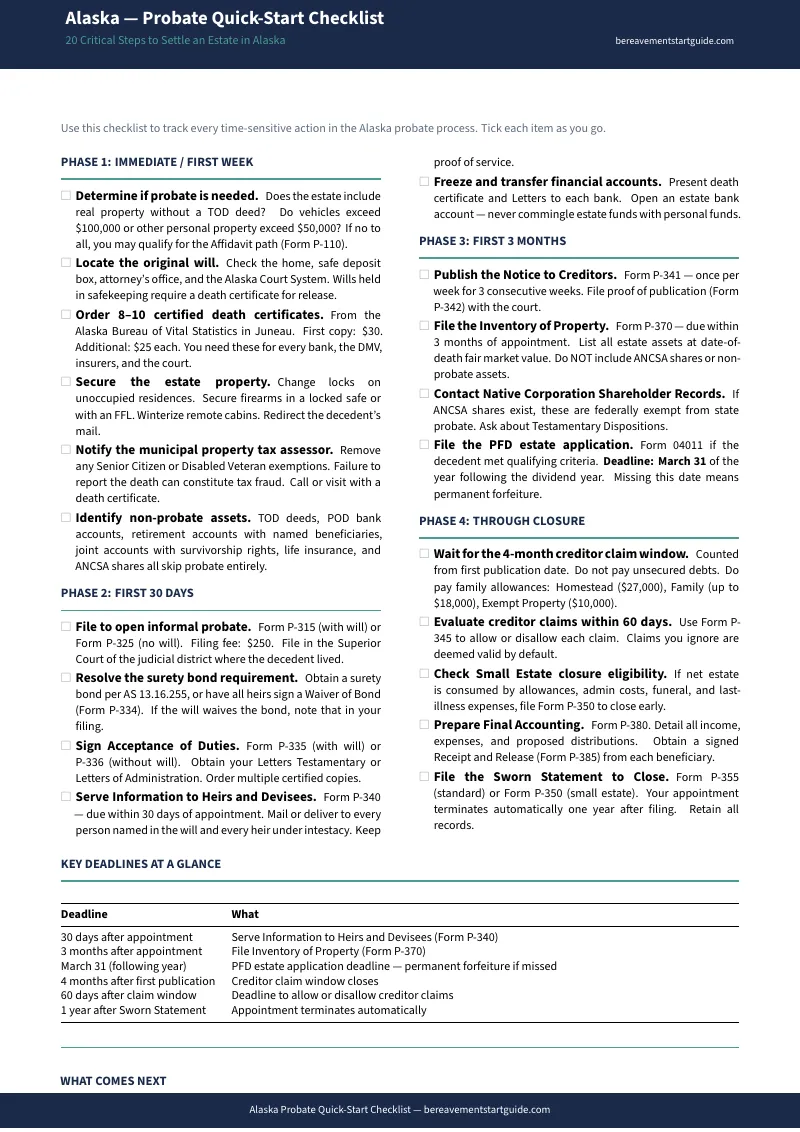
Your download includes the complete step-by-step guide, the standalone Alaska Probate Quick-Start Checklist, and printable reference sheets: the Probate vs. Small Estate Decision Tree (with the bifurcated threshold math), Personal Representative Duties Timeline (every statutory deadline from Day 1 through estate closing), Notice to Creditors Publication Guide, Creditor Priority and Statutory Allowances Reference ($55,000 shield), Inventory Preparation Worksheet (Form P-370), Judicial District Filing Reference (all four districts with community assignments), and ANCSA Share Transfer Reference (all 12 regional corporations). Instant download, no account required.
Money-back guarantee, no time limit. If the guide does not give you clarity on which forms to file, in what order, at which courthouse, and by which deadlines — email us for a full refund. No questions asked.
Not ready for the full guide? Download the free Alaska Probate Quick-Start Checklist — an overview of the probate process and the key decisions, thresholds, and deadlines you need to understand before you file anything with the Superior Court. Enough to determine whether you even need probate and what your next step should be.
You were not trained for this. The court cannot help you. The attorney costs more than the estate can absorb. But the process is navigable — and the guide shows you exactly how, one filing at a time.
Frequently Asked Questions
What if the rules change after I buy?
We update the guide when the rules change. Email us any time, even years later, and we'll send you the current edition free.