Someone You Love Just Died in Arizona. The Bank Will Not Release Their Accounts. The Funeral Director Needs a Number for Death Certificates. And You Just Found Out Arizona Has a 30-Day Waiting Period Before You Can Touch Anything.
You are standing in a chaos that nobody prepared you for. Maybe you were named personal representative in a will you barely remember seeing, and now the funeral home is asking you to approve charges you cannot pay because the bank froze the accounts this morning. Maybe there was no will at all, and because you are the surviving spouse or the eldest child, everyone is looking at you for answers you do not have. Maybe you are a snowbird's adult child calling from Ontario, trying to figure out how Arizona probate works from 2,000 miles away while someone mentions FIRPTA withholding and ancillary proceedings — words you have never heard in your life.
You are grieving and sleep-deprived, but Arizona's statutory clocks are already running. The funeral director needs a death certificate count by tomorrow — $20 each from ADHS, and ordering more later means weeks of delay. Social Security will claw back any benefit deposited for the month of death. The county Superior Court has its own filing fees — $306 in Maricopa, $351 in Coconino, $176 in Pima — and you do not even know which county you are supposed to file in. And somewhere in the back of your mind, a question keeps circling: if I sign the wrong affidavit, or miss a waiting period I didn't know about, or pay a creditor out of order — am I personally on the hook for the estate's debts?
Here is the answer most people do not hear until it is too late: Arizona law does make you personally liable for debts up to the value of assets you claim by affidavit. If you use the small estate affidavit to collect $40,000 from a bank account and there are $40,000 in unpaid debts, the creditors can come after you — not the estate, you personally. The 30-day waiting period for personal property and the 6-month waiting period for real property exist specifically to give creditors time to surface. Skip those windows or misuse the affidavit process, and you inherit liability along with the assets.
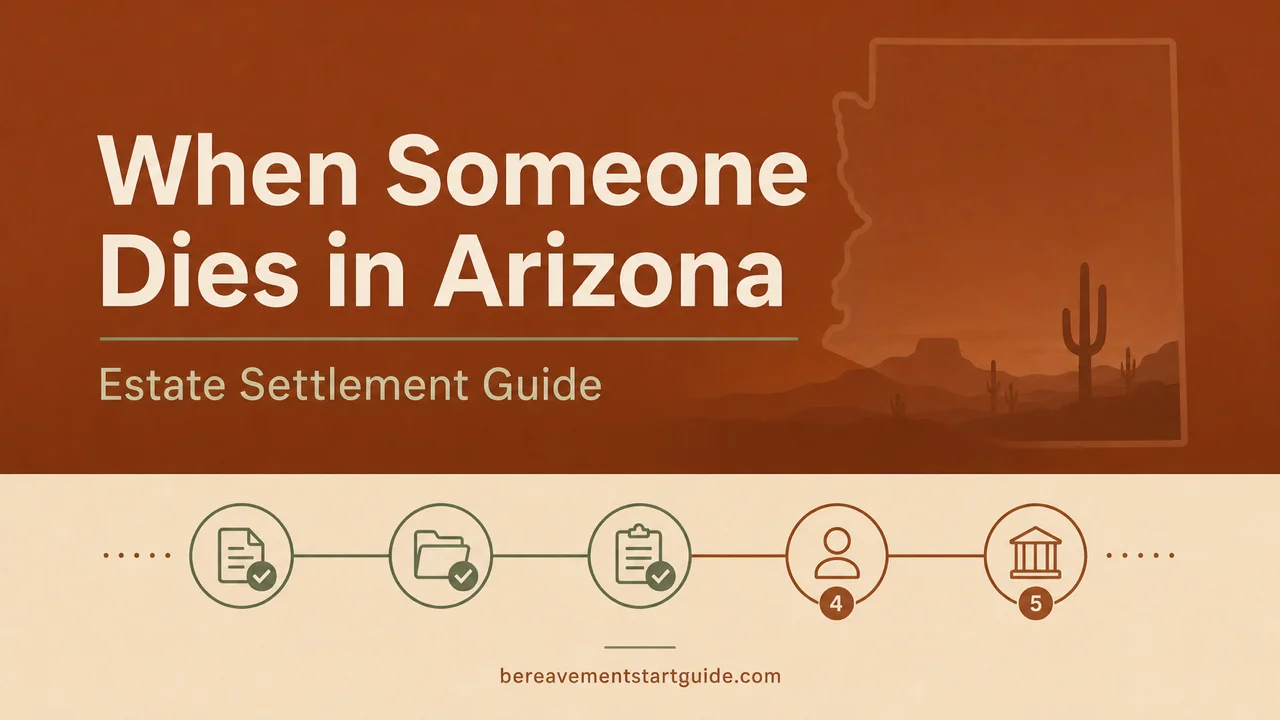
The When Someone Dies in Arizona — Estate Settlement Guide is a Calm Sequencing System for every legal, financial, and administrative step between the funeral home and final distribution. Not a law textbook. Not a generic national checklist that does not know the difference between Maricopa's $306 filing fee and Pima's $176. A structured, Arizona-specific manual that separates what must be done in the first 48 hours from what cannot legally be done until Day 30 or Month 6 — so you stop guessing, stop panicking, and start working through this in the right order.
What's Inside the Calm Sequencing System
A 13-chapter guide, the First 48 Hours Checklist, and 3 appendices — covering every stage from the moment of death through final asset distribution, built specifically for Arizona Revised Statutes Title 14, county Superior Court procedures, and the state-specific rules that make settling an estate here different from any other state:
The First 48 Hours: Death Certificates and Immediate Actions
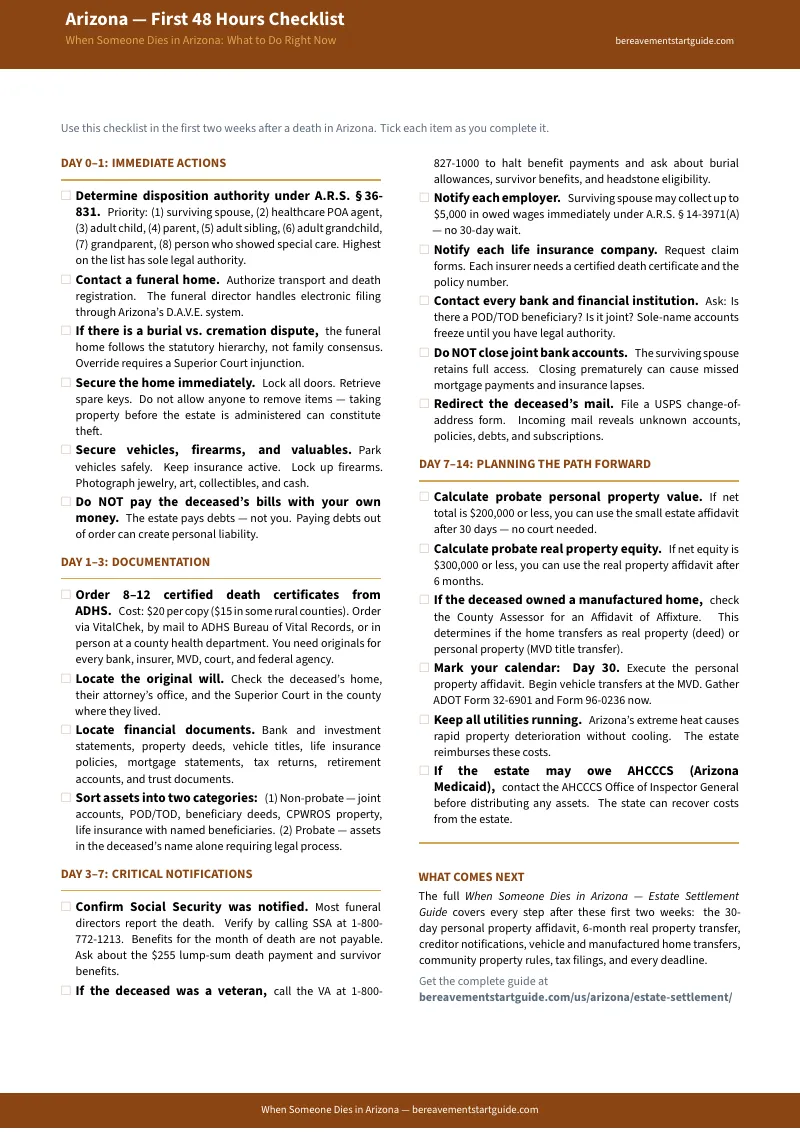
The funeral director is going to ask how many certified death certificates to order, and most families guess wrong. You need originals — not photocopies — for every bank, every insurance company, the Superior Court, ADOT for vehicle transfers, every county where the deceased owned property, and the IRS. Each certified copy costs $20 from the Arizona Department of Health Services, and some rural counties like Cochise and Yuma charge $15. Coming back later for more means processing delays and VitalChek surcharges. Order the right number now. This chapter also covers the A.R.S. 36-831 disposition authority hierarchy — who has legal authority over burial and cremation decisions when the family disagrees — and the single most important rule in this entire guide: do not pay any of the deceased's bills with your own money.
The First Week: Securing the Estate and Setting Family Expectations
Before any court gives you legal authority over anything, you have a duty to prevent assets from being lost, stolen, or damaged. This chapter covers locking the home — especially critical if the deceased was a seasonal resident with a property sitting empty in Scottsdale or Mesa — securing vehicles and valuables, rerouting mail (your best forensic tool for discovering unknown accounts and debts), canceling subscriptions that drain the estate, and the family meeting where you set the most important expectation: no one takes anything until the process says they can. It also addresses what to do when relatives have already started "helping themselves," which is the most common source of probate litigation in Arizona.
Banking and Financial Accounts: Unlocking Frozen Money
When a bank learns an account holder has died, individual accounts freeze. Being the surviving spouse does not override the freeze. But not every account is locked. Payable-on-Death accounts transfer directly to named beneficiaries with a death certificate. Joint accounts with right of survivorship stay open. Community property accounts with right of survivorship — a designation unique to community property states like Arizona — transfer automatically. And surviving spouses have a special statutory right to collect up to $5,000 in unpaid wages from the deceased's employer immediately, without waiting for any affidavit period. The guide maps every account type, what unlocks it, and what paperwork you need — including what to do when a bank refuses to honor a legally valid affidavit, which happens far more often than the statutes suggest.
The $200K/$300K Decision: Affidavit vs. Probate
This is the most consequential decision in the entire process. Arizona's HB 2116 raised the small estate thresholds dramatically — personal property from $75,000 to $200,000, real property from $100,000 to $300,000. If the estate falls below these limits, you can bypass formal probate entirely using affidavits. But the process is not as simple as downloading a form. Personal property affidavits require a mandatory 30-day wait after death. Real property affidavits require a 6-month wait and must be filed with the Superior Court — unlike personal property affidavits, which go directly to banks and holders. The guide includes a decision tree that walks you through the exact calculation: total fair market value, minus liens and encumbrances, compared against the threshold. If you qualify, you save months of court proceedings and thousands in attorney fees. If you do not, the guide tells you exactly why and routes you to the probate chapter.
Vehicle Title Transfers: The MVD Path
Arizona handles vehicle transfers through the Department of Transportation Motor Vehicle Division, not the probate court. If the estate's total personal property is under $200,000, you use ADOT Form 32-6901 — the Non-Probate Affidavit — alongside Form 96-0236, the Title and Registration Application, after the 30-day waiting period. The fee is $4. But if the deceased registered a Transfer-on-Death beneficiary using Form 96-0561 before they died, the named beneficiary can transfer the title immediately with just a death certificate — no waiting period, no affidavit. The guide covers both paths, the AND versus OR joint title nuance, what happens when the name on the death certificate does not match the name on the title, and the manufactured home trap: if no Affidavit of Affixture was recorded, the mobile home is personal property titled like a vehicle, not real estate — and transferring it through a real estate deed will cloud the title.
Real Property: Beneficiary Deeds, Community Property, and the Recording Trap
Arizona is one of the states that allows beneficiary deeds — a powerful tool that lets real estate bypass probate entirely. But families routinely discover a signed, notarized beneficiary deed in the deceased's desk drawer that was never recorded with the County Recorder. That deed is legally void. The property goes straight into the probate estate. This chapter explains every path real property can take: beneficiary deed (recorded before death), community property with right of survivorship, joint tenancy, the small estate affidavit for real property under $300,000 (filed with the Superior Court after 6 months), and full probate for everything else. It also covers the $30 flat recording fee at the County Recorder's office and what to do when the property has an existing mortgage.
Full Probate Administration: Informal, Formal, and Every Deadline
If the estate requires probate, Arizona offers two tracks: informal probate (processed administratively by a court registrar, no hearing required) and formal probate (contested estates requiring a Superior Court judge). This chapter walks you through filing the application, posting the fiduciary bond — required unless the will waives it or all heirs consent — receiving Letters of Appointment, opening an estate bank account with its own EIN, publishing the Notice to Creditors in a local newspaper for three consecutive weeks, filing the mandatory inventory within 90 days, and managing the 4-month creditor claim window. It includes county-specific filing fees for Maricopa, Pima, Coconino, Mohave, Yavapai, and Pinal counties — because the costs vary from $176 to $351 across the state.
Government Notifications: SSA, VA, IRS, and Arizona DOR
Each agency operates on its own timeline with its own forms. Social Security benefits must stop — payments deposited for the month of death will be clawed back. The VA requires separate notification to halt pension or disability payments. The IRS needs the deceased's final Form 1040, and if the estate generates any income during administration (rental income, bank interest, investment dividends), you must file Arizona Form 141AZ — the fiduciary income tax return — alongside federal Form 1041. Arizona has no state estate tax, but the fiduciary income tax catches many families by surprise. The guide covers every agency, every form, every deadline, and what happens if you miss each one.
Community Property: What Belongs to the Surviving Spouse
Arizona is a community property state. That means most assets acquired during the marriage belong equally to both spouses, regardless of whose name is on the account. When one spouse dies, the surviving spouse already owns their half — it was never part of the estate. But the line between community property and separate property (assets owned before marriage, gifts, inheritances) is where families get into trouble. Community Property with Right of Survivorship transfers the deceased spouse's half automatically. Community property without CPWROS goes through probate. The guide explains how to classify every asset, what documentation proves separate property status, and how the community property rules interact with the small estate affidavit thresholds.
Creditor Management: Personal Liability and Payment Priority
The estate pays the debts, not the family — but only if you follow the rules. Arizona law dictates a strict priority order for paying claims: funeral expenses first, then costs of administration, then federal taxes, then medical expenses of the last illness, then state taxes, then everything else. If you pay a lower-priority creditor before a higher-priority one and the estate runs out of money, you are personally liable for the difference. And if you used a small estate affidavit to collect assets, you are personally liable to creditors for the value of what you received. The guide maps the full priority hierarchy, explains the 4-month creditor claim window, the 60-day window for known creditors who received direct notice, and the specific protections that exist for personal representatives who follow the statutory process correctly.
The Snowbird Chapter: Cross-Border Estates
If the deceased was a Canadian citizen who owned Arizona real property, this chapter exists specifically for you. When Canadian heirs sell inherited Arizona property, FIRPTA requires the buyer to withhold 15% of the gross sale price and send it directly to the IRS. On a $400,000 condo, that is $60,000 trapped in escrow unless you proactively file IRS Form 8288-B for a withholding certificate. The estate also faces ancillary probate in Arizona — the Canadian court has no jurisdiction over Arizona real estate, and the Arizona court has no jurisdiction over Canadian assets. And while Arizona has no state estate tax, the IRS imposes federal estate tax on non-resident aliens owning U.S. property, with a much lower exemption than U.S. citizens receive. The US-Canada Tax Treaty may help, but only if you know it exists and know how to invoke it. This chapter walks through every trap and every form.
Special Property: Water Rights, Mineral Rights, and Tribal Land
Rural and agricultural estates in Arizona involve asset types that most estate guides ignore entirely. If the property includes a registered well, you must file ADWR Form 55-71A ($30 fee) to update the state registry. If the deceased held Irrigation Grandfathered Rights, the transfer requires ADWR Form 58-500 and a $500 fee — and you cannot use the water until the transfer is complete. If the deceased held mineral rights in another state, you may need ancillary probate in that state. And if the deceased was a tribal member holding federal trust land, Arizona probate law does not apply at all — the federal American Indian Probate Reform Act (AIPRA) overrides state law, and the Bureau of Indian Affairs handles the probate. This chapter tells you exactly when Arizona's rules stop and a different system takes over.
When You Need a Lawyer — and When You Do Not
This guide does not pretend that every estate can be settled without professional help. If the estate involves contested wills, cross-border tax exposure, tribal trust land, business interests, or significant debt, you need a licensed Arizona probate attorney. This chapter is honest about exactly when that threshold is crossed. It is also honest about the cost: Arizona estate attorneys typically charge $1,500 to $5,500 for standard probate, and document preparation services charge $195 to $495 for basic form completion without legal advice. For the many families whose estate falls below the $200,000/$300,000 thresholds, or whose assets pass entirely through non-probate channels like beneficiary deeds, CPWROS accounts, and POD designations, this guide handles the entire process.
The Complete Timeline: Every Statutory Deadline in One Calendar
From Day 1 through Year 2 and beyond, every Arizona statutory deadline in one sequential reference. The immediate $5,000 spousal wage right. The 30-day wait for personal property affidavits. The 60-day creditor response window. The 90-day inventory deadline. The 4-month creditor publication period. The 6-month wait for real property affidavits. The 2-year limit to initiate probate. Every deadline that matters, in the order it appears, with clear language about what happens if you miss it.
Who This Guide Is For
- The surviving spouse whose partner just died and whose bank accounts were frozen this morning — who needs to know which accounts transfer automatically under community property with right of survivorship, which ones require the 30-day affidavit process, and how to collect up to $5,000 in unpaid wages immediately without waiting for any court proceeding
- The adult child named as personal representative who has never been through probate, may live out of state, and is terrified of making a mistake that triggers personal liability — who needs the complete sequence of fiduciary duties, Superior Court deadlines, and filing requirements in one document
- The family with no will who just learned that Arizona's intestate succession laws will decide everything — who needs to understand exactly who inherits what under the community property rules, whether the estate qualifies for the $200K/$300K affidavit process, and whether probate is required at all
- The person who just got rejected at the bank trying to access their deceased parent's checking account with a small estate affidavit — who needs to know whether the bank's refusal is legally valid, what to do about it, and whether a POD designation or joint account can bypass the problem entirely
- The Canadian snowbird's family trying to settle an Arizona property from outside the United States — who needs to understand FIRPTA withholding, ancillary probate, the US-Canada Tax Treaty, and why their Canadian lawyer cannot handle the Arizona side
- The family with a manufactured home, water rights, or rural property who just discovered that transferring these assets involves entirely different agencies, forms, and fees than a standard house — and who needs to know whether the Affidavit of Affixture was recorded before they can figure out which process applies
Why Free Resources Will Not Get You Through This
The information exists. It is scattered across Arizona Superior Court self-service centers, the ADHS vital records portal, ADOT vehicle transfer pages, and a dozen federal agency websites that do not reference each other. Here is what you actually encounter when you try to settle an estate using free sources alone:
- County Superior Courts give you forms and tell you to hire a lawyer. Maricopa County's self-service center publishes an informal probate packet. Pima County posts fee schedules and AOCPBPA forms. But every court website explicitly states it "cannot provide legal advice" and directs you to retain counsel. If you are dealing with a $150,000 estate and the attorney quotes $3,500, the math does not work — but the court offers no alternative path.
- Attorney blogs highlight complexity to justify retainer fees. Firms like Bivens, Rahnema, and Gottlieb publish detailed Arizona probate articles — and they are explicitly designed to convince you that the process is too dangerous to handle without spending thousands on representation. For contested estates and cross-border situations, that is true. For the majority of straightforward estates under the new $200K/$300K thresholds, the answer costs a fraction of what an attorney charges.
- National platforms miss Arizona-specific details and charge recurring fees. Nolo, LegalZoom, and Trust & Will offer general estate tools. They do not cover the HB 2116 threshold increase, the ADOT Form 32-6901 non-probate vehicle transfer, the Affidavit of Affixture for manufactured homes, the ADWR water rights transfer process, or the difference between Maricopa's $306 filing fee and Pima's $176. Arizona is not a footnote — it is a state with its own rules, and generic tools miss them.
- Document preparation services fill in forms but give no strategy. Certified Legal Document Preparers charge $195 to $495 to complete probate paperwork. They are legally prohibited from telling you which forms to file, whether you qualify for the affidavit process, or how to handle a bank that rejects your legally valid affidavit. They fill in what you tell them to fill in. If you tell them the wrong thing, you pay for correctly completed wrong paperwork.
- Free checklists cover the first 48 hours and stop. Funeral home bereavement pages and state bar pamphlets tell you to order death certificates and notify Social Security. They do not explain the 30-day personal property waiting period, the 6-month real property waiting period, the 4-month creditor window, the 90-day inventory deadline, or the personal liability that attaches when you sign an affidavit. Their advice ends exactly where the hard decisions begin.
Free resources give you fragments from a dozen different sources that do not reference each other. The Calm Sequencing System puts every Arizona-specific statute, form, deadline, and procedure into one document, in the order you actually need them.
— Less Than Twenty Minutes With an Arizona Estate Attorney
A single consultation with an Arizona probate attorney costs $200 to $400 per hour. Standard probate representation runs $1,500 to $5,500. Document preparation services charge $195 to $495 just to fill in forms you still have to choose yourself. National estate platforms charge $149 per year in recurring subscription fees. This guide costs less than twenty minutes of professional legal time and gives you the complete Arizona-specific roadmap — every statute, every deadline, every form, every county fee table, and the decision tree that tells you whether you even need an attorney at all.
Your download includes the complete 13-chapter guide with three appendices (county court reference, key forms, and glossary), the standalone Arizona First 48 Hours Checklist, and eight printable reference sheets: the Affidavit vs. Probate Decision Tree ($200K/$300K threshold calculator), Vehicle Title Transfer walkthrough (ADOT non-probate and probate paths), County Superior Court Reference (fees and contacts for Maricopa, Pima, Coconino, Mohave, Yavapai, and Pinal), Community Property Classification Worksheet (community vs. separate property sorter), Statutory Deadline Calendar (every deadline with space for your dates), Creditor Priority Reference, Account-Closing Checklist, and Government Notification Tracker. Ten PDFs total — instant download, no account required.
Money-back guarantee, no time limit. If the guide does not give you clarity on what to do next and confidence that you are doing it in the right order, email us for a full refund. No questions asked.
Not ready for the full guide? Download the free Arizona — First 48 Hours Checklist — covering everything that must happen in the first two days after a death in Arizona: death certificates, disposition authority, securing the home, notifying Social Security, what not to pay, and what to gather. It is enough to get through tonight and tomorrow.
You did not ask for this job. But you can do it. The guide shows you how, one step at a time.
Frequently Asked Questions
What if the rules change after I buy?
We update the guide when the rules change. Email us any time, even years later, and we'll send you the current edition free.