The Funeral Home Quoted $5,200 for a Cremation That Legally Costs $800. You Have 24 Hours Before the Embalming Deadline They Told You Was Mandatory. And Nobody Mentioned That the State Board You Are Trying to Call No Longer Exists.
Someone you love just died in Arizona. Or they are about to. And suddenly you are being asked to make financial decisions that range from $800 to $8,000 while operating on grief, adrenaline, and the word of a funeral director whose income depends on the choices you make in the next 48 hours.
You called the funeral home because that is what people do. They walked you through a "cremation package" that included embalming, a viewing, a chapel service, and a rental casket. The total came to $5,200. When you asked about a simpler option, the director said embalming is required by state law. It is not. When you asked about providing your own casket, they said they do not accept outside caskets. Federal law says they must. When you asked what direct cremation costs without the extras, there was a long pause before a number appeared that was $3,000 less than what they had just quoted you.
You went home and searched "Arizona funeral laws" looking for clarity. You found broken links to the Arizona State Board of Funeral Directors and Embalmers, which was absorbed into the Arizona Department of Health Services in 2023. You found a dense state licensing portal that tells you nothing about your consumer rights. You found attorney blogs explaining how complicated funeral law is, ending with a $300-per-hour consultation offer. You found lead-generation sites disguised as helpful resources that sell your contact information to the same funeral homes you are trying to protect yourself from.
Meanwhile, the 24-hour refrigeration deadline is running. The 72-hour death certificate filing window is closing. Your siblings are arguing about burial versus cremation, and the funeral home says they will not proceed until everyone agrees. Daily refrigeration fees are accruing at $75 per day while your family fights. And you still do not know who actually has the legal authority to make this decision.
The Arizona Funeral Consumer Shield
The Arizona Funeral Laws & Consumer Rights Guide is The Arizona Funeral Consumer Shield — a plain-English manual that translates Arizona's funeral statutes, administrative codes, and federal consumer protections into clear, step-by-step instructions so you can arrange a lawful disposition, protect your family's money, and stop funeral homes from selling you services you do not legally need.
Not a national overview that treats Arizona like every other state. Not an attorney blog designed to generate retainer clients. Not a lead-generation site that sells your information to funeral homes. A structured, Arizona-specific consumer protection manual built on A.R.S. Title 36, A.R.S. Title 32, A.A.C. Title 9, A.A.C. Title 4, and the FTC Funeral Rule — the exact statutes and codes that govern every funeral home, crematory, and mortuary operating in this state.
What's Inside The Arizona Funeral Consumer Shield
A 13-chapter guide, a Funeral Consumer Rights Checklist, and 2 appendices — covering every phase of funeral planning and consumer protection in Arizona, from the moment of death through final disposition and complaint filing:
The 24-Hour Embalming Decision That Saves or Costs You Thousands
Arizona law is specific: if final disposition does not occur within 24 hours of death, the body must be embalmed or refrigerated at 38 degrees Fahrenheit or below (A.A.C. R4-12-612). That is the entire legal requirement. Embalming is a cosmetic procedure, not a public health mandate. The guide explains the exact statute, the precise temperature standard, the rare exceptions involving communicable diseases and interstate shipping, and the exact words to say when a funeral director claims the state requires embalming. If this one chapter prevents a $500 embalming charge you did not need, it has already paid for itself many times over.
Your FTC Funeral Rule Rights — Applied to Arizona Funeral Homes
Federal law gives you the right to a General Price List before discussing any arrangements, the right to select services a la carte instead of purchasing a bundled package, the right to provide your own casket with no handling fee, and the right to an inexpensive alternative container for cremation. Arizona adds its own protections: funeral homes must provide pricing by phone, email, or mail on request, and the maximum mailing fee is $2. The guide covers both the federal and state layers together, showing you exactly how to enforce them when a funeral director pushes back.
Who Has the Legal Authority to Make Decisions — The Full 10-Tier Hierarchy
A.R.S. SS 36-831 establishes a rigid statutory hierarchy that determines who can authorize cremation, burial, and every other disposition decision. Surviving spouse first — unless legally separated or a divorce was pending. Then a designated agent, but only if the Power of Attorney explicitly includes disposition authority (most do not, and this catches families off guard). Then adult children, where a majority of those reasonably available must consent. The guide maps all 10 tiers, explains the majority-consent rules, clarifies when courts get involved, and shows you how to resolve the sibling standoff that is costing $75 per day in refrigeration fees while everyone argues.
Death Certificates: The 72-Hour Filing Window and the Closed-Record System
Arizona uses the Electronic Death Registration System (EDRS). The death certificate must be filed within 72 hours. Arizona is a closed-record state — you cannot simply walk in and order copies. You need documentary proof of relationship: marriage certificates, birth certificates, court orders. The guide walks through who can certify the cause of death, who can complete the demographic section, how to avoid the most common errors that trigger the $30 amendment process, and how to order the 8-10 certified copies you will need at $20 each.
The Disposition-Transit Permit: Your Authorization for Everything
No burial, cremation, or interstate transport can legally happen in Arizona without a Disposition-Transit Permit (A.R.S. SS 36-326). The guide explains who can obtain one — a funeral director or an "other responsible person," which means you can do this yourself. It covers the cremation-specific verification requirement, the home burial recording prerequisite, and the interstate transport rules that snowbird families need when a parent dies in Arizona but the burial plot is in Minnesota.
How to Read a General Price List and Strip Out $2,000-$5,000 in Unnecessary Charges
Every funeral home must provide a GPL. Most families have never seen one and do not know what to compare. The guide walks you through the basic services fee (the only non-declinable charge), the direct cremation line item, the casket markup, cash advance items, and the five most common upselling tactics funeral directors use — with the exact statutory response to each one. Compare at least three GPLs before choosing a funeral home. The price difference between the most and least expensive provider in the same Arizona city can be thousands of dollars.
Cremation in Arizona: Costs, Authorization, and the 24-Hour Waiting Period
Arizona's cremation rate exceeds 65%, but the process involves more legal steps than most families expect. Written authorization from the person with the highest statutory priority. A separate written authorization from the County Medical Examiner ($30-$35 fee). A mandatory 24-hour waiting period between death and cremation. The guide breaks down direct cremation ($800-$1,500) versus full-service cremation packages ($4,000-$7,000+), shows you exactly what direct cremation legally requires, and identifies every charge that is optional.
Home Burial, Green Burial, Veterans Burial, and Tribal Considerations
Arizona permits burial on private property, green burial in a shroud without a casket or vault, and free veterans burial at the National Memorial Cemetery of Arizona in Phoenix or the Southern Arizona Veterans' Memorial Cemetery in Sierra Vista. But each path has specific legal requirements: county recorder filing before home burial, an easement survey for some counties, and the reality that the VA does not cover funeral home services, transport, or body preparation. The guide covers every option with the exact steps, costs, and legal prerequisites.
County Indigent Burial: The Lien Nobody Warns You About
Maricopa and Pima counties provide up to approximately $1,200 in burial or cremation assistance for indigent decedents. What the application does not make obvious: under A.R.S. SS 36-831(G), the county can place a lien on the deceased's real estate and personal property to recover costs. If your deceased family member owned a mobile home, a vehicle, or had a small bank account, the county can seize those assets. The guide walks you through the lien math so you can determine whether county assistance actually saves money — or whether paying for direct cremation out of pocket preserves more for the family.
Preneed Contracts: The 15% Fee, the Non-Fixed Price Trap, and Your Cancellation Rights
If you are planning ahead, Arizona preneed contracts come with protections and pitfalls. Trust-funded contracts allow a 15% initial service fee and a 10% annual interest deduction. "Non-fixed price" contracts mean the funeral home charges at current rates when you die, not when you signed. You have a 3-day full-refund cancellation window. After that, remaining trust funds must be returned within 5 business days. The guide also covers the Payable-on-Death bank account alternative — no fees, no lock-in, full control.
Filing Complaints When Your Rights Are Violated
ADHS Funeral Services Licensing handles state violations. The FTC handles federal Funeral Rule violations. The Arizona Attorney General handles consumer fraud. The guide provides the exact process, forms, and contacts for each complaint avenue, plus the documentation you should preserve from the first phone call forward.
Who This Guide Is For
- The out-of-state adult child managing a parent's death from 2,000 miles away — who cannot visit funeral homes in person, cannot compare prices face to face, and is making $5,000 decisions by phone based on what a funeral director tells them without knowing which claims are legally required and which are upsells
- The surviving spouse on a fixed income facing a $5,200 cremation quote — who needs to know that direct cremation in Arizona costs $800 to $1,500, that embalming is not required, that a casket is not needed for cremation, and that the FTC requires funeral homes to provide a la carte pricing
- The snowbird family dealing with a death far from home — who needs to transport remains out of Arizona, does not know about the Disposition-Transit Permit, does not know about the TSA Known Shipper requirement for air transport, and needs to decide whether local cremation and shipping ashes by USPS Priority Mail Express is the practical answer
- The family fighting over cremation versus burial — who needs the A.R.S. SS 36-831 hierarchy to determine who legally has the final say, what "majority of reasonably available" means when two siblings are unreachable, and how to stop the $75-per-day refrigeration charges from accumulating while everyone argues
- The family that cannot afford a funeral — who needs to understand county indigent burial programs, the lien risk on the deceased's assets, whole-body donation as a zero-cost alternative, and the specific math that determines whether county assistance actually saves money or costs more than it provides
Why Free Resources Will Not Protect You
- The Arizona Department of Health Services website will not help you exercise your rights. The 2023 absorption of the State Board of Funeral Directors fractured the information landscape. Consumer searches lead to broken links, dead pages, and a licensing portal written in bureaucratic language designed for funeral industry professionals, not grieving families. The ADHS site tells you what funeral homes must do. It does not tell you what to say when a funeral home does not do it.
- Nolo and FindLaw give you one paragraph where you need a chapter. They confirm that home burial is legal in Arizona. They do not tell you that you need a county recorder filing before the local registrar will issue a Disposition-Transit Permit, that some counties require an easement survey, or that recording a burial creates a permanent property easement that affects future sales. They cover the basic right without the procedural steps that make it exercisable.
- Ever Loved, Parting.com, and US-Funerals.com are lead-generation businesses. Their content exists to collect your contact information and sell it to local funeral homes as qualified leads. The funeral home that calls you after you fill out their form is a paying advertiser, not a recommendation. These sites will never teach you to bypass their own clients.
- Funeral home websites will never teach you to spend less at their funeral home. They explain their services helpfully and professionally. They do not explain that you can decline every optional service, bring your own casket, skip embalming, and reduce a $5,200 quote to $1,200 using rights you already have under federal and state law. They have a financial interest in your not knowing this.
Free resources give you fragments of federal law, fragments of state law, and fragments of county rules spread across broken government portals, lead-generation websites, and attorney marketing blogs. The Arizona Funeral Consumer Shield puts every right, every deadline, every cost, and every protection into one document, in the order you need them.
— Less Than Ten Minutes of an Arizona Attorney's Time
A single consultation with an Arizona estate or elder law attorney costs $300 to $400 per hour. A funeral home "cremation package" runs $3,000 to $7,000 for services you may not legally need. If this guide prevents one unnecessary embalming ($500+), one casket purchase for a cremation ($2,000+), or one bundled package when direct cremation was all you needed ($2,000-$5,000 difference), the return is immediate.
Your download includes 10 printable PDFs: the complete 13-chapter guide, the Arizona Funeral Consumer Rights Checklist, plus 8 standalone worksheets and reference cards you can print individually — the FTC Funeral Rule Reference Card, the GPL Audit & Price Comparison Worksheet, the Disposition Authority Hierarchy Reference, the Death Certificate Tracker, the Home Burial Compliance Checklist, the Indigent Burial Lien Decision Worksheet, the Interstate Transport Checklist, and the Preneed Contract Review Checklist.
Money-back guarantee, no time limit. If the guide does not give you clarity on your consumer rights, the legal deadlines, and the specific steps to protect your family's money when arranging a funeral or cremation in Arizona — email us for a full refund. No questions asked.
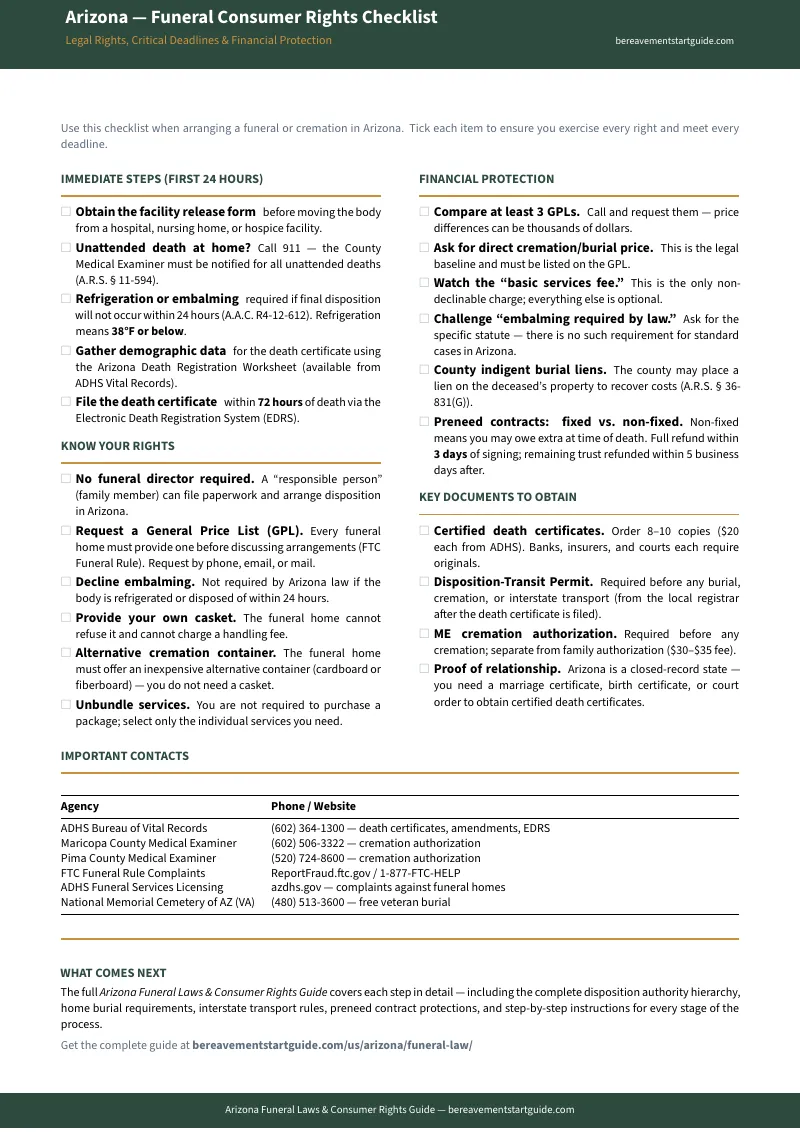
Not ready for the full guide? Download the free Arizona Funeral Consumer Rights Checklist — a quick-reference summary of your legal rights, the critical deadlines, the financial protection steps, and the key contacts you need. Enough to know what questions to ask the funeral home and which claims to challenge. When you need the full statutes, the complete hierarchy, the GPL audit process, and the step-by-step instructions for every scenario from home burial to interstate transport — the complete guide is here.
The funeral home is not your adversary. But they are not your advocate either. Their job is to sell services. Your job is to know which ones you actually need. This guide makes sure you do.
Frequently Asked Questions
What if the rules change after I buy?
We update the guide when the rules change. Email us any time, even years later, and we'll send you the current edition free.