The Maricopa County Court Gives You the Forms. It Cannot Tell You Which Ones to File, in What Order, or What Happens When You Miss the 90-Day Inventory Deadline Because Nobody Told You It Existed.
You went to the Arizona Superior Court website looking for help. You found a stack of downloadable forms — petitions, cover sheets, affidavits, instructions for five different Maricopa filing locations. You found a disclaimer saying court staff cannot tell you which forms apply to your situation, cannot review your paperwork, and cannot give you legal advice. You found filing fees that vary from $306 in Maricopa to $371 in Mohave, with no explanation of why. You left the website with more forms and less clarity than when you started.
So you called a probate attorney. The quote came back at $4,000 to $5,000 for an uncontested estate. Specialists charge $350 to $400 per hour. For a modest estate — a house, a checking account, a vehicle, maybe a retirement account that already has a beneficiary — the retainer alone could consume a quarter of what was left behind. You are stuck between a court system that hands you blank forms without instructions and a legal profession that charges more than many families can afford for straightforward cases.
Meanwhile, deadlines are running. The 90-day inventory deadline starts the moment you are appointed — and nobody sends a reminder. The four-month creditor window does not begin until you publish the Notice to Creditors in a newspaper of general circulation for three consecutive weeks, and every week you delay publication is another week before you can distribute a single asset. Arizona requires all non-licensed fiduciaries to complete a mandatory 90-minute Supreme Court training before the court will appoint you — and if you show up at the clerk's window without the training certificate, your entire application packet gets rejected. And with the 2025 House Bill 2116 changes raising the small estate thresholds to $200,000 for personal property and $300,000 for real property, you might not need probate at all — but the math involves net equity from the county assessor's records, not your Zillow estimate, and families who get the calculation wrong either file unnecessary petitions or attempt affidavits they do not qualify for.
The Arizona Probate Process Guide is The Arizona Probate Navigator — a plain-English manual that does what the court system explicitly cannot: it tells you which forms to file, in what order, with what attachments, at which courthouse, by which deadlines, and what happens at each stage from the initial threshold decision through final estate closing. Not a national overview that treats Arizona like every other state. Not an attorney blog post designed to convince you that probate is too dangerous to attempt without a $5,000 retainer. A structured, Arizona-specific procedural manual built on A.R.S. Title 14, the Arizona Rules of Probate Procedure, and the county-by-county filing details that make probating an estate here different from anywhere else in the country.
What's Inside The Arizona Probate Navigator
A 17-chapter step-by-step guide, a Probate Quick-Start Checklist, and 3 appendices — covering every phase of probate in Arizona from the threshold decision through estate closing, built on Arizona Revised Statutes Title 14, the Rules of Probate Procedure, and the county-specific rules that trip up even careful executors:
Before You File: Does the Estate Actually Need Probate?
This is the decision that saves families thousands of dollars — or costs them months in court if they get it wrong. Arizona provides multiple ways to bypass probate entirely: Beneficiary Deeds that override the will (A.R.S. Section 33-405), Community Property with Right of Survivorship, joint tenancy, POD and TOD designations, and the small estate affidavit. The 2025 House Bill 2116 raised the affidavit thresholds dramatically — $200,000 for personal property (30-day wait) and $300,000 for real property (6-month wait). But the thresholds use net equity from the county assessor's tax rolls, not market estimates. The guide includes the exact math, the decision tree, and the waiting period rules so you do not open a full probate case for an estate that qualifies for the shortcut — and do not attempt the shortcut on an estate that fails the valuation test.
The Mandatory Fiduciary Training That Blocks Your Appointment
Arizona is one of the few states that requires non-licensed fiduciaries to complete a mandatory training module before the court will appoint them. Under Rule 42 of the Arizona Rules of Probate Procedure, you must complete the Arizona Supreme Court's 90-minute training and submit the certificate of completion with your petition. Show up without it and the clerk rejects your packet. The guide walks you through registration, the training content, what to expect, and how to file the certificate — so this unique Arizona requirement does not delay your appointment by weeks.
Arizona's Three Probate Tracks: Informal, Formal, and Supervised
Arizona adopted the Uniform Probate Code, which means most uncontested estates qualify for informal probate — an administrative process through the Probate Registrar with no court hearing required. You file the petition, the registrar reviews it, and if everything checks out, you receive your Letters. Formal probate requires a hearing before a judge — necessary when the will is contested, when someone disputes your appointment, or when the court needs to resolve disputes among heirs. Supervised administration puts the court in control of every distribution. The guide covers all three tracks: the petition requirements, the supporting documents, what triggers each track, and the specific circumstances where informal probate is not available.
County-by-County Filing Fees and Logistics
Filing fees in Arizona are not uniform. Maricopa County charges $306 for a probate petition. Mohave charges $371. Pinal, Yavapai, and the other 12 counties each set their own fee schedules. And the filing logistics vary too — Maricopa accepts electronic filing, while some counties still require wet signatures on original documents. The guide includes a county-by-county fee table and filing contact information so you do not show up at the wrong window with the wrong check amount.
The Four-Month Creditor Window: Publication, Claims, and Your Protection
Within the first weeks after appointment, you must publish a Notice to Creditors in a newspaper of general circulation for three consecutive weeks. This triggers Arizona's four-month creditor claim period under A.R.S. Section 14-3801. Any creditor who does not file within four months of the first publication is permanently barred. But the statute also sets a one-year absolute bar from the date of death for any creditor who was not directly notified. The guide maps the publication requirements, which newspapers qualify in each county, the creditor response procedures, and the specific protections that shield the estate once the window closes.
The 90-Day Inventory: What to Value and How
Within 90 days of appointment, the personal representative must file a comprehensive inventory of estate assets with date-of-death valuations. This is not optional — it is a statutory duty, and failure to comply gives the court grounds to remove you. The guide covers which assets must be included, how to determine fair market value for each asset type, how to handle assets with uncertain valuations, and the format the court expects on the inventory filing.
Personal Representative Duties and Personal Liability
This is the chapter executors read first. Arizona law imposes specific fiduciary duties on personal representatives — and violations can result in personal liability. Distribute assets too early and you are personally liable if a creditor files a valid claim. Commingle estate funds with personal accounts and you face removal and surcharge. Pay debts in the wrong order and you can be held responsible for the difference. The guide lays out every duty, the specific liability risks, and the procedures that protect you from each one.
Intestate Succession: When There Is No Will
If the deceased died without a will, Arizona's intestate succession rules determine who inherits — and for blended families, the results are often shocking. Under A.R.S. Section 14-2102, if the deceased was married with children from a prior relationship, the surviving spouse does not inherit everything. The separate property gets divided between the spouse and the children from the prior relationship. And the community property vs. separate property distinction — which is uniquely important in community property states like Arizona — determines how big each share is. The guide maps every intestate scenario and the community property rules that apply to each one.
Special Situations: Out-of-State Executors, Beneficiary Deeds, and Community Property Step-Up
The guide covers the practical realities that generic probate resources skip: the ancillary probate process for out-of-state executors managing Arizona property through the Proof of Authority procedure, how Beneficiary Deeds override wills and transfer property outside probate, how Community Property with Right of Survivorship gives surviving spouses a full double step-up in cost basis for tax purposes, and the specific procedures for handling vehicles, bank accounts, and investment accounts during estate administration.
The Complete Timeline, Forms Reference, and Court Contacts
Every statutory deadline from Day 1 through estate closing mapped on a single reference. Every form number cross-referenced to its purpose. Contact information for all 15 county Superior Courts and their probate divisions. The priority of appointment hierarchy. A glossary of Arizona probate terms. And the key A.R.S. Title 14 statutes referenced throughout the guide.
Who This Guide Is For
- The personal representative named in the will who has never been through probate, did not know about the mandatory fiduciary training requirement, and needs to know exactly which forms to file, in what order, at which courthouse — because the court gave them a stack of PDFs and told them to figure the rest out on their own
- The surviving spouse whose bank accounts were frozen — who needs Letters Testamentary to unlock financial accounts, needs to understand the community property rules that determine what does and does not require court, and cannot afford to wait months because the wrong form was filed in the wrong county
- The adult child managing probate from out of state — who lives in another state, is unfamiliar with A.R.S. Title 14 and the county-by-county filing variations, does not know whether the estate qualifies for the new HB 2116 small estate thresholds, and needs the complete filing sequence including the ancillary probate process and the Proof of Authority procedure
- The family trying to determine whether probate is even necessary — who needs the decision tree that maps the small estate affidavit thresholds ($200,000 personal property / $300,000 real property net equity), the Beneficiary Deed bypass, the Community Property with Right of Survivorship transfer, and the specific criteria that separate a court proceeding from a simplified affidavit
- The executor who just got a $4,000 attorney quote — who needs to know whether an uncontested estate with agreeable heirs and straightforward assets can be handled pro se, how to determine if the case is truly simple enough to manage without counsel, and where the line is between what you can do yourself and what genuinely requires a licensed attorney
Why Free Resources Will Not Get You Through This
Arizona probate information exists. It is scattered across the Maricopa County Law Library, 14 other county court websites, attorney blogs designed to generate retainer clients, and national legal platforms that treat Arizona like every other state. Here is what you actually encounter when you try to navigate probate using free sources:
- The Maricopa County Law Library gives you forms and explicitly tells you it cannot help you use them. The self-help center publishes petitions, cover sheets, affidavits, and instructions — with the disclaimer that court staff cannot tell you which forms apply to your case, in what order to file them, or how to fill them out. Five separate Maricopa filing locations, each with different hours and procedures. If you are managing a modest estate and the attorney charges $350 per hour, the math does not work — but the court offers no alternative path.
- Every county runs its own fee schedule and filing rules. Filing fees range from $306 in Maricopa to $371 in Mohave. Some counties accept electronic filing. Others require wet signatures on original documents. The information is spread across 15 separate court websites with no centralized reference. Families waste hours calling clerk offices to confirm basic filing logistics that should be in one place.
- National platforms miss everything that makes Arizona probate different. LegalZoom, Nolo, and similar services cover probate in general terms. They do not cover the mandatory fiduciary training requirement, the HB 2116 threshold changes, the county-by-county fee variations, the community property step-up rules, or the Beneficiary Deed supremacy over wills. Arizona is not a variation on the standard template — it has rules that exist in no other state, and generic tools skip all of them.
- Attorney blog posts explain the complexity and end with "call our office." Every probate firm in Phoenix, Tucson, Scottsdale, and Mesa publishes articles explaining how technical and risky probate is. For contested estates, that is accurate. For the straightforward case where the will is clear, the heirs agree, and the assets are modest, the blog never quite tells you that you can do this without a multi-thousand-dollar retainer. It always ends with "schedule a consultation."
Free resources give you scattered forms across 15 county court websites, no instructions on which ones apply to your case, and a phone number for an attorney who charges $350 per hour. The Arizona Probate Navigator puts every form, every deadline, every filing procedure, and every threshold calculation into one document, in the exact order you need them.
— Less Than Seven Minutes With an Arizona Probate Attorney
A single consultation with an Arizona probate attorney costs $350 to $400 per hour on average. Standard retainers for uncontested probate run $4,000 to $5,000 before a single form is filed. National estate platforms charge $149 or more per year in recurring subscriptions. This guide costs less than seven minutes of professional legal time and gives you the complete Arizona-specific probate roadmap — every statute, every form reference, every filing deadline, every threshold calculation, and the decision tree that tells you whether you need to go to court at all.
Your download includes the complete 17-chapter step-by-step guide, the standalone Arizona Probate Quick-Start Checklist, three appendices (Glossary of Arizona Probate Terms, Key Arizona Statutes, and County Court Contact Information), and 8 standalone printable worksheets and reference cards:
- Probate Decision Tree — step-by-step flowchart: full probate, small estate affidavit, or no court at all
- Statutory Deadline Calendar — every deadline from Day 1 through estate closing, pin-it-to-your-wall format
- County Court Reference — all 15 Arizona Superior Courts with filing fees, addresses, and e-filing status
- Personal Representative Duties Reference — every fiduciary duty and liability risk on one page
- Forms Reference Card — every probate form, its purpose, and when to use it
- Creditor Notification Tracker — publication dates, direct notices, AHCCCS, and the 4-month claim window
- Estate Inventory Worksheet — fillable asset tracker organized by category with date-of-death valuations
- Asset Classification Worksheet — sort every asset as probate or non-probate before you file anything
Instant download, no account required.
Money-back guarantee, no time limit. If the guide does not give you clarity on which forms to file, in what order, at which courthouse, and by which deadlines — email us for a full refund. No questions asked.
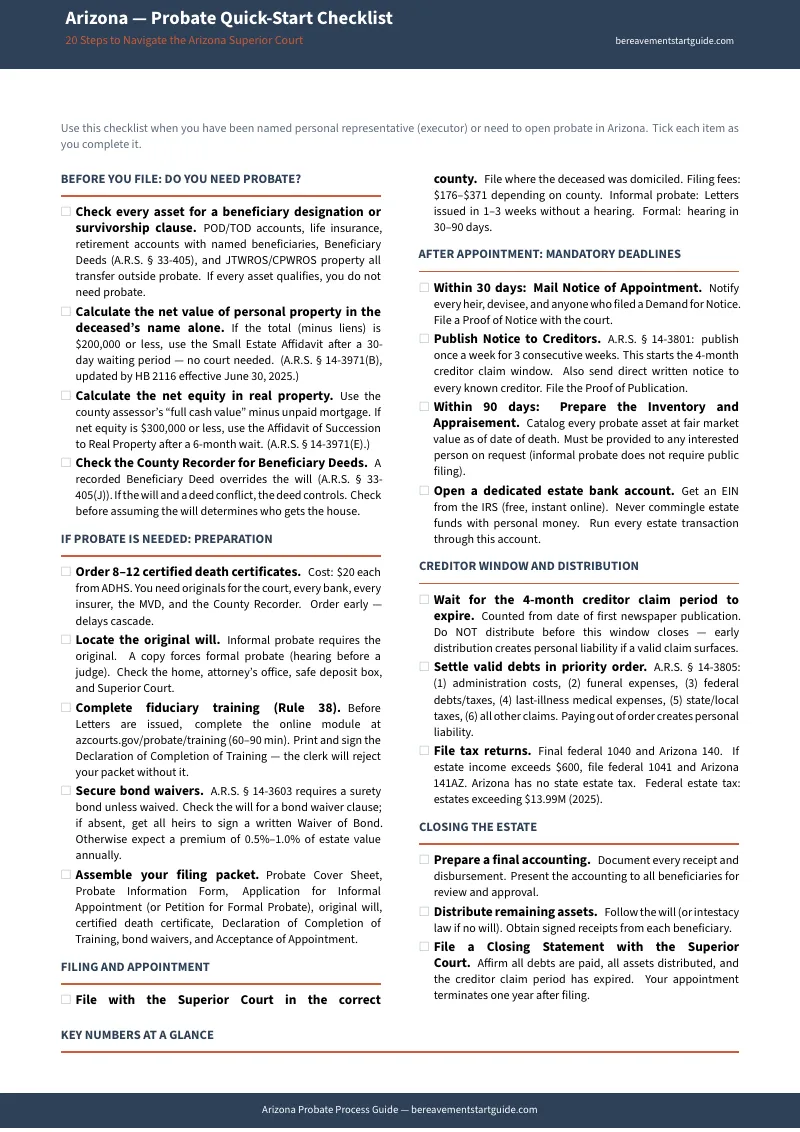
Not ready for the full guide? Download the free Arizona Probate Quick-Start Checklist — an overview of the probate process and the key decisions, thresholds, and deadlines you need to understand before you file anything with the Superior Court. Enough to determine whether you even need probate and what your next step should be.
You were not trained for this. The court cannot help you. The attorney costs more than the estate can absorb. But the process is navigable — and the guide shows you exactly how, one filing at a time.
Frequently Asked Questions
What if the rules change after I buy?
We update the guide when the rules change. Email us any time, even years later, and we'll send you the current edition free.