
Your Parent Is Rushed to the ER. The Doctor Asks Who Has Authority to Make Medical Decisions. Nobody Does. And the Living Will Your Family Downloaded Last Month Won't Stop the Paramedics — Because Arkansas Requires a Separate Physician-Signed EMS-DNR Order That Nobody Told You About.
This is how most Arkansas families discover the gap between having a document and having a document that works. Not during thoughtful planning. During a crisis — when someone is hospitalized, a dementia diagnosis lands, or a parent is declining — and you realize the forms you printed from the state website have no execution instructions, no witness guidance, and no explanation of how to make emergency responders actually honor your wishes at home.
Arkansas is not like other states. The Healthcare Decisions Act allows you to appoint a healthcare agent and document treatment preferences — but a signed living will alone cannot stop CPR during a 911 call. Paramedics are legally required to resuscitate unless they see an official, physician-signed EMS-DNR order. The state's pink POLST form converts preferences into active medical orders — but nobody tells families it exists until they are already in crisis. And Arkansas remains one of only three states enforcing dower and curtesy rights, creating a property-law minefield that families must navigate alongside medical planning.
The Arkansas Advance Directive & Living Will Kit is a Clinical Coordination System — not a blank form, but a structured walkthrough that bridges every gap between the legal document you sign at your kitchen table and the medical orders that actually govern your care in an Arkansas hospital, nursing home, or home emergency.
What's Inside the Clinical Coordination System
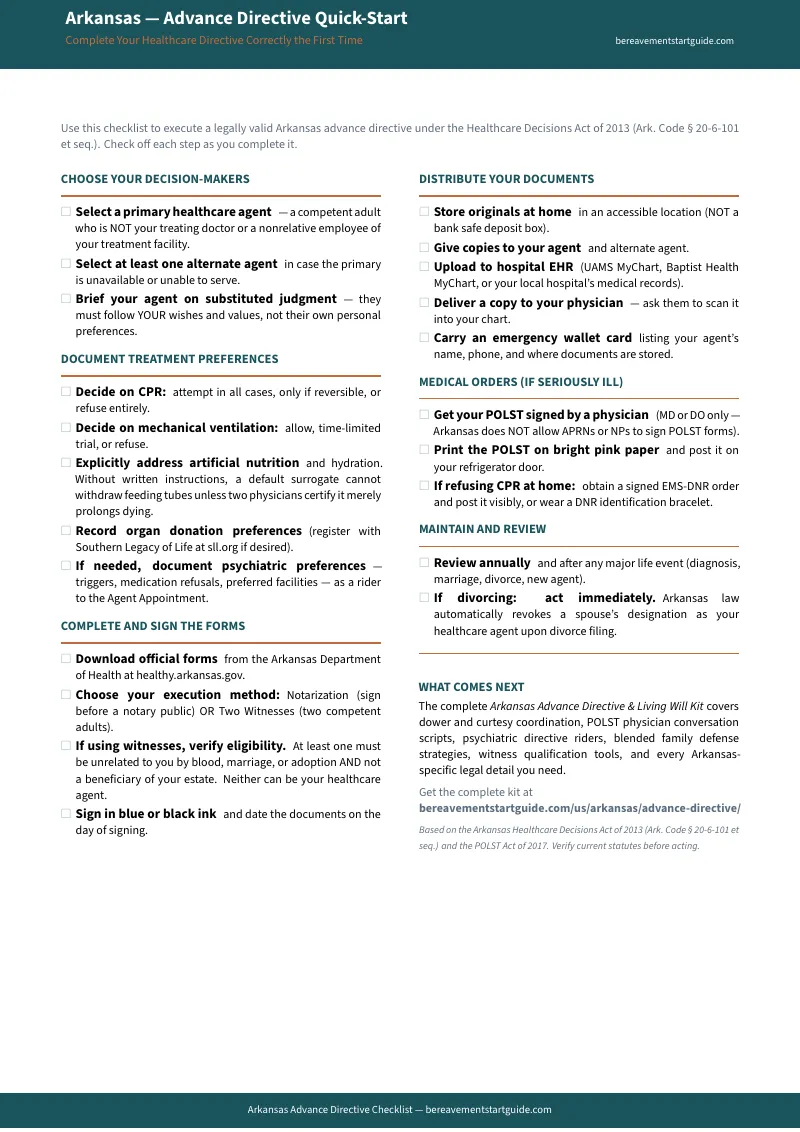
A comprehensive 15-chapter guide, a Quick-Start Advance Directive Checklist, and 10 standalone printable tools — covering every step from understanding Arkansas's Healthcare Decisions Act through coordinating your legal directives with physician medical orders, built specifically for the statutory framework and clinical workflows that make advance care planning in Arkansas different from any other state:
Healthcare Agent Appointment: Getting Authority and Boundaries Right
Choosing your healthcare agent under the Arkansas Healthcare Decisions Act is not as simple as naming someone you trust. The guide walks you through who is disqualified — your physician and their employees cannot serve as your agent unless they are related to you. It explains how to designate alternate agents, how to define the scope of authority (full decision-making versus directive-only), and how to structure the appointment so your agent can communicate with doctors, access records under HIPAA, and make real-time treatment decisions during a crisis.
Treatment Preference Documentation: Making Your Wishes Unambiguous
The kit translates complex medical interventions — mechanical ventilation, CPR, artificial nutrition, hydration, dialysis — into structured decision frameworks that leave no room for family disagreements or hospital legal challenges. You document your preferences across multiple clinical scenarios: terminal illness, permanent unconsciousness, and advanced progressive illness. The guide explains what each intervention means in practice, what happens if you leave instructions vague, and how to use supplemental directives for situations the standard form does not cover.
The POLST Coordination Roadmap
A living will is a legal declaration of intent. A POLST — the pink Physician Order for Life-Sustaining Treatment form — is an active medical order that travels with you across every care setting and takes effect immediately. The guide explains exactly how to use your completed advance directive to request a POLST from your physician, what clinical scenarios qualify, and how the two documents work together. Most families do not know this second layer exists until a hospital ignores their living will because no medical order backs it up.
The EMS-DNR Home Protection Guide
If you want paramedics to withhold resuscitation during a home emergency, a living will is legally insufficient. Arkansas emergency responders can only honor an official EMS Do Not Resuscitate order signed by a physician. The kit explains how to request this order, where to post it in your home so responders can locate it immediately during a 911 call, and how it relates to your advance directive and POLST. This is the gap that causes the most family trauma — and the one no free state form explains.
The Dower and Curtesy Boundary Guide
Arkansas is one of three states that still enforces medieval spousal property protections. A surviving spouse automatically receives a life estate in one-third of marital real property (with children) or one-half (without children). The guide explains exactly where the boundary falls between medical decision authority and property rights — your healthcare agent appointment has zero impact on dower and curtesy protections. This matters most for blended families where stepchildren and a current spouse may have conflicting interests.
Witness Execution and the Rural Notary Alternative
Arkansas does not require notarization for a valid advance directive — two competent adult witnesses are sufficient. At least one witness must be disinterested: not related to you, not entitled to inherit from your estate, not your healthcare provider or their employee. The kit includes a witness eligibility checklist that translates statutory language into plain screening questions, specifically designed for rural families who may not have easy access to a notary public.
Psychiatric Advance Directive Rider
For individuals who want to document mental health treatment preferences during periods of diminished capacity, the guide covers how to add psychiatric instructions to your healthcare directive — specifying preferred medications, treatment approaches, and facility preferences that apply during a mental health crisis, separate from end-of-life medical decisions.
10 Standalone Printable Tools
In addition to the full guide and checklist, your kit includes standalone PDFs you can print individually — bring them to appointments, hand them to your agent, or post them on the fridge:
- Healthcare Agent Appointment Form — complete the agent designation with clear authority scope and alternate agents
- Treatment Preference Matrix — record your decisions across all clinical scenarios before meeting with your physician
- Witness Eligibility Checklist — screen both witnesses against all Arkansas disqualification categories before signing day
- POLST Coordination Tracker — step-by-step instructions for requesting and filing your pink POLST form
- EMS-DNR Request Template — exactly what to discuss with your physician, and where to post the signed order
- Document Distribution Log — track where every copy goes (physicians, hospitals, facilities, family, agent)
- Family Conversation Guide — compassionate frameworks for initiating the planning conversation with reluctant family members
- Agent Briefing Packet — hand this directly to your named agent so they understand their legal role, HIPAA rights, and statutory limits
- Organ Donation Attestation — legally binding anatomical gift language with proper witness requirements
- Revocation and Amendment Reference — how to cancel, update, or replace your directive if circumstances change
Who This Kit Is For
- The adult child managing a parent's declining health — who needs clear legal authority to communicate with doctors and make treatment decisions, especially in rural counties where the nearest estate attorney is hours away
- The spouse in a blended family — who needs airtight documentation to prevent legal disputes between a current partner and children from a previous marriage, particularly where dower and curtesy rights create competing property interests
- The patient facing surgery or a new diagnosis — who needs to complete legally valid documents before a hospital admission, so treatment preferences are on file and a healthcare agent has authority from day one
- The caregiver of someone with early cognitive decline — who knows there is a narrowing window to execute planning documents while capacity remains, and cannot afford to get the execution wrong
- The family transitioning a loved one to hospice or nursing care — who needs completed directives for facility admission and wants a POLST on file so comfort-focused care is backed by a physician order
- The rural family without local legal resources — who needs a self-directed planning system that does not require multiple trips to a metropolitan law office or expensive attorney consultations
Why Free Arkansas Forms Leave Families Unprotected
The Arkansas Department of Health provides free advance directive forms. The legal skeleton is there. Here is what is missing:
- No witness guidance. The free forms give you signature lines but do not explain the disinterested witness requirement. Families discover their witness was ineligible after the declarant has lost capacity — when re-execution is impossible.
- No POLST coordination. Free forms produce a legal directive. They do not explain that hospitals and nursing facilities operate on physician medical orders, not legal documents. Without a POLST, your directive may be acknowledged but not acted upon in real-time clinical decisions.
- No EMS-DNR instructions. Standard state forms do not mention the separate physician-signed order required for home emergency protection. Families learn this gap exists when paramedics resuscitate a loved one who explicitly did not want it — because a living will is not a medical order.
- No dower and curtesy context. Free forms do not warn blended families about the property-law boundary between medical proxies and spousal property rights. Stepchildren and surviving spouses enter legal disputes that could have been prevented with clear boundary documentation.
- No agent preparation. Free forms designate a decision-maker but do not explain their legal duties, their HIPAA access rights, or the clinical conversations they will face in ICU hallways. Agents walk into life-and-death discussions unprepared.
National platforms like LegalZoom, Rocket Lawyer, and FreeWill generate forms using automated nationwide templates. They produce the document. They do not help you coordinate that document with the Arkansas-specific clinical workflow — POLST, EMS-DNR, facility admission requirements — that determines whether your wishes are actually followed during the moments that matter.
Your Purchase Is Protected
If the kit does not help you complete a legally sound Arkansas advance directive, email hello@bereavementstartguide.com for a full refund. No time limit, no questions, no hassle.
Start Planning Today
Download the free Arkansas Advance Directive Quick-Start Checklist to see what goes into proper execution under Arkansas law. When you are ready for the complete system — the full 15-chapter guide, 10 standalone printable tools (agent appointment, treatment matrix, witness screening, POLST tracker, EMS-DNR template, distribution log, conversation guide, agent briefing, organ donation attestation, and revocation reference), plus the checklist — the full kit is . Less than twenty minutes with an Arkansas elder-law attorney, and you keep everything forever.
Frequently Asked Questions
What if the rules change after I buy?
We update the guide when the rules change. Email us any time, even years later, and we'll send you the current edition free.