The County Clerk Handed You a Blank Form and Said "We Cannot Help You Fill It Out." The Bank Froze the Accounts. The Title Company Wants a Document You Have Never Heard Of. And the 45-Day Clock Is Already Ticking.
Someone you love just died in Arkansas. You went to the county clerk's office expecting help. They handed you a blank Form 23 — the Small Estate Affidavit — and told you, in almost exactly these words: "We cannot offer legal advice. Should you need legal advice you will need to consult an attorney." Then they pointed to the door.
You tried the bank. Arvest, Simmons, or wherever the checking account lives. The teller looked at the death certificate, said "the account is frozen," and asked for "Letters of Administration" or a "certified Small Estate Affidavit" — two documents you cannot produce because you do not know how to create them, and the county clerk just refused to explain the process. Meanwhile, the mortgage payment is due, the electric bill is overdue, and the funeral home is waiting to be paid with money you cannot access.
You went online. One site says you can skip probate with a small estate affidavit if the estate is under $100,000. Another says you must wait 45 days before filing. A third says you need to publish a notice in a local newspaper and wait three months if the estate includes any real property. A fourth mentions something called a "Deed of Distribution" that you must draft, record with the county recorder, and send to the county assessor — a document none of the other sites mentioned. And a fifth threw around terms like "dower," "curtesy," and "ancestral property" as if everyone knows what feudal English property law has to do with settling a parent's estate in Benton County.
Here is the truth: Arkansas mandates one of the most procedurally specific estate settlement processes in the country — and then legally forbids the people who administer it from explaining how to do it. Every county clerk's office in the state will hand you blank forms and refuse to walk you through them. Every state website publishes raw statutes and offers no instructions. And every probate attorney blog explains how dangerous it is to do this alone — because they charge 5% of the first $5,000 and 4% of the next $20,000 to do it for you.
The When Someone Dies in Arkansas — Estate Settlement Guide is the County Clerk's Missing Instructions — the step-by-step manual that the county clerk is legally prohibited from giving you. Not a generic legal overview. Not a national template with "Arkansas" pasted into the header. A 15-chapter, Arkansas-specific manual that tells you what to file, where to file it, what fees to bring, what the 45-day waiting period actually means, how to draft the Deed of Distribution the title company is demanding, and exactly when in the process you need a lawyer versus when you are wasting thousands of dollars on statutory fees for work you can do yourself.
What's Inside the County Clerk's Missing Instructions
A 15-chapter guide, the First 48 Hours Checklist, and four appendices — covering every stage from the moment of death through final asset distribution, built specifically for Arkansas statutes, circuit court procedures, and the county-level filing rules that make settling an estate here different from any other state:
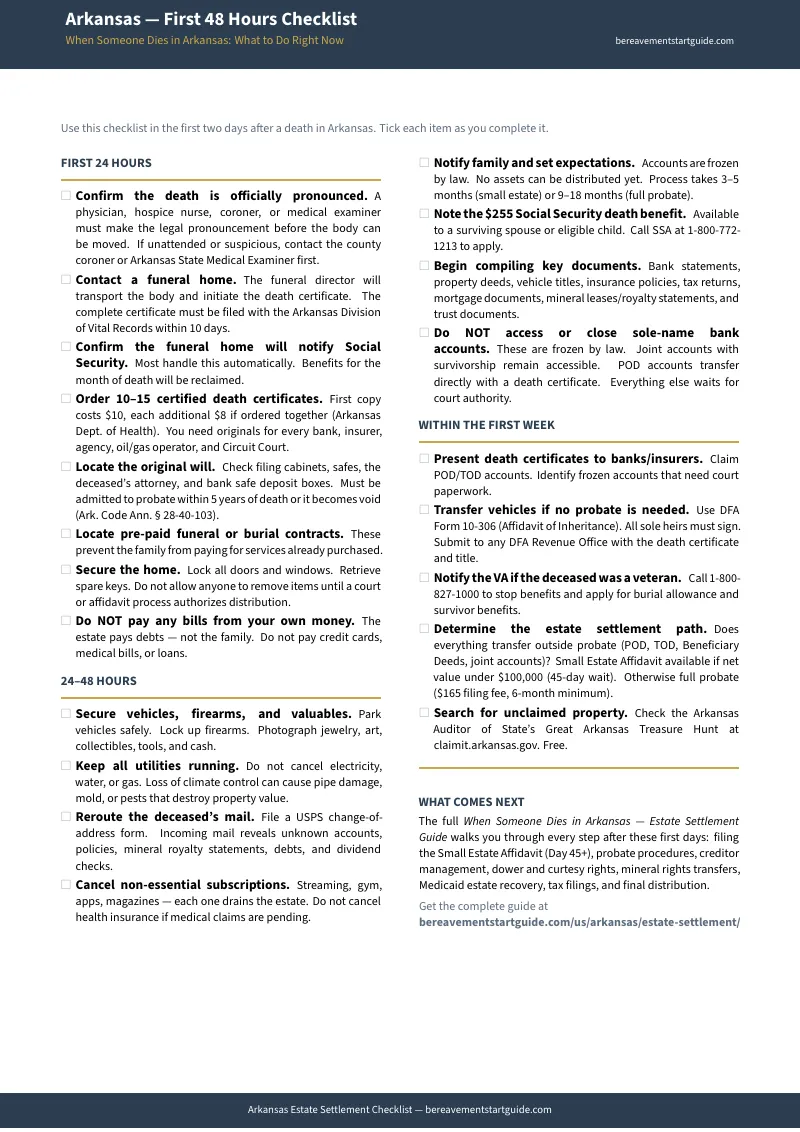
The First 48 Hours: Death Certificates and Immediate Actions
The funeral director is going to ask you how many certified death certificates to order, and most families guess wrong. You need originals — not photocopies — for every bank, every insurance company, every oil or gas operator, the circuit court, the DFA for vehicle transfers, and every county where real property exists. The first copy costs $10 from the Arkansas Department of Health, and each additional copy ordered at the same time costs $8. Coming back weeks later for more means navigating the LexisNexis identity verification system that rejects half of first-time applicants. Order the right number now — 10 to 15 for most families — or pay for it in weeks of delay later. This chapter also covers the single most important rule in the entire guide: do not pay any of the deceased's bills with your own money.
The First Week: Securing the Estate and Setting Expectations
Before probate gives you authority over anything, you have a common-law duty to prevent assets from being lost, stolen, or damaged. This chapter covers locking the home, securing vehicles and firearms, rerouting mail (your best forensic tool for discovering unknown bank accounts, mineral royalty statements, and outstanding debts), canceling subscriptions that drain the estate, and the family meeting where you set the single most important expectation: nobody takes anything from the house until a court says so. It also addresses the relatives who have already started "helping themselves" — the most common source of probate litigation in Arkansas.
Banking and Financial Accounts: Unlocking Frozen Money
When a bank receives notice that an account holder has died, sole-owner accounts are frozen immediately. Being the surviving spouse does not override the freeze. But not every account is locked. Payable-on-Death accounts transfer directly to named beneficiaries with just a death certificate. Joint accounts with right of survivorship stay accessible. The guide maps every account type you will encounter at Arvest, Simmons Bank, Bank of the Ozarks, and other Arkansas institutions — what unlocks each one, and what paperwork the teller will demand before releasing a single dollar.
Vehicle Title Transfers via DFA Form 10-306
Arkansas has a specific form for transferring vehicles without probate: the Affidavit of Inheritance of a Motor Vehicle (DFA Form 10-306). This sworn document requires all sole heirs to sign — which creates a coordination problem when siblings are scattered across different states. The guide explains both the probate path and the non-probate path, the critical difference between "AND" and "OR" on a joint title (hint: "John AND Jane" means the deceased's half goes to the estate, while "John OR Jane" means automatic survivorship), and exactly what to bring to the DFA revenue office so you are not turned away.
The Big Decision: Probate vs. the $100,000 Small Estate Shortcut
Not every estate needs full probate. If the total value of all property — excluding the homestead and statutory allowances for the surviving spouse and minor children — is $100,000 or less, you may qualify for a Small Estate Affidavit instead. But there is a mandatory 45-day waiting period after the death before you can file. And if the estate includes real property, the process gets longer: publish a creditor notice in a local newspaper within 30 days of filing, wait three months for claims, then draft and record a Deed of Distribution. The guide includes the decision tree that walks you through every qualification requirement — including when an Order of No Administration applies for very small estates.
Full Probate Administration
If the estate exceeds the threshold or involves contested claims, this chapter walks you through every milestone: filing the petition at the circuit court, obtaining Letters Testamentary or Letters of Administration, opening a dedicated estate bank account with its own EIN, filing the inventory, publishing the Notice to Creditors, managing the creditor claim window, and the statutory fee schedule governing what the personal representative and attorney may charge. County-specific filing fees are included — because the costs vary across jurisdictions.
Intestate Succession: Dower, Curtesy, and Ancestral Property
If there was no will, Arkansas's intestate succession law decides everything. And Arkansas still uses 19th-century property concepts that genuinely confuse families. If the deceased left a spouse and children, the spouse gets a one-third life estate in all real property and one-third of personal property absolutely. If there are no children, the spouse gets half of non-ancestral lands in fee simple but only a life estate in half of ancestral lands. The guide translates these feudal formulas into plain-English asset division you can actually apply to your family's situation — especially when second marriages, stepchildren, and blended families complicate the math.
Surviving Spouse Protections
Arkansas law guarantees the surviving spouse several financial protections that apply regardless of what the will says: homestead rights, dower or curtesy interests, and $4,000 in statutory allowances for personal property and sustenance. These protections exist in addition to whatever the spouse inherits under the will or intestacy law — and most families do not realize they stack. The guide explains how each protection works and how they interact with creditor claims and Medicaid estate recovery.
Real Property, Beneficiary Deeds, and Mineral Rights
How to transfer the family home — through probate, a small estate Deed of Distribution, or a beneficiary deed recorded before the death. The mandatory newspaper publication requirement: which newspaper qualifies, how to calculate the three-month claim window, and how to draft and record the Deed of Distribution that the title company demands before issuing a policy. Plus: how to handle mineral rights, timber interests, and oil and gas royalties — situations where operators frequently reject small estate affidavits and demand formal probate to release locked royalty payments.
Creditor Claims and the Statutory Priority
The estate pays the debts, not you. But when the estate does not have enough to pay everyone, Arkansas law dictates a strict priority: costs of administration first, then funeral expenses, then federal debts, then medical bills from the last illness, then state and local taxes, then general unsecured claims. The guide maps this hierarchy and explains why paying a lower-priority creditor before a higher-priority one creates personal liability for the executor.
Medicaid Estate Recovery
If the deceased received Medicaid long-term care benefits, the Arkansas Department of Human Services will seek reimbursement from the estate. When filing a Small Estate Affidavit, you must swear under oath that DHS furnished no benefits, or that DHS has been reimbursed. If benefits were paid, expect a Notice of Estate Recovery (Form DHS-20v). The guide explains what the notice means, which assets are recoverable, which are protected, and where to find the undue hardship application.
Taxes, Government Notifications, and the Complete Timeline
Who signs the final Form 1040. Whether you need a separate Form 1041 for the estate. The agencies to notify — Social Security, the VA, the IRS, the DFA, and DHS — each with its own timeline and consequences for delay. And every statutory deadline mapped in one calendar from Day 1 through Month 12: the 3-day funeral director filing window, the 10-day death certificate registration deadline, the 45-day minimum wait, the 3-month creditor claim period, and every milestone in between.
When You Need a Lawyer — and When You Do Not
Contested wills, mineral rights disputes, hostile family members filing fraudulent affidavits, and estates with serious debt require professional help. This chapter is honest about where the guide handles everything and where you need an Arkansas probate attorney. It provides the statutory fee schedule — 5% of the first $5,000, 4% of the next $20,000, 3% of the next $75,000 — so you know what that typically costs before you pick up the phone.
Who This Guide Is For
- The surviving spouse who cannot access the bank accounts — the checking account is frozen, the mortgage is due, and the bank is demanding court documents you do not know how to create. The guide tells you exactly which filings unlock sole-owner accounts, which joint and POD accounts you can access immediately, and how the 45-day waiting period affects your timeline.
- The adult child named as executor who has never filed a legal document — you are now personally responsible for managing someone else's financial affairs under Arkansas fiduciary duty laws and you have no idea what that means. The guide gives you the complete job description: what you must do, what you must not do, and the deadlines that determine whether you fulfill your obligations or breach them.
- The out-of-state executor who cannot drive to the courthouse — you live in Texas or Missouri or California and your parent died in Arkansas. The county clerk's website says they cannot offer legal advice. The guide gives you every form, every mailing address, every filing fee, and every deadline so you can coordinate everything remotely.
- The family trying to decide whether they need probate — the attorney quoted thousands in statutory fees. You suspect there is a cheaper path but you do not know the $100,000 threshold rules, whether the homestead is excluded, or what the real property publication requirements involve. The guide includes the decision tree.
- The family dealing with dower, curtesy, and ancestral property confusion — the second spouse says the house is hers, the children from the first marriage disagree, and nobody understands the difference between ancestral property and new acquisitions. The guide translates these archaic legal concepts into clear math.
- The family facing Medicaid estate recovery — DHS mailed a notice demanding reimbursement for nursing home costs, and you have no idea what your options are. The guide explains what Form DHS-20v means, which assets are protected, and where to find the hardship application.
Why Free Resources Will Not Get You Through This
The forms exist for free. The instructions do not. Here is what actually happens when you try to settle an estate using free Arkansas sources:
- County clerks give you blank forms and say they cannot help. Pulaski, Benton, Saline, Craighead, and Garland County all post some version of the small estate forms online. Every site includes the same warning: "We cannot offer legal advice." They hand you Form 23, a blank Deed of Distribution template, and a phone number for the county bar association. The forms are there. The instructions — how to calculate the $100,000 threshold, how to handle the newspaper publication, how to draft the Deed of Distribution — are not.
- National legal platforms miss the Arkansas-specific rules that actually matter. LegalZoom, Nolo, eForms, and USLegal offer clean interfaces and downloadable PDFs. They also gloss over the 45-day mandatory waiting period, skip the newspaper publication requirement for real property, never mention the Deed of Distribution, and have never heard of the distinction between ancestral property and new acquisitions. A generic small estate template that ignores these requirements gets rejected at the clerk's window.
- Attorney blogs create fear to justify retainer fees. Local probate attorney blogs are accurate — detailed analyses of Arkansas Code Title 28, the small estate threshold, and creditor claim procedures. But every article is designed to convince you the process is so dangerous you need to spend thousands on representation. For contested estates, that is true. For straightforward estates, the administrative steps are sequential, predictable, and documented in the Arkansas Code.
- State government websites cover their own slice and refuse to connect the dots. The Arkansas Judiciary publishes Form 23. The DFA posts Form 10-306. The ADH runs the Vital Records portal. Each covers its own domain. None tells you the order, the dependencies, or the consequences of filing one before the other.
Free resources give you blank forms and a warning not to make mistakes. The County Clerk's Missing Instructions give you the complete Arkansas sequence — from death certificate to Deed of Distribution to final distribution — in the order you actually need them.
— Less Than Thirty Minutes With an Arkansas Probate Attorney
A single consultation with an Arkansas probate attorney costs $150 to $300 per hour. Standard representation runs thousands in statutory percentage fees — 5% of the first $5,000, 4% of the next $20,000. National estate software platforms charge $149 per year in recurring subscriptions for generic tools that do not know the difference between ancestral property and a new acquisition. This guide costs less than thirty minutes of professional legal time and gives you the complete Arkansas-specific roadmap — every statute, every deadline, every form, every county filing fee, and the decision tree that tells you whether you even need an attorney at all.
Your download includes the complete 15-chapter guide with four appendices (circuit court reference, key forms, fee schedule summary, and glossary), the standalone Arkansas First 48 Hours Checklist, and six printable reference sheets — the Probate vs. Small Estate Decision Tree, Vehicle Title Transfer Walkthrough, Dower and Curtesy Reference, Statutory Deadline Calendar, Circuit Court and Fee Reference, and Creditor Priority Reference. Instant download, no account required.
Money-back guarantee, no time limit. If the guide does not give you clarity on what to do next and confidence that you are doing it in the right order, email us for a full refund. No questions asked.
Not ready for the full guide? Download the free Arkansas First 48 Hours Checklist — covering death certificate ordering, securing the home, financial boundaries, and the critical actions that must happen in the first two days. It is enough to get through tonight and tomorrow.
You did not ask for this job. But you are the one doing it. The county clerk will not explain the forms. The bank will not release the money. The title company will not clear the deed. This guide puts every Arkansas-specific step into one sequence so you can stop searching and start settling.
Frequently Asked Questions
What if the rules change after I buy?
We update the guide when the rules change. Email us any time, even years later, and we'll send you the current edition free.