Arkansas Eliminated Its Estate Tax. It Did Not Eliminate the Final Income Tax Return, the Fiduciary Return, the Capital Gains on Inherited Farmland, or the Two-Month Probate Inventory Deadline That Nobody Mentioned at the Funeral.
Someone in your family has died in Arkansas. You heard that the state repealed its estate tax in 2005, so you assumed the tax part was done. Then January came. A W-2 arrived addressed to the deceased. Two 1099s followed. The bank sent a statement showing interest earned after the date of death. A refund check arrived from the Arkansas Department of Finance and Administration payable to "Estate of" --- and your bank refused to deposit it into your account.
Here is what happened: Arkansas repealed its estate tax, but it did not repeal the final individual income tax return (Form AR1000F), the fiduciary income tax return for income the estate earns during probate (Form AR1002F), the capital gains tax when you sell inherited property, or the income tax on inherited IRA distributions. The absence of an estate tax created a false sense of security. By the time most families realize they still owe filings, deadlines have passed, basis documentation has not been gathered, and a CPA charging $200 per hour is the only option left.
The Arkansas Tax Settlement System is a single, chronological roadmap through every post-death tax obligation in the state --- from ordering death certificates on day one through the final return filing deadline on April 15. Not a blog post. Not a collection of scattered government PDFs. A plain-English, step-by-step guide that tells you which forms to file, in what order, with which agency, and what happens if you miss each deadline.
What the Arkansas Tax Settlement System Covers
A 15-chapter guide, 7 standalone printable tools, and a quick-reference checklist --- 9 PDFs covering every tax filing, basis calculation, and statutory deadline an Arkansas executor, surviving spouse, or beneficiary faces after a death:
The Final Individual Income Tax Return
The federal Form 1040 and Arkansas Form AR1000F, covering income from January 1 through the exact date of death. How to mark the return "Deceased." Joint filing rules for surviving spouses. Filing Form 1310 (federal) and AR1310 (state) to claim refunds owed to the deceased --- because banks will not deposit a check made payable to "Estate of" into your personal account, and the DFA will not reissue it without the correct form.
The Estate Fiduciary Return
The moment someone dies, the estate becomes its own taxable entity. Any interest, dividends, rental income, or proceeds from asset sales earned after the date of death belong to the estate --- not the deceased. Arkansas requires Form AR1002F if the estate has $3,000 or more in net income. The federal threshold is lower: Form 1041 is required at $600. The guide explains how to prorate income between the final personal return and the fiduciary return, how to issue Schedule K-1s to beneficiaries, and how to choose the estate's fiscal year to defer tax liability.
The Step-Up in Basis
The single biggest tax advantage for heirs --- and the one most Arkansas families fail to document. When you inherit property, the IRS resets its cost basis to the fair market value on the date of death. A farm purchased for $80,000 in 1985 and worth $400,000 at death gets a new basis of $400,000. If you sell it for $410,000, you owe capital gains on $10,000 --- not $330,000. But only if you documented the date-of-death valuation. Without a formal appraisal, comparable sales analysis, or county assessor records obtained before the evidence becomes stale, the IRS can challenge your basis. The guide explains exactly when to get an appraisal, what documentation the IRS accepts, and how to defend the valuation if questioned.
Inherited Farmland, Timberland, and Mineral Rights
Arkansas-specific rules that national tax guides completely ignore. Special use valuation under IRC Section 2032A for agricultural land --- and the rollback tax trap that can devastate families who change the use of inherited land within 10 years. Timberland basis calculation using the residual method, allocating between land, standing timber, and improvements. Severed mineral rights subject to county ad valorem taxes assessed on market value and future production capacity --- not prior income. Percentage depletion versus cost depletion for producing interests. How to value producing versus non-producing mineral rights at the date of death.
Inherited Retirement Accounts
IRAs, 401(k)s, and pensions do not receive a step-up in basis. Every dollar withdrawn is taxed as ordinary income. The SECURE Act eliminated the stretch IRA for most non-spouse beneficiaries --- you must empty inherited accounts within 10 years. The guide covers spousal rollovers, the 10-year rule, required minimum distributions, and strategies to minimize the tax hit by spreading withdrawals across multiple years instead of creating a single large taxable event.
The Federal Estate Tax and Portability Election
The 2026 exemption is $15 million per individual. Most Arkansas estates owe nothing. But the guide explains why filing Form 706 anyway can be worth the effort: the portability election lets a surviving spouse inherit the unused portion of the deceased spouse's exemption, potentially sheltering $30 million from federal estate tax on the second death. Miss this filing and that portability is lost permanently.
The Small Estate Affidavit
For estates with an adjusted gross value under $100,000 (excluding the homestead and statutory allowances). Available 45 days after death. Lets you collect bank accounts, vehicle titles, and final paychecks without formal probate --- and without the statutory attorney fee that can consume 5% of the first $5,000. The guide explains exactly how to calculate whether the estate qualifies, what the 45-day waiting period means, and which assets are excluded from the threshold.
The Probate Tax Timeline
Every statutory deadline in chronological order, printed on a single calendar. The 2-month estate inventory filing deadline. The 6-month nonclaims period for creditors. The April 15 final return deadline. The portability election window. Each entry includes the form name, the responsible agency, and the financial consequence of missing it.
Standalone Printable Tools
In addition to the 15-chapter guide, the toolkit includes 7 standalone PDFs you can print separately and use at your desk, hand to your CPA, or post where you manage the estate paperwork:
- Master Deadline Calendar --- every statutory deadline on a single page: the 2-month inventory, 6-month creditor period, April 15 returns, and portability election window.
- Forms Reference Card --- AR1000F, AR1002F, AR1310, AR4FID, Form 1041, Form 706, and every other required form with filing thresholds and deadlines.
- Step-Up in Basis Worksheet --- fillable form to document the date-of-death fair market value for every inherited asset before appraisals, assessor records, and comparable sales evidence become stale.
- Form Decision Tree --- visual flowchart that tells you exactly which state and federal forms to file based on the estate's assets, income, and value.
- Small Estate Affidavit Worksheet --- calculate whether the estate qualifies for the $100,000 small estate affidavit and can bypass formal probate entirely.
- First 30 Days Action Plan --- printable checklist covering the time-sensitive steps: ordering death certificates, applying for the EIN, opening the estate bank account, notifying the IRS and DFA.
- CPA Document Checklist --- everything your CPA or attorney needs on day one, organized by document category so your first meeting is billable work, not document collection at $200 per hour.
Who This Guide Is For
- Executors and personal representatives who need to identify exactly which tax returns to file, which deadlines to meet, and which forms to submit --- without hiring a CPA for administrative tasks they can handle themselves.
- Surviving spouses filing a final joint return, claiming refunds through Form AR1310, navigating the Qualifying Surviving Spouse filing status for two additional years of favorable tax brackets, and making spousal rollover decisions on inherited retirement accounts.
- Adult children managing a parent's estate from out of state --- especially when the estate includes Arkansas farmland, timberland, or mineral rights with complex basis and valuation rules they have never encountered.
- Beneficiaries who inherited property and plan to sell --- the difference between documenting the step-up in basis correctly and not can be tens of thousands of dollars in capital gains tax.
- Farm families navigating special use valuation, timberland depletion, the rollback tax, and the specific triggers that destroy agricultural tax protections after an operator's death.
- Anyone told "Arkansas has no estate tax" who assumed that meant no tax paperwork --- you still have filing obligations, and this guide shows you exactly what they are.
Why Government Websites and Tax Software Fall Short
The information exists. The problem is how it is delivered and what it leaves out:
- The Arkansas DFA publishes the AR1000F instructions, the AR1002F fiduciary return, the AR1310 refund form, and the AR4FID interest and dividends schedule --- each as a separate PDF on a different page of the website. None of them explain which return to file first, how to prorate income between the final personal return and the fiduciary return, or how the estate's tax year interacts with the decedent's final tax year. You are expected to already know how the pieces fit together.
- TurboTax and H&R Block can file a standard decedent return. They cannot tell you the stepped-up basis of inherited Arkansas farmland. The software is a calculator. It processes the numbers you input. If you input the wrong basis because you did not know how to value timberland using the residual method or how to account for severed mineral rights, the software will file a perfectly formatted return with the wrong numbers.
- Nolo and LegalZoom cover estate planning. They do not cover post-death tax administration in Arkansas. Their books focus on drafting wills and trusts before a death. If the death has already occurred and you need to file the AR1002F, they have nothing for you.
- A probate attorney or CPA solves the problem --- at $200 to $300 per hour. Under Arkansas Code § 28-48-108, attorneys are entitled to tiered percentage-based fees: up to 5% on the first $5,000, 4% on the next $20,000, and 3% on the next $75,000. For a $200,000 estate, legal fees alone can exceed $6,000. For straightforward estates, that is an enormous expense for work that is fundamentally organizational, not legal.
The guide does not replace a CPA or attorney for complex estates. It eliminates the need for one on straightforward filings --- and if you do hire a professional, arriving with your EIN secured, your inventory organized, your basis documented, and your deadlines mapped will cut their billable hours dramatically.
The Guarantee
If this guide does not make the post-death tax process in Arkansas completely clear --- if it does not save you hours of government website research and give you a concrete, step-by-step plan for every filing --- email us for a full refund. No forms. No explanations. You have enough to deal with right now.
Get Started Now
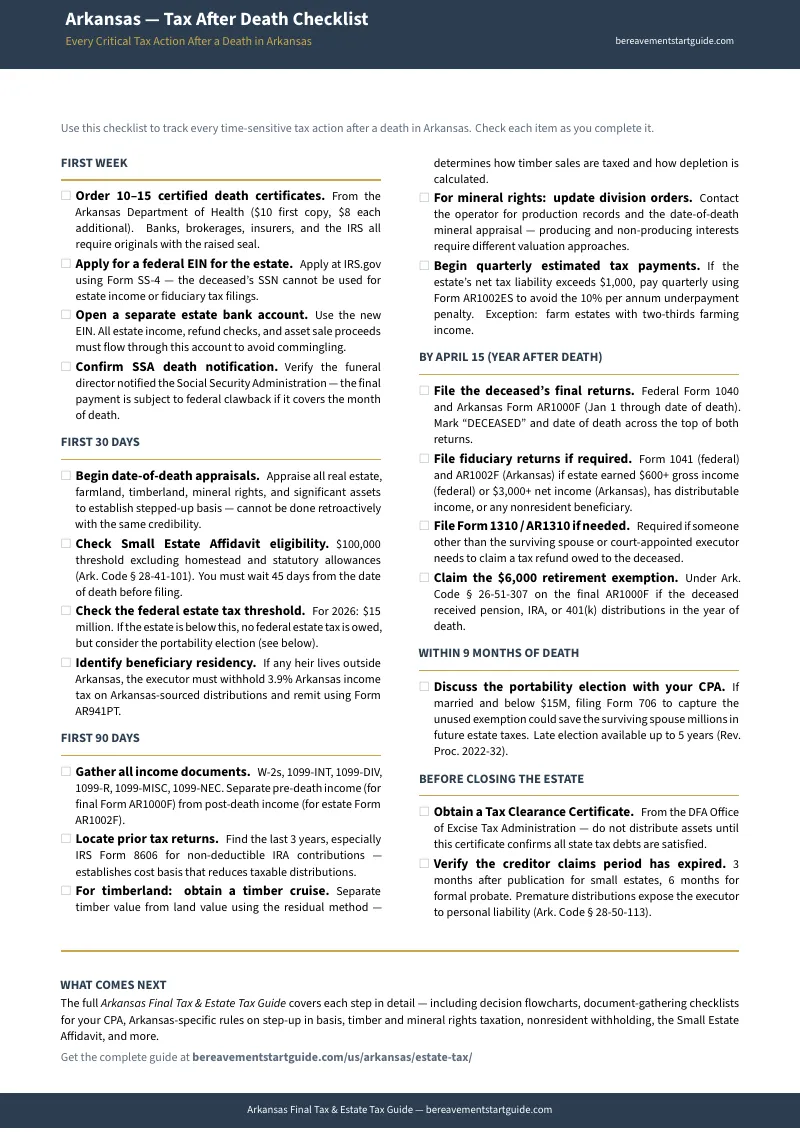
Download the free Arkansas Tax After Death Checklist to see every filing obligation on a single page. Or get the complete Arkansas Final Tax & Estate Tax Guide for --- 9 PDFs covering every form, every deadline, every basis calculation, and 7 standalone printable tools you can use at your desk or hand to your CPA.
This guide provides comprehensive education on Arkansas and federal tax procedures following a death. It is designed for informational purposes and does not constitute legal, accounting, or financial advice. Executors bear fiduciary responsibility for the estate and should consult a qualified professional for contested estates, active business successions, or assets approaching the federal exemption threshold.
Frequently Asked Questions
What if the rules change after I buy?
We update the guide when the rules change. Email us any time, even years later, and we'll send you the current edition free.