The Funeral Director Just Told You Embalming Is "Required by Arkansas Law." It Is Not. And That Single Lie Is About to Cost You $700.
Someone you love died in Arkansas. You are sitting across from a funeral director — exhausted, heartbroken, barely able to think — and they are sliding an itemized price sheet across the table. Embalming: $695. Casket: $2,400. "Mandatory" vault liner: $1,350. A handling fee for the urn your sister found online for $89. The total is climbing toward $9,000 and you have not even discussed the burial plot.
You asked if embalming is legally required. The funeral director said yes — "state law, forty-eight-hour rule." You asked if you could bring your own casket. They hesitated. You asked for a price list before entering the showroom. They said they would "walk you through everything together." Something felt wrong about every answer, but you could not articulate why — because you do not know Arkansas funeral law. And they are counting on that.
Here is the truth: Arkansas does not require embalming. The forty-eight-hour rule means the body must be embalmed or refrigerated at 45 degrees or below if burial or cremation does not happen within two days. Refrigeration costs a fraction of embalming. The funeral director is not required to tell you that. The FTC Funeral Rule requires them to hand you an itemized General Price List before discussing any services — not after you have already been emotionally committed in the showroom. And federal law explicitly prohibits charging a handling fee for a casket, urn, or outer burial container you purchased elsewhere. Every one of those "policies" the funeral director presented as law is a revenue strategy.
The Arkansas Funeral Laws & Consumer Rights Guide is the Consumer Defense Manual — the plain-English translation of every Arkansas statute, administrative code, and federal regulation that governs what funeral homes can and cannot do. Not a generic national overview with "Arkansas" in the title. Not an FTC pamphlet that stops at federal law and ignores state-specific rules about cremation intermediaries, home burials, and the right-of-disposition hierarchy. A single, consolidated manual that turns you from a passive customer into an informed auditor of every charge on that itemized sheet.
What's Inside the Consumer Defense Manual
15 chapters, three appendices, and four standalone printable tools — covering every legal right, procedural requirement, and cost-saving strategy for families arranging a funeral, cremation, or burial in Arkansas:
Chapter 1: Your Federal Rights Under the FTC Funeral Rule
The Funeral Rule is the single most powerful consumer protection in the deathcare industry — and most families do not know it exists. This chapter covers the mandatory General Price List, the casket price list, the outer burial container price list, and the explicit prohibition on handling fees for third-party merchandise. Exactly what the funeral director must disclose, when they must disclose it, and what to do when they fail to comply. The specific language to use when requesting an itemized breakdown before entering the casket showroom.
Chapter 2: Arkansas Embalming Laws — The 48-Hour Rule Exposed
The most commonly exploited misunderstanding in Arkansas funeral planning. The actual statute: 20 CAR Section 1-802 requires embalming or refrigeration at 45 degrees Fahrenheit if the body is not buried or cremated within forty-eight hours. Refrigeration is the legal equivalent of embalming — at a fraction of the cost. When embalming is genuinely required (public viewing with an open casket). When it is not (direct cremation, immediate burial, closed-casket services). The exact words to use when declining embalming and invoking the refrigeration alternative.
Chapter 3: Cremation in Arkansas — Authorization, Waiting Periods, and the Intermediary Requirement
Arkansas imposes a rule that surprises most families: a crematory authority cannot enter into a direct contract with the public. You must go through a licensed funeral director as a statutory intermediary — even for a simple direct cremation with no viewing or ceremony. This chapter explains the mandatory twenty-four-hour waiting period before cremation, the right-of-disposition hierarchy that determines who can authorize the procedure, the burial-transit permit required by the Arkansas Department of Health, and how to minimize costs within a system that legally requires a middleman. The Funeral Consumers Alliance of Northwest Arkansas and how their pre-negotiated arrangements work.
Chapter 4: Home Funerals and Private Burial on Family Land
Arkansas law permits families to care for their own dead and to establish private family graveyards on private property — but the gap between state permission and local enforcement catches rural families off guard. This chapter covers the state health regulations, the mandatory registration of a family graveyard with the county clerk before any burial takes place, the local zoning ordinances that can override state law, the health department consultation process, and the burial-transit permit requirement. A step-by-step checklist for legally establishing a private burial site without incurring state penalties or county fines.
Chapter 5: Transporting Human Remains in Arkansas
Moving a body from the place of death — whether across the county or across state lines — involves specific legal requirements that families rarely anticipate. When a licensed funeral director is required for transport versus when the family can legally handle it. The coroner notification requirement after a home death. The ADH burial-transit permit for cremation and out-of-state transport. The rules for shipping remains by air or ground carrier. The documentation required at every step. And the common scenario where a family discovers at the worst possible moment that they cannot move their loved one without official permission from a physician, medical examiner, or county coroner.
Chapter 6: Death Certificates and the E-RAVE System
The death certificate is the document that unlocks everything — life insurance payouts, bank account access, property transfers, Social Security survivor benefits. In Arkansas, death certificates are processed through the Electronic Registration of Arkansas Vital Events (E-RAVE) system. Medical certifiers have a statutory window of two to three business days to complete the medical certification. When they miss that window — and they frequently do — the family's financial access freezes. This chapter explains the timeline, the process for applying pressure to non-compliant physicians or hospitals, how many certified copies to order (10 to 15 minimum), and the costs ($10 for the first, $8 for each additional ordered simultaneously).
Chapter 7: Right of Disposition — Who Has Legal Authority
When the family cannot agree on burial versus cremation, Arkansas law does not leave it to a vote at the kitchen table. The Arkansas Final Disposition Rights Act establishes a rigid hierarchy: a military designee (DD Form 93) or a formally appointed representative comes first, followed by the surviving spouse, then a majority of adult children, then parents. This chapter maps the complete hierarchy, explains how disputes are resolved when people at the same level disagree, covers the specific rules for veterans, and provides the language for asserting legal authority when an estranged relative or unauthorized party attempts to take control of arrangements.
Chapter 8: Paying for a Funeral When There Is No Money
Arkansas has no centralized statewide funeral assistance fund. Families without resources face a fragmented, opaque system. County judges administer "pauper funds" on a county-by-county basis, with varying eligibility requirements and severely limited budgets. This chapter covers the county indigent burial process, how to apply, what documentation is required, veterans' burial benefits through the VA, Medicaid and FEMA assistance when applicable, and the practical options that reduce costs to the minimum — direct cremation, immediate burial in an alternative container, and the FTC rules that prohibit funeral homes from requiring a casket for cremation.
4 Standalone Printable Tools — Take Them Into the Funeral Home
Every purchase includes four standalone PDFs designed to be printed and used in real time — at the arrangement conference, at the kitchen table, or on the phone with the crematory. Each one works on its own:
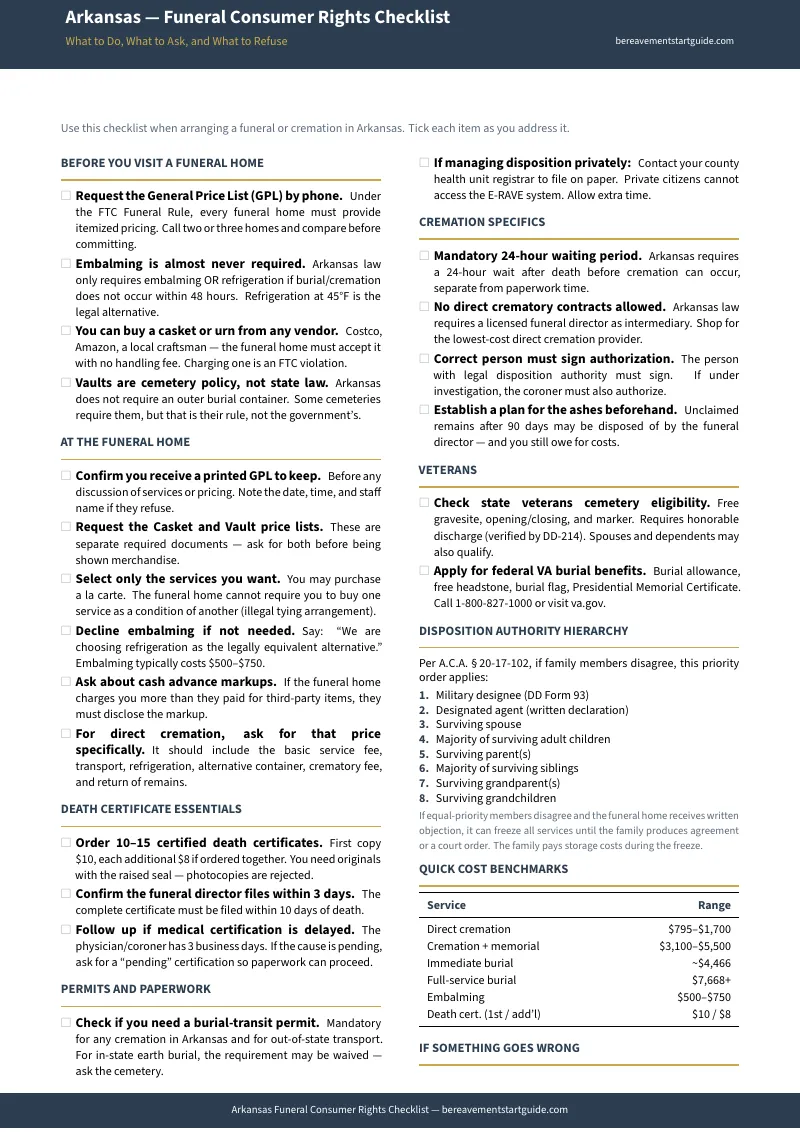
- Funeral Consumer Rights Checklist — A one-page summary of every federal and Arkansas-specific right you can invoke during the arrangement conference. Your right to an itemized General Price List before discussing services. Your right to decline embalming. Your right to bring your own casket, urn, or outer burial container without a handling fee. Your right to choose direct cremation or immediate burial. Print it. Bring it. Use it.
- Price Comparison Worksheet — A fillable worksheet for comparing itemized pricing across multiple funeral homes. Columns for every major service category — basic services fee, embalming, preparation, viewing, ceremony, hearse, casket, vault, cremation fee, death certificates — so you can make an apples-to-apples comparison instead of relying on confusing bundled packages.
- Right-of-Disposition Hierarchy Card — The complete Arkansas legal authority hierarchy on one printable card. Who has the legal right to make decisions, in what order, and what happens when people at the same level disagree. Carry it to resolve family disputes with statutory clarity instead of emotional arguments.
- Home Burial and Cremation Compliance Checklist — Every permit, registration, and notification required for home burial on private property or for authorizing cremation in Arkansas. County clerk registration, health department consultation, zoning verification, burial-transit permit, and the twenty-four-hour cremation waiting period — all in one checklist.
Plus the Quick-Start Action Plan — a chronological checklist covering the first 72 hours after a death through final disposition. 6 PDFs total.
Who This Guide Is For
- The family sitting in the arrangement conference right now — the funeral director is presenting charges you cannot evaluate because you do not know which are legally required and which are optional revenue. The guide gives you the statutory basis for every service so you can accept what you need and decline what you do not.
- The spouse who was just quoted $8,500 for a "standard" funeral — the number does not match your budget and you suspect you are paying for services the law does not require. The guide shows you exactly which charges are mandatory under Arkansas law, which are facility policies, and which are prohibited under the FTC Funeral Rule.
- The rural family that wants to bury Dad on the farm — the county clerk says one thing, the health department says another, and a neighbor warned you it is illegal. The guide maps the exact process: state law, county registration, zoning verification, health department approval, and the burial-transit permit.
- The family fighting over cremation versus burial — siblings disagree, an estranged parent has resurfaced, and nobody knows who has the legal authority to decide. The guide provides the Arkansas right-of-disposition hierarchy so the person with statutory authority can proceed without being blocked.
- The veteran's family navigating two systems at once — VA burial benefits, the DD Form 93 disposition authority, the National Cemetery Administration, and Arkansas state requirements all apply simultaneously. The guide explains how federal and state rules interact and which one controls when they conflict.
- The family with no money and no idea where to turn — the funeral home wants payment upfront, there is no life insurance, and nobody mentioned that Arkansas counties administer indigent burial funds through the county judge. The guide walks you through every low-cost and no-cost option available in Arkansas.
Why Free Websites Are Not Enough
The information exists. It is scattered across six different sources that contradict each other, bury critical details in legal jargon, or have a financial incentive to keep you uninformed.
- The FTC website explains federal law but stops at the Arkansas border. It covers the Funeral Rule, the General Price List requirement, and the prohibition on handling fees. It says nothing about the Arkansas forty-eight-hour embalming rule, the cremation intermediary requirement, the right-of-disposition hierarchy, home burial registration, or the E-RAVE death certificate system. Federal law is half the picture.
- Nolo and FindLaw translate statutes but do not tell you what to do with them. They accurately explain that Arkansas permits home burial and that embalming is not universally required. They do not give you the script for declining embalming at the arrangement conference, the checklist for registering a family graveyard with the county clerk, or the worksheet for comparing funeral home prices. Information is not the same as execution.
- Funeral portals like Ever Loved and Funeral.com are lead-generation platforms for funeral homes. Their business model depends on routing you to local funeral directors. They have a structural disincentive to teach you how to minimize your spending at those same funeral homes. The cost comparisons are superficial. The consumer rights coverage is nonexistent.
- Arkansas state agency PDFs are written for regulators, not families. The Arkansas Department of Health publishes the administrative code governing burial-transit permits and embalming requirements. It runs hundreds of pages, uses statutory citation formatting (20 CAR Section 1-802), and assumes the reader is a licensed funeral professional. No grieving family has the bandwidth to parse this during the worst week of their life.
— Less Than the Handling Fee They Should Not Be Charging You
Funeral homes in Arkansas charge an average of $7,000 to $9,000 for a traditional funeral with burial. Embalming alone averages $695. A single unnecessary vault liner adds $1,350. And the handling fee that federal law explicitly prohibits for your third-party casket? Funeral homes still charge it — because most families do not know it is illegal.
This guide costs . Once. No subscription. No membership. No hourly billing. 15 chapters covering every Arkansas funeral law and consumer right — from the FTC Funeral Rule through home burial registration and indigent assistance. Four standalone printable tools you can carry into the arrangement conference. A price comparison worksheet that forces transparency. And a Quick-Start Action Plan you can print and start using tonight.
100% satisfaction guarantee. If this guide does not save you multiples of its cost by helping you avoid unnecessary funeral charges, or if it fails to give you clarity and confidence during the planning process, email us at any time for a full refund. No questions asked.
This guide provides comprehensive, plain-English consumer education about Arkansas funeral laws and consumer rights based on the FTC Funeral Rule, Arkansas Code Annotated, Arkansas Administrative Code, and Arkansas Department of Health regulations current as of 2025-2026. It is not legal advice and does not create an attorney-client relationship. It does not provide instructions for the physical preparation of human remains, which requires a licensed funeral director in Arkansas.
Frequently Asked Questions
What if the rules change after I buy?
We update the guide when the rules change. Email us any time, even years later, and we'll send you the current edition free.