26 Blank Forms. A $100 Electronic Filing Fee. A 60-Day Inventory Deadline That Starts the Moment the Court Appoints You. And the County Clerk Just Told You They Cannot Explain Any of It.
Someone you love died in Arkansas. The will named you executor — or there was no will, and the family expects you to figure out the court process. You went to the circuit court clerk's office. They handed you a printout of 26 probate forms — Form 3, Form 10, Form 11, Form 23, Form 20 — and said, in almost exactly these words: "We are prohibited from answering specific questions about your case."
You asked which form to start with. They pointed to the eFlex electronic filing system and said you will need to register, complete online training, pay a $100 fee, and sign a user agreement before you can submit a single document — even if you are representing yourself. Then they handed you a bar association phone number and pointed to the door.
You called an attorney. The attorney quoted a fee based on the estate's value: 5% of the first $5,000, 4% of the next $20,000, 3% of the next $75,000. For a $400,000 estate, the math comes to over $11,000. For a $200,000 estate, over $7,000. That money comes directly out of the inheritance.
You went online. One site says to file Form 3. Another says Form 23. A third mentions a mandatory 45-day waiting period. A fourth says you have exactly 60 days to file a complete inventory of every asset — and if you miss that deadline, you face personal liability. Nobody agrees on the sequence. Nobody explains the eFlex system. And nobody mentions that Arkansas still enforces 19th-century dower and curtesy laws that override whatever the will says about who gets the house.
Here is the reality: Arkansas requires one of the most procedurally specific probate court processes in the country — and then legally forbids the people who run the courts from explaining how to navigate it. The forms are free. The eFlex system costs $100 before you can file a single page. And the statutory deadlines start counting the moment the court appoints you — whether you understand the process or not.
The Arkansas Probate Process Guide is the Missing Court Filing Manual — the procedural instruction set that the county clerk is legally prohibited from giving you. Not a generic legal overview. Not a national template with "Arkansas" pasted into the header. A 12-chapter, Arkansas-specific court manual that tells you which form to file, in what order, at which court, with what filing fee, and within which deadline — from the initial petition through the final discharge.
What's Inside the Missing Court Filing Manual
12 chapters and three appendices — covering every stage of the Arkansas probate court process, from determining whether you even need to file through obtaining your final discharge from fiduciary duty:
Chapter 1: Understanding Probate in Arkansas
Before you file anything, you need to understand what probate actually does and whether your situation even requires it. Many families assume every death triggers a court proceeding — that is not true. Joint accounts with right of survivorship, POD/TOD accounts, life insurance with named beneficiaries, retirement accounts with beneficiaries, and recorded beneficiary deeds all transfer outside of probate. This chapter explains the three pathways through the Arkansas system — no probate needed, the simplified small estate affidavit, and full formal administration — and when each applies.
Chapter 2: The Decision Tree — Do You Need Full Probate?
A systematic process for evaluating every asset the deceased owned and determining which pathway applies. How to categorize each asset as probate or nonprobate property. The exact $100,000 threshold for the small estate affidavit — including how to exclude the homestead and statutory allowances from the calculation, which most families get wrong. When an Order of No Administration may apply. And the specific triggers that force full formal probate regardless of estate size: contested wills, significant creditor disputes, business interests, and mineral rights.
Chapter 3: The Small Estate Affidavit — Form 23 Step-by-Step
If the estate qualifies, the Small Estate Affidavit lets you bypass formal probate entirely. But the process has procedural traps that catch families who file without understanding the requirements. The mandatory 45-day waiting period after death — submit on Day 44 and the clerk rejects it. The threshold calculation — what counts, what is excluded, and why most people overcount. What happens when the estate includes real property: you must publish a creditor notice in a local newspaper within 30 days of filing, wait three months for claims, then draft and record a Deed of Distribution. The personal-property-only shortcut when no real estate is involved. Every step, every form, every fee.
Chapter 4: Formal Probate — Petition Through Letters
Filing the Petition for Probate (Form 3). The requirements for admitting a will — self-proving affidavits, witness testimony via Form 4, and what happens when the original will is missing. The appointment priority hierarchy and the difference between executors and administrators. The fiduciary bond — when the court demands one, what it costs (typically 0.5-1% of the estate value per year), and the out-of-state executor trap that catches families off guard with doubled costs. How to obtain Letters Testamentary (Form 11) or Letters of Administration (Form 10) — the documents that unlock frozen bank accounts and give you legal authority to act. And the eFlex electronic filing system: the $100 registration, online training, $20 per-case fee, and exact registration steps for pro se filers.
Chapter 5: The 60-Day Inventory Deadline
Once the court appoints you as personal representative, the clock starts. A.C.A. § 28-49-110 gives you exactly two months to file a true and complete inventory of every estate asset. Miss this deadline and the court can remove you and hold you personally liable. This chapter walks you through locating and valuing every asset — bank accounts, real property, vehicles, retirement accounts, personal property, and business interests. When to hire an appraiser. How to open a dedicated estate bank account with its own EIN. And the ongoing fiduciary duty to manage assets prudently while administration is pending.
Chapter 6: Creditor Claims — Newspaper Publication and the Six-Month Window
One of the most anxiety-inducing requirements: publishing a notice in a local newspaper for two consecutive weeks to initiate the six-month statutory claim window. Which newspaper qualifies. How to draft the notice. The direct notification requirement for known creditors. How to evaluate, accept, or reject claims filed against the estate. The statutory priority order for paying debts — administration costs first, then funeral expenses, then federal debts, then medical expenses of the last illness, then state and local taxes, then general unsecured debts. The absolute two-year bar. And why paying a lower-priority creditor before a higher-priority one creates personal liability for you.
Chapter 7: Real Estate, Homestead, and the Deed of Distribution
The rural homestead exemption — 160 acres if valued under $2,500, or 80 acres regardless of value. The urban homestead exemption — one-quarter acre, regardless of value. How homestead rights protect the surviving spouse and minor children from creditors. The Deed of Distribution — the document that actually transfers real estate title. Manufactured home title cancellation. Mineral rights, timber interests, and oil and gas royalties — when operators reject the small estate affidavit and demand formal probate to release locked payments.
Chapter 8: Surviving Spouse Rights — Dower, Curtesy, and Statutory Allowances
Arkansas is one of the few states that still enforces traditional dower and curtesy laws. These guarantee the surviving spouse a share of the deceased's real estate — regardless of what the will says. The one-third life estate rule when the deceased left children. The different calculation when there are no children. The difference between "ancestral" property (inherited from the deceased's family) and "new acquisition" property (obtained through the deceased's own efforts). Statutory allowances: $4,000 in personal property and a two-month sustenance allowance of up to $1,000. How these protections stack. Intestate succession for every family configuration. And the blended family scenarios where stepchildren and a surviving spouse are in direct conflict over who gets the house.
Chapter 9: Executor Fees and the Full Cost Picture
The statutory executor fee schedule: 10% of the first $1,000, 5% of the next $4,000, and 3% of the remaining personal property balance. The separate attorney fee schedule: 5% of the first $5,000, 4% of the next $20,000, 3% of the next $75,000, 2.75% of the next $300,000, and 2.5% of the balance above $400,000. Court filing fees. Bond premiums. Death certificate costs. Publication costs. And five specific strategies to minimize total costs — including exactly when doing the work yourself makes financial sense and when hiring an attorney actually saves money.
Chapter 10: Contesting a Will
The six-month window to contest a will after admission to probate. The shortened three-month window when formal notice is served. Grounds for contest: lack of testamentary capacity, undue influence, fraud, and improper execution. How to compel production of a will when someone is withholding it. The court's authority to remove a personal representative for mismanagement. What happens when someone files a fraudulent small estate affidavit. This chapter exists because family disputes during probate are common in Arkansas — and understanding the timelines prevents both frivolous challenges and missed deadlines.
Chapter 11: Closing the Estate — Form 20 and Final Discharge
Filing the Final Accounting (Form 20) — a detailed report of all assets received, debts paid, expenses incurred, and distributions made. The court's review process. The 60-day objection period for interested parties. The petition for discharge that releases you from fiduciary duty. What to do if a creditor or beneficiary objects. The end of the process — the point where the court says you are done and you are no longer personally responsible.
Chapter 12: When to Hire an Attorney — and When You Are Wasting Money
Specific criteria for when this guide handles everything versus when professional help is functionally required. Complexity signals: contested wills, mineral rights disputes, business ownership, blended family hostility, estates with serious debt, and cross-border issues. How to use this guide as a diagnostic tool — determine whether the estate is straightforward enough for pro se filing or complex enough to justify the statutory fee schedule. How to interview a probate attorney. What they handle versus what you still do yourself. And the conversation that saves the most money: telling the attorney exactly which tasks you need them for, rather than handing them the entire estate.
Appendices: Forms, Deadlines, and County Resources
Key Arkansas probate forms reference table — Form 3, Form 4, Form 10, Form 11, Form 20, Form 23, and more, with what each one does and when you need it. Every statutory deadline in one timeline — from death through estate closing. eFlex registration steps for pro se filers. Death certificate ordering through the Arkansas Department of Health. Vehicle title transfer via DFA Form 10-306. County-specific resources.
8 Standalone Printable Tools — Use Them Without Opening the Guide
Every purchase includes eight standalone PDFs extracted from the guide's most actionable sections. Print the ones you need and keep them at your desk, in your courthouse folder, or on the kitchen table — each one works on its own:
- Probate Decision Tree — Walk through a series of questions to determine whether you need full probate, qualify for the small estate affidavit, or can bypass court entirely
- Court Filing Sequence — Every form number, filing order, required attachments, and fee in one printable reference card
- Asset Inventory Worksheet — A fillable worksheet organized by asset category for the mandatory 60-day inventory filing
- Creditor Priority Reference — The statutory debt payment order so you do not create personal liability by paying in the wrong sequence
- Dower and Curtesy Reference — Surviving spouse rights, statutory allowances, and intestate succession for every family configuration
- Executor Fee Calculator — Fee schedules and fillable calculation areas for executor fees, attorney fees, and total estate costs
- Forms Reference Card — The 11 key Arkansas probate forms: what each one does, when you need it, and where to file it
- Statutory Deadline Calendar — Every deadline mapped from death through estate closing: the 45-day waiting period, 60-day inventory deadline, six-month creditor window, and more
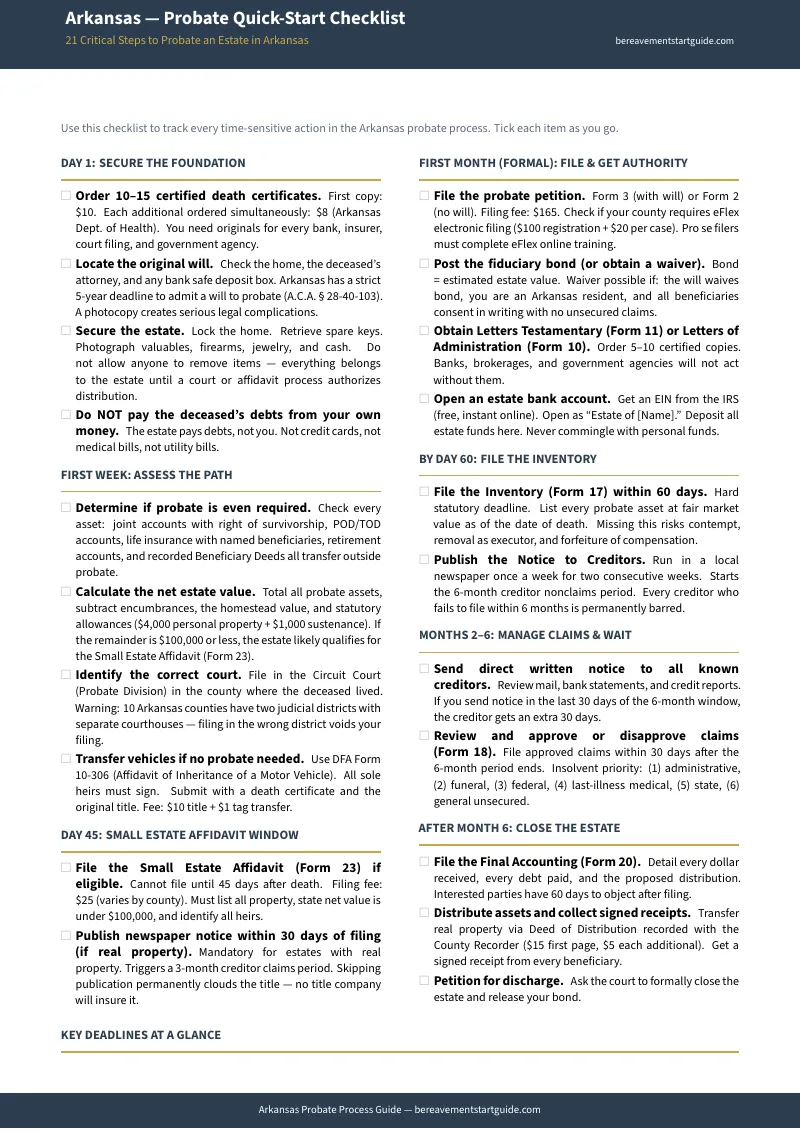
Plus the Quick-Start Checklist — a 20-item chronological checklist from Day 1 through Month 6. 10 PDFs total.
Who This Guide Is For
- The executor who has never filed a legal document — the will named you personal representative and nobody explained what that means. The fiduciary duties, the deadlines, the personal liability if you miss one. The guide gives you the complete job description from petition through discharge, with every form number and every deadline mapped.
- The family trying to avoid a five-figure attorney fee — the attorney quoted statutory fees that would consume thousands from the estate. For a straightforward estate with no contested claims, the guide walks you through every administrative step the attorney would have billed you for.
- The surviving spouse locked out of frozen bank accounts — the bank demands Letters Testamentary or a certified Small Estate Affidavit. The guide explains exactly which court filings unlock each account type and how the 45-day waiting period affects your cash flow timeline.
- The family that found Form 23 online and thinks they can file it tomorrow — it looks simple until you hit the 45-day wait, the homestead exclusion calculation, the real property publication requirement, and the three-month creditor window. The guide walks you through every qualification step so you do not file an affidavit that gets rejected.
- The out-of-state executor who cannot drive to the courthouse — the county clerk's website says they cannot offer legal guidance. The guide covers eFlex electronic filing, remote coordination, and the out-of-state executor bond trap that doubles your costs if you do not anticipate it.
- The blended family where trust has already broken down — stepchildren, a second spouse, and a will that someone may have signed under pressure. The guide explains the contest timelines, the grounds, and the dower and curtesy rules that determine what the surviving spouse receives regardless of the will.
Why Free Court Forms Are Not Enough
The 26 forms are free. The knowledge of which form to file, in what sequence, at which court, with what attachments, and within which deadline — that is the part nobody provides for free.
- County clerks hand you blank forms and refuse to explain them. Every circuit court clerk's office in Arkansas includes the same disclaimer: "We cannot offer legal advice." They give you Form 23 or Form 3, a bar association phone number, and nothing else. The forms are there. The filing sequence, the threshold calculations, the publication requirements, and the eFlex registration steps are not.
- National legal platforms miss the Arkansas-specific procedures. LegalZoom, Nolo, and Trust & Will offer clean interfaces and strong search visibility. They also have no mention of eFlex electronic filing, the $100 pro se registration fee, the mandatory online training, the dual-district county problem, or the dower and curtesy calculations. A generic probate overview for California does not work in a state that uses 19th-century property rules.
- Local attorney blogs create fear to justify retainer fees. The most accurate free content comes from Arkansas probate attorney blogs — detailed discussions of Title 28, the small estate threshold, and creditor claim procedures. But every article is structured to demonstrate that the process is too dangerous to attempt without professional help. For contested estates, that is true. For straightforward estates, the steps are sequential, predictable, and documented in the Arkansas Code.
- The eFlex filing system is its own barrier. You must register with the Bar of Arkansas, pay $100, complete online training, and sign a user agreement before filing anything electronically — even as a pro se litigant. No free resource walks you through this process from start to finish.
— Less Than One Hour of an Attorney's Time
Arkansas probate attorneys charge statutory percentage fees that can consume thousands of dollars from the estate. National platforms charge annual subscription fees for software that repackages what a structured PDF accomplishes as a one-time purchase. Legal Aid of Arkansas has strict income requirements and frequently declines probate cases because the existence of an estate implies assets. And the county clerk hands you Form 23 and tells you they are prohibited from explaining how to use it.
This guide costs . Once. No subscription. No membership. No hourly billing. Twelve chapters covering the complete Arkansas probate process — from the initial petition through the final court discharge. Every form number. Every statutory deadline. Every filing fee. A decision tree for choosing between the small estate affidavit and full probate. eFlex filing instructions. Executor fee calculations. Attorney fee schedules. And a Quick-Start Checklist you can print and start using tonight.
100% satisfaction guarantee. If the guide does not save you hours of confusion and help you navigate the Arkansas court process with confidence, email us at any time for a full refund. No questions asked.
This guide provides comprehensive, plain-English educational information about Arkansas probate procedures based on the Arkansas Code Annotated, Arkansas Supreme Court Committee on Civil Practice forms, and state agency policies current as of 2025-2026. It is not legal advice and does not create an attorney-client relationship.
Frequently Asked Questions
What if the rules change after I buy?
We update the guide when the rules change. Email us any time, even years later, and we'll send you the current edition free.