The ATRS Child Benefit Window Closes in Six Months. The County Assessor Needs Your Personal Property by May 31. Mini-COBRA Gives You Ten Days. And Nobody Has Mentioned That Arkansas Still Enforces Dower and Curtesy Laws That Can Give Your Stepchildren a Legal Claim to the House.
Someone has died, and now you are the person responsible for figuring out what the surviving family is owed. You called APERS and received an eligibility questionnaire full of references to A.C.A. § 24-8-218 and "contributory versus non-contributory credited service." You called Social Security and learned the lump-sum death payment is $255. You called the county assessor and were told about a May 31 deadline that no one mentioned at the funeral. You called the Department of Human Services and received a Medicaid Estate Recovery notice that implies the state may take the family home.
Meanwhile, deadlines are running. If your spouse worked for a small business with fewer than 20 employees, you have exactly ten days to elect Mini-COBRA health coverage --- and that coverage only lasts 120 days. If DHS sends a Medicaid recovery notice, you have 30 days to file the Undue Hardship Waiver or lose your right to contest it. If your spouse was a teacher and you have dependent children, ATRS applications must be received within six months of the death to receive retroactive payments --- file late and you lose every dollar between the death and the month you finally got the paperwork in. Every agency has its own clock, its own forms, and its own rules for who qualifies. None of them will mention the other agencies you should also be contacting.
The Arkansas Survivor Benefits Navigator is a Cross-Agency Deadline Tracker for every federal payment, state pension, county exemption, and statutory entitlement available to surviving families in Arkansas --- from the death certificate order on day one through Medicaid estate recovery defense and workers' compensation claims months later. Not a grief resource. Not a blog post from a funeral home or an insurance company. A plain-English, Arkansas-specific administrative reference that tells you which benefits exist, who qualifies, what forms to file, what documents to bring, and which deadlines will permanently disqualify you if you miss them.
What's Inside the Cross-Agency Deadline Tracker
A 14-chapter guide, a quick-start checklist, and 8 standalone printable reference sheets --- covering every survivor benefit, application process, and statutory deadline that Arkansas families face after a death:
Chapter 1: The First Seven Days
The triage sequence that prevents cascading financial losses. Order 10-15 certified death certificates from ADH Vital Records (Form VR-8, first copy $10, additional copies $8 each). Request a free veteran's copy using Form VR-40 --- Arkansas law entitles you to one at no charge. Freeze the decedent's credit with all three bureaus before identity thieves find the obituary. Notify every retirement system to halt direct deposits --- because when APERS, ATRS, or Social Security catches the overpayment, they claw back every dollar posted after the date of death, potentially overdrafting the joint account you depend on for groceries.
Chapter 2: Social Security Survivor Benefits
Survivor benefit calculations at every age threshold: reduced benefits at age 60, full benefits at full retirement age. The child-in-care exception that lets a surviving spouse of any age collect benefits. The $255 lump-sum death payment and why you must actively apply for it. The earnings test that withholds benefits if you work while collecting. Every document you need for the SSA appointment: death certificate, marriage certificate, birth certificates, W-2s, bank routing numbers.
Chapter 3: Arkansas Workers' Compensation Death Benefits
When death results from a workplace injury, Arkansas provides a separate compensation system. Spousal benefit: 35% of the decedent's average weekly wage, paid weekly until death or remarriage. Each dependent child: 15%. Maximum burial allowance: $6,000. The 2026 maximum weekly indemnity rate is $953. The employer must file Forms AR-D and AR-W within 30 days --- but the burden of filing the family's claim rests entirely on you. The two-year statute of limitations is absolute. After that date, the claim is permanently barred.
Chapter 4: Arkansas Public Retirement Systems
Four separate pension systems with four sets of rules. APERS requires six months of marriage. ATRS requires twelve months. LOPFI uses a unique B75 benefit structure that guarantees 75% of the member's reduced annuity. ASPRS provides 50% to a surviving spouse with no children. The guide covers active member death vs. retiree death calculations, the lump-sum death benefit ($6,667 to $10,000 for 10+ years of service), dependent child annuities that continue until age 23 or for life if incapacitated, and the reciprocity rules that let you combine service credit across multiple systems.
Chapter 5: Health Insurance Continuation
The most time-sensitive chapter in the guide. Federal COBRA (employers with 20+ employees) gives you 60 days to elect and up to 36 months of coverage. Arkansas Mini-COBRA (employers under 20) gives you ten days to elect and only 120 days of coverage. If your spouse was a state employee, ARBenefits surviving spouse coverage is reduced to roughly 50% of the active employee level --- and once the one-time option to terminate retirement health coverage is exercised, the decision is final and irrevocable. At age 65, you must coordinate ARBenefits with Medicare or lose supplemental coverage.
Chapter 6: Defending Against Medicaid Estate Recovery
If the decedent received Medicaid-funded long-term care after age 55, DHS will attempt to recover those costs. But Arkansas is a "probate-only" recovery state --- the critical fact that most families do not know. POD bank accounts, joint tenancy property, Transfer-on-Death deeds, life insurance, and retirement accounts with named beneficiaries are all completely shielded. Federal law permanently bars recovery if a living spouse, a child under 21, or a disabled child survives. The guide covers the 30-day Undue Hardship Waiver process, the mailing address for the Office of Chief Counsel, and the one consolidation mistake that destroys the protection your assets already had.
Chapter 7: Probate, Property Transfer, and Dower/Curtesy
The $100,000 Small Estate Affidavit lets you transfer assets without formal probate --- but you cannot file it until 45 days after the death. File on Day 44 and it gets rejected. Statutory allowances that vest immediately regardless of the will: $4,000 personal property, $1,000 sustenance, and household goods. And the dower/curtesy trap that makes Arkansas different from almost every other state: if your spouse had children from a prior marriage and died without a will, those stepchildren own the fee-simple remainder in the home. You get a one-third life estate. You can live there, but you cannot sell without their cooperation.
Chapter 8: Property Tax Relief and Exemptions
The Amendment 79 Homestead Credit provides up to $600 per year against property taxes and freezes the assessed value. The Disabled Veteran exemption eliminates all property tax on the home and personal property --- but requires annual renewal by October 15 and terminates upon remarriage. The age-65 value freeze protects against millage increases. Farm families face the rollback tax risk: if agricultural land is withdrawn from farming after the operator's death, the county can collect the difference between use-value and market-value assessments going back several years.
Chapter 9: Veterans Survivor Benefits
Federal Dependency and Indemnity Compensation: $1,699.36/month effective December 1, 2025 for surviving spouses of veterans who died from service-connected conditions. VA Survivors Pension for wartime veterans' families below the income threshold. Arkansas State Veterans Cemetery interment: free for the veteran, $807 for a spouse or dependent. The Arkansas Heroes Scholarship: full tuition plus room and board at any public Arkansas institution for dependents of military KIA, 100% disabled veterans, and public safety officers killed in the line of duty. Required documents: DD-214, marriage certificate, VA rating decision.
Chapter 10: Public Safety Line-of-Duty Death Benefits
The Arkansas State Claims Commission provides a $150,000 lump-sum benefit for families of police officers, firefighters, forestry officers, and correctional officers killed as a result of a criminal act in the line of duty. Municipal benefits add up to $50,000 more, plus accrued leave payouts. The federal PSOB program adds over $400,000. These stack on top of LOPFI pension benefits and Social Security.
Chapter 11: State Assistance Programs
SNAP for food assistance. Transitional Employment Assistance for cash support. ARHOME for health coverage up to 138% of the federal poverty level. The Great Arkansas Treasure Hunt for unclaimed property --- dormant bank accounts, uncashed checks, forgotten utility deposits, and unpaid wages in the decedent's name. All applications through Access.Arkansas.gov.
Chapter 12: Educational Benefits for Surviving Children
The Heroes Scholarship and Law Enforcement Officers Dependents Scholarship (up to 8 semesters). ATRS and APERS child annuities that can fund education until age 23. Federal Pell Grant recalculations and FAFSA dependency overrides for students who lose a parent.
Chapter 13: When to Hire a Professional
Not every estate needs an attorney. But contested dower/curtesy claims, workers' compensation disputes, Medicaid estate recovery involving complex assets, and estates with property in multiple counties do. The guide covers when a probate attorney is worth the cost, when a workers' comp attorney is essential, and the specific scenarios where self-help will cost you more than professional help.
Chapter 14: The Deadline Calendar
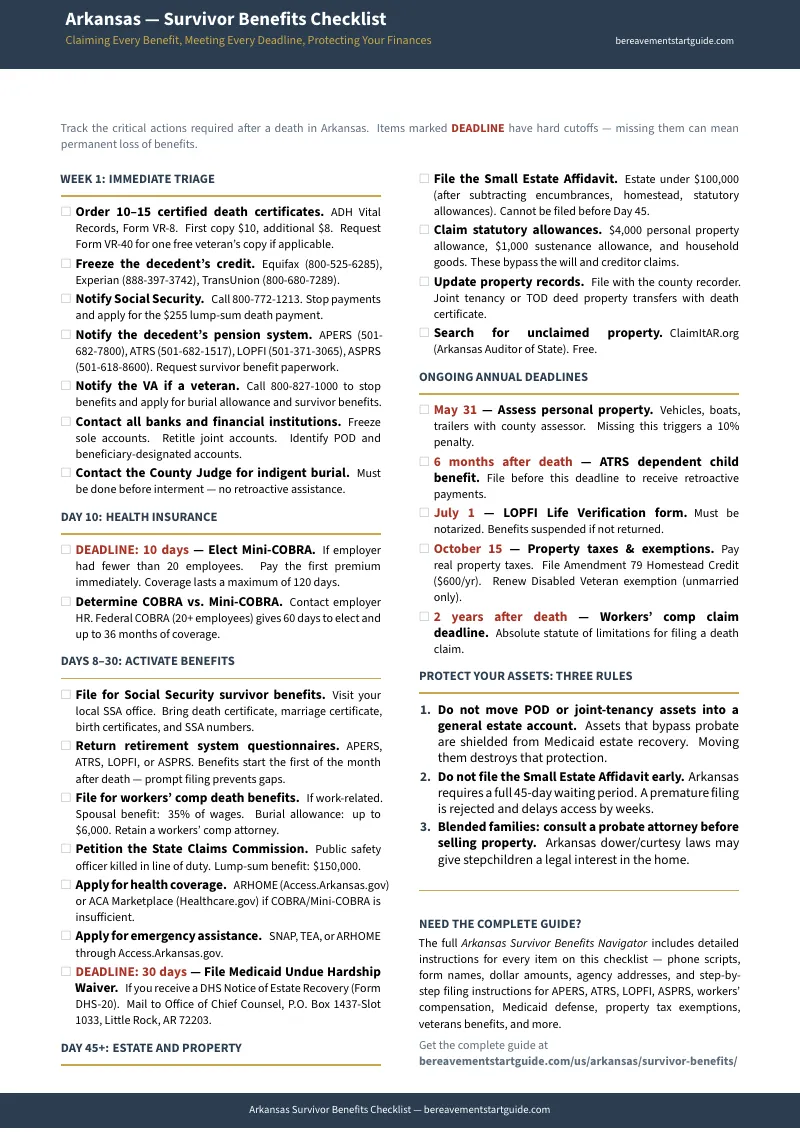
Every time-sensitive filing organized chronologically from the date of death. Day 10: Mini-COBRA election. Day 30: Medicaid hardship waiver. Day 45: earliest Small Estate Affidavit filing. May 31: personal property assessment. Six months: ATRS child benefit retroactivity. July 1: LOPFI life verification. October 15: property taxes, homestead credit, and DAV exemption renewal. Two years: workers' compensation statute of limitations. Plus a complete agency contact directory with phone numbers for every entity referenced in the guide.
Who This Guide Is For
- The surviving spouse who just lost the household's primary income --- who needs to know whether the APERS pension continues, how to elect health insurance before the ten-day Mini-COBRA window closes, whether Medicaid can take the house, and what the county assessor needs by May 31. The guide maps the entire income replacement sequence from the day-one notifications through monthly benefit activation.
- The adult child managing an estate from out of state --- who has never dealt with Arkansas property tax assessment dates, does not know the difference between the May 31 and October 15 deadlines, and cannot physically visit 75 different county offices. The guide gives you the chronological action plan, the document checklist, and the cross-agency filing sequence so you can process everything remotely instead of discovering benefits after their deadlines have passed.
- The family of a state employee or teacher --- who received an APERS or ATRS eligibility questionnaire dense with statutory references and actuarial language. The guide translates the 67% annuity splits, the six-month retroactive windows, the marriage duration requirements, and the pension option consequences into plain English.
- The family of a worker killed on the job --- who must navigate the Workers' Compensation Commission, the Death and Permanent Total Disability Trust Fund, the dependency hierarchy, and a hard two-year statute of limitations --- all while dealing with an employer that may be disputing the claim.
- A farm family trying to keep the land --- who needs to ensure that the agricultural use-value assessment continues uninterrupted after the operator's death, or risk a rollback tax that could force a sale. The guide covers what the county assessor needs, how to document ongoing farming operations, and the specific triggers that destroy the tax protection.
Why Free Resources Leave Money on the Table
Survivor benefit information exists. It is spread across the Social Security Administration in one portal, APERS in another, ATRS in a third, DHS in a fourth, 75 county assessors with varying deadlines and forms, the Workers' Compensation Commission, and the VA. Here is what happens when you try to navigate all of this yourself:
- The SSA website covers Social Security benefits. It does not mention APERS pensions, workers' compensation death benefits, property tax exemptions, or Medicaid estate recovery. Every federal agency covers only its own programs. If you stop at Social Security, you miss everything Arkansas provides at the state and county level.
- APERS and ATRS cover pension survivor benefits. They do not cross-reference health insurance deadlines, property tax exemptions, or the small estate affidavit process. A surviving spouse can lose Mini-COBRA coverage while waiting for the pension paperwork to arrive. Neither retirement system will tell you about the ten-day health insurance window.
- The county assessor handles property tax exemptions. They will not flag that your Amendment 79 credit needs to be re-filed under a new name. By the time you realize the homestead credit did not automatically transfer, the October 15 deadline may have passed. The DAV exemption alone saves thousands per year --- but only if you submit the VA letter annually.
- DHS administers Medicaid estate recovery. Their notices arrive in formal legal language that implies they can take everything. They do not explain that Arkansas is a probate-only recovery state, that POD accounts and TOD deeds are completely shielded, or that federal law bars all recovery when a surviving spouse is alive. The guide explains what DHS can actually reach and what they cannot.
- Hiring a probate attorney for straightforward benefit claims costs $250 or more per hour. For a surviving spouse who needs to know which forms to file with which agencies in which order, a legal retainer is a disproportionate expense for what is fundamentally an organizational problem --- not a legal one.
Free resources give you one agency at a time, with no sequencing, no cross-referencing, and no way to know what you are missing. The Cross-Agency Deadline Tracker maps every benefit to every situation, organizes every form by deadline, and tells you exactly which agencies to contact in which order --- so you can claim everything your family is owed without spending weeks navigating portals that were never designed to talk to each other.
--- Less Than One Hour of a Probate Attorney's Time
Arkansas families leave thousands of dollars in unclaimed survivor benefits every year --- not because they are ineligible, but because no one told them the benefit existed. An ATRS child annuity goes unclaimed because the family did not know about the six-month retroactive window. A Disabled Veteran property tax exemption goes unclaimed because the county assessor did not send a reminder. A workers' compensation death claim worth years of weekly payments is permanently barred because the family did not file within two years. A Medicaid estate recovery claim takes the family home because no one explained that a Transfer-on-Death deed would have protected it entirely. This guide costs less than any of those lost benefits and tells you where to find every one of them.
Your download includes 10 PDFs: the complete 14-chapter guide, the quick-start checklist, and 8 standalone reference sheets you can print individually --- a Cross-Agency Deadline Calendar, Agency Contacts Directory, Document Checklist, Pension Comparison Table (APERS/ATRS/LOPFI/ASPRS), Health Insurance Triage Card, Medicaid Defense Reference, Property Tax Calendar, and Statutory Allowances Reference. Print the ones that match your situation and keep them where you handle estate paperwork.
Money-back guarantee, no time limit. If the guide does not give you a clear map of every survivor benefit available to your family, every form you need to file, and every deadline you need to meet --- email us for a full refund. No questions asked.
Not ready for the full guide? Download the free Arkansas Survivor Benefits Checklist --- a summary of the most time-sensitive actions, deadlines, and forms that most families do not discover until it is too late. Enough to start contacting the right agencies in the right order.
You did not plan for this. But you can plan what happens next. The guide gives you the benefits, the forms, the deadlines, and the filing sequence --- so the next six months are spent claiming what your family is owed, not discovering what you missed.
Frequently Asked Questions
What if the rules change after I buy?
We update the guide when the rules change. Email us any time, even years later, and we'll send you the current edition free.