The Bank Froze the Accounts. The Assessor Is Threatening a $15,000 Property Tax Increase. The Probate Attorney Quoted $46,000 in Statutory Fees on a Home With $200,000 in Equity. And You Just Found Out the Trust Was Never Funded.
Someone you love just died in California. You went to the bank with the death certificate and the Small Estate Affidavit you spent two days researching. The teller looked at it, disappeared into the back office, and came back with: "We can't accept this. You need Letters of Administration from the court." You cited the statute. She said it was "bank policy." You asked for a manager. The manager said the same thing. The account is frozen, the rent is due, the funeral home is waiting for payment, and you are standing in a bank lobby holding a legally valid document that nobody will honor.
Then the county assessor's office sent a notice. The home your parent bought in 1987 for $180,000 --- now worth $900,000 --- is being reassessed at current market value. The property taxes are going from $3,200 per year to over $15,000. You have heard of Proposition 19 and something called a BOE-19-P form, but you do not know the deadline, whether you qualify, or what happens if you miss it. The deadline is one year from the date of death. If you miss it, the reassessment is permanent.
You called a probate attorney. The consultation was $350 for thirty minutes. The attorney explained that California's statutory probate fees are calculated on the gross value of the estate --- not the equity. So a family home worth $1,000,000 with an $800,000 mortgage generates $46,000 in combined executor and attorney fees, even though the family's actual equity is $200,000. You asked about alternatives. The attorney mentioned something about a "small estate affidavit" and a "DE-310 petition" but said the details were "complicated" and offered to handle everything for a retainer.
You went online. The California Courts website has forms but no instructions. The Department of Health Care Services has a page about Medi-Cal estate recovery that says the state can seek reimbursement from the estate for benefits paid after age 55 --- and you have no idea whether your parent received Medi-Cal. The Franchise Tax Board requires a final state return on Form 540 and possibly a fiduciary return on Form 541 --- but no one explains when each is due or who signs them. The DMV says vehicle transfers require Form REG 5 and a 40-day waiting period, but the form itself is two pages of boxes with no context for which boxes apply to your situation.
Here is the reality: California has the most expensive probate system in the country --- and also the most generous set of shortcuts to avoid it entirely. But nobody tells you what those shortcuts are, nobody explains the combination plays that let you use them together, and nobody tells you what to do when the bank rejects your legally valid paperwork.
The When Someone Dies in California --- Estate Settlement Guide is the California Estate Settlement System --- the step-by-step operational blueprint that sequences every obligation, every form, every deadline, and every escalation tactic in the order you actually need them. Not a generic legal overview with "California" in the header. Not a set of blank forms with a disclaimer. A 15-chapter, California-specific manual that covers all 58 counties, all simplified transfer pathways, the bank rejection escalation process that actually works, the Proposition 19 calculation and filing sequence, the Medi-Cal estate recovery defense, and the decision tree that tells you whether you need a $46,000 probate or a $0 affidavit.
What's Inside the California Estate Settlement System
A 15-chapter guide and the First 48 Hours Checklist --- covering every stage from the moment of death through final asset distribution, built specifically for California statutes, Judicial Council forms, and the county-level Superior Court procedures that make settling an estate here unlike any other state:
Chapter 1: The First 48 Hours --- Death Certificates, the VS-9, and the Actions That Cannot Wait
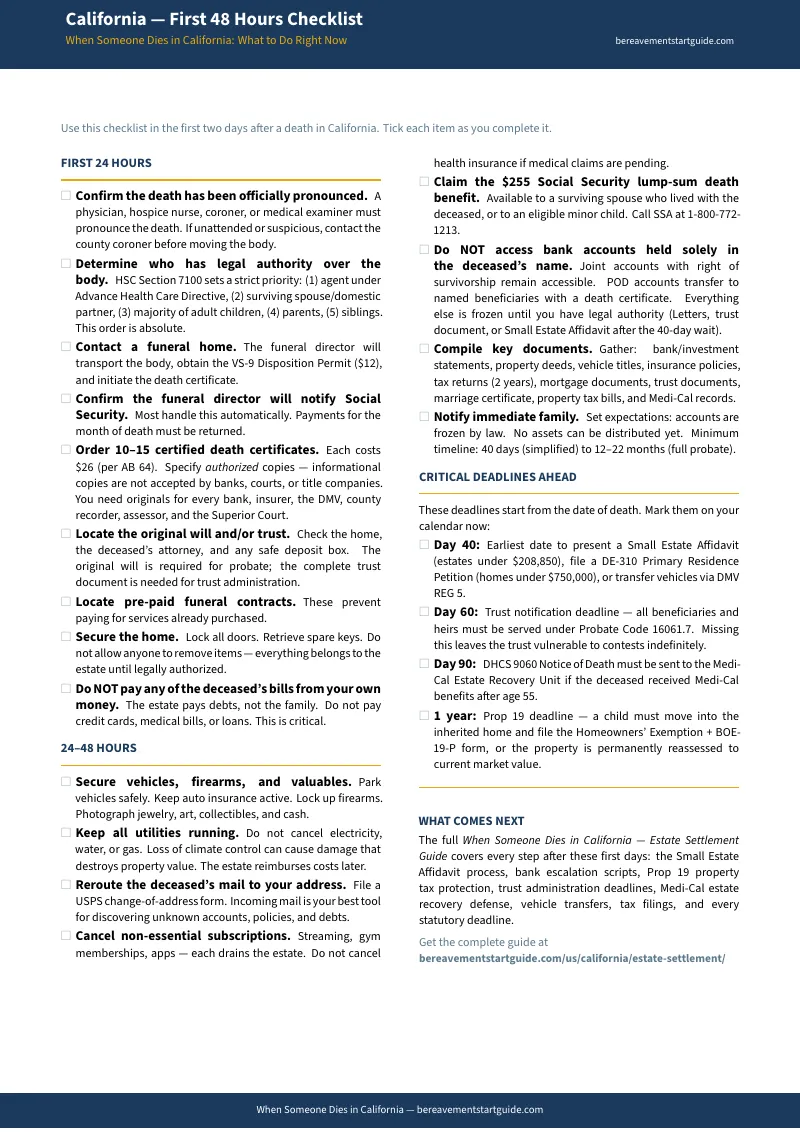
The funeral director is going to ask how many certified death certificates to order. The answer is 10 to 15 for most California families. Each authorized copy costs $26 under Assembly Bill 64, and you need originals --- not photocopies --- for every bank, every insurer, the Superior Court, the DMV, each county recorder, and the county assessor. California makes a critical distinction between authorized copies and informational copies. Informational copies bear a stamp saying they cannot establish identity, and no bank, title company, or court will accept them. This chapter also covers the Health and Safety Code Section 7100 hierarchy that determines who has legal authority over the body --- not the family consensus, but the statutory order that the funeral director is legally bound to follow.
Chapter 2: The First Two Weeks --- Securing the Estate and Setting Expectations
Before any court grants you authority over anything, you need to prevent assets from disappearing. Secure the home, reroute mail (your primary forensic tool for discovering unknown accounts), cancel subscriptions draining the estate, and hold the family meeting where you set the most important expectation: nobody takes anything from the house until legal authority says so. This chapter also addresses the relatives who have already started "helping themselves" --- the most common source of probate litigation in California.
Chapter 3: The Big Decision --- Which Legal Pathway Applies to Your Estate
This is the single most consequential chapter in the guide. California provides at least five distinct legal pathways for transferring assets, and most families qualify for the simplified routes that bypass full probate entirely. The decision tree walks you through each question in order: Do all assets transfer outside probate (joint tenancy, POD/TOD, trust, insurance)? Is a surviving spouse inheriting (Spousal Property Petition, Form DE-221 --- no dollar limit, 30-60 days)? Is the probate estate under $208,850 in personal property (Small Estate Affidavit)? Is the primary residence under $750,000 (new DE-310 petition under AB 2016)? Only if none of these apply do you need full probate. The guide maps every combination play --- including using DE-310 for the house and the affidavit for the bank accounts simultaneously.
Chapter 4: Simplified Transfer Procedures --- DE-300, DE-310, DE-221, DE-305
The specific filing procedures for each simplified pathway: how to draft the Small Estate Affidavit (there is no official Judicial Council form --- you draft it yourself under Probate Code Sections 13100-13106), how to file the DE-310 primary residence petition, how to use the Spousal Property Petition to transfer community property with no dollar limit, and the DE-305 procedure for minor real estate interests under $69,625. Each procedure includes the waiting period, the filing fees, the supporting documents, and the strategic notes about when to combine pathways.
Chapter 5: Trust Administration --- The 60-Day Deadline Nobody Warns You About
If the deceased had a living trust, you might assume probate is avoided and the hard part is done. Half right. Probate Code Section 16061.7 requires the successor trustee to serve written notice on every beneficiary and legal heir within 60 days of the death. Miss this deadline and the trust becomes vulnerable to contests indefinitely --- the statute of limitations never starts running. This chapter also covers the unfunded trust problem (the trust exists on paper, but assets were never titled into it), obtaining the trust's EIN, the fiduciary duties that expose you to personal liability, and the notification requirements that most families learn about only after the deadline has passed.
Chapter 6: Bank Accounts --- Unfreezing Money When Banks Say No
This is the chapter families need most urgently. When a bank receives a death notification, sole-owner accounts freeze. Being the surviving spouse does not override the freeze. The guide maps every account type: which ones stay open (joint with right of survivorship, POD/TOD designations), which require court paperwork, and which can be released with a Small Estate Affidavit after the 40-day waiting period. Then it covers what to do when the bank rejects your legally valid affidavit --- the six-step escalation process from branch manager to estate services hotline to formal demand letter citing Probate Code Section 13105 to Superior Court petition. Most rejections resolve at step 3 or 4. The key is knowing the statute numbers and using them.
Chapter 7: Real Property and the Proposition 19 Trap
Proposition 19 changed everything for inherited homes in California. Before November 2020, children could inherit their parents' low property tax base with few restrictions. Now, an inherited home that is not the child's primary residence gets reassessed to current market value --- turning a $3,200 annual tax bill into $15,000 or more. But there is an exclusion: if the child moves into the home within one year of the transfer and claims the homeowners' exemption, they can keep the parent's tax base on the first $1,044,586 of value above the original assessed value. This chapter covers the BOE-19-P filing, the county assessor's Preliminary Change of Ownership Report (PCOR), and the one-year deadline that, once missed, cannot be recovered. It also covers the deed recording sequence, the county recorder's requirements, and the critical difference between a grant deed, a quitclaim deed, and an affidavit of death of trustee.
Chapter 8: Vehicle Transfers --- DMV Form REG 5 and the 40-Day Wait
California has a specific DMV procedure for transferring vehicles without probate. Form REG 5 (Affidavit for Transfer Without Probate) allows a vehicle transfer once 40 days have passed since the death, provided the gross value of the deceased's total California property does not exceed $208,850. The guide covers the REG 5 process, the smog certification requirements, the AND vs. OR joint title distinction, the manufactured home exception, and what to bring to the DMV so you are not turned away after a two-hour wait.
Chapter 9: Medi-Cal Estate Recovery --- SB 833 and the Surviving Spouse Exemption
If the deceased received Medi-Cal benefits after age 55, the Department of Health Care Services will seek reimbursement from the estate. This terrifies families --- many assume the state will take the house. The reality is more nuanced. Senate Bill 833 narrowed the scope of recoverable claims to only those services the estate is required to pay. The surviving spouse exemption prevents any recovery while a surviving spouse is alive. This chapter explains the DHCS 9060 notification, the 90-day deadline, which assets are protected, which are recoverable, the hardship waiver process, and how SB 833 changed the landscape in favor of families.
Chapter 10: Tax Obligations --- Final Returns, Portability, and the Step-Up in Basis
Who signs the final Form 1040. When to file the California Form 540. Whether you need a Form 1041 (federal fiduciary return) or Form 541 (California fiduciary return) for estate income earned after death. The step-up in basis that resets the capital gains clock on inherited assets --- and the community property double step-up that can save a surviving spouse hundreds of thousands of dollars on a later sale. Form 706 estate tax portability for married couples (the federal estate tax exemption is $15 million in 2026, but portability must be elected on a timely-filed 706 --- even when no estate tax is owed). California has no state estate tax, but there are franchise tax obligations that catch families off guard.
Chapter 11: Full Probate --- The Process, the Fees, and How to Minimize Both
If the estate requires full probate, this chapter walks you through the entire process: filing the petition (DE-111), the hearing for appointment, Letters Testamentary or Letters of Administration, the creditor notification period, the inventory and appraisal, the final accounting, and the petition for distribution. The statutory fee schedule: 4% of the first $100,000, 3% of the next $100,000, 2% of the next $800,000, 1% of the next $9,000,000. On a $1,000,000 estate, combined executor and attorney fees total $46,000 --- calculated on the gross value, ignoring the $800,000 mortgage. The guide shows exactly which assets count toward the gross estate and which strategies can reduce the amount subject to statutory fees.
Chapter 12: The Master Timeline --- Every Deadline on One Calendar
Every statutory deadline from Day 1 through Month 24+, in one sequential calendar: the 40-day affidavit wait, the 60-day trust notification deadline, the 90-day DHCS Medi-Cal notification, the 120-day creditor claim period, the one-year Proposition 19 deadline, the tax filing deadlines for 1040, 540, 1041, 541, and 706, and the probate milestones for estates in full administration. Each deadline includes the statutory citation and the consequence of missing it.
Chapter 13: When to Hire a Professional --- and When You Are Wasting Money
Contested wills, complex trust litigation, business interests, multi-state assets, insolvent estates, and Medi-Cal disputes with DHCS require a licensed attorney. Straightforward estates using simplified transfer procedures do not. This chapter provides the decision tree, the questions to ask before retaining anyone, and the fee verification checklist that tells you whether the quoted fees match the statutory schedule or include padding.
Chapter 14: County-Specific Local Rules --- Navigating 58 Superior Courts
California has 58 counties, and each Superior Court has its own local rules for probate filings: different formatting requirements, different hearing calendars, different ex parte procedures, different fee schedules. Los Angeles requires a specific cover sheet. San Francisco has different filing deadlines than Sacramento. This chapter covers the major county variations and tells you exactly where to find the local rules for your county before you file anything.
Chapter 15: California Intestacy --- What Happens When There Is No Will
If the deceased died without a will, California's intestacy statute dictates everything. Community property goes entirely to the surviving spouse. Separate property is divided based on who survives: all to the spouse if there is no child, parent, sibling, or grandchild of a sibling; half to the spouse and half to the sole child; one-third to the spouse and two-thirds to multiple children. The guide maps every family configuration --- including the blended family scenarios where stepchildren, half-siblings, and predeceased children with their own children complicate the distribution.
Who This Guide Is For
- The surviving spouse who cannot access the bank accounts --- the checking account is frozen, the mortgage is due, and the bank is demanding Letters of Administration for money that is half yours under community property law. The guide shows you the Spousal Property Petition (no dollar limit, 30-60 days) and which accounts you can access immediately without any court involvement.
- The adult child named as executor who has never filed a legal document --- you are now personally responsible for managing someone else's financial affairs under California fiduciary duty law, and every mistake exposes you to personal liability. The guide gives you the complete sequence: what to file, where to file it, and the deadlines that determine whether you fulfill your obligations or breach them.
- The successor trustee who just learned the trust was never fully funded --- the trust document exists, but the house, the bank accounts, or both were never titled into it. Now you are dealing with both trust administration and probate for the unfunded assets. The guide covers the 60-day notification deadline, the trust EIN, and how to handle assets that fell outside the trust.
- The out-of-state family member trying to coordinate everything remotely --- you live in New York or Texas or Florida and your parent died in Los Angeles County. The Superior Court clerk told you they "cannot provide legal advice." The guide gives you every form number, every filing fee, every mailing address, and every deadline so you can manage the process without flying back and forth.
- The family trying to save a home from Proposition 19 reassessment --- the inherited home's property taxes are about to quadruple, and you have one year to move in, claim the homeowners' exemption, and file the BOE-19-P. The guide walks you through the calculation, the $1,044,586 indexed cap, and the exact filing sequence with the county assessor.
- The family afraid Medi-Cal will take the house --- DHCS sent a recovery notice and you do not know whether the surviving spouse exemption applies, whether SB 833 limits the claim, or how to file a hardship waiver. The guide explains all three protections and the 90-day deadline.
Why Free Resources and Generic Legal Software Will Not Get You Through This
The forms exist for free on the California Courts website. The instructions do not. Here is what actually happens when families try to settle a California estate using free resources:
- The California Courts Self-Help Center provides forms and filing instructions, but no strategic sequencing. You can download DE-111, DE-221, DE-310, DE-305, and DE-300. What the website does not tell you is which form applies to your situation, which combinations bypass full probate, or what to do when the institution holding the assets refuses to honor your legally valid affidavit. The forms are the raw materials. The decision tree and the escalation tactics are what actually get assets transferred.
- LegalZoom and Trust & Will sell generic templates that California banks reject. National legal software platforms produce clean-looking documents with your information filled in. They also generate small estate affidavits that do not comply with the specific requirements of Probate Code Sections 13100-13106, miss the DE-300 attachment that proves the current inflation-adjusted threshold, and include no guidance for the bank escalation that becomes necessary when the branch manager has never seen the form before.
- Attorney blogs explain how dangerous it is to do this alone --- because they charge statutory fees to do it for you. California probate attorney blogs are accurate and detailed. They are also designed to convince you that a $46,000 statutory fee on a million-dollar estate is money well spent. For contested estates, complex trusts, and business interests, that is true. For a straightforward estate where the deceased had a house, a bank account, a car, and a trust that needs administration, the process is sequential, predictable, and documented in the Probate Code.
- Government agencies cover their own slice and refuse to connect the dots. The Superior Court handles probate. The county assessor handles Proposition 19. The DMV handles vehicle transfers. The Department of Health Care Services handles Medi-Cal recovery. The Franchise Tax Board handles state taxes. Each publishes its own forms and deadlines. None tells you the order, the dependencies, or the consequences of filing one before the other.
Free resources give you blank forms and a warning not to make mistakes. The California Estate Settlement System gives you the complete sequence --- from death certificate to final distribution --- in the order you actually need them, with the escalation tactics for when institutions refuse to cooperate.
--- Less Than Ten Minutes With a California Probate Attorney
A single consultation with a California probate attorney costs $350 to $500 per hour. Standard representation on a million-dollar estate runs $46,000 in combined statutory fees --- calculated on the gross value, ignoring mortgages, because that is how the California Probate Code works. National estate planning platforms charge $89 to $199 per year in recurring subscriptions for generic templates that do not include the bank escalation process, the Proposition 19 filing sequence, or the Medi-Cal recovery defense. This guide costs less than ten minutes of professional legal time and gives you the complete California-specific roadmap --- every statute, every Judicial Council form, every deadline, every county variation, and the decision tree that tells you whether you even need a probate attorney at all.
Your download includes the complete 15-chapter guide, the standalone California First 48 Hours Checklist, and seven printable worksheets --- the Legal Pathway Decision Tree, the Bank Escalation Worksheet, the Proposition 19 Filing Worksheet, the Trust Administration Checklist, the Medi-Cal Recovery Reference, the Statutory Deadline Calendar, and the Vehicle Title Transfer Reference. Print the worksheets, bring them to the bank or the county assessor's office, and fill them in as you work through the process. Instant download, no account required.
Money-back guarantee, no time limit. If the guide does not give you clarity on what to do next and confidence that you are doing it in the right order, email us for a full refund. No questions asked.
Not ready for the full guide? Download the free California First 48 Hours Checklist --- covering death certificate ordering, securing the home, the authorized vs. informational copy distinction, financial boundaries, and the critical actions that must happen in the first two days. It is enough to get through tonight and tomorrow.
You did not ask for this job. But you are the one doing it. The bank will not release the money. The county assessor is reassessing the house. The probate attorney quoted fees that dwarf the equity. This guide puts every California-specific step into one operational sequence so you can stop searching five different government websites and start settling.
This guide provides educational information about California estate settlement procedures. It is not legal advice and does not create an attorney-client relationship. For contested estates, complex trust litigation, business interests, multi-state assets, or insolvent estates, consult a licensed California probate attorney. The guide includes a chapter on when professional help is necessary and how to verify that the fees you are quoted match the statutory schedule.
Frequently Asked Questions
What if the rules change after I buy?
We update the guide when the rules change. Email us any time, even years later, and we'll send you the current edition free.