The Colorado Estate Settlement Roadmap — Every Form, Every Deadline, One Clear Path
You just lost someone. Now the bank froze the accounts, the DMV rejected your paperwork, and you discovered a deadline you already missed. The state of Colorado provides hundreds of free forms — but no one tells you which form works where, what order to file them in, or what to say when an institution refuses to cooperate.
Free resources fail you in three specific ways. The Colorado Judicial Branch provides the JDF 999 Small Estate Affidavit — but does not mention that the DMV will reject it on sight and demand their own form (the DR 2712). Attorney blogs explain the creditor process — but their goal is to sell you a $3,000 retainer, not to tell you that a single mailed notice can collapse a creditor's claim window from four months to 60 days. Reddit threads offer empathy — but the advice is frequently based on other states' laws.
The Colorado Estate Settlement Roadmap translates the entire post-death bureaucracy into a single chronological action plan. It covers every pathway — the $88,000 small estate threshold, informal probate, formal probate — and tells you exactly which forms go to which agency, in what order, with which documents attached.
What You Get
The Complete Settlement Guide
A 14-chapter guide organized by timeline — from the first 48 hours through final distribution and estate closing. Written in plain English, not legal jargon.
- The DMV Form Trap — Why the court's JDF 999 gets rejected at the Colorado DMV, and the exact form (DR 2712) you actually need to transfer a vehicle title without probate
- The 10-Day Rule — Colorado requires the original will to be lodged with the county court within 10 days of death (C.R.S. § 15-11-516), whether or not you plan to open probate. The guide covers what to do if you've already missed the deadline.
- Track Selection Decision Tree — A step-by-step assessment that maps your specific situation to the correct legal pathway: Small Estate Affidavit, Informal Probate, or Formal Probate
- Bank Freeze Strategies — What to say when a financial institution refuses your Small Estate Affidavit, how to reference C.R.S. § 15-12-1201, and when to escalate to their legal compliance department
- The Creditor Shield — How to use JDF 943 (newspaper publication) and JDF 944 (direct mail) together to cut off creditor claims in 60 days instead of waiting a full year
- The 4-Month Beneficiary Deed Deadline — If real estate has a Transfer-on-Death deed, the death certificate must be recorded with the county clerk within 4 months or the transfer fails
- Creditor Priority Map — The exact payment hierarchy under C.R.S. § 15-12-805. Paying in the wrong order makes you personally liable for the difference.
- County-Specific Procedures — Denver Probate Court's unique rules, the $43 flat recording fee, pro se filing restrictions, and local publication newspapers
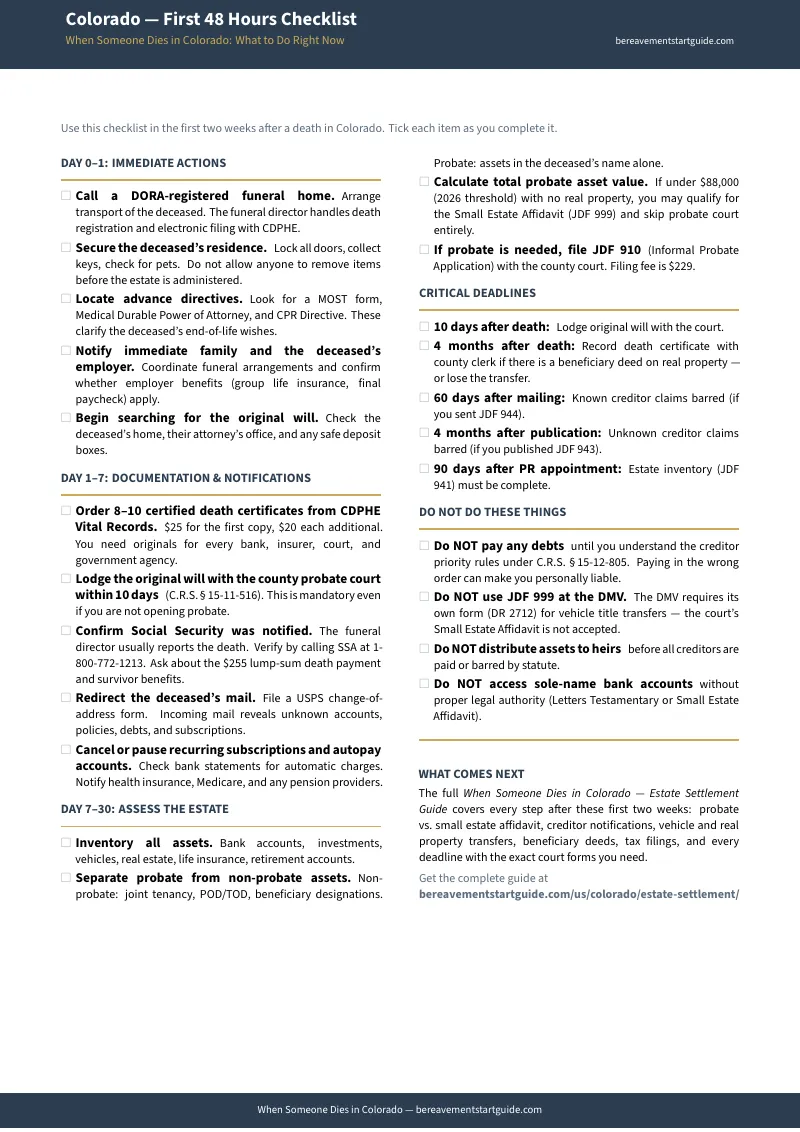
The First 48 Hours Checklist
A printable one-page checklist covering every immediate action: securing property, ordering death certificates ($25 first copy, $20 each additional in 2026), notifying agencies, and the critical deadlines you cannot miss in the first two weeks.
6 Printable Standalone Tools
Separate PDF worksheets and reference cards you can print and bring to meetings with banks, the DMV, attorneys, and county offices:
- Asset Inventory Worksheet — Fill-in tables for every asset category: bank accounts, investments, vehicles, real estate, and digital assets. Bring this to your first meeting with a probate attorney or use it to prepare the JDF 941 estate inventory.
- Forms Reference Card — One-page quick reference mapping every Colorado form to where it goes and when you need it: JDF 999 for banks, DR 2712 for the DMV, JDF 943/944 for creditors, JDF 941/942 for inventory and accounting, plus all tax forms.
- Probate Decision Tree — Step-by-step yes/no flowchart that walks you through the three questions that determine your track: Small Estate Affidavit, Informal Probate, or Formal Probate.
- Creditor Priority Reference — The C.R.S. § 15-12-805 payment hierarchy on one printable page with practical warnings about personal liability for out-of-order payments.
- Statutory Deadline Calendar — Every critical deadline on one timeline: 10-day will lodging, 60-day creditor notice, 90-day inventory, 4-month beneficiary deed recording, and more.
- Account Closing Checklist — Institution-by-institution checklist for closing bank accounts, utilities, subscriptions, and government accounts after death.
Who This Is For
- Families settling an estate in Colorado who want to handle the process themselves — saving thousands on attorney fees for straightforward, uncontested estates
- Executors and Personal Representatives named in a will who need a clear sequence of actions instead of scattered government PDFs
- Surviving spouses who need to know about their $44,000 exempt property allowance, $44,000 family allowance, and how to access frozen bank accounts immediately
- Families navigating an intestate estate (no will) who need to understand Colorado's succession rules and the process for getting court-appointed authority
Why Not Free Resources?
The Colorado Judicial Branch website provides the raw forms. Local attorney blogs explain individual steps. Neither gives you the full picture:
- The state site does not tell you that the DMV has its own affidavit form — you discover this after a wasted trip
- Attorney blogs are designed to funnel you into a $3,000+ retainer, not to help you handle it yourself
- Reddit advice is often based on laws from other states — Colorado's thresholds, deadlines, and procedures are specific to this jurisdiction
- No single free source provides the creditor priority hierarchy, the county-level variations, and the tax obligations in one place
This guide costs less than a single certified death certificate. It replaces 15+ hours of researching scattered state websites, sitting on hold with banks, and deciphering legal forms.
— Less Than a Single Filing Fee
The court charges $229 to open probate. The county clerk charges $43 to record a deed. A probate attorney charges $250-$450 per hour. This guide costs a fraction of any single fee you'll encounter during estate settlement — and it tells you which fees you can avoid entirely.
If you don't feel the guide gave you complete clarity, email us at any time for a full refund. No questions asked.
Frequently Asked Questions
What if the rules change after I buy?
We update the guide when the rules change. Email us any time, even years later, and we'll send you the current edition free.