You Shouldn't Need a $400-an-Hour Attorney to File a Tax Return for Someone Who Died
Someone in your family has died in Colorado, and now you're staring at a stack of tax forms, agency websites, and contradictory advice from relatives who "heard something" about estate taxes. The bank won't release the accounts without an EIN. A 1099 arrived in the deceased's name for a paycheck they never cashed. The county assessor's office says something about a property tax exemption expiring. And April 15 is closer than you think.
You already know Colorado has no state estate tax and no inheritance tax. What nobody told you is that "no estate tax" does not mean "no tax work." The deceased's final income still needs to be reported. If the estate earned a single dollar of interest during probate, a separate fiduciary return is required. The step-up in basis that protects you from capital gains on inherited property only works if you document it correctly. And the senior property tax exemption your spouse counted on? It doesn't transfer automatically --- miss the July 15 deadline and the exemption is gone for the year.
The Executor's Tax Resolution System
The Colorado Final Tax & Estate Tax Guide is a plain-English manual that walks you through every tax filing, asset transfer, and agency interaction required to close an estate in Colorado --- in order, with specific form numbers, statutory deadlines, and dollar amounts current for 2026.
Free government forms tell you which boxes to fill in. Law firm blogs tell you to call them at $300 an hour. This guide tells you what to do, when to do it, and why it matters --- so you can handle straightforward estates yourself and walk into professional meetings (when you need them) already knowing the right questions to ask.
What's Inside
- Final income tax return walkthrough (DR 0104 + Form 1040) --- exactly how to sign as a legal representative, where to write "DECEASED," and how to submit the death certificate through Revenue Online so the refund actually gets processed
- Fiduciary income tax instructions (DR 0105 + Form 1041) --- the return most executors don't know exists until the IRS sends a notice, covering estate income from bank interest, dividends, rental payments, and asset sales during probate
- Step-up in basis protection --- how to document the date-of-death value on the family home, investment accounts, and other appreciated assets so your beneficiaries pay zero capital gains when they sell, plus the rare UDCPRDA double step-up for community property imported from another state
- Income in Respect of a Decedent (IRD) handling --- what to do when a 1099 arrives for a paycheck, bonus, or IRA distribution paid after death, so you don't accidentally report it on the wrong return and trigger a notice
- Real estate transfer procedures --- recording the Personal Representative's Deed ($43 flat fee), filing the TD-1000 Transfer Declaration to prevent inflated property tax assessments, and avoiding the penalty for skipping it
- Vehicle title transfers --- including the DR 2009 beneficiary designation that supersedes the will and the standard DR 2395 process
- Senior property tax exemption transfer --- the exact Long Form the surviving spouse must file with the county assessor by July 15, plus the August 15 grace period most people don't know about
- Month-by-month executor timeline --- every deadline from Day 1 through estate closing, including the 4-month creditor window, the 6-month minimum before informal closing, and the fiscal year election that can defer K-1 income to your beneficiaries' advantage
- CPA handoff checklist --- if you do hire a professional, this tells you exactly what documents to bring and which questions to ask so you don't burn billable hours on basics
- 10 mistakes that cost Colorado families money --- distributing assets before reserving for taxes, missing the small estate affidavit threshold ($88,000 for 2026), filing DR 0102 without a death certificate, and seven more
Plus 5 standalone printable tools you can use independently: an executor timeline with every statutory deadline and a column for your own dates, a forms quick-reference card listing every form for every agency, the CPA handoff checklist, the 10 common mistakes guide, and a cost estimates sheet covering every fee from court filing to professional costs.
Who This Guide Is For
- Executors and personal representatives handling tax filings for the first time
- Surviving spouses who need to file jointly, transfer property tax exemptions, and protect the step-up in basis
- Adult children managing a parent's estate across agencies that don't talk to each other
- Small estate administrators using the JDF 999 Small Estate Affidavit and wondering what tax obligations remain even without formal probate
- Families preparing in advance --- organizing records and understanding the process before a crisis forces them to learn it under pressure
Why Not Just Use the Free Government Forms?
You absolutely can --- every form referenced in this guide (DR 0104, DR 0105, DR 0102, JDF 999, Form SS-4, TD-1000) is available for free from the Colorado Department of Revenue, the Colorado Judicial Branch, or the IRS. The forms themselves are not the problem.
The problem is that the CDOR's instructions are written for tax professionals, not grieving family members. The probate court doesn't explain how to handle the fiduciary tax return. The IRS doesn't tell you about Colorado's property tax exemption transfer deadline. Each agency covers its own domain and points you to a different agency for the rest. You end up spending 20+ hours cross-referencing fragmented instructions, and if you misread a single requirement --- filing DR 0102 without attaching a death certificate via Revenue Online, or using the Short Form instead of the Long Form for the property tax exemption --- the rejection sets you back weeks.
This guide consolidates the strategic knowledge that connects all of it: which forms to file in which order, which deadlines actually matter, which ones have grace periods, and which mistakes silently cost your beneficiaries thousands of dollars.
Updated for 2026 Legislation
- Permanent $15 million federal estate tax exemption ($30 million married with portability) --- the OBBBA eliminated the sunset, this is no longer a temporary provision
- Colorado flat income tax rate: 4.40%
- Small Estate Affidavit threshold: $88,000 (personal property, no real estate)
- Court filing fee: $229
- Death certificate: $25 first copy, $20 additional
The Guarantee
If this guide doesn't save you at least 5 hours of frustrating research and prevent at least one filing mistake, email us for a full refund. No questions, no justification required. The risk is entirely ours.
Get Started Now
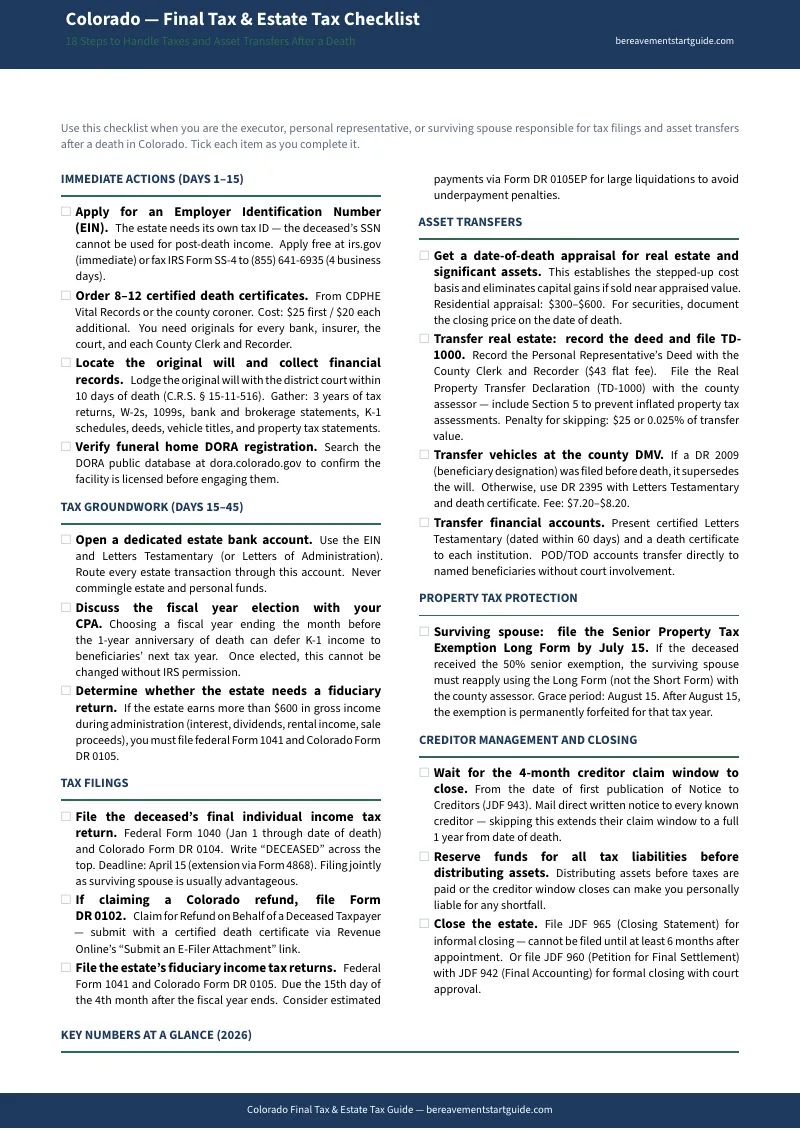
Download the free Colorado Tax After Death Checklist --- 18 steps covering every form, deadline, and dollar amount --- and see exactly what's ahead. When you're ready for the complete walkthrough, the full guide is .
This guide provides educational information and procedural checklists. It is not legal, tax, or accounting advice, and purchasing it does not create a professional-client relationship. For contested estates, complex trusts, or multi-state property, consult a CPA or attorney licensed in Colorado.
Frequently Asked Questions
What if the rules change after I buy?
We update the guide when the rules change. Email us any time, even years later, and we'll send you the current edition free.