
The Funeral Director Said Embalming Was Required by Law. It Is Not. And Colorado Has Not Required Funeral Director Licensing Since 1983 --- Until the Bodies Started Piling Up.
Someone you love just died in Colorado. You called the nearest funeral home because the hospital needed the body moved. Within an hour, a funeral director handed you a price list north of $12,000 and told you that embalming was mandatory under state law.
It is not. Colorado law requires only that a body be embalmed or refrigerated if final disposition does not occur within 24 hours of death. Refrigeration costs a fraction of the price. The funeral director knew this. They were counting on you not knowing it.
This is not an outlier. Colorado operated without mandatory funeral director licensing from 1983 until SB24-173 passed in 2024. During those decades of deregulation, the "Return to Nature" funeral home in Penrose was caught storing 190 decomposing bodies while the owners allegedly spent prepaid cremation funds on luxury vehicles and cryptocurrency. The Davis Mortuary scandal implicated an elected Pueblo County Coroner in mishandling two dozen remains. Full licensing enforcement under the new law will not take effect until 2027. You are arranging a funeral during the most dangerous transitional period in Colorado's death care history.
Meanwhile, the deadlines are already running. The 24-hour embalming-or-refrigeration deadline. The 72-hour death certificate filing window. Your siblings cannot agree on cremation versus burial, and the funeral home says they will not proceed until a court resolves the dispute. Refrigeration fees are accruing while your family argues. And you still do not know who actually has the legal authority to make the decision.
The Colorado Funeral Consumer Defense System
The Colorado Funeral Laws & Consumer Rights Guide is the Colorado Funeral Consumer Defense System --- a plain-English manual that translates Colorado's funeral statutes, DORA regulations, CDPHE administrative rules, and federal FTC protections into step-by-step instructions so you can arrange a lawful disposition, protect your family's money, and stop funeral homes from selling you services you do not legally need.
Not a national overview that treats Colorado like every other state. Not an attorney blog designed to convert you into a $300-per-hour retainer client. Not a funeral home's website dressed up as consumer education. A Colorado-specific consumer protection manual built on C.R.S. Title 15, the FTC Funeral Rule, DORA's mortuary science regulations, CDPHE vital records requirements, and county-level disposition rules --- the exact laws that govern every funeral home, crematory, and disposition facility operating in this state.
What's Inside The Colorado Funeral Consumer Defense System
A 10-chapter guide, a Funeral Consumer Rights Checklist, and 5 standalone printable tools --- covering every phase of funeral planning and consumer protection in Colorado, from the moment of death through final disposition, estate bridging, and complaint filing:
The First 72 Hours: The Deadlines Nobody Explains
Colorado law imposes interlocking deadlines that start the moment someone dies. The death certificate must be certified through the EDRS within 72 hours. If no disposition occurs within 24 hours, the body must be embalmed or refrigerated. If you want to handle the body yourself --- which Colorado law permits --- you need a disposition/transit permit from the county coroner, and you must register the death record with your local vital records office. The guide walks through each deadline, who files what, how many certified copies to order ($25 first, $20 each additional), and the 5-to-10 day rule that automatically terminates disposition authority if nobody acts.
Your Consumer Rights Under the FTC Funeral Rule and Colorado Law
Federal law gives you the right to an itemized General Price List before any discussion of arrangements, the right to select services individually instead of purchasing a bundled package, the right to supply your own casket with no handling fee, and the right to refuse embalming. Colorado adds its own protections through DORA regulations, including the requirement for funeral establishments to maintain proper registration during the SB24-173 transitional period. The guide covers both layers together --- the federal rights and the state-specific enforcement mechanisms --- with the exact citations you need when a funeral director pushes back.
Every Disposition Option Legal in Colorado --- and What Each Actually Costs
Colorado offers more legal disposition methods than almost any other state. Traditional burial. Cremation. Aquamation (alkaline hydrolysis). Human composting (natural organic reduction, legalized under HB20-1060). Green burial in a shroud with no vault. Home burial on private land with GPS-logged coordinates and a Private Burial Affidavit filed within 30 days. Scattering ashes in Rocky Mountain National Park (with the free RMNP permit, 200 feet from trails and water). The guide maps the specific permits, filing requirements, costs, and county-level restrictions for each option.
Who Has the Legal Authority --- The Strict Disposition Hierarchy
C.R.S. Section 15-19-106 establishes a non-negotiable hierarchy: the decedent's own written declaration first, then the court-appointed personal representative, surviving spouse, designated beneficiary, majority of adult children, majority of parents, majority of adult siblings. If people at the same priority level cannot agree, the funeral home has statutory immunity to refuse to act. The body sits in refrigeration at $75-per-day fees until a probate court issues an order. The guide maps the hierarchy, explains the majority-consent rules, covers the 5-to-10 day automatic termination, and walks through the court petition process.
Preneed (Prepaid) Funeral Contracts
If the deceased had a prepaid plan, the Division of Insurance --- not DORA --- regulates it. Trust-funded contracts can charge a cancellation fee of up to 15% of the original price. "Non-guaranteed" contracts mean the funeral home charges current rates when you die, not when you signed. If the funeral home goes bankrupt --- a real risk in Colorado's post-scandal landscape --- the contract's trust fund may be your only protection. The guide covers verification procedures, transfer rights, cancellation math, and the Payable-on-Death bank account alternative that avoids all preneed fees.
Home Funerals: What Colorado Law Allows and Requires
Colorado allows families to care for the body themselves without hiring a funeral director. You must comply with the 24-hour embalming-or-refrigeration rule, file the death certificate through the EDRS, and obtain a disposition permit from the county coroner. For home wakes and viewings, dry ice and proper ventilation serve as practical alternatives to embalming. The guide covers every step --- from washing and dressing the body to transport in a private vehicle to filing the final paperwork.
Transporting Remains Within and Out of Colorado
The disposition/transit permit must accompany the body during all transport. Ground transport in a private vehicle requires the permit and compliance with the 24-hour preservation rule. Air transport requires hermetic sealing and compliance with carrier-specific requirements. For families with burial plots in other states, the guide covers interstate transport logistics and the practical alternative of local cremation followed by shipping cremated remains via USPS Priority Mail Express.
Filing Complaints When Your Rights Are Violated
Colorado's regulatory system is fragmented across four agencies, and filing with the wrong one wastes critical time. Funeral home misconduct and licensing violations: DORA, Office of Funeral and Mortuary Science Services. Cemetery and interment disputes: Division of Real Estate or the Attorney General's office (DORA has no jurisdiction over cemeteries). Prepaid funeral plan problems: Division of Insurance. Consumer fraud: Attorney General's Office. The guide maps the correct agency for every type of complaint, with contact information and filing procedures.
Who This Guide Is For
- Families arranging a funeral right now --- who need to know their legal rights before signing a contract, including the right to refuse embalming, demand itemized pricing, and use a third-party casket without handling fees
- The surviving spouse or adult child who is first in the disposition hierarchy --- and needs to understand what legal authority they actually hold under C.R.S. Section 15-19-106, and what happens if they do not act within 5 to 10 days
- Families in conflict over burial versus cremation --- who need the exact legal process for resolving disposition disputes, including the court petition process and the statutory immunity that allows funeral homes to refuse to act until a judge issues an order
- Anyone considering a home funeral, green burial, aquamation, or human composting --- who needs the specific permits, filing deadlines, and county requirements for each alternative disposition method
- Anyone who suspects a funeral home is overcharging or misrepresenting legal requirements --- and needs to know exactly which agency to contact, because filing with the wrong one wastes weeks during a time when every day matters
- Executors and estate administrators --- who need to understand how funeral expenses interact with the creditor priority waterfall under C.R.S. Section 15-12-805 and the estate settlement timeline
Why Free Resources Will Not Protect You
- DORA's website will not help you exercise your rights. It tells you that funeral establishments must be registered. It does not tell you what to say when a funeral director claims embalming is legally required, or how to strip $3,000 from a quote using rights you already have. The state's "Consumer Guide to Death Care in Colorado" is buried in an obscure PDF, heavy on legislative history, and missing the step-by-step instructions families actually need.
- Nolo and FindLaw give you a paragraph where you need a chapter. They confirm that home burial is legal in Colorado. They do not tell you about the 4 feet of compacted soil requirement, the GPS coordinate logging, the 30-day Private Burial Affidavit filing deadline with the county clerk, or the county zoning ordinances that can prohibit it entirely. They cover the right without the procedures that make it usable.
- Funeral home websites will never teach you to spend less at their funeral home. They explain their services warmly and professionally. They do not explain that you can decline every optional service, supply your own casket, skip embalming, and reduce a $12,000 quote to $2,000 using rights you already have under federal and state law.
- Lead-generation sites disguised as helpful resources sell your contact information to funeral homes. The funeral home that calls you after you fill out their form is a paying advertiser, not a recommendation. These sites will never teach you to bypass their own clients.
Free resources give you fragments of federal law, fragments of state law, and fragments of county rules scattered across four different regulatory agencies, lead-generation websites, and attorney blogs ending in $300-per-hour consultation offers. The Colorado Funeral Consumer Defense System puts every right, every deadline, every cost, and every protection into one document, in the order you need them.
--- Less Than Ten Minutes of a Colorado Attorney's Time
A single consultation with a Colorado estate or elder law attorney costs $300 to $400 per hour. A funeral home "cremation package" runs $3,000 to $7,000 for services you may not legally need. If this guide prevents one unnecessary embalming ($500+), one casket purchase for a cremation ($2,000+), or one bundled package when direct cremation was all you needed ($2,000-$5,000 difference), the return is immediate.
Your download includes the complete 10-chapter guide, the Colorado Funeral Consumer Rights Checklist, and five standalone printable tools:
- FTC Price Comparison Worksheet --- print and use to compare line-item costs from at least three funeral homes before committing
- Cremation/Burial Document Checklist --- tracks every document required for legal disposition in Colorado, from death certificate filing through permit endorsement
- Complaint Filing Guide --- routes your complaint to the correct agency (DORA, Division of Insurance, Division of Real Estate, or Attorney General) with step-by-step filing instructions
- Quick Reference Card --- every financial threshold, cost, deadline, form number, and agency contact on one page
- End-of-Life Document Audit --- 7-item checklist to verify your advance planning documents are complete and legally valid
Money-back guarantee, no time limit. If the guide does not give you clarity on your consumer rights, the legal deadlines, and the specific steps to protect your family's money when arranging a funeral or cremation in Colorado --- email us for a full refund. No questions asked.
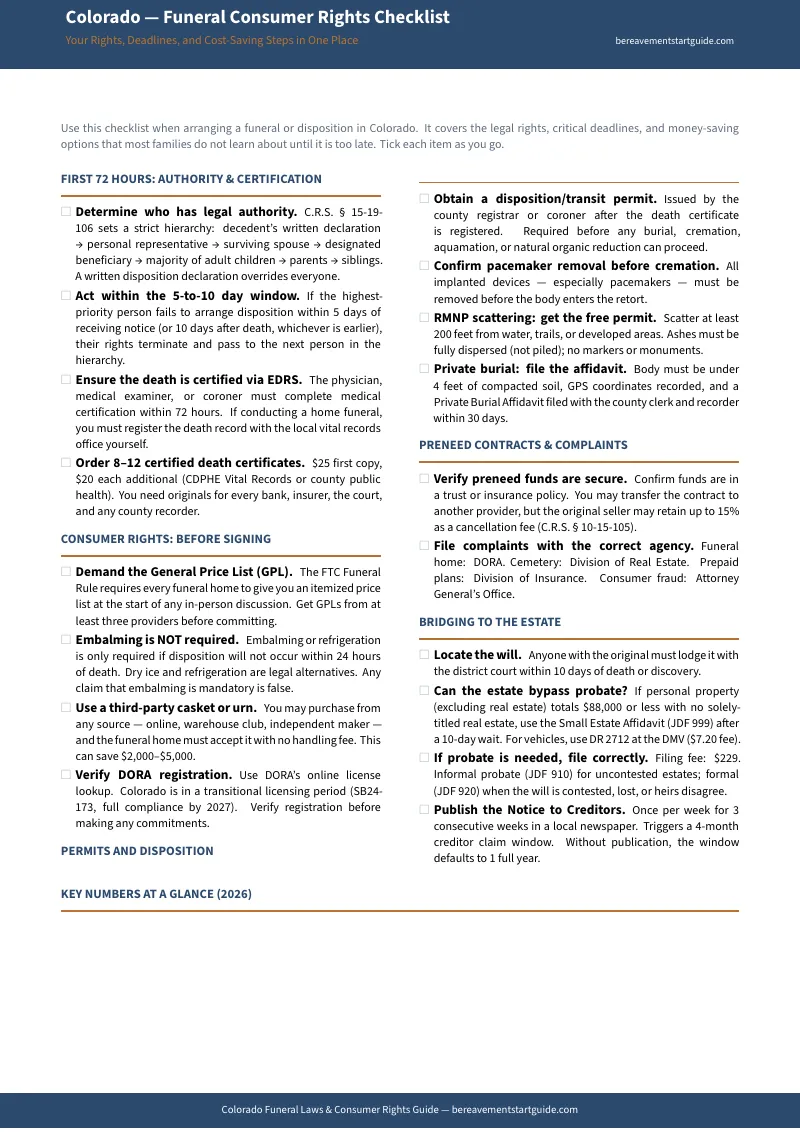
Not ready for the full guide? Download the free Colorado Funeral Consumer Rights Checklist --- an 18-item quick-reference covering authority, deadlines, consumer rights, permits, preneed protections, and estate bridging steps. Enough to know what questions to ask and which claims to challenge. When you need the full statutes, the complete disposition hierarchy, the FTC enforcement language, and the step-by-step instructions for every scenario from home burial to interstate transport --- the complete guide is here.
The funeral home is not your adversary. But they are not your advocate either. Their job is to sell services. Your job is to know which ones you actually need. This guide makes sure you do.
Frequently Asked Questions
What if the rules change after I buy?
We update the guide when the rules change. Email us any time, even years later, and we'll send you the current edition free.