The Bank Froze the Account. The Court Clerk Said She Cannot Tell You How to Unfreeze It. You Are Holding a Will That Means Nothing Until a Registrar Issues You Letters Testamentary.
You went to the bank with the death certificate and the original will, and the teller said the account is locked until you produce Letters Testamentary. You drove to the county courthouse and asked the Probate Registrar how to get them. She handed you a stack of JDF forms and told you — politely, firmly — that the court cannot provide legal advice. She cannot tell you which form to file first, how to fill in the blanks, what to attach, or what happens after you submit the packet. She told you to consult an attorney.
So now you are home with blank JDF forms, a frozen bank account, a will that is legally inert until a court official validates it, and a growing suspicion that you are about to make a mistake that will cost months or money or both. Maybe you will file the wrong application and waste the $229 filing fee. Maybe you will attempt a Small Estate Affidavit because someone online said the threshold is $70,000, when the 2026 threshold is actually $88,000 — and it does not matter anyway because the deceased owned a house, and any real estate in their name alone disqualifies the estate from the affidavit process entirely. Maybe you will distribute assets to the family before the four-month creditor claim window closes and discover — when a hospital submits a $12,000 bill — that you are personally liable for the shortfall. Maybe you will ignore a creditor's claim for 63 days and learn that under Colorado law, silence means the court automatically approves the debt against the estate. Or maybe you will hire an attorney for $3,500 to $5,000 to handle a straightforward informal probate that the Uniform Probate Code was specifically designed to let you handle yourself.
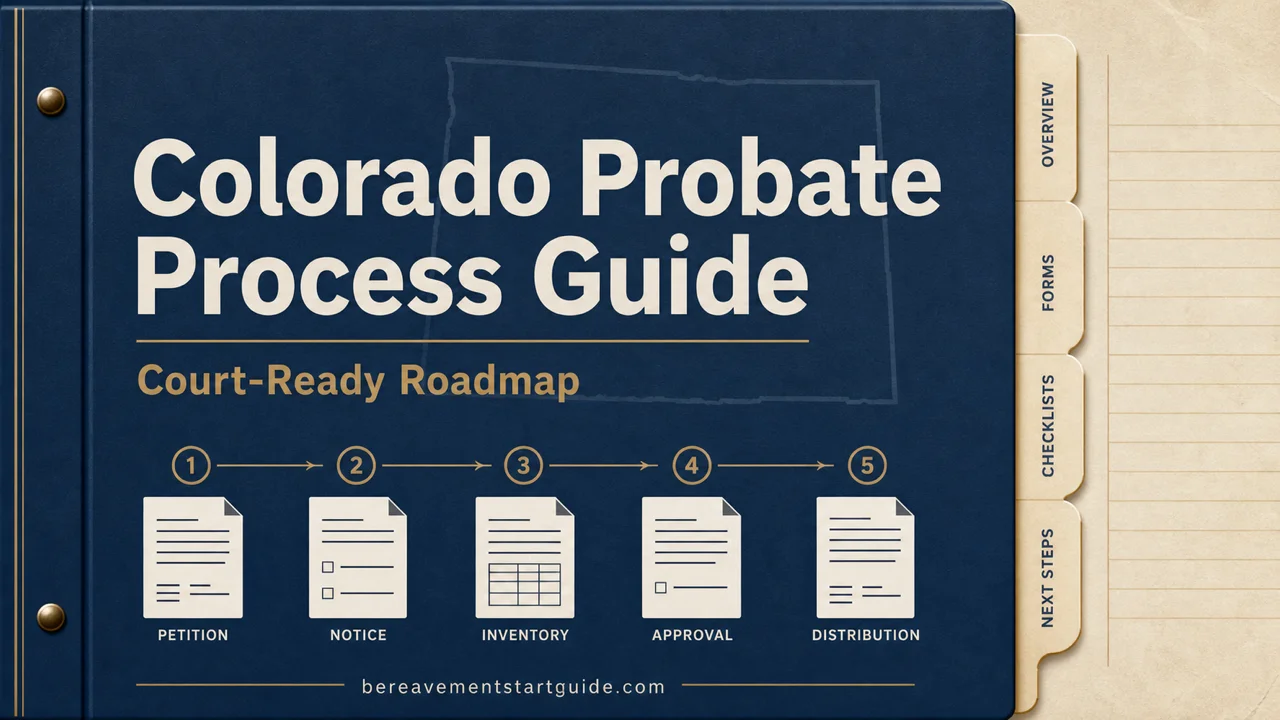
The Colorado Probate Process Guide is a Court-Ready Roadmap for every filing, deadline, form, and decision in a Colorado probate case — from the initial application through final closing and discharge. Not a generic overview written for all 50 states. Not a blog post designed to convince you that probate is too complex to attempt without a retainer. A plain-English, Colorado-specific manual that tells you exactly what the court clerk cannot: which JDF forms to file, in what order, with what attachments, and which mistakes will cost you money or expose you to personal liability.
What's Inside the Court-Ready Roadmap
A step-by-step guide, a filing-readiness checklist, and standalone reference sheets — covering every phase of probate in Colorado from opening the case through final discharge, built on the Colorado Uniform Probate Code (Title 15), the JDF form system, and the county-specific rules that make this process different from any other state:
Before You File: Does the Estate Actually Need Probate?
This is the question that determines whether you spend six months in court or bypass the system entirely. Colorado provides two ways to avoid full probate. First, assets with beneficiary designations, survivorship clauses, or recorded beneficiary deeds (C.R.S. Section 15-15-401) transfer automatically — outside probate. Second, estates with personal property valued at $88,000 or less and no real estate can use the Small Estate Affidavit (JDF 999) after a 10-day waiting period — no court filing, no hearing, no appointment. But there is a hard disqualifier that catches families every time: if the deceased owned any real estate solely in their name, the affidavit cannot be used, regardless of the property's value. A $50,000 house disqualifies the estate just as surely as a $500,000 one. The guide includes a decision tree that walks you through the exact criteria — so you do not file a full probate petition for an estate that qualifies for the shortcut, and you do not attempt the affidavit on an estate that does not qualify.
Informal vs. Formal Probate: Two Tracks, Two Levels of Court Involvement
Most Colorado families will use informal probate — an administrative process handled by the county's Probate Registrar, not a judge. You file JDF 910 (testate) or JDF 916 (intestate), the Registrar reviews your paperwork, and if everything is in order, you receive Letters Testamentary (JDF 915) without a hearing. But informal probate is only available when the original will exists, no one disputes who should serve, and no one contests the will's validity. If the original is lost and you only have a copy, if the estate is insolvent, or if beneficiaries are fighting — you are in formal probate, which means a Petition (JDF 920 or JDF 922), a Notice of Hearing (JDF 711), and a judge. The guide covers both tracks end to end, because the forms are different, the timelines are different, and the notification requirements are different.
Filing the Application: What the Court Needs and What Triggers a Rejection
The filing packet is not a single form. For informal probate, you need JDF 910 (the Application), the original will, a certified death certificate, JDF 911 (Acceptance of Appointment), and JDF 912 (Renunciation) from anyone with higher statutory priority who is not serving. The filing fee is $229. Denver Probate Court — the only constitutionally distinct probate court in the state — requires pro se filers to submit paper filings in person or by mail. No fax. No email. Other counties have their own procedures. Boulder and Adams Counties are known for rejecting applications with blank fields on the spot. The guide maps the filing requirements and the county-specific procedures so your first submission is your last.
The Creditor Notification System: The Most Dangerous Phase for Executors
This is the chapter that protects you from personal liability. You must publish JDF 943 (Notice to Creditors by Publication) in a local newspaper once a week for three consecutive weeks. You must also mail JDF 944 (direct notice) to every creditor whose identity you know or can reasonably discover. Publication starts a four-month clock for unknown creditors. Known creditors who receive direct mail notice get the later of four months or 60 days from mailing. If you skip notice entirely, creditors retain the right to file claims for a full year after death. The guide explains the dual deadline system, the publication requirements, the cost ($50 to $200), and the 63-day disallowance trap — the rule that automatically approves a creditor's claim against the estate if you fail to mail a Notice of Disallowance (JDF 945) within 63 days after the presentation period expires.
The 63-Day Disallowance Rule: The Deadline Nobody Mentions
If a creditor files a claim and you do nothing — no acceptance, no rejection, no formal response — Colorado law deems the claim automatically allowed after 63 days. The estate is legally bound to pay the debt, even if the claim was inflated, stale, or potentially invalid. But if you properly mail a Notice of Disallowance (JDF 945) within that window, the burden shifts entirely to the creditor — they have 63 days to petition the court, and if they miss it, their claim is permanently barred. The difference between paying a questionable $15,000 medical bill and extinguishing it entirely can come down to whether you mailed one piece of paper on time. The guide walks you through the mechanics of this rule and the exact timeline.
Family Protections: Spousal and Dependent Allowances
Before general unsecured creditors can be paid, Colorado law requires the estate to satisfy statutory family protections. The 2026 Exempt Property Allowance is $44,000. The Family Allowance is $44,000 (lump sum) or $3,667 per month. The Spousal Elective Share minimum is $73,000 — meaning a will cannot completely cut out a surviving spouse. The Homestead Exemption protects up to $250,000 in home equity ($350,000 for elderly or disabled homeowners). The guide explains each allowance, who qualifies, and the strict priority of payment that determines the order in which debts are satisfied.
Real Estate Transfers, Tax Returns, and Closing the Estate
Transferring real estate requires a Personal Representative's Deed of Distribution — not a standard warranty deed or quitclaim deed. Recording costs a flat $43 per document under HB 24-1269, and recording a death certificate into the real estate records is free. For taxes: Colorado has no state estate tax, but you must file the deceased's final income tax returns and a fiduciary return if the estate earned more than $600. Federal estate tax applies only to estates exceeding $15 million. To close informally, file JDF 965 (Closing Statement) at least six months after appointment. For full judicial closure and immediate release from fiduciary liability, file JDF 960 (Petition for Final Settlement) with JDF 942 (Interim/Final Accounting). The guide covers both paths.
Who This Guide Is For
- The executor who just received the will and does not know what to do with it — who needs to understand that a will is legally inert until validated by the Probate Registrar or a judge, and that the process between "holding the will" and "having legal authority" involves specific JDF forms, a $229 filing fee, and potentially a five-day waiting period before you can even begin
- The surviving spouse whose bank account was frozen this morning — who needs Letters Testamentary (JDF 915) to unlock those accounts and cannot afford to wait weeks because the application was filed incorrectly or a higher-priority person forgot to file their Renunciation (JDF 912)
- The family with no will navigating intestate succession — who needs to understand that Colorado's intestate statute dictates exactly who inherits what, that a surviving spouse with stepchildren does not receive the entire estate, and that the process uses JDF 916 instead of JDF 910
- The adult child managing probate from out of state — who is filing in a Colorado county court remotely and needs every form number, every deadline, and the specific county procedures for Denver, Arapahoe, El Paso, Jefferson, and Boulder in one document instead of calling the Registrar's office repeatedly
- The executor who thinks the estate qualifies for the Small Estate Affidavit — who needs to verify the 2026 inflation-adjusted threshold ($88,000), confirm that no real estate is involved, and understand that executing JDF 999 when the estate does not actually qualify constitutes perjury
- The family trying to decide whether to hire an attorney or handle it themselves — who needs an honest framework: the Uniform Probate Code was designed for pro se administration of routine estates, but contested wills, insolvent estates, and complex real estate situations warrant professional help at $250 to $450 per hour
Why Free Resources Will Not Get You Through This
Colorado probate information exists. The state publishes the JDF forms, county courts maintain filing procedures, and dozens of law firms blog about the probate timeline. Here is what you actually encounter when you try to navigate probate using free sources:
- The Colorado Judicial Branch provides every JDF form you need — and no instructions for connecting them. The forms are free. Understanding which form to file first, what to attach, what happens after you submit, and how the 25+ JDF forms connect sequentially is not provided anywhere on the state website. The forms exist as isolated PDFs without a narrative.
- County court clerks and Probate Registrars cannot give you legal advice. They can confirm filing fees, verify that your packet is complete, and tell you the correct counter. They cannot tell you whether you should use informal or formal probate, how to answer specific questions on the forms, or whether the Small Estate Affidavit applies to your situation. If you ask, they will refer you to an attorney.
- Denver Probate Court has unique rules that differ from every other county. Pro se filers must submit paper filings — in person or by mail. The court rejects fax and email submissions. Denver also requires supplemental cover sheets and demographic data forms that no other county uses. None of this is immediately obvious from the state website.
- Attorney blog posts are accurate, detailed, and designed to sell you representation. Every probate firm in Denver, Colorado Springs, and Boulder publishes content explaining how complex and dangerous the process is. For contested estates, that is accurate. For the straightforward estate where the will is clear and the heirs agree, those posts never quite tell you that informal probate was designed for exactly your situation. The post always ends with "schedule a consultation."
- National platforms like LegalZoom miss Colorado-specific rules. They do not cover the 2026 inflation-adjusted Small Estate threshold ($88,000), the JDF numbering system, the 63-day disallowance trap, the HB 24-1269 recording fee changes, or the fact that Boulder and Adams Counties reject applications with blank fields on the spot. Colorado has the Uniform Probate Code — but "uniform" does not mean "generic."
Free resources give you isolated forms from the state, refusals from the court, and fear from attorneys. The Court-Ready Roadmap puts every Colorado JDF form, statute, deadline, and county procedure into one document, in the order you actually need them.
— Less Than Ten Minutes With a Colorado Probate Attorney
A consultation with a Colorado probate attorney runs $250 to $450 per hour. Full representation for a straightforward informal probate costs $3,500 to $5,000. Contested or formal cases run $5,000 to $15,000 or more. This guide costs less than ten minutes of professional legal time and gives you the complete Colorado-specific probate roadmap — every JDF form in sequence, every statutory deadline, every county filing procedure, and the decision tree that tells you whether you need full probate at all.
Your download includes the complete step-by-step guide covering testate and intestate probate, informal and formal tracks, the standalone Colorado Probate Filing-Readiness Checklist, and printable reference sheets: the Probate vs. Small Estate Decision Tree, Executor Duties Timeline (every statutory deadline from Day 1 through closing), the Creditor Notification and Disallowance Guide, Payment Priority Reference, Inventory Preparation Worksheet, County Filing Procedures Reference (Denver, Arapahoe, El Paso, Jefferson, Boulder, and rural counties), a Probate Liquidity Worksheet, and a Creditor Tracking Ledger. Instant download, no account required.
Money-back guarantee, no time limit. If the guide does not give you clarity on what to file, when to file it, and what happens next — email us for a full refund. No questions asked.
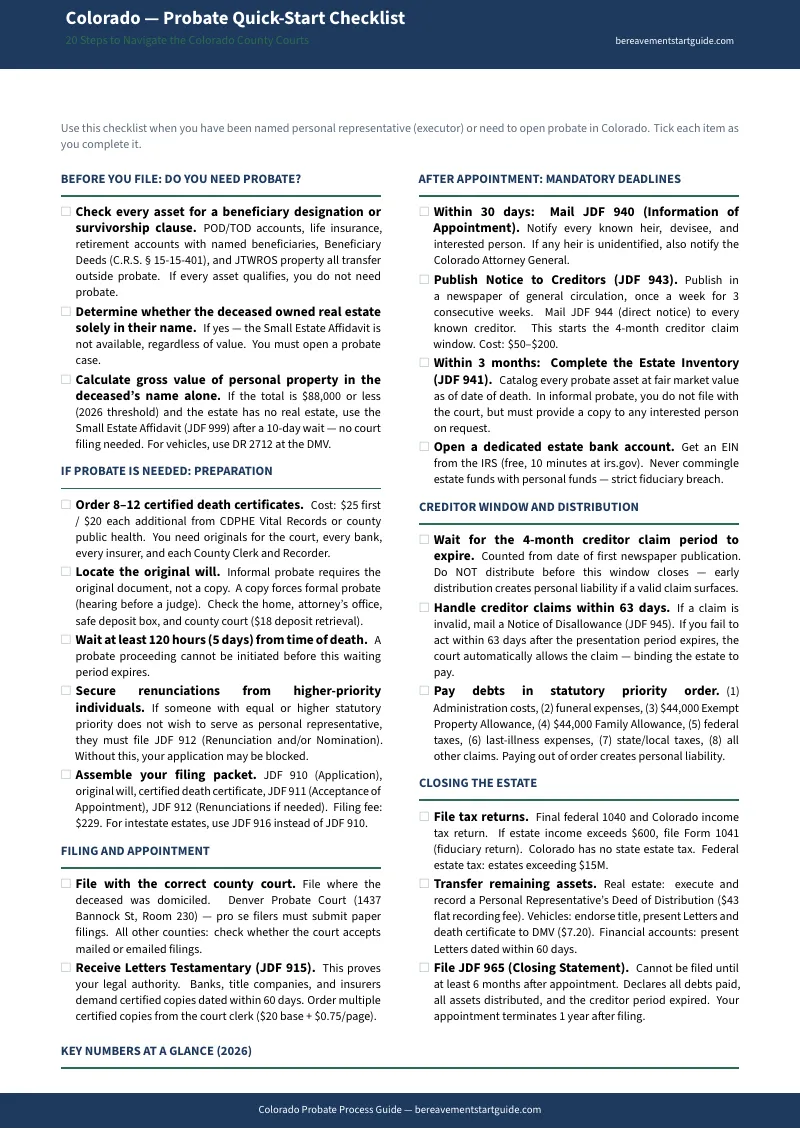
Not ready for the full guide? Download the free Colorado — Probate Quick-Start Checklist — an overview of the probate process, the key deadlines, the 2026 thresholds, and the 20 essential steps you need to complete. Enough to understand what you are facing and whether you need the full guide.
Probate is not something you were trained for. But Colorado's Uniform Probate Code was designed to let capable people handle routine estates without a lawyer. The guide gives you the instructions the court cannot — one JDF form at a time.
Frequently Asked Questions
What if the rules change after I buy?
We update the guide when the rules change. Email us any time, even years later, and we'll send you the current edition free.