
The Connecticut Estate Settlement Compass — Every Form, Every Deadline, One Clear Path
You just lost someone. The bank froze the accounts and told you to bring a "Fiduciary's Probate Certificate" before they will release a single dollar. You have no idea what that is or where to get it. Meanwhile, the Probate Court mailed a fee invoice calculated on the living trust, the joint bank accounts, and the life insurance — assets your family specifically structured to "avoid probate." Nobody told you Connecticut charges probate fees on non-probate assets.
Free resources fail you in three specific ways. The Connecticut Probate Courts website provides the blank CT-706 NT form — but explicitly refuses to help you fill it out, and families who get it wrong have it sent back "several times" with no explanation of what needs to change. Attorney blogs explain the probate fee structure — but their goal is to sell you an $8,000 retainer, not to tell you the exact filing sequence that prevents compounding interest penalties. Reddit threads offer empathy — but the advice is frequently based on other states' laws, not Connecticut's unique 54-district probate system.
The Connecticut Estate Settlement Compass translates the entire post-death bureaucracy into a single chronological action plan. It covers every pathway — the $40,000 small estate affidavit, full probate administration, non-probate transfers — and tells you exactly which forms go to which office, in what order, with which documents attached.
What You Get
The Complete Settlement Guide
A 17-chapter guide organized by timeline — from the first 48 hours through final distribution and estate closing. Written in plain English, not legal jargon.
- The CT-706 NT Decoder — The form that confuses families the most, broken down field by field. Even if the estate owes zero tax, Connecticut requires this filing within six months of death. Miss it and you trigger a 0.5% per month interest penalty on probate fees — and block every real estate transfer until it's filed.
- The Non-Probate Fee Trap — Connecticut is one of the few states that levies probate fees on living trusts, joint accounts, and life insurance payouts. The guide explains the complete tiered fee schedule, the 50% spousal reduction, and exactly how to calculate what you owe.
- The Real Estate Lien Sequence — Connecticut places an automatic lien on every deceased resident's real property. Families trying to sell inherited homes are blindsided during the title search. The guide provides the exact 5-step sequence: PC-251, CT-706 NT, PC-256 lien release, PC-250, and town clerk recording.
- Small Estate Decision Tree — A step-by-step assessment that maps your situation to the correct pathway. The $40,000 threshold requires zero solely owned real estate — and families frequently miscalculate by including non-probate assets.
- The DAS Recovery Shield — If the deceased ever received Medicaid, TFA, or SAGA, the Department of Administrative Services holds a priority lien under CGS Section 17b-95. DAS can seize 50% of joint bank account balances. The guide explains how to check for DAS claims before distributing any assets.
- Vehicle Transfer Mastery — DMV Form H-13B with the Code 4 family sales tax exemption that saves you 6.35% on transfers to a spouse, child, parent, sibling, or grandchild
- The 150-Day Creditor Window — How to publish the legal notice (Form PC-234), manage claims within the 90-day response period, and file the Return of Claims (Form PC-237)
- Spousal Rights Protection — The elective share (life estate of one-third), the buyout option, the 150-day exercise deadline, and the Family Support Allowance (Form PC-202)
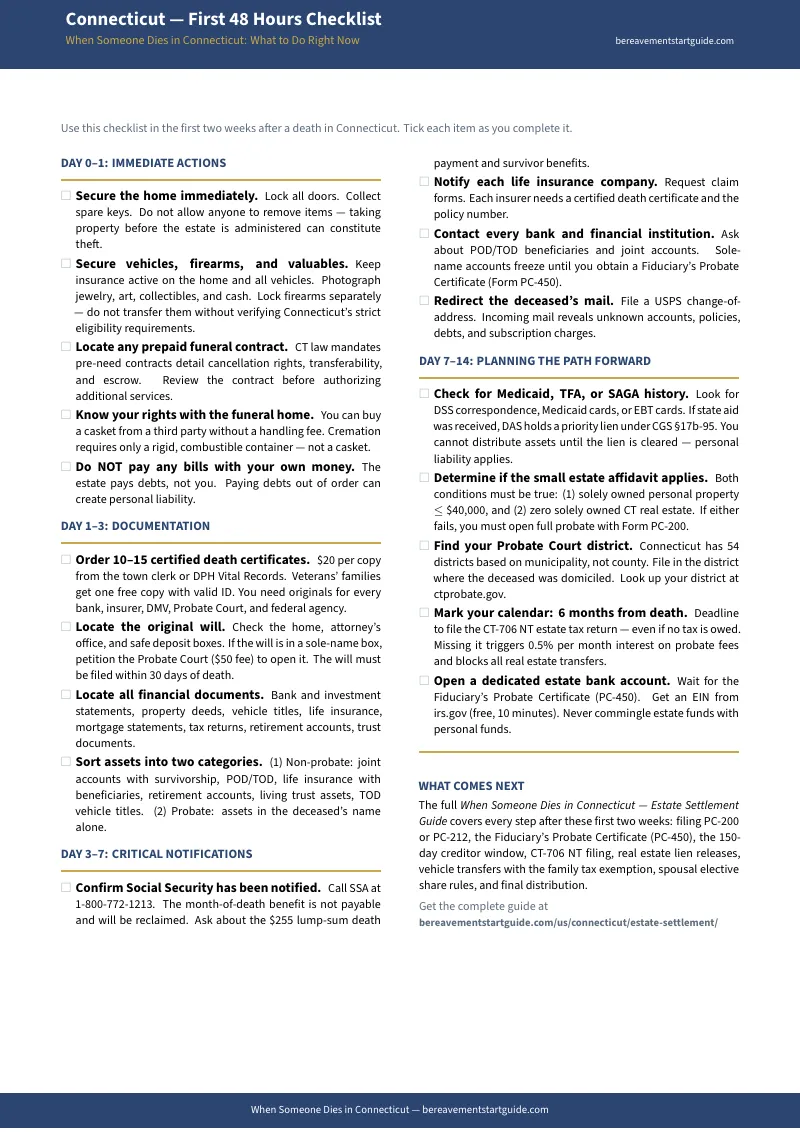
The First 48 Hours Checklist
A printable checklist covering every immediate action: securing property, ordering death certificates ($20 per copy with a free copy for veteran families), notifying agencies, and the critical deadlines you cannot miss in the first two weeks.
Printable Standalone Tools
Separate PDF worksheets and reference cards you can print and bring to meetings with banks, the DMV, attorneys, and Probate Court:
- Asset Inventory Worksheet — Fill-in tables for every asset category: bank accounts, investments, vehicles, real estate, and digital assets. Use this to prepare the Inventory (Form PC-2407) and calculate the probate fee basis.
- Forms Reference Card — One-page quick reference mapping every Connecticut form to where it goes and when you need it: PC-212 for small estates, PC-200 for full probate, CT-706 NT for taxes, PC-205B for lien releases, H-13B for vehicles.
- Probate Fee Calculator Worksheet — Walk through the tiered percentage schedule with your actual asset values to estimate the fee before the court sends its invoice.
- Statutory Deadline Calendar — Every critical deadline on one timeline: 30-day will filing, 2-month inventory, 6-month CT-706 NT, 150-day creditor window, 210-day Return of Claims.
Who This Is For
- Families settling an estate in Connecticut who want to handle the process themselves — saving thousands on attorney fees for straightforward, uncontested estates
- Executors and administrators named in a will who need a clear sequence of actions instead of scattered government PDFs and court forms that come with no instructions
- Surviving spouses who need to understand their elective share rights, the Family Support Allowance, and why the probate fee was calculated on assets they thought avoided probate
- Families trying to sell an inherited home who need to clear the automatic state lien before the buyer walks away
- Anyone dealing with DAS Medicaid recovery who needs to understand what can and cannot be seized from the estate
Why Not Free Resources?
The Connecticut Probate Courts website provides the raw forms. CTLawHelp explains small estate procedures. Neither gives you the full picture:
- The Probate Court provides the CT-706 NT form but explicitly refuses to help you fill it out — families report having filings rejected "several times" with no useful guidance
- Attorney blogs are designed to funnel you into an $8,000+ retainer, not to tell you how to handle a standard estate yourself
- CTLawHelp focuses on low-income populations and small estates — it does not cover the full probate administration process for middle-class families with real property and investment accounts
- No single free source connects the CT-706 NT filing to the real estate lien release to the creditor claims window to the final distribution — every office operates in isolation
— Less Than the Interest Penalty for One Late Filing
Missing the six-month CT-706 NT deadline costs 0.5% per month in compounding interest on probate fees. On a $500,000 estate, that's roughly $10 per month — and it compounds. This guide costs less than a single month of that penalty, and it prevents it entirely.
For simple estates under the $40,000 threshold, this guide can replace an attorney entirely. For larger estates, organizing your paperwork with this guide before your first attorney meeting can save hundreds in billable hours.
60-day, no-questions-asked refund guarantee. If this guide does not save you at least 10 hours of frustrating research, email us for a full refund. You keep the guide.
Frequently Asked Questions
What if the rules change after I buy?
We update the guide when the rules change. Email us any time, even years later, and we'll send you the current edition free.