Connecticut Law Requires a Funeral Director for Every Death. That Director Just Handed You a $9,000 Quote. Here Is How to Know Which Lines You Can Cross Out.
Someone you love has died in Connecticut. The hospital told you a funeral home needed to pick up the body. You called the nearest one because you did not know you had a choice. Within hours, a funeral director sat you down and walked you through a price list that exceeded $9,000 --- casket, embalming, "basic services," preparation fees, transportation surcharges, documentation charges.
You were told embalming was required. It is not. Connecticut law does not mandate embalming except in narrow cases involving certain communicable diseases or interstate transport via common carrier. Refrigeration at 36--39°F is the legal alternative. That single line item --- $800 or more --- was optional. The funeral director knew this. They were counting on you not knowing it.
Connecticut is one of only eight or nine states in the country that legally requires a licensed funeral director for transportation of remains and securing of burial and cremation permits. Under CGS Section 7-69 and Section 20-222, you cannot move the body or file the paperwork yourself. That mandatory involvement means the Basic Services Fee is non-declinable. But everything else on that price list? The casket markup, the embalming, the "visitation facility" charge, the flower handling fee --- those are choices. And the funeral home has a financial incentive to make them look like requirements.
Meanwhile, the clock is running. The death certificate must be filed within 3 days (electronic) or 5 days (paper). The 48-hour cremation waiting period under CGS Section 19a-323 is ticking. The Office of the Chief Medical Examiner needs $150 to issue the VS-47a cremation certificate before the crematory will proceed. Your siblings are arguing about burial versus cremation and the funeral home says they will not act until everyone agrees --- or a Probate Court issues an order. Refrigeration fees are accruing daily while your family argues.
You need to know what the law actually says. Not what the funeral director tells you it says.
The Connecticut Funeral Consumer Defense System
The Connecticut Funeral Laws & Consumer Rights Guide is the Connecticut Funeral Consumer Defense System --- a plain-English manual that translates Connecticut General Statutes, Department of Public Health regulations, Office of the Chief Medical Examiner requirements, and federal FTC protections into step-by-step instructions so you can arrange a lawful disposition, protect your family's money, and stop funeral homes from selling you services you do not legally need.
Not a national overview that treats Connecticut like every other state. Not an attorney blog designed to convert you into a $300-per-hour retainer client. Not a funeral home's website dressed up as consumer education. A Connecticut-specific consumer protection manual built on CGS Title 7, Title 19a, Title 20, Title 42, and Title 45a, the FTC Funeral Rule, and DPH and OCME administrative rules --- the exact laws that govern every funeral home, crematory, and disposition facility operating in this state.
What's Inside The Connecticut Funeral Consumer Defense System
A 9-chapter guide and a 19-item Funeral Consumer Rights Checklist --- covering every phase of funeral planning and consumer protection in Connecticut, from the moment of death through final disposition, estate bridging, and complaint filing:
Who Has Legal Authority Over the Remains
Before you call a funeral home, you need to know who has the legal right to make decisions. If the deceased signed a written Appointment of Agent under CGS Section 45a-318, that person's authority overrides everyone --- including the surviving spouse. If no appointment exists, authority follows a strict statutory hierarchy: surviving spouse, then majority of adult children, then parents, then siblings. When family members at the same priority level cannot agree, the funeral director can refuse to proceed until the Probate Court issues an order. The guide walks through the hierarchy, the majority-consent rules, and the court petition process for deadlocked disputes.
The Mandatory Funeral Director Requirement and Death Registration
Connecticut requires a licensed funeral director for transportation and permit filing. That is non-negotiable. But it does not mean you must hand over all control. You can hold a wake in your home. You can wash and dress the body yourself. You can choose every detail of the ceremony. What you cannot do is transport the body or file the death certificate independently. The guide explains the exact boundary between what the law requires and what funeral homes add on --- and how to hire a director for minimal "transport and paperwork only" services to keep costs at baseline.
Every Disposition Option Legal in Connecticut
Traditional burial. Cremation (with the 48-hour waiting period, $150 OCME fee, and VS-47a certificate). Aquamation (alkaline hydrolysis), which Connecticut legalized and which offers an eco-friendly alternative to flame cremation. Scattering ashes on private land with the owner's permission, in state parks (100+ yards from trails, beaches, and waterways), or at sea (3+ nautical miles offshore, biodegradable container, EPA notification within 30 days). The guide maps the specific permits, filing requirements, costs, and restrictions for each option --- including why human composting (natural organic reduction) is not legal in Connecticut as of 2026 and which neighboring states permit it.
Your Consumer Rights Under the FTC Funeral Rule and Connecticut Law
Federal law gives you the right to an itemized General Price List before any discussion of arrangements, the right to select services individually instead of purchasing a bundled package, the right to supply your own casket with no handling fee, and the right to refuse embalming. Connecticut adds its own protections through the Department of Consumer Protection, including complaint channels for funeral home misconduct. The guide covers both layers together --- the federal rights and the state-specific enforcement mechanisms --- with the exact citations you need when a funeral director pushes back.
After the Funeral --- Probate, Estate Tax, Liens, and Financial Steps
Connecticut has rules that catch families off guard. Every estate --- regardless of size --- must file the CT-706NT nontaxable estate tax return within 6 months of death or face a 0.5% per month interest penalty on the probate fee. Connecticut automatically places an unrecorded lien on all real property owned by the deceased; you must file Form PC-205 to release it before you can sell or transfer any real estate. If the estate is small enough ($40,000 or less in personal property, no sole-owned real estate), you can skip full probate entirely using Form PC-212 (Affidavit in Lieu of Administration). The guide covers each of these steps and explains how funeral expenses take first-priority status under CGS Section 45a-365.
Paying for the Funeral --- Assistance Programs, Medicaid, Veterans, and Workers' Compensation
If cost is a concern, Connecticut has programs most families never learn about. The Department of Social Services provides up to $1,800 for indigent burial or cremation. Eligible veterans qualify for free burial at the Connecticut State Veterans Cemetery in Middletown. Workers' compensation death benefits include a burial allowance of $14,816.74 for deaths occurring on or after January 1, 2026. And for families navigating Medicaid spend-down, the guide explains the $10,000 cap on irrevocable funeral trusts and the unlimited allowance for burial space item contracts --- the two tools that legally shelter assets from the $1,600 Title 19 asset limit.
Planning Ahead --- Advance Directives, MOLST, and Pre-Need Contracts
If you are reading this before a crisis, the guide covers how to appoint a health care representative under CGS Section 19a-575a, how to execute a MOLST form (which does not require witnesses per Public Act 24-19), how to designate an agent for disposition of remains, and how to evaluate pre-need funeral contracts --- including the difference between revocable and irrevocable contracts and the critical distinction between "guaranteed" and "non-guaranteed" pricing.
Forms, Agencies, and Contact Directory
Every form number, filing deadline, fee amount, and agency contact referenced in the guide --- compiled into a single reference chapter so you do not have to hunt through multiple state websites.
Timeline --- What Happens When
A chronological walkthrough of every action, deadline, and filing from the moment of death through estate settlement, so you can see the full sequence at a glance and know what is coming next.
Who This Guide Is For
- Families arranging a funeral right now --- who need to know their legal rights before signing a contract, including the right to refuse embalming, demand itemized pricing, and use a third-party casket without handling fees
- The surviving spouse or adult child who holds disposition authority --- and needs to understand what legal authority they actually hold under CGS Section 45a-318, and what happens when family members at the same priority level disagree
- Families in conflict over burial versus cremation --- who need the exact legal process for resolving disposition disputes, including the Probate Court petition process and why the funeral home can refuse to act until a judge issues an order
- Anyone considering cremation, aquamation, or scattering ashes --- who needs the specific permits, fees, waiting periods, and filing requirements for each alternative disposition method in Connecticut
- Anyone who suspects a funeral home is overcharging or misrepresenting legal requirements --- and needs to know how to file a complaint with the Department of Consumer Protection
- Families navigating Medicaid spend-down --- who need to understand the $10,000 irrevocable funeral trust cap, the unlimited burial space item allowance, and the five-year look-back period that can disqualify a family member from Title 19 nursing home coverage
Why Free Resources Will Not Protect You
- The Department of Public Health website is built for funeral directors, not families. It tells you that funeral directors must be licensed. It does not tell you what to say when a funeral director claims embalming is legally required, or how to strip thousands from a quote using rights you already have. Critical consumer information is buried in Board of Examiners meeting minutes that no grieving family will ever find.
- CTLawHelp and the Connecticut Bar Association offer trustworthy basics, but not procedures. Their brochures explain the difference between revocable and irrevocable funeral contracts. They do not walk you through how to secure a cremation permit from a reluctant town registrar, how to file the VS-47a with the Medical Examiner's office, or how to use a third-party casket over a funeral director's objections.
- Funeral home websites will never teach you to spend less at their funeral home. They explain their services warmly and professionally. They do not explain that you can decline every optional service, supply your own casket, skip embalming, and reduce a $9,000 quote to $2,500 using rights you already have under federal and state law.
- Elder law attorney blogs are designed to sell $8,000 retainers, not to help you file a PC-212. They will explain just enough about Medicaid spend-down to terrify you, then offer a consultation. The guide gives you the same statutory information --- the $10,000 trust cap, the $40,000 small estate threshold, the mandatory CT-706NT filing --- without the sales pitch.
Free resources give you fragments of federal law, fragments of state law, and fragments of agency rules scattered across DPH, OCME, DRS, Probate Courts, and DSS. The Connecticut Funeral Consumer Defense System puts every right, every deadline, every cost, and every protection into one document, in the order you need them.
--- Less Than Ten Minutes of a Connecticut Attorney's Time
A single consultation with a Connecticut estate or elder law attorney costs $300 to $400 per hour. A funeral home "full service" package runs $7,000 to $12,000 for services you may not legally need. If this guide prevents one unnecessary embalming ($800+), one casket purchase for a cremation ($2,000+), or one bundled package when direct cremation was all you needed ($3,000-$7,000 difference), the return is immediate.
Your download includes the complete 9-chapter guide, the Connecticut Funeral Consumer Rights Checklist, and 7 standalone reference cards you can print individually and bring to the funeral home, the probate court, or keep on your fridge:
- guide.pdf --- 9 chapters covering legal authority over remains, the mandatory funeral director requirement, every disposition option, your FTC and state consumer rights, probate and estate tax steps, financial assistance programs, advance planning, a complete forms directory, and a full timeline from death through estate settlement
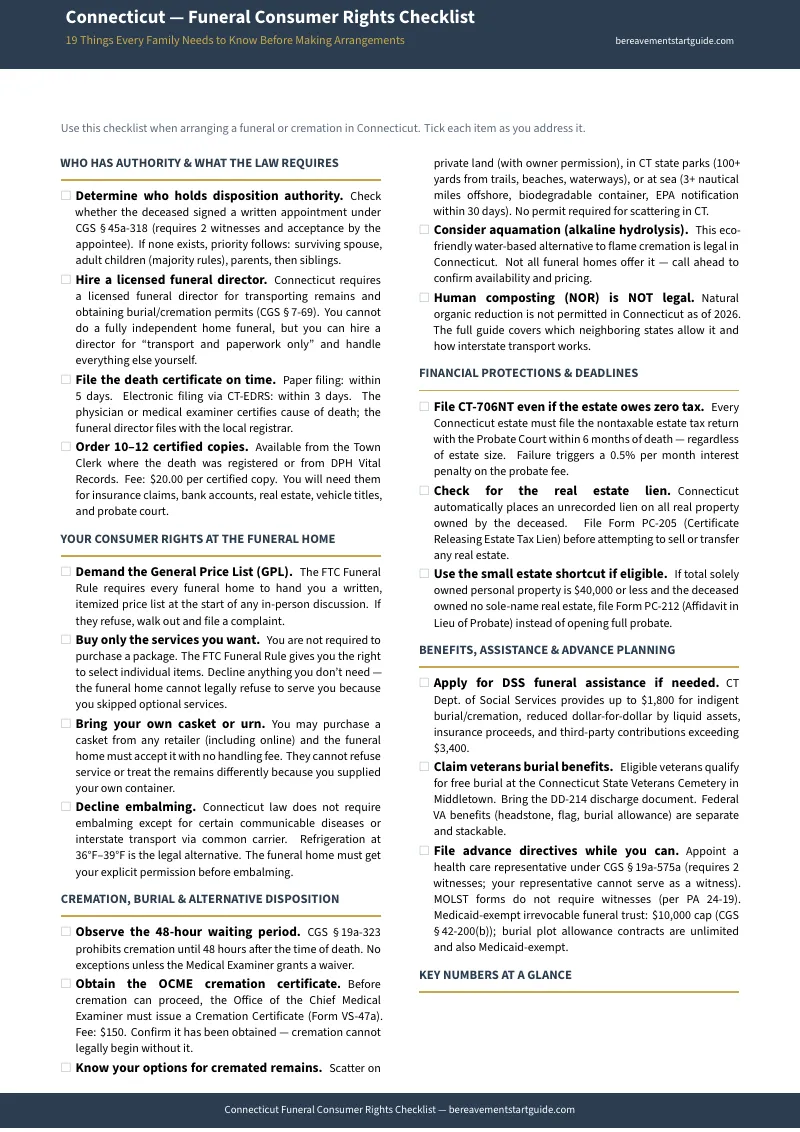
- checklist.pdf --- 19-item quick-reference covering authority and deadlines, consumer rights at the funeral home, cremation and burial requirements, financial protections and filing deadlines, benefits and assistance programs, and a key numbers reference table
- funeral-rights-card.pdf --- one-page card listing your FTC and Connecticut consumer rights, a price comparison table, and the exact language to use when a funeral home pushes back
- disposition-options-comparison.pdf --- side-by-side comparison of every legal disposition method in Connecticut (burial, cremation, aquamation, green burial, scattering ashes) with permits, costs, and waiting periods
- cremation-authorization-sequence.pdf --- the complete cremation paperwork flow from death through final authorization, step by step
- authority-hierarchy-chart.pdf --- the CGS §45a-318 priority chart showing who decides when family members disagree, with the Probate Court petition process
- forms-directory.pdf --- every form number, agency, contact, and cost referenced in the guide, compiled into a two-page quick-lookup reference
- estate-filing-reference.pdf --- the mandatory CT-706NT filing, automatic real estate lien release (PC-205), small estate shortcut (PC-212), probate fee schedule, and key deadlines on one page
- financial-assistance-programs.pdf --- every funeral assistance program available in Connecticut: Medicaid funeral trusts, DSS indigent assistance, veterans burial benefits, workers' compensation, and Social Security
Money-back guarantee, no time limit. If the guide does not give you clarity on your consumer rights, the legal deadlines, and the specific steps to protect your family's money when arranging a funeral or cremation in Connecticut --- email us for a full refund. No questions asked.
Not ready for the full guide? Download the free Connecticut Funeral Consumer Rights Checklist --- a 19-item quick-reference covering authority, deadlines, consumer rights, permits, financial protections, and benefits. Enough to know what questions to ask and which claims to challenge. When you need the full statutes, the complete disposition hierarchy, the FTC enforcement language, and the step-by-step instructions for every scenario from cremation authorization to Medicaid funeral trusts --- the complete guide is here.
The funeral home is not your adversary. But they are not your advocate either. Their job is to sell services. Your job is to know which ones you actually need. This guide makes sure you do.
Frequently Asked Questions
What if the rules change after I buy?
We update the guide when the rules change. Email us any time, even years later, and we'll send you the current edition free.