The Pension Office Said Your Spouse Elected Option B. The Town Assessor Said the Exemption Application Was Due Last Month. The State Filed a Lien on Your Home for Medicaid Recovery. You Are Grieving, and Connecticut's Benefit System Assumes You Already Know How All of This Works.
You called the State Employees Retirement System to ask about your survivor pension. They told you your spouse elected Option B at retirement and that the decision is irrevocable. They could not explain what Option B means for your monthly income, how it differs from Options A, C, or D, or whether your dependent children qualify for a separate statutory allowance. They said SERS does not provide advisory services and suggested you consult an attorney.
You drove to the town assessor's office to ask about the property tax exemption for surviving spouses. The clerk handed you a form, told you the filing window depends on the municipality, and said she cannot advise you on whether you qualify under CGS 12-81 or the income-adjusted doubling under CGS 12-81g. She suggested you consult an attorney. You went home and searched online. You found the Department of Revenue Services website, a 47-page PDF about HUSKY Medicaid estate recovery, three law firm blogs that explained how dangerous your situation is and ended with "call us for a consultation at $300 per hour," and a Reddit thread where someone said the state took their mother's house. You do not know what is true, what applies to your situation, or where to start.
Meanwhile, you may be missing benefits you do not know exist. A $4,000 workers' compensation burial benefit if the death was work-related. A property tax exemption that could save you thousands annually. A continuation of health insurance through Access Health CT that has a strict enrollment window. A veteran's total property tax exemption under Public Act 24-46 that your town may not have publicized. A SERS or TRB pension survivor benefit that requires specific documentation filed within specific deadlines. Every one of these programs is administered by a different agency, with different forms, different deadlines, and different eligibility rules. None of them tells you about the others.
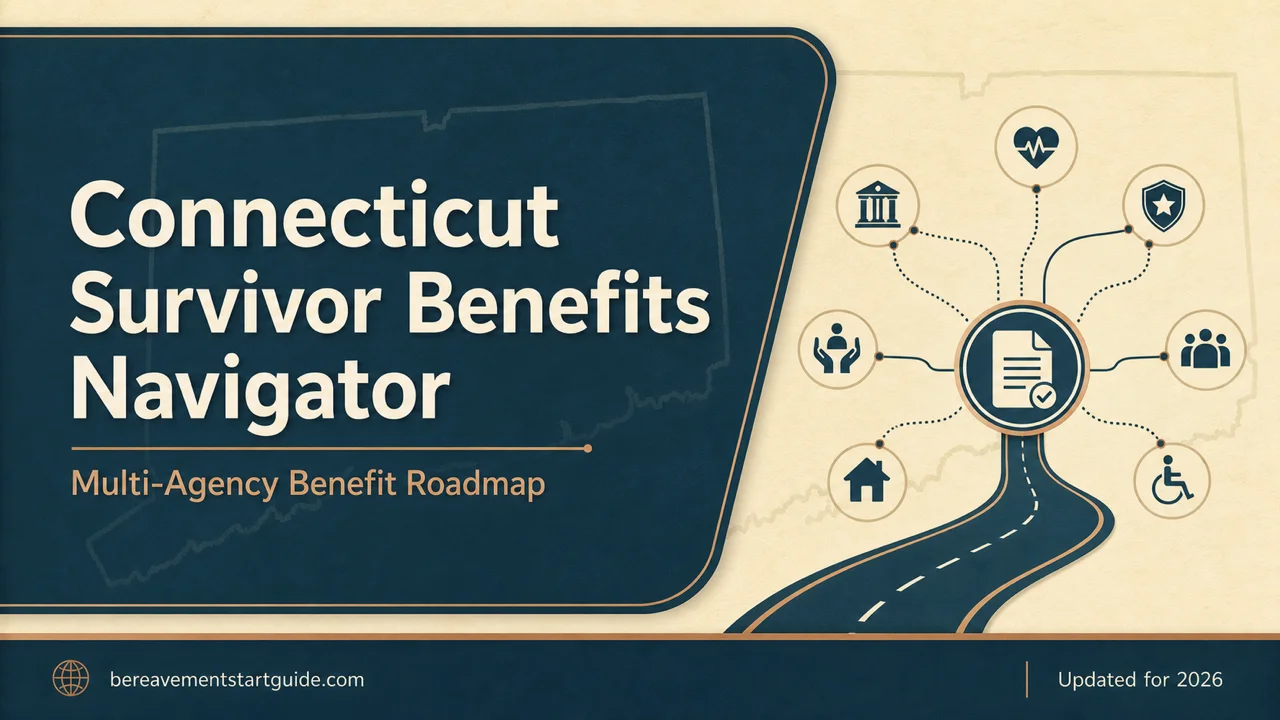
The Connecticut Survivor Benefits Navigator is a Multi-Agency Benefit Roadmap for every pension, exemption, insurance continuation, death benefit, and government program available to surviving spouses and dependents in Connecticut. Not a generic national checklist repurposed with Connecticut's name. Not a law firm blog designed to convince you that $300 per hour is your only option. A plain-English, Connecticut-specific manual that tells you what the pension offices, town assessors, and state agencies cannot: which benefits exist, who qualifies, which agency administers each one, what forms to file, in what order, and which deadlines will cost you money if you miss them.
What's Inside the Multi-Agency Benefit Roadmap
A step-by-step guide, a survivor benefits checklist, and standalone reference sheets — covering every benefit available to surviving spouses and dependents in Connecticut, built on the Connecticut General Statutes, the pension systems, the municipal tax code, and the state agency procedures that make this process different from any other state:
State Employee and Teacher Survivor Pensions: SERS and TRB Decoded
This is the chapter that cuts through the most opaque benefit system in Connecticut. If the deceased was a state employee under SERS or a public school teacher under TRB, their retirement option — selected at the time of retirement, irrevocable — determines exactly what you receive. Option A provides the maximum retirement benefit but zero survivor continuation. Option B provides a reduced benefit during the retiree's life and a 50% continuation to the surviving spouse. Options C and D provide different splits. The guide explains every option, identifies whether you qualify as a Statutory Survivor or a Designated Beneficiary (the difference between a monthly pension and a one-time lump sum), walks you through the documentation requirements, and addresses the complications introduced by divorce, QDROs, and dependent children's allowances.
Property Tax Exemptions: Town-by-Town Municipal Relief
Connecticut administers property tax exemptions at the municipal level, which means the rules, application windows, and income thresholds vary by town. The basic surviving spouse exemption under CGS 12-81 provides a flat assessment reduction. The income-adjusted exemption under CGS 12-81g can double that relief if your income falls below the municipal threshold. Veterans' surviving spouses may qualify for additional exemptions, and 100% disabled veterans' surviving spouses may qualify for total exemption under Public Act 24-46. The guide maps the exemption tiers, explains the application process for your town assessor's office, identifies the documentation you need, and flags the filing deadlines that vary by municipality — because missing the window means waiting an entire year.
HUSKY Medicaid Estate Recovery: What the State Can and Cannot Take
This is the chapter that replaces fear with facts. If the deceased received Medicaid (HUSKY) benefits for nursing home care or long-term services, Connecticut has the legal right to file a lien against real property to recover those costs. The widespread panic — "the state will take the house" — is understandable but legally incomplete. Connecticut cannot enforce recovery while the surviving spouse is alive and residing in the home. It cannot enforce recovery while a disabled child or a child under 21 is living in the home. Undue hardship waivers exist. The guide explains the exact scope of Connecticut's recovery authority, the specific exemptions that protect surviving spouses, how to respond to a lien notice, and when the asset protection strategies that elder law attorneys charge thousands to explain actually apply to your situation.
Workers' Compensation Death Benefits
If the death resulted from a workplace injury or occupational disease, Connecticut provides a $4,000 burial expense benefit and ongoing weekly compensation equal to 75% of the deceased employee's average weekly wage to the surviving spouse and dependent children. These claims are administered by the Workers' Compensation Commission and have strict filing deadlines. The guide covers eligibility, the claims process, the specific forms and documentation the WCC requires, the calculation of weekly benefits, and the dependency rules that determine whether adult children or other dependents qualify.
Health Insurance Continuation and Transition
The death of a spouse who carried the family health insurance triggers an immediate coverage crisis. Connecticut provides specific pathways depending on the source of the deceased's coverage. Employer-sponsored plans offer COBRA continuation for up to 36 months. State employee plans under the CT Partnership Plan have their own survivor continuation rules. Access Health CT — Connecticut's health insurance marketplace — offers a Special Enrollment Period triggered by the death of a spouse. Medicare-eligible survivors face different coordination rules. The guide maps every pathway based on the source of the deceased's coverage and provides the enrollment windows, the forms, and the agency contacts for each one.
Federal Benefits with Connecticut-Specific Coordination
Social Security survivor benefits, VA Dependency and Indemnity Compensation, and federal employee survivor pensions all interact with Connecticut's state-level benefits in ways that generic federal guides do not address. The guide covers the federal benefits themselves and then explains how they coordinate with Connecticut-specific programs — which state benefits are offset by federal payments, which are independent, and how to sequence your claims to avoid triggering reductions or overpayment recovery.
Who This Guide Is For
- The surviving spouse who just lost a state employee or teacher — who needs to understand what Option A, B, C, or D means for their income starting next month, whether they qualify as a Statutory Survivor or a Designated Beneficiary, and what documentation TRB or SERS requires before they will release a single payment
- The surviving spouse terrified about Medicaid estate recovery — who read online that the state takes your house and needs to know the specific statutory protections that prevent enforcement while a surviving spouse occupies the home, and when a hardship waiver applies
- The veteran's surviving spouse who does not know what exemptions exist — who may be paying full property taxes on a home that qualifies for a partial or total municipal exemption under CGS 12-81, CGS 12-81g, or Public Act 24-46, depending on the veteran's disability rating and the town's ordinances
- The family of a worker killed on the job — who needs to file for the $4,000 burial benefit and ongoing weekly compensation through the Workers' Compensation Commission within the filing deadlines, and does not know where to start or what forms to use
- The adult child helping a surviving parent navigate benefits from another state — who is trying to coordinate federal, state, and municipal benefits for a parent in Connecticut remotely, and needs every agency, form, deadline, and eligibility rule in one document instead of calling five different offices
- The surviving spouse whose health insurance just ended — who has a narrow Special Enrollment Period to secure coverage through Access Health CT, COBRA, or Medicare coordination, and cannot afford a gap in coverage while managing everything else
Why Free Resources Will Not Get You Through This
Connecticut survivor benefit information exists. The pension systems publish their handbooks, the DRS publishes tax forms, and dozens of agencies maintain websites. Here is what you actually encounter when you try to navigate benefits using free sources:
- SERS and TRB publish pension handbooks — written for actuaries, not widows. The handbooks explain the retirement options in statutory language, reference tier structures that vary by hire date, and assume the reader understands terms like "Statutory Survivor," "Designated Beneficiary," and "QDRO." They do not explain what happens to your income next month in plain language. They do not tell you which forms to submit. They tell you to consult with a benefits counselor, and the benefits counselor tells you they cannot advise you on your specific situation.
- Town assessors provide the exemption forms — and no guidance on which exemption applies to you. The application form for CGS 12-81 is free. Understanding whether you qualify for the base exemption, the income-adjusted doubling, the veteran's additional exemption, or the total exemption under Public Act 24-46 requires reading the statute, calculating your income against municipal thresholds, and filing before a deadline that varies by town. The assessor's office cannot advise you on eligibility.
- The Department of Social Services publishes Medicaid estate recovery procedures — in 47 pages of regulatory language. The document explains the state's authority to recover costs from estates. It does not clearly explain the specific exemptions for surviving spouses living in the home, the conditions under which a hardship waiver applies, or what to do when you receive a lien notice. The practical translation of that 47-page document into "what does this mean for my house" is exactly what $300-per-hour elder law attorneys charge for.
- Law firm blogs explain how dangerous your situation is — and end with a phone number. Every estate planning and elder law firm in Hartford, New Haven, and Stamford publishes blog posts about survivor benefits. They are accurate, alarming, and deliberately incomplete. The post explains the risk. It never explains the solution in enough detail to act on. It always ends with "schedule a consultation." Those consultations run $300 to $500 per hour.
- No free resource synthesizes all of these programs into one chronological action plan. The pension office handles pensions. The town assessor handles property tax exemptions. The WCC handles workers' compensation. Access Health CT handles health insurance. The DSS handles Medicaid recovery. The SSA handles Social Security. The VA handles veteran benefits. Each agency knows its own program and nothing about the others. No free resource tells you which benefits you are owed, which agency administers each one, what forms to file, in what order, and which deadlines will cost you if you miss them.
Free resources give you agency handbooks written in statutory language, assessor's offices that cannot advise you, and law firm blogs that end with a billable-hour phone number. The Multi-Agency Benefit Roadmap puts every Connecticut survivor benefit, form, deadline, and eligibility rule into one document, in the order you actually need them.
— Less Than Fifteen Minutes With a Connecticut Elder Law Attorney
A consultation with a Connecticut elder law or estate planning attorney runs $300 to $500 per hour. A single session to review your benefit eligibility and explain the pension options, property tax exemptions, Medicaid recovery rules, and health insurance pathways will consume that first hour and often a second. This guide costs less than fifteen minutes of professional legal time and gives you the complete Connecticut-specific benefit roadmap — every program, every agency, every form, every deadline, and the coordination rules that determine how state and federal benefits interact.
Your download includes the complete step-by-step guide covering every survivor benefit category, the standalone Connecticut Survivor Benefits Checklist, and printable reference sheets: the Benefit Eligibility Decision Tree, the Pension Options Comparison Chart (SERS and TRB), the Property Tax Exemption Application Guide, the Health Insurance Transition Pathway, the Workers' Compensation Claim Checklist, the Medicaid Estate Recovery Quick Reference, and an Agency Contact Directory with every relevant state, municipal, and federal office. Instant download, no account required.
Money-back guarantee, no time limit. If this guide does not save you hours of hold time with state agencies and make the benefit claims process immediately clearer, email us for a full refund. No questions asked.
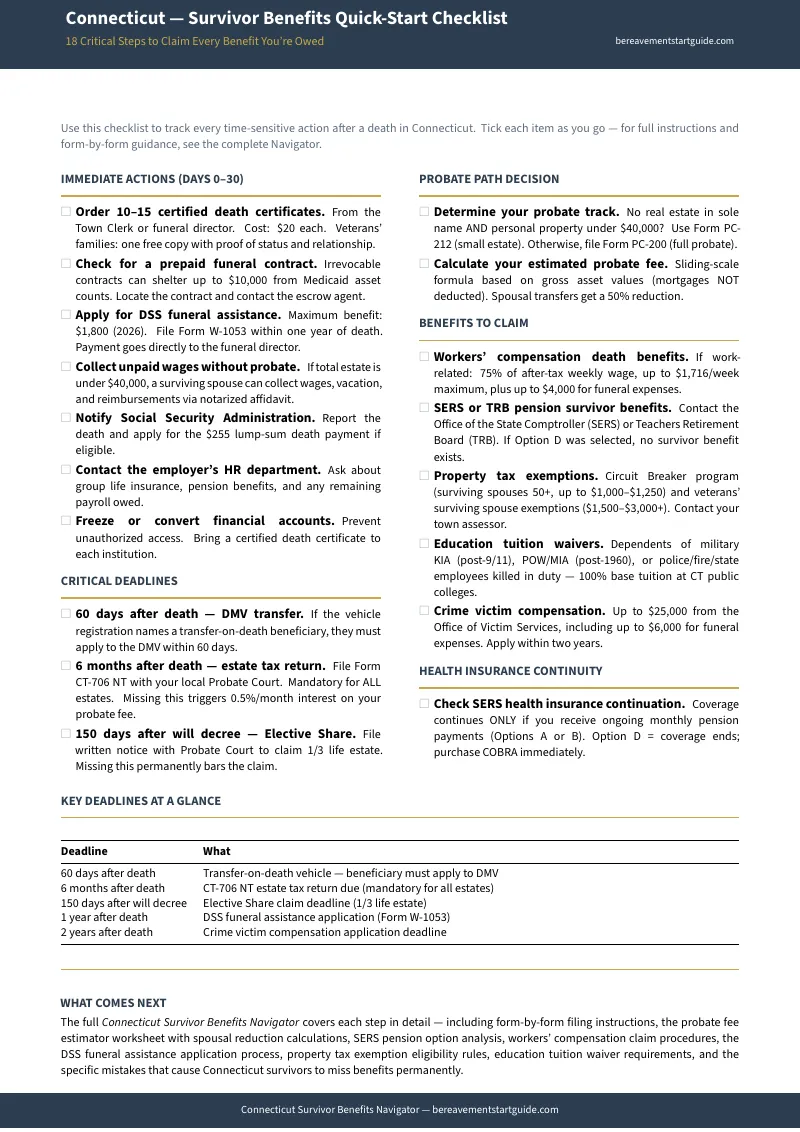
Not ready for the full guide? Download the free Connecticut — Survivor Benefits Checklist — an overview of the benefits available, the key agencies, the 2026 thresholds, and the critical deadlines. Enough to understand what you may be owed and whether you need the full guide.
Nobody trained you for this. The pension office assumes you understand actuarial tables. The town assessor assumes you have read the statute. The state agencies assume you know they exist. You have something none of them provide — a single roadmap that connects every Connecticut survivor benefit into one sequence, with plain-English instructions for each one.
Frequently Asked Questions
What if the rules change after I buy?
We update the guide when the rules change. Email us any time, even years later, and we'll send you the current edition free.