The Funeral Director Just Handed You a Price List. Do You Know Which Charges Are Required by Delaware Law — and Which Ones Aren't?
Someone you love has died in Delaware. Within hours, you're sitting across from a funeral director, signing contracts, approving charges, and making decisions about embalming, cremation permits, and casket selections — all while grieving.
The funeral director knows Delaware Title 16, Title 12, and Title 24 inside and out. You don't. That information gap is where families lose thousands of dollars on services they never needed and didn't have to buy.
The Delaware Funeral Rights Roadmap
This guide puts you on equal footing with funeral industry professionals. It translates Delaware's scattered statutes — across three separate Titles, the Board of Funeral Services regulations, and three county court systems — into a single, chronological walkthrough that tells you exactly what's required, what's optional, and what you can refuse.
No more guessing whether embalming is mandatory (it isn't, except under specific conditions). No more wondering if the $250 cremation permit fee is a state charge or a funeral home markup (it's real — but now you'll know exactly what the state charges vs. what the funeral home adds on top). No more family arguments about who has the legal right to make burial decisions (Delaware Title 12, § 264 settles it with a strict priority list).
What's Inside
Chapter 1: Understanding Your Rights
The FTC Funeral Rule gives you specific, enforceable rights that many funeral homes underplay. You can demand an itemized General Price List. You can bring your own casket. You can refuse embalming. This chapter explains each right and gives you the exact language to use at the arrangement conference.
Chapter 2: Delaware's Disposition Authority Hierarchy
When siblings disagree or a spouse and adult children are in conflict, Delaware law provides a strict legal hierarchy under Title 12, Chapter 2, Subchapter III. A written declaration instrument overrides everyone — including the surviving spouse. This chapter maps the full priority chain so you can settle disputes with statute citations, not arguments.
Chapter 3: The 24-Hour Rule and Preservation Requirements
If final disposition doesn't happen within 24 hours, Delaware law requires embalming, hermetic sealing, or approved refrigeration. This chapter explains each option, what they cost, and how the 5-day extension works — so funeral homes can't pressure you into expensive preservation you don't need.
Chapter 4: Cremation in Delaware — Permits, Costs, and Authorization
Cremation requires a permit from the Division of Forensic Science (up to $250), a signed authorization from the legal next of kin, and a completed death certificate. If the cause of death is listed as "pending," cremation can be delayed for weeks. This chapter walks you through the full sequence and explains how to handle delays.
Chapter 5: Home Funerals and Private Burial
Delaware doesn't ban home funerals or private property burials — but county zoning codes in New Castle, Kent, and Sussex heavily regulate them. Graves must be at least 18 inches deep from the top of the coffin. You still need a burial permit. This chapter covers the state-level rules and tells you exactly which county office to contact for zoning clearance.
Chapter 6: Natural Organic Reduction (Human Composting)
Delaware legalized human composting through HB 162, with Board of Funeral Services regulations taking effect in 2025-2026. This chapter covers the current requirements, facility licensing, and container specifications for transport to composting facilities.
Chapter 7: Scattering Ashes in Delaware
Delaware law is permissive about scattering cremated remains — but ocean scattering requires Clean Water Act compliance (3 nautical miles offshore, EPA notification within 30 days), and state parks require advance permission. This chapter gives you the rules for beaches, parks, private property, and waterways.
Chapter 8: The Real Cost of a Delaware Funeral
Average traditional funeral costs in Delaware run about $9,200. Direct cremation ranges from $1,325 to $2,224 — but some Wilmington-area providers charge over $4,300 for the same service. This chapter breaks down state-mandated fees ($25 death certificates, $3 burial permits, up to $250 cremation permits) county by county, so you can spot markup before you sign anything.
Chapter 9: Prepaid Funeral Plans and the Medicaid Trap
Delaware's irrevocable preneed funeral trusts are capped at $15,000 under Title 5 banking regulations. If you're considering a Medicaid spend-down, that cap matters. This chapter explains how prepaid plans are protected if a funeral home closes, and what happens if the trust funds exceed the actual cost of services.
Chapter 10: Probate Shortcuts for Funeral Expenses
Estates under $30,000 in personal property (excluding real estate) can skip formal probate using Delaware's Small Estate Affidavit — but you must wait 30 days. This chapter includes the county-specific filing fees for New Castle, Kent, and Sussex, so you know whether probate is worth the cost or the affidavit is enough.
Chapter 11: Veterans Benefits and Financial Assistance
VA burial benefits, Delaware Division of Veterans Affairs programs, and FEMA disaster assistance all have different eligibility requirements and application timelines. This chapter covers each program with contact information and deadlines.
Chapter 12: Filing Complaints and Enforcing Your Rights
Overcharged by a funeral home? Cemetery in disrepair? Delaware routes complaints to different agencies depending on the issue — Board of Funeral Services for licensed professionals, Cemetery Board and the Distressed Cemetery Fund for gravesite maintenance, and the Attorney General for deceptive practices. This chapter gives you the exact filing path for each type of complaint.
Appendix: Decision Flowcharts and Forms Registry
Visual decision trees for choosing between burial, cremation, and natural organic reduction — plus a registry of every Delaware form referenced in the guide, with filing deadlines and associated fees.
Who This Guide Is For
- Families arranging a funeral in Delaware right now — you need answers today, not after hours of legal research
- Executors and personal representatives — you need to know which costs are legitimate and which are negotiable
- People pre-planning their own arrangements — you want to document your wishes in a way that's legally binding under Delaware Title 12
- Out-of-state families — your loved one died in Delaware and you're navigating an unfamiliar legal system
- Families considering alternatives — home funerals, green burial, human composting, or direct cremation outside the traditional funeral home system
- Anyone in a family dispute — you need the statute citations to prove who has legal authority over funeral decisions
Why Not Just Use Free Online Resources?
You can find Delaware funeral regulations online — scattered across the Office of Vital Statistics, the Board of Funeral Services, three county Register of Wills offices, the Division of Forensic Science, and the Delaware General Assembly website. The statutes span Title 12, Title 16, Title 24, and Title 5. Chancery Court opinions like Boyer v. Irvin interpret the rules but are written in dense judicial prose.
Funeral home websites rank well in search results, but their advice is inherently conflicted — they're unlikely to emphasize your right to refuse embalming or bring your own casket.
This guide pulls everything into one document, organized in the order you need it. It saves you hours of cross-referencing and ensures you don't miss a filing deadline, overpay for a state fee, or sign away rights you didn't know you had.
100% Peace of Mind Guarantee
If this guide doesn't save you time, stress, or money during the Delaware funeral process, email us at any time for a full refund. No questions asked.
Get Started Now
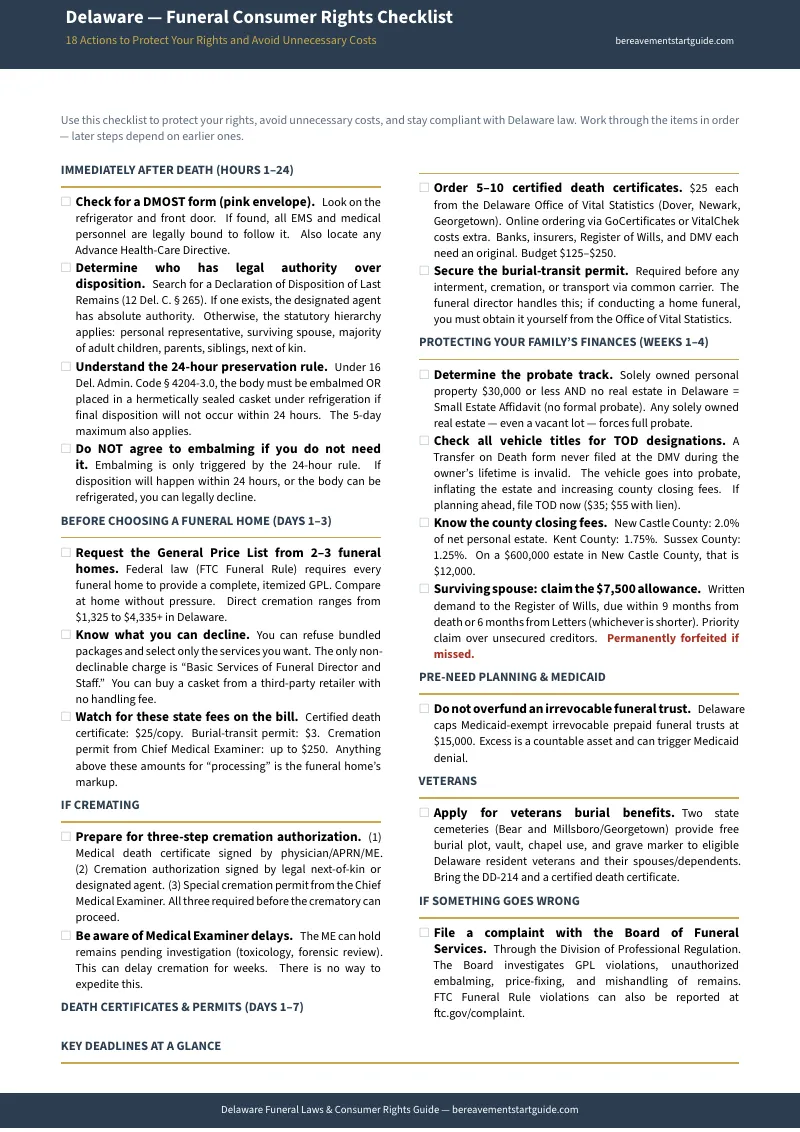
Download the free Delaware Funeral Consumer Rights Checklist to see the format and approach. When you're ready for the full 12-chapter guide with 6 standalone printable tools — FTC compliance checklist, disposition authority reference, 3-county fee comparison, cremation authorization checklist, probate decision flowchart, and forms registry — the complete toolkit is just .
Frequently Asked Questions
What if the rules change after I buy?
We update the guide when the rules change. Email us any time, even years later, and we'll send you the current edition free.