The Register of Wills Handed You a Stack of Forms. Nobody Told You What to Do With Them.
You showed up at the courthouse with the original will and a death certificate. The deputy handed you a packet of forms — Opening Petition, Form 600 RW, creditor notice templates — and said you need to file everything on time or face penalties. When you asked which form comes first, they told you they are not permitted to give legal advice.
That is the Delaware probate system. The Register of Wills processes your filings. The Court of Chancery enforces the rules. And you — the executor who never asked for this job — are expected to figure out the sequence on your own. Miss the three-month inventory deadline and you owe compounding $25 fines. Let the one-year accounting window lapse and the court can remove you entirely. Distribute a single dollar before the eight-month creditor bar date and you are personally liable for every unpaid debt.
The attorneys can guide you through it. For several thousand dollars. The free government PDFs can inform you of the rules. In eight pages of Title 12 citations with no indication of where to start.
The Delaware Probate Roadmap
This guide takes the Chancery Court's complex filing requirements and arranges them in the order you will actually encounter them — from the day of death through estate closing. It is not a collection of forms. It is the instruction manual that connects the forms to the deadlines to the county-specific procedures, so you always know what comes next.
It covers all three counties. The different closing fees (2.0% in New Castle, 1.75% in Kent, 1.25% in Sussex). The formatting rules that get inventories rejected. The filing sequences that differ between Wilmington, Dover, and Georgetown. The traps that generic national checklists never mention — like the fact that a Sussex County inventory functions as the legal deed to pass real property, and an error in the property description breaks the chain of title permanently.
What's Inside
The Probate Decision Framework
Delaware's $50,000 small estate threshold sounds generous until you learn the single disqualifier: any solely titled real estate, regardless of value, forces full probate. The guide walks you through the decision — small estate affidavit, formal probate, or no probate at all — so you do not file the wrong paperwork and start over.
Opening the Estate — Step by Step
What to bring to your first Register of Wills appointment. How to file the Opening Petition. How to secure Letters Testamentary (with a will) or Letters of Administration (without one). How many Short Certificates to order and why you will need more than you think — because every bank, insurance company, and brokerage demands an original, and in Sussex County they expire after 60 days.
The Three Deadlines That Determine Everything
Three months for the inventory. Eight months for the creditor bar date. One year for the final accounting. Miss any of them and the consequences range from fines to personal liability to removal as executor. The guide maps every deadline on a timeline with the exact actions due at each stage.
Tri-County Filing Procedures
New Castle, Kent, and Sussex each run their own Register of Wills with different fees, different forms, and different rules. The guide explains the specific procedures for each county — including which counties allow mail-in filings, which require in-person appointments, and why the accounting form numbers differ.
Creditor Management and the Eight-Month Window
Delaware gives creditors eight months from the date of death to file claims. You must publish notice in an approved newspaper, send direct written notice to known creditors, and then wait. The guide covers the publication requirements, the debt priority hierarchy that determines who gets paid first, and how to formally reject claims that are invalid — without accidentally agreeing to assume personal liability.
Closing Fee Calculations
The Register charges a percentage of the net personal estate as a closing fee. The rate varies by county and the calculation requires subtracting every allowable expense — funeral costs, attorney fees, executor compensation, valid debts — from the gross personal estate. The guide includes a cost estimator worksheet so your accounting is accepted on the first submission instead of bounced back for corrections.
Real Estate Transfers in Probate
Selling or transferring the decedent's home during probate triggers a separate set of requirements. The guide covers how inventory filings act as deeds in Sussex County, the Chancery Court petition and surety bond requirements for selling property under Title 12 Section 2711, joint property affidavits, and the steps that prevent title defects that can delay a sale for months.
Surviving Spouse Protections
The $7,500 priority allowance on written demand. The elective share (one-third of the augmented estate). The strict deadlines for both — miss them and these rights are permanently forfeited. The guide explains what the executor must honor and what the surviving spouse must file to preserve their claims.
Every Form, Referenced by Name and Number
Opening Petition, Form 600 RW, SC30, NC 5, Form 650, Form 651, Small Estate Affidavit, Form MV11, Form FID-TAX, Beneficiary Release — all in one reference appendix with what each form does, where to file it, and when.
8 Standalone Printable Tools
Beyond the guide and checklist, the toolkit includes 8 standalone PDFs you can print and use independently — at the courthouse, on a call with the bank, or pinned above your desk:
- Deadline Timeline — Month-by-month map of every statutory deadline from date of death through estate closing
- Probate Decision Tree — Visual framework for determining your probate track in under 15 minutes
- Forms Quick Reference — One-page card listing every Delaware probate form by name, number, and filing location
- Asset Inventory Worksheet — Fillable worksheet for cataloging assets across 7 categories with valuation columns and summary totals
- Closing Fee Calculator — Net personal estate worksheet with county-specific rates so your accounting passes on the first submission
- Creditor Notification Checklist — Step-by-step process for publishing notice, contacting known creditors, and tracking claims
- Executor Fee Log — Time and expense template for documenting compensation under Delaware's reasonable fee standard
- Spousal Allowance Demand Letter — Ready-to-complete template for the $7,500 priority allowance with all required fields
Who This Is For
- Named executors — preparing for their first Register of Wills appointment or already mid-process and falling behind
- Administrators of intestate estates — navigating probate without a will, including the petition for authority and Delaware's succession rules
- Surviving spouses — understanding frozen accounts, elective share rights, and the deadlines that protect your claims
- Adult children settling a parent's estate — especially those managing the process from out of state across all three counties
- Anyone facing Delaware probate — who needs a clear roadmap before deciding whether to hire an attorney or handle it themselves
Why Not Just Use the Free County Forms?
The forms are free. You can download every one of them from the Register of Wills website today. What you cannot download is someone telling you which forms apply to your estate, what order to file them in, which county-specific rules will get your filing rejected, or what the three-month and eight-month deadlines actually mean for your personal liability.
The county clerks hand you the forms. They are legally barred from explaining them. The national checklists from sites like Atticus give you a generic to-do list that does not know Sussex County from New Castle. And the attorneys will walk you through every step — at rates that can consume a significant portion of a modest estate.
This guide bridges the gap. It is the interpretive layer between the raw forms and a competent filing — without the attorney bill.
Risk-Free Guarantee
If this guide does not save you hours of confusion and prevent at least one costly filing mistake, email us for a full refund. No forms to fill out, no waiting period.
Start With the Free Checklist
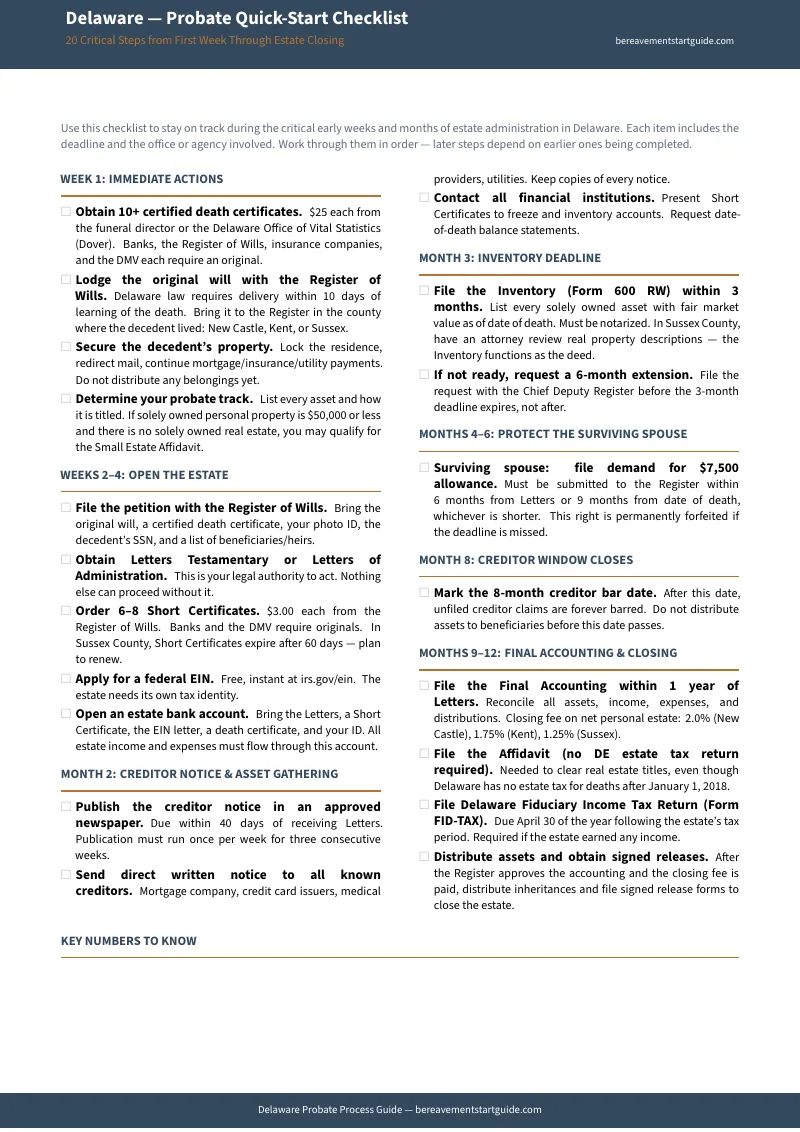
Not ready for the full guide? Download the Delaware — Probate Quick-Start Checklist for free. It covers the 20 most critical actions — from ordering death certificates and lodging the will to filing the inventory and closing the estate. When you need the full county-by-county process, the complete guide will be here.
Frequently Asked Questions
What if the rules change after I buy?
We update the guide when the rules change. Email us any time, even years later, and we'll send you the current edition free.