Delaware Has 14 Agencies That Owe You Money. None of Them Will Tell You About the Others.
Your spouse or parent just died. Within 72 hours, their pension checks stop, the bank freezes joint accounts, and their health insurance starts a countdown clock you didn't know existed. Somewhere in the Delaware bureaucracy, there is a $7,500 cash allowance with your name on it — money that's legally yours before most creditors get a dime. But the Register of Wills won't mention it. The Office of Pensions won't tell you about the property tax exemption. And the county tax assessor has no idea whether you qualify for workers' comp burial assistance.
Delaware's survivor benefit system isn't broken. It's just scattered across so many offices that no single person — not the clerk, not the funeral director, not even most attorneys — sees the whole picture.
The Benefits Sequencing System
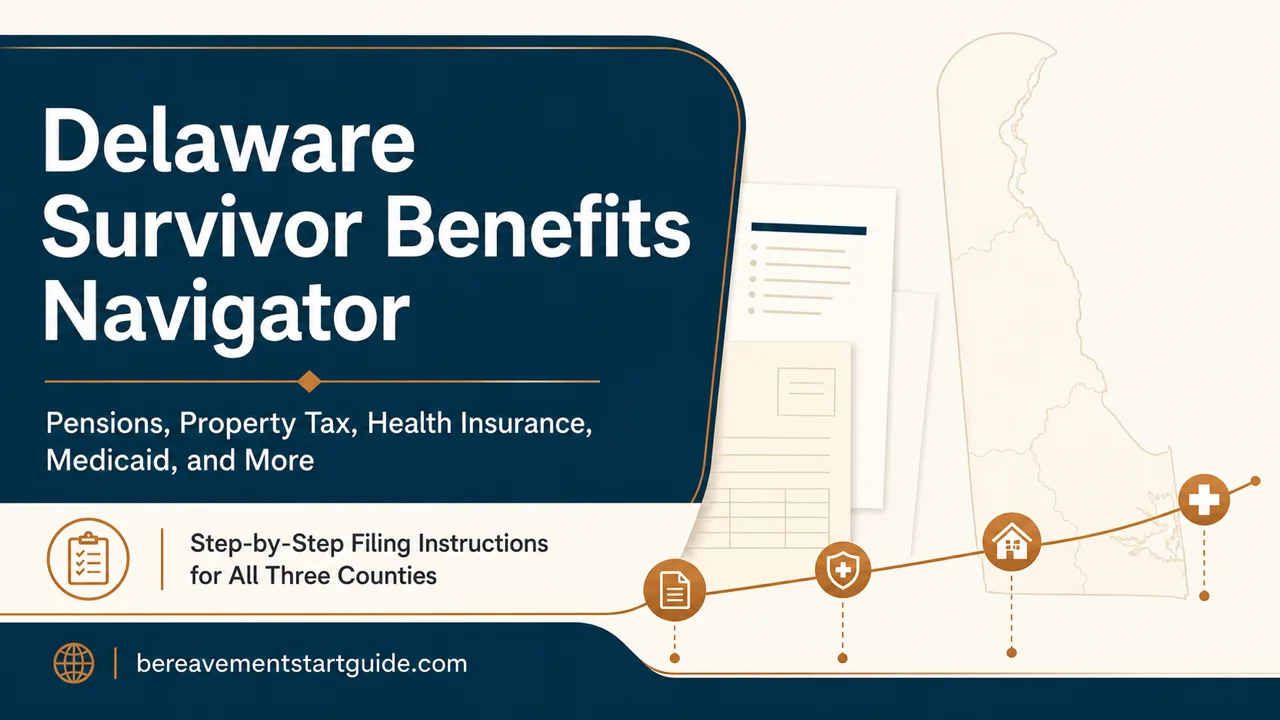
The Delaware Survivor Benefits Navigator is a complete administrative roadmap that connects every benefit you're owed, in the order you need to claim them. It's not a general overview or a list of phone numbers. It's 17 chapters of Delaware-specific instructions covering Title 12 spousal protections, Title 19 workers' compensation, state pension survivor elections, Mini-COBRA health continuation, Medicaid estate recovery defenses, and county-by-county property tax exemptions — sequenced so each filing unlocks the next.
The difference between this guide and calling each agency individually is about 40 hours of hold music, three courthouse trips, and the risk of making an irrevocable pension election before understanding how it interacts with your health insurance.
What's Inside
The $7,500 Spousal Allowance
Delaware Title 12 Section 2308 gives surviving spouses a priority cash allowance from the estate — paid before most creditors and before the will is even read. The guide explains exactly how to claim it at the Register of Wills, including the filing fee schedule for all three counties and the documentation the clerk will require.
State Pension Survivor Elections
If the deceased was a state, county, or municipal employee, the pension doesn't just stop — there are survivor options ranging from 50% to 100% of the service pension. But the election is irrevocable. The guide walks through each option, explains the actuarial reduction for spouses under 50, and details what Form SOP-1 requires so you don't lock yourself into the wrong payment for the rest of your life.
The 9-Month Health Insurance Window
Delaware's Mini-COBRA law gives surviving spouses of small-employer workers up to 9 months of continued health coverage — but only if you invoke it correctly and on time. Federal COBRA applies to larger employers. The guide explains which law applies to you, the notification deadlines, and what happens when coverage runs out.
Property Tax Exemption Transfers
The death of a property owner can trigger a reassessment that wipes out years of tax breaks. The guide covers the Senior School Property Tax Credit, the Disabled Veterans exemption, and county-specific elderly exemptions with their income thresholds — New Castle, Kent, and Sussex each set their own limits. Miss the April 30 deadline and you lose the exemption for the entire year.
Medicaid Estate Recovery Defense
If the deceased received long-term Medicaid care, the state may attempt to recover costs from the estate. The guide explains the categorical exemptions that permanently block recovery: surviving spouse in the home, a child under 21, or a blind or permanently disabled dependent. It also covers the undue hardship waiver and how to respond if DMMA sends a recovery notice.
Workers' Compensation Death Benefits
Work-related deaths trigger a specific set of benefits under Title 19: a burial allowance up to $3,500, ongoing wage replacement calculated at 66 2/3% of the deceased's average weekly wage, and duration rules that change based on the number of dependents. The guide maps out how the Department of Labor calculates each payment.
Vehicle Transfers and the 5.25% Trap
Transferring a vehicle title after death involves Form MV11 for small estates, Form MV14 for a temporary driving permit, and a document fee of 5.25% of the vehicle's NADA value — a cost that surprises nearly every family. The guide explains which transfer path avoids probate and which requires Letters Testamentary.
Every Deadline on One Calendar
The 30-day small estate eligibility window, the 3-month inventory deadline, the 6-month elective share cutoff, the 8-month creditor bar, the 12-month final accounting, the annual April 30 property tax deadline — all mapped on a master calendar so nothing expires while you're still figuring out the last step.
Who This Is For
- Surviving spouses — claiming pension benefits, the $7,500 allowance, health insurance continuation, and property tax protections
- Adult children managing a parent's affairs — especially those coordinating across agencies while balancing their own jobs and families
- Families of state employees — navigating the irrevocable pension election and Office of Pensions paperwork
- Veterans' families — coordinating VA survivor benefits with Delaware-specific state programs and cemetery eligibility
- Anyone who just got a Medicaid recovery notice — and needs to know whether the family home is actually at risk
Why Not Just Call Each Agency?
You can. The Office of Pensions will explain pension options. The DMMA will explain Medicaid recovery rules. The county tax assessor will tell you about property exemptions. But none of them will mention the others. The Office of Pensions won't tell you that your pension election affects your Mini-COBRA eligibility timeline. The county tax office won't mention the $7,500 spousal allowance. And the Register of Wills clerk — by law — cannot advise you on which forms to file or in what order.
This guide connects the dots between 14 separate agencies and offices. It tells you who to call first, what to say, what paperwork to bring, and what to do immediately after you hang up — so the next call is already prepared.
Risk-Free Guarantee
If this guide doesn't save you hours of confusion and reduce the number of phone calls, courthouse trips, and "I didn't know about that" moments in your first month, email us for a full refund. No questions, no forms.
Standalone Printables Included
The full Navigator includes 6 standalone reference sheets you can print and bring to appointments:
- Deadline Master Calendar — every filing window on one page with a fillable "Your Date" column
- Three-County Reference — fees, property tax thresholds, and filing rules for New Castle, Kent, and Sussex
- Forms Directory — every form, agency, and requirement on one page
- Property Tax Exemption Reference — county thresholds, the state credit, and April 30 action steps
- DMV Vehicle Transfer Guide — the exact script to claim the 5.25% fee exemption at the counter
- Creditor Priority Reference — the payment hierarchy, the 8-month bar, and the mistakes that create personal liability
Start With the Free Checklist
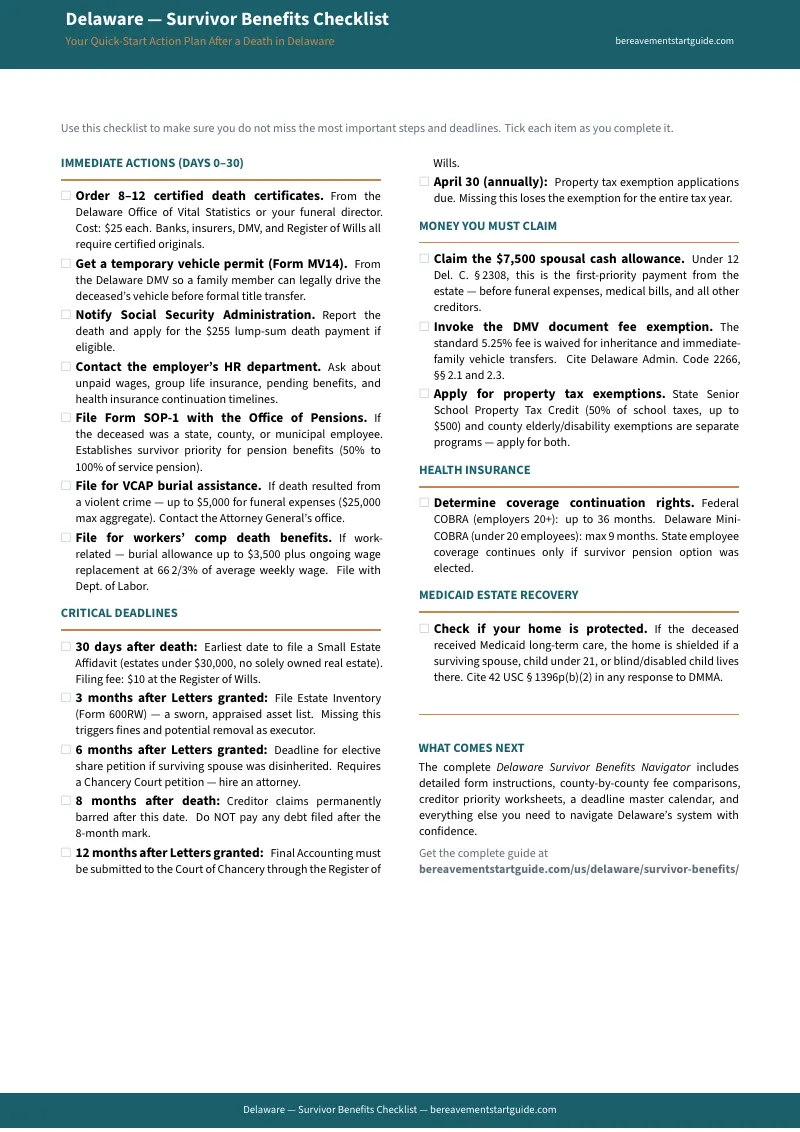
Not ready for the full guide? Download the Delaware — Survivor Benefits Checklist for free. It covers the 20 most critical actions across five categories — immediate filings, critical deadlines, financial claims, asset protection, and long-term planning. When you're ready for the full step-by-step instructions, county-specific details, and professional-help boundaries, the complete Navigator will be here.
Frequently Asked Questions
What if the rules change after I buy?
We update the guide when the rules change. Email us any time, even years later, and we'll send you the current edition free.