The Bank Froze the Accounts. The Clerk Said "We Cannot Give Legal Advice." The Attorney Quoted $15,000. And You Still Do Not Know Whether You Need Probate at All.
Someone you love just died in Florida. You went to the bank with the death certificate. The teller pulled up the account, paused, and said: "This account is frozen. We need Letters of Administration." You asked what that meant. She handed you a business card for a probate attorney and suggested you call Monday.
You tried the Clerk of the Circuit Court. They accepted the original will — which Florida law says you must deposit within 10 days — took your filing fee, and told you they cannot provide legal advice or tell you which probate track applies to your situation. They are legally barred from helping you. You left the courthouse with a receipt and no direction.
You went online. One site says Florida has three probate tracks. Another mentions a new law that doubled some threshold to $150,000. A third says the homestead property cannot be sold until the court issues an order you have never heard of. A fourth warns that if you miss a March 1 deadline at the county property appraiser, the property taxes on the house could jump by thousands of dollars — permanently, with no way to undo it. A fifth says the attorney and the personal representative can each charge 3% of the estate value, which on a $500,000 estate means $30,000 in combined fees before anyone inherits a dollar.
Meanwhile, the mortgage is due, the HOA is sending letters, the car insurance is lapsing, and three different relatives have opinions about what should happen with the house.
Here is the truth: Florida requires attorney representation for most formal probate — but it does not require you to walk into an attorney's office unprepared, uninformed, and unable to tell whether you even need formal probate in the first place. Florida Probate Rule 5.030 mandates an attorney for Formal Administration. It does not mandate ignorance. The families who spend the most money and lose the most time are the ones who hire an attorney before understanding their own situation — before knowing which of Florida's three probate tracks applies, before calculating whether the estate falls under the new $150,000 Summary Administration threshold, before realizing that the homestead property operates under completely different rules than every other asset.
The When Someone Dies in Florida — Estate Settlement Guide is the Estate Settlement Triage System — the bridge between the moment of death and your first meeting with a probate attorney. It does not replace the attorney. It makes sure you arrive at that meeting knowing exactly what you need, what you do not need, and what questions to ask — so you stop paying for education and start paying only for execution.
What Is Inside the Estate Settlement Triage System
A 15-chapter guide, the First 48 Hours Checklist, and standalone reference sheets — covering every stage from the first hours after death through final asset distribution, built specifically for Florida statutes, Circuit Court procedures, county filing fees, and the constitutional homestead protections that make settling an estate in Florida different from any other state:
The First 48 Hours: Death Certificates, the Short-Form Trap, and Immediate Actions
The funeral director will ask how many death certificates to order and whether you want short-form or long-form. Most families do not know the difference — and it matters enormously. Short-form certificates do not include cause of death and work for banks, the FLHSMV, and court filings. Long-form certificates include cause of death and are required for life insurance claims, pension benefits, and VA survivor benefits. Order the wrong type and you wait weeks for replacements at $15 per copy. This chapter tells you exactly how many of each to order based on your specific assets. It also covers the Florida cremation rule — no cremation can proceed without the district medical examiner's explicit authorization number — and the critical 10-day deadline to deposit the original will with the Clerk of the Circuit Court.
Florida's Three Probate Tracks: The Decision That Controls Everything
Not every estate needs full probate. Florida offers three tracks — Disposition Without Administration (very small estates, under $10,000 effectively), Summary Administration (under the threshold, no personal representative appointed), and Formal Administration (everything else). Choosing the wrong track wastes months and thousands of dollars. This chapter includes the complete decision tree: calculate your estate value, subtract exempt property (household furnishings up to $20,000 plus up to two motor vehicles), compare against the threshold, and check for disqualifying factors. You will know within 20 minutes which track applies to your family's situation.
The CS/SB 1500 Change: What the New $150,000 Threshold Means for You
Florida CS/SB 1500, effective July 1, 2026, doubled the Summary Administration threshold from $75,000 to $150,000. Thousands of estates that previously required Formal Administration — with mandatory attorney representation, 6-to-12-month timelines, and $400 filing fees plus percentage-based attorney fees — now qualify for the faster, cheaper Summary track. But the date-of-death rule controls which threshold applies: if the person died before July 1, 2026, you are still under the old $75,000 limit even if you file the petition after that date. The chapter also covers CS/SB 1500's new provisions compelling banks to honor Letters of Administration — a statutory weapon for families fighting bank pushback.
Florida Homestead Property: Constitutional Protections That Override the Will
This is where Florida is genuinely unique. Homestead protections are embedded in the state constitution — not just statute — and they override the deceased's will. If the deceased was survived by a spouse or minor child, they could not freely leave the homestead to anyone they chose. The surviving spouse has a constitutional right to either a life estate or an undivided one-half interest. A will that attempts to leave the homestead to someone other than the surviving spouse is invalid as to that property. The chapter covers the mandatory Petition to Determine Homestead Status (no one can sell the home until the court issues this order), the Save Our Homes portability transfer, and the March 1 deadline at the county property appraiser that — if missed — permanently reassesses the property to full market value and increases the tax bill by thousands of dollars per year with no way to recover the loss.
The 8-Class Creditor Priority System
The estate pays the debts, not you. But when the estate cannot cover everything, Florida Statute 733.707 dictates a strict 8-class priority — from costs of administration (Class 1) through general unsecured debts like credit cards (Class 8). Pay a Class 8 creditor before a Class 1 or Class 2 claim is satisfied and the personal representative becomes personally liable for the misallocation. The guide maps every class, explains the 3-month creditor claim window triggered by the published Notice to Creditors, and shows you the safe sequence: wait for the window to close, tally all claims, then pay in strict priority order.
Transferring Vehicles Through the FLHSMV
Florida vehicle title transfers go through the county Tax Collector's office — not the "DMV." Surviving spouses use Form HSMV 82152. Heirs of a solely-owned vehicle use Form HSMV 82040. Up to two motor vehicles are classified as exempt property and excluded from the estate value calculation for Summary Administration. The chapter covers both transfer paths, what documents to bring, and what happens when multiple heirs disagree about who gets the car.
Bank Accounts, Investments, and Life Insurance Claims
Joint accounts with right of survivorship stay accessible. Payable-on-death accounts transfer with just a death certificate. Solely-owned accounts stay frozen until you present either an Order of Summary Administration or Letters of Administration. Each bank has its own forms, its own processing time, and its own interpretation of what documentation is sufficient. The chapter tells you exactly what to bring to each conversation and how to handle the brokerage firms (Schwab, Fidelity, Vanguard) that take 4 to 6 weeks to process estate transfers. It also covers the step-up in cost basis for inherited investments — the rule that eliminates capital gains tax on appreciation during the deceased's lifetime.
Taxes, Documentary Stamps, and the No-State-Estate-Tax Reality
Florida has no state estate tax. The federal estate tax applies only to estates exceeding $15 million. For most families, the real tax issues are the deceased's final Form 1040 and, if the estate earns more than $600 during administration, the estate income tax return (Form 1041). The chapter also covers the documentary stamp tax exemption for personal representative deeds — a rule that can save the estate hundreds or thousands of dollars on real estate transfers if your attorney applies it correctly.
Filing Fees by County, Attorney Fee Schedules, and the Negotiation Tip That Saves Thousands
Filing fees vary by county and by track — from $231 for Disposition Without Administration to $401 for Formal Administration in Miami-Dade, Broward, and Palm Beach. Attorney fees follow the statutory schedule: $1,500 for estates up to $40,000, climbing to $3,000 plus 3% for estates over $100,000. And both the attorney and the personal representative can each claim this fee. For a $500,000 estate, that is potentially $30,000 in combined fees. The guide explains the critical negotiation tip: these are "presumptively reasonable" fees, not hard caps — you can negotiate a flat fee before signing the retainer, especially in high-value real estate markets where percentage-based fees become absurdly expensive.
When You Need a Lawyer — and When You Do Not
Contested wills, complex trust structures, hostile creditor disputes, estates with business interests — these require professional representation. This chapter is honest about where the guide handles everything and where you need a Florida probate attorney. It also gives you the statutory fee schedule so you know what to expect before you pick up the phone, and what to say in the first meeting to avoid paying for education you already have.
Who This Guide Is For
- The surviving spouse who cannot access the bank accounts — the checking account is frozen, the mortgage is due, and the bank is demanding Letters of Administration. The guide tells you which accounts you can access immediately (joint, POD), which require court documents, and how to get those documents as fast as possible through the correct probate track.
- The adult child named as personal representative who has never done this before — you are now a court-appointed fiduciary with personal liability for mismanaging someone else's financial affairs, and you have no idea where to start. The guide gives you the complete job description, the timeline, the deadlines, and the mistakes that create liability.
- The out-of-state executor who cannot drive to the courthouse — you live in New York or Texas and your parent died in Florida. The e-filing portal exists but county requirements vary dramatically. The guide gives you county-specific filing fees, local procedural quirks, and every form reference so you can coordinate with a local attorney remotely without wasting billable hours on basic questions.
- The family trying to decide whether they even need formal probate — the attorney quoted thousands in percentage-based fees. You suspect there is a cheaper path but you do not know whether the estate qualifies for Summary Administration under the new $150,000 threshold, how to calculate exempt property, or what happens to creditor liability under the summary track. The guide includes the decision tree.
- The family dealing with homestead property confusion — the will says the house goes to the children, but the surviving spouse is still alive and an attorney just told you the will is invalid as to the homestead. The guide explains the constitutional protections, the Petition to Determine Homestead Status, and the March 1 property appraiser deadline that nobody warned you about.
- The family facing a $30,000 combined fee estimate — the attorney and personal representative each want their statutory percentages, and you do not know whether to accept it, negotiate, or find someone cheaper. The guide gives you the fee schedule, the negotiation framework, and the knowledge to walk into that conversation as an informed client.
Why Free Resources Will Not Get You Through This
The forms exist for free. The sequencing does not. Here is what actually happens when you try to settle a Florida estate using free sources:
- The Clerk of the Circuit Court cannot help you. Every county clerk in Florida processes filings, holds original wills, and collects fees. They are legally barred from telling you which probate track applies, whether your petition is correct, or what you should do next. They will accept an incorrectly filed petition and keep the filing fee without offering guidance. The forms are there. The instructions are not.
- National legal platforms miss the Florida-specific rules that actually matter. LegalZoom, Nolo, and other national sites offer clean interfaces and downloadable templates. They gloss over the short-form vs. long-form death certificate distinction, skip the constitutional homestead protections that override wills, never mention the Petition to Determine Homestead Status, and have no idea that CS/SB 1500 just doubled the Summary Administration threshold. A generic probate template that ignores these rules fails at the first institution that demands Florida-specific documentation.
- Attorney blogs create fear to justify retainer fees. Florida probate attorney blogs are technically accurate — detailed analyses of the creditor priority system, homestead law, and filing procedures. But every article ends the same way: "This is too complex to do alone. Call us." For contested estates, that is true. For straightforward estates that qualify for Summary Administration, the process is sequential, documented in statute, and manageable — if you know the sequence.
- County and state websites cover their own slice and refuse to connect the dots. The Florida Courts E-Filing Portal handles filings. The FLHSMV handles vehicles. The Bureau of Vital Statistics handles death certificates. The county property appraiser handles homestead exemptions. Each agency covers its own domain. None tells you the order, the dependencies, or that missing the property appraiser's March 1 deadline while you were focused on the probate court creates a permanent tax increase on the house.
Free resources give you forms and a warning not to make mistakes. The Estate Settlement Triage System gives you the complete Florida sequence — from death certificate to creditor claims to final distribution — in the order you actually need them, with every county-specific cost and every constitutional quirk that makes Florida different.
— Less Than Fifteen Minutes With a Florida Probate Attorney
A single consultation with a Florida probate attorney costs $250 to $400 per hour. Standard representation runs thousands in statutory percentage fees — $1,500 for the smallest estates, $15,000 each for the attorney and personal representative on a $500,000 estate. National estate planning platforms charge $149 per year in recurring subscriptions for generic tools that do not know the difference between a short-form and long-form death certificate. This guide costs less than fifteen minutes of professional legal time and gives you the complete Florida-specific roadmap — every statute, every deadline, every form, every county filing fee, and the decision tree that tells you whether you even need formal probate at all.
Your download includes the complete 15-chapter guide with county filing fee tables and the statutory attorney fee schedule, the standalone Florida First 48 Hours Checklist, and printable reference sheets — the Probate Track Decision Tree, Homestead Property Reference, 8-Class Creditor Priority Chart, Vehicle Transfer Walkthrough, Statutory Deadline Calendar, and County Filing Fee Reference. Instant download, no account required.
Money-back guarantee, no time limit. If the guide does not give you clarity on what to do next and confidence that you are doing it in the right order, email us for a full refund. No questions asked.
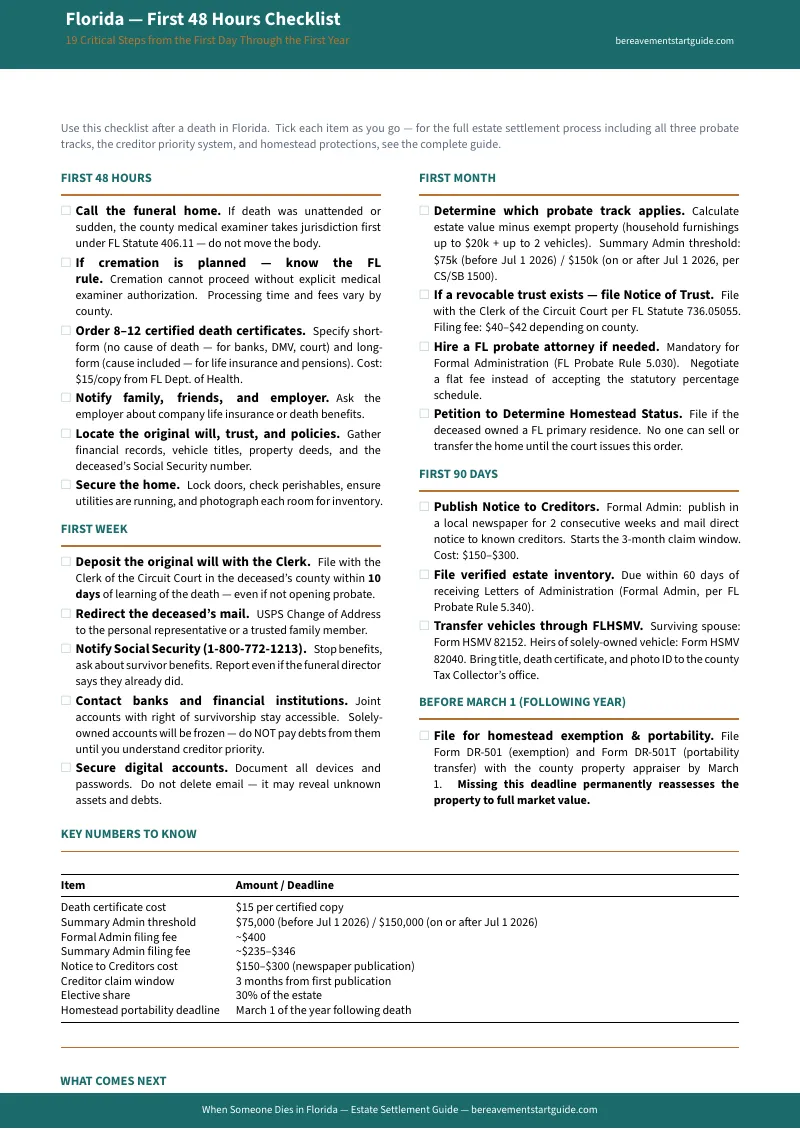
Not ready for the full guide? Download the free Florida First 48 Hours Checklist — covering death certificate ordering (short-form vs. long-form), securing the home, the 10-day will deposit deadline, and the critical actions that must happen in the first two days. It is enough to get through tonight and tomorrow.
You did not ask for this job. But you are the one doing it. The clerk cannot explain the forms. The bank will not release the money. The title company will not clear the deed until the court issues an order. This guide puts every Florida-specific step into one sequence so you can stop searching and start settling.
Frequently Asked Questions
What if the rules change after I buy?
We update the guide when the rules change. Email us any time, even years later, and we'll send you the current edition free.