Florida Probate Requires an Attorney. It Doesn't Require You to Pay Them to Sort Your Paperwork.
The bank froze the account. The attorney quoted a percentage fee based on the estate's value. And then you found out about Rule 5.030 — the Florida law that says you almost certainly cannot handle probate without hiring a lawyer.
You are not the first person to feel blindsided by this. Florida's probate system is one of the strictest in the country. Mandatory attorney representation. Court-supervised creditor notification. A 60-day inventory deadline that the judge actually enforces. And 67 county courts, each with their own local forms, checklists, and submission quirks that trip up even experienced attorneys.
Free resources exist — county clerk websites, Bar pamphlets, legal blogs — but they all share the same fatal flaw. The county clerk will hand you blank forms and legally refuse to explain how to fill them out. Law firm blogs will give you just enough information to scare you into a retainer. And national legal portals will tell you things about DIY probate that are flat-out wrong in Florida.
The Executor's Administrative Roadmap
This guide exists in the gap between "the court won't help you" and "the attorney hasn't been hired yet." It organizes everything you need to know — before, during, and after the legal process — into a single reference that works alongside your attorney, not instead of one.
The result: you walk into your first attorney meeting with the estate already organized, the right questions ready, and the leverage to negotiate a flat fee instead of accepting the statutory percentage.
Three Tracks, One Clear Decision
Florida offers three probate tracks, and choosing the wrong one wastes months and thousands of dollars. The guide walks you through the exact financial thresholds — including the brand-new $150,000 Summary Administration limit that took effect July 1, 2026 under HB 1337 — so you know which track applies before your attorney does.
The County Trap
Broward County requires proprietary Smart Forms — submit a standard PDF and your filing gets rejected. Miami-Dade requires CC-series checklists for every petition type. Orange County routes non-evidentiary orders via email to chambers in Word format. The guide flags the county-specific procedures that cause first-time rejections, so your filings go through cleanly.
The Fee Calculation They Hope You Won't Do
Florida Statute 733.6171 sets attorney fees as a percentage of the estate — 3% on the first million above $100,000, on top of flat-rate brackets for smaller estates. Many attorneys accept these rates as a given. The guide includes a fee calculator worksheet that shows you exactly what the statutory schedule costs for your estate size, so you can negotiate a flat-fee arrangement from a position of knowledge.
What You Get
- The Complete Florida Probate Guide — 17 chapters covering every step from the day of death to the final Order of Discharge, written for executors who need plain English, not court jargon
- Document Tracker — a printable worksheet covering vital records, court documents, financial accounts, real estate, vehicles, creditor management, and tax filings — every document you need to locate and file, in the order you need it
- Attorney Fee Calculator — calculate the presumed statutory attorney fee for your specific estate value, then use it to benchmark flat-fee quotes
- Homestead Protection Roadmap — step-by-step instructions for the Petition to Determine Homestead Status, the Save Our Homes portability filing (Forms DR-501 and DR-501T), and the documentary stamp tax calculation on mortgage assumptions
- Critical Deadline Timeline — every non-negotiable deadline on one printable page: the 10-day will deposit, 60-day inventory, 90-day creditor bar, March 1 SOH portability filing, and the two-year absolute statute of repose
- County-Specific Filing Notes — what Broward, Miami-Dade, Palm Beach, Orange, Hillsborough, Lee, and Sarasota counties require beyond the standard state forms
Who This Is For
- Named executors preparing for their first attorney meeting who want the estate organized, the deadlines mapped, and the fee conversation ready
- Surviving spouses who need to understand their elective share, exempt property rights, and how to protect the homestead tax cap
- Out-of-state adult children settling a parent's Florida estate remotely — especially those navigating county-specific procedures they have never encountered
- Families considering Summary Administration who want to confirm their estate qualifies under the new $150,000 threshold
What This Guide Does Not Do
This guide is an educational and administrative tool — not legal representation. Florida Probate Rule 5.030 requires a licensed Florida attorney for most probate proceedings, and this guide is designed to prepare you to work with one efficiently. It does not provide legal, tax, financial, or medical advice. When you need a professional, it tells you exactly which kind and why.
— Less Than Fifteen Minutes of an Estate Attorney's Billable Time
Florida probate attorneys charge between $150 and $400 per hour. If this guide saves you even a single billing increment by having the estate organized before your first meeting, it has paid for itself several times over. If it prevents a rejected filing, a missed deadline, or a surprise reassessment on the family home, the return is immeasurable.
Every purchase includes a money-back guarantee, no time limit. If the guide does not give you the clarity and control you need, email us for a full refund.
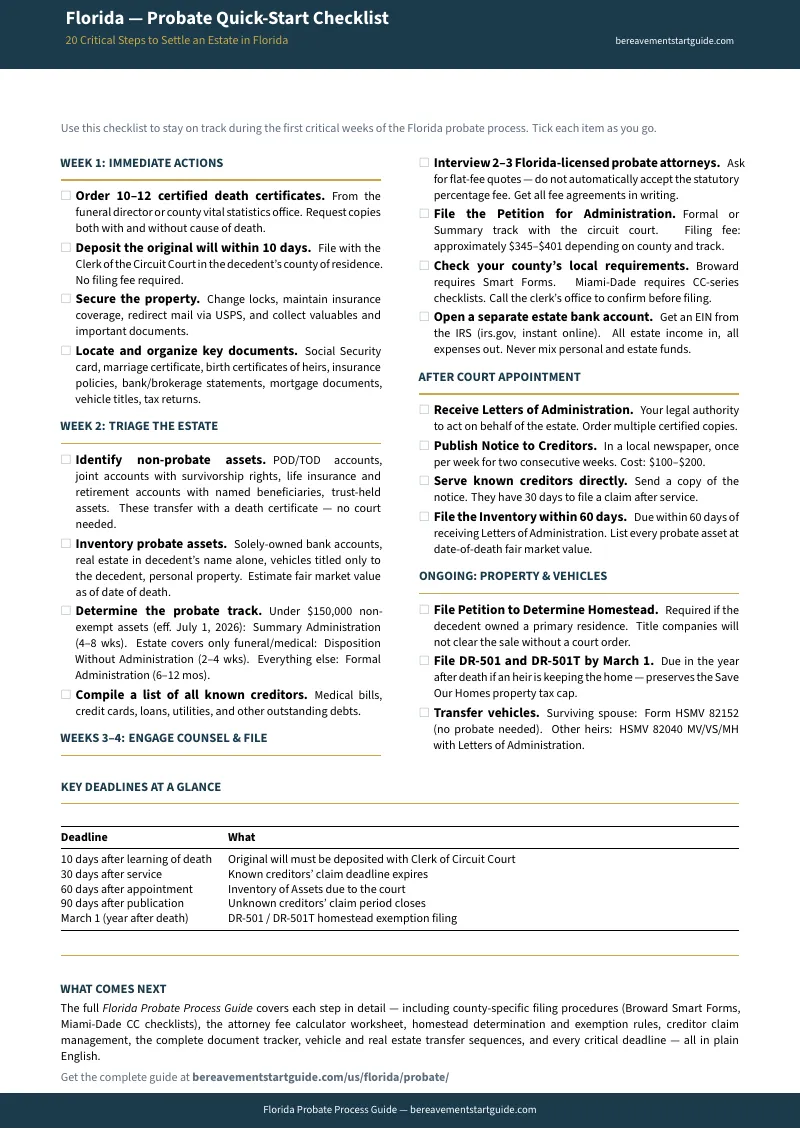
The free Quick-Start Checklist covers the first 30 days — the immediate actions, the estate triage, and the track decision. The full guide covers every step from there through the final Order of Discharge, with county-specific procedures, fee negotiation tools, and the homestead protection roadmap.
Frequently Asked Questions
What if the rules change after I buy?
We update the guide when the rules change. Email us any time, even years later, and we'll send you the current edition free.