The SSA Said "File in Person." The FRS Sent Four Forms. The Property Appraiser Has a Deadline Nobody Mentioned. And You Still Do Not Know What Benefits You Are Entitled To.
Someone you depended on just died in Florida. You called Social Security. They confirmed the $255 lump-sum death payment and told you to come to the office to discuss survivor benefits. You asked what percentage you would receive. They said it depends on your age, whether you are caring for children, and whether you have your own work record — and they cannot tell you over the phone.
You called the deceased's employer. They mentioned something about COBRA continuation for health insurance. You asked how long you have to decide. They were not sure — maybe 60 days? Maybe 63? They said HR would send you a packet. Meanwhile the monthly premium for the family plan is $1,800 and you have no income.
You went online. One site says surviving spouses in Florida get a $5,000 property tax exemption. Another says the exemption is 100% if the deceased was a first responder. A third says you have to file by March 1 or you lose it permanently. A fourth says the Florida Retirement System has four different survivor payout options and choosing the wrong one costs you hundreds of dollars a month for the rest of your life. A fifth says workers' comp death benefits in Florida are capped at $150,000 total — but only if you can prove dependency.
The benefits exist. They are real and they add up to real money. But they are scattered across the Social Security Administration, the Florida Retirement System, the county property appraiser, the Florida Department of Financial Services, workers' compensation carriers, the Florida Attorney General's office, and the VA — and not one of those agencies will tell you about the others. The property appraiser will not mention your FRS pension options. The FRS will not mention your health insurance continuation rights. The VA will not mention the CSDDV tuition waiver for your children. You are expected to know all of this already, at the worst moment of your life.
Here is the truth: Florida survivor benefits are generous — more generous than most states — but the system is built to pay you only if you know exactly what to ask for, who to ask, and when. There is no central office. There is no master checklist. There is no caseworker assigned to walk you through it. The families who collect everything they are owed are the ones who show up at each agency already knowing the forms, the deadlines, and the eligibility rules. Everyone else leaves money on the table because they did not know it was there.
The Florida Survivor Benefits Navigator is the Benefit Recovery System — a single document that maps every benefit, exemption, pension option, and deadline a surviving spouse or dependent is entitled to in the State of Florida. It does not replace the SSA, the FRS, or a probate attorney. It makes sure you walk into each conversation knowing exactly what you qualify for and what paperwork to bring — so you stop missing benefits because nobody told you they existed.
What Is Inside the Benefit Recovery System
A 21-chapter guide with 3 appendices, a 20-item survivor benefits checklist, and a benefit estimation worksheet — covering every benefit available to surviving spouses and dependents in Florida, from the first 72 hours through the six-month mark, built specifically for Florida statutes, agency procedures, county-level variations, and the 2026 legislative changes that most online resources have not caught up with:
The First 14 Days: Immediate Actions and Benefit Preservation
The clock starts before you are ready. Banks freeze accounts within 48 hours of the funeral home notifying Social Security. The county clerk requires the original will within 10 days — failure to deposit it is a misdemeanor. Life insurance companies need long-form death certificates with cause of death; short-form certificates get rejected and you wait weeks for replacements at $9 per copy. The employer needs to know about final wages — and most families do not realize that Florida Statute 222.15 lets a surviving spouse collect unpaid wages directly without probate. This chapter sequences every action so nothing gets missed and nothing gets done out of order.
Money You Can Access Without Waiting for Probate
Not everything requires a court order. Joint accounts with right of survivorship stay accessible immediately. Payable-on-death accounts transfer with a death certificate and photo ID. The Family Allowance provides up to $18,000 during probate administration, exempt from creditor claims. Final wages can be collected directly under F.S. 222.15. Exempt property — household furnishings up to $20,000 and up to two motor vehicles — belongs to the family by statute. This chapter identifies every dollar you can access before the probate process begins.
Florida Retirement System (FRS) Survivor Benefits: The Decision That Follows You for Life
If the deceased worked for the State of Florida, a county, a school district, or a special district, they were almost certainly in the FRS. The survivor benefit depends entirely on which plan they were in (Pension Plan vs. Investment Plan), whether they were vested, whether they had retired, and — if retired — which payment option they elected. Option 1 pays the highest monthly amount but stops at death. Options 3 and 4 continue paying a joint annuitant for life. If the member died in the line of duty, the surviving spouse may receive 50% or 100% of the final salary as a continuing benefit. Filing requires Forms DFS-A3-2123 and DFS-A3-1912. The FRS offers free financial counseling through EY — most families never learn this exists. This chapter walks through every scenario and tells you which option to elect and what it means for your monthly income.
Social Security Survivor Benefits: What You Actually Receive
The $255 lump-sum death payment is the one everyone knows about. The monthly survivor benefits are what actually matter — up to 100% of the deceased's benefit if you are at full retirement age, 71.5% if you claim at age 60, and 75% for each eligible child under 18. But there are traps: if you have your own work record, you get either your own benefit or the survivor benefit — not both. If you remarry before age 60, you lose eligibility. If you are caring for the deceased's child under age 16, you qualify for a "mother's/father's benefit" regardless of your age. This chapter calculates what you will actually receive and explains the earnings test that reduces payments if you are still working.
The Property Tax Exemptions Nobody Warns You About
Florida Statute 196.202 gives surviving spouses a $5,000 reduction in assessed property value — roughly $100 per year in tax savings. But the application deadline is March 1 at the county property appraiser, and if you miss it, you wait an entire year. For surviving spouses of first responders who died in the line of duty, the exemption is 100% — complete property tax elimination on the primary residence. For surviving spouses of disabled veterans with a 100% rating, the exemption is also complete. None of these apply automatically. You have to file, and you have to file before March 1. This chapter tells you exactly which exemption applies, what form to bring, and which county office to visit.
Workers' Compensation Death Benefits: The Caps and the Dependency Test
If the death was work-related, Florida workers' compensation provides weekly benefits to the surviving spouse and dependents — 50% of the Average Weekly Wage for the spouse alone, up to 66.7% combined for spouse and children, capped at $1,358 per week and $150,000 total over the lifetime of the claim. Funeral expenses are covered up to $7,500. But eligibility requires proving dependency, and the three-pronged dependency test is where most claims get complicated. This chapter covers the calculations, the maximum payout scenarios, the educational benefits available to surviving spouses, and the supplemental benefits that kick in when the estate is small.
Health Insurance Continuation: The 63-Day Window
Federal COBRA applies to employers with 20 or more employees and provides up to 36 months of continuation coverage for spouses and dependents. But if the employer had fewer than 20 employees, COBRA does not apply — Florida Mini-COBRA does, with different rules and a critical 63-day election window. Miss the window and you are uninsured. The premiums are steep — up to 115% of the group rate — but coverage continuity matters more than cost when you have pre-existing conditions or ongoing medical treatment. This chapter covers both programs, the exact enrollment deadlines, and the alternatives if continuation coverage is unaffordable.
Crime Victim Compensation, Veterans Benefits, Homestead Protections, and More
The guide also covers: the Bureau of Victim Compensation program (up to $25,000 for funeral and counseling costs when the death resulted from a crime), the CSDDV tuition waiver for children of deceased veterans (110% of credit hours at Florida public institutions), the Florida homestead protections that pass the primary residence outside of probate and shield it from creditors and Medicaid Estate Recovery, the documentary stamp tax exemption for real estate transfers, county-by-county procedural differences across Florida's 67 counties and 20 judicial circuits, the Patient-Directed Medical Order (PDMO) for advance care planning, and strategies for protecting yourself from the predatory solicitors who target families after probate filings become public record.
Who This Guide Is For
- The surviving spouse who just lost their household's primary income — the monthly deposits have stopped, the bank accounts may be frozen, and you do not know which benefits replace that income or how long they take to start. The guide maps every income replacement benefit — Social Security survivor payments, FRS pension continuation, workers' comp, life insurance — and tells you which ones you can access this week versus which take months.
- The widow or widower of a state employee, teacher, or county worker — the FRS pension is the largest single benefit most Florida survivor families will receive, but the four payment options are confusing and the wrong choice reduces your monthly income permanently. The guide explains each option in plain English so you can make an informed decision before signing the election form.
- The family of a veteran who died from a service-connected condition — you qualify for the total property tax exemption, the CSDDV scholarship for dependents, VA burial benefits, and DIC payments, but the VA will not tell you about the state benefits and the state will not tell you about the federal ones. The guide consolidates both.
- The surviving spouse panicking about health insurance — the group coverage ends when the employment relationship ends, and the deadline to elect continuation coverage is strict. Whether you fall under COBRA or Florida Mini-COBRA depends on the employer's size, and the enrollment windows are different. The guide tells you which one applies and what the deadline is.
- The out-of-state adult child trying to help a surviving parent in Florida — your parent is grieving and overwhelmed. You are trying to coordinate benefit claims remotely across agencies you have never dealt with, in a state whose laws you do not know. The guide gives you the agency names, phone numbers, form numbers, and filing procedures so you can make the calls and fill out the paperwork on their behalf.
- The family dealing with a workplace death, a crime-related death, or a first-responder death — these circumstances unlock additional benefits that standard deaths do not. Workers' comp death benefits, crime victim compensation, 100% property tax exemptions for first-responder families — each has its own eligibility rules, caps, and filing procedures. The guide covers all of them.
Why Free Resources Will Not Get You Through This
The information exists for free. The synthesis does not. Here is what actually happens when you try to claim Florida survivor benefits using free sources:
- The Social Security Administration covers Social Security. Period. The SSA will process your survivor benefit claim. They will not mention your FRS pension options, your property tax exemption, your workers' comp eligibility, or the CSDDV scholarship for your children. They handle one program. You are dealing with eight.
- The FRS website explains pension options but ignores everything else. MyFRS.com has detailed information about the Pension Plan and Investment Plan survivor options. It does not mention health insurance continuation deadlines, the Family Allowance, the property tax exemption, or any federal benefit. If the deceased was a teacher with a veterans' background, you need three different agencies — and the FRS will send you to zero of them.
- County property appraisers explain their exemptions but not your deadlines. The property appraiser's website lists the $5,000 widow/widower exemption. It does not mention that the March 1 deadline is absolute, that first-responder families qualify for 100% exemption, or that failing to file for Save Our Homes portability when transferring the homestead can increase property taxes by thousands of dollars permanently.
- Attorney blogs explain the law but steer every answer toward a retainer. Florida estate planning and elder law firm blogs are technically excellent — detailed, accurate, well-sourced. But the conclusion of every article is the same: "This is complicated. Call us." For probate proceedings where attorney representation is mandatory, that advice is correct. For claiming Social Security, filing a property tax exemption, or electing an FRS pension option, you do not need an attorney — you need the right forms and the right deadlines.
- National platforms miss the Florida-specific rules that determine your benefits. AARP, LegalZoom, and financial planning sites provide national overviews of survivor benefits. They do not know about the Florida Mini-COBRA 63-day window, the CSDDV tuition waiver, the $150,000 workers' comp death benefit cap, or the constitutional homestead protections that pass the home outside of probate. A national overview that ignores state rules is an outline, not a plan.
Free resources give you fragments — one agency at a time, one benefit at a time, with no connection between them. The Benefit Recovery System puts every Florida survivor benefit into one document, in the order you need them, with every form number, deadline, and eligibility rule in one place.
— Less Than the Filing Fee for a Single Court Petition
A one-hour consultation with a Florida estate attorney costs $250 to $400. A formal probate filing fee ranges from $231 to $401 depending on the county. Workers' compensation attorneys take 20% of recovered benefits. This guide costs less than a single court filing fee and covers every benefit, exemption, and pension option available to surviving families in Florida — including the ones that do not require an attorney, a court order, or a filing fee at all.
Your download includes the complete 21-chapter guide covering Social Security survivor benefits, FRS pension options, workers' comp death benefits, property tax exemptions, health insurance continuation, crime victim compensation, veterans' benefits, homestead protections, and county-by-county procedures — plus five standalone printable tools:
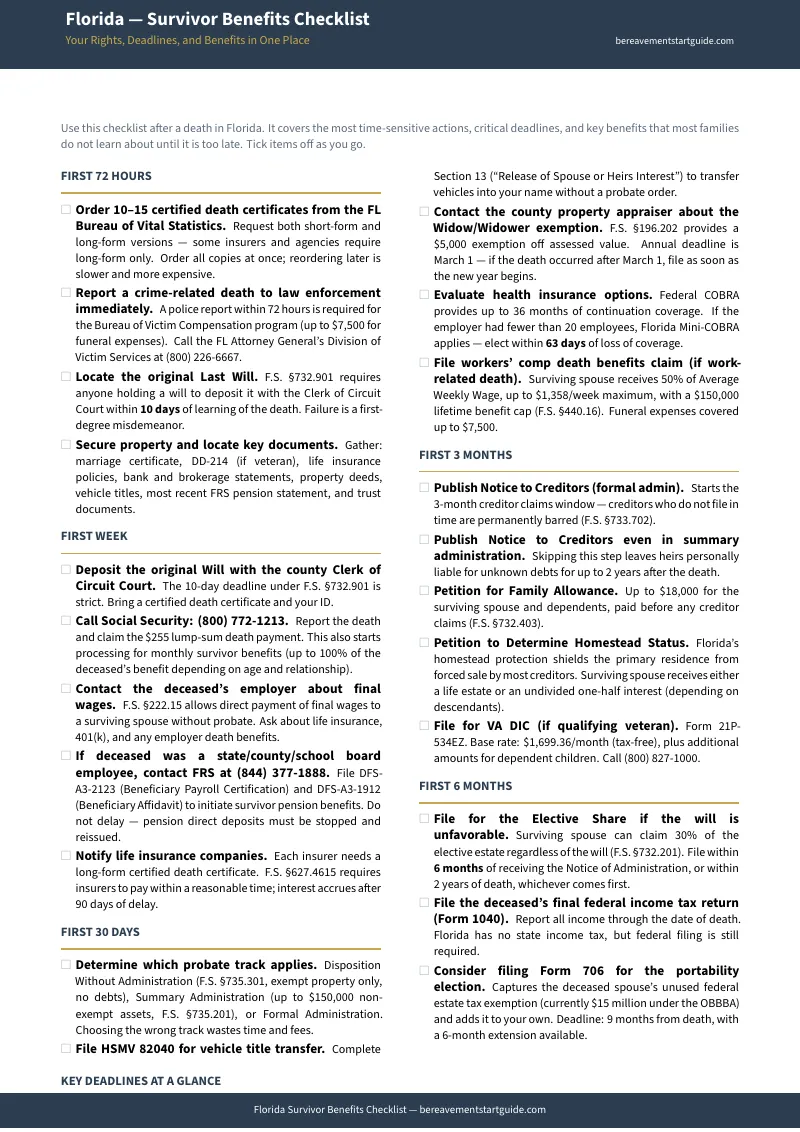
- Florida Survivor Benefits Checklist — 20 time-sensitive items organized by deadline
- Benefit Estimation Worksheet — calculate your total expected benefits across all programs on one page
- Deadline Calendar — every statutory filing deadline on one printable page, from 72 hours through 2 years
- Forms Reference Card — every form number, name, and filing location across all agencies
- Agency Contact Directory — every phone number and website on one page to keep by your phone
Instant download, no account required.
Money-back guarantee, no time limit. If this guide does not help you identify a benefit you did not know about, save you hours of research across agency websites, or give you clarity on the forms and deadlines you are facing, email us for a full refund. No questions asked.
Not ready for the full guide? Download the free Florida Survivor Benefits Checklist — 20 items covering death certificate ordering, the 10-day will deposit deadline, SSA notification, FRS forms, property tax exemption deadlines, health insurance election windows, and the actions that must happen in the first 72 hours, first week, and first 30 days. It is enough to make sure nothing critical falls through the cracks tonight.
No one agency will tell you what you are entitled to. No single website covers all of it. The benefits exist — Social Security, pensions, property tax exemptions, health insurance, workers' comp, veteran scholarships, crime victim compensation — and they add up to real money. But you have to claim them, on time, with the right forms. This guide puts every Florida survivor benefit in one place so you can stop searching and start collecting what your family is owed.
Frequently Asked Questions
What if the rules change after I buy?
We update the guide when the rules change. Email us any time, even years later, and we'll send you the current edition free.