
The Bank Froze the Account. The Court Wants Forms You've Never Heard Of. Georgia Gave You No Instructions.
You walked into the bank expecting to pay a bill from your loved one's account. The teller said the account was frozen. They told you to come back with "Letters Testamentary." You had never heard that phrase before yesterday.
That was just the beginning. The county Probate Court handed you a stack of blank GPCSF forms with zero explanation of which ones you actually need. A law firm quoted you $4,000 to $6,500 to handle what they called "a straightforward estate." And every website you found either reproduced the raw text of O.C.G.A. Title 53 without interpretation or gave you just enough information to scare you into hiring someone.
Meanwhile, the clock is running. Georgia gives creditors six months to file claims after you publish notice in the county's designated legal organ. Miss the publication deadline and that six-month clock never starts. Pay debts in the wrong order and the estate — or you personally — can be held liable under the statutory priority system in O.C.G.A. § 53-7-40.
The Georgia Estate Settlement Roadmap
This guide does what the Probate Court legally cannot: it tells you which forms to file, in what order, at what cost, and why. It translates Georgia's estate settlement process from dense statutory language into a chronological, plain-English roadmap that covers every step from the day of death through the final discharge of the personal representative.
The result: you walk into every interaction — with banks, the county Probate Court, the Department of Revenue, insurers, and family members — knowing exactly what to do next instead of guessing.
Year's Support: The Georgia Provision Most Families Miss
Georgia has one of the most powerful surviving spouse protections in the country. A Year's Support petition lets the surviving spouse or minor children set aside estate assets for twelve months of support — and it takes priority over nearly all debts and claims. But families routinely confuse it with a "Petition for No Administration Necessary," which is an entirely different procedure with different requirements. The guide walks you through both mechanisms, explains exactly who qualifies for each, and shows you how to file the petition in your county Probate Court.
The $15,000 Banking Shortcut Nobody Told You About
Under O.C.G.A. § 7-1-239, Georgia banks can release deposits up to $15,000 directly to a surviving spouse, children, or parents using a simple affidavit — no probate filing required. Every year, thousands of Georgia families pay $200 in court filing fees and wait months for Letters of Administration when a one-page banking affidavit would have freed the money in days. The guide tells you exactly when this shortcut applies and what the bank needs from you.
Vehicle Titles, Real Estate, and the Forms That Trip Everyone Up
The Georgia Department of Revenue requires a Form T-20 Affidavit of Inheritance to transfer a vehicle to an heir — but only in certain situations. If you need to sell the vehicle to a third party, you must first title it in the estate's name. The guide maps every scenario. For real estate, Georgia law requires the personal representative to execute and record an "Assent to Devise" or "Executor's Deed" before a beneficiary actually owns the property — being named in the will is not enough. The guide includes the recording steps for your county land records.
What You Get
- The Complete Georgia Estate Settlement Guide — 17 chapters covering every step from the first 48 hours through final accounting and discharge, written for families and executors who need plain English, not O.C.G.A. citations
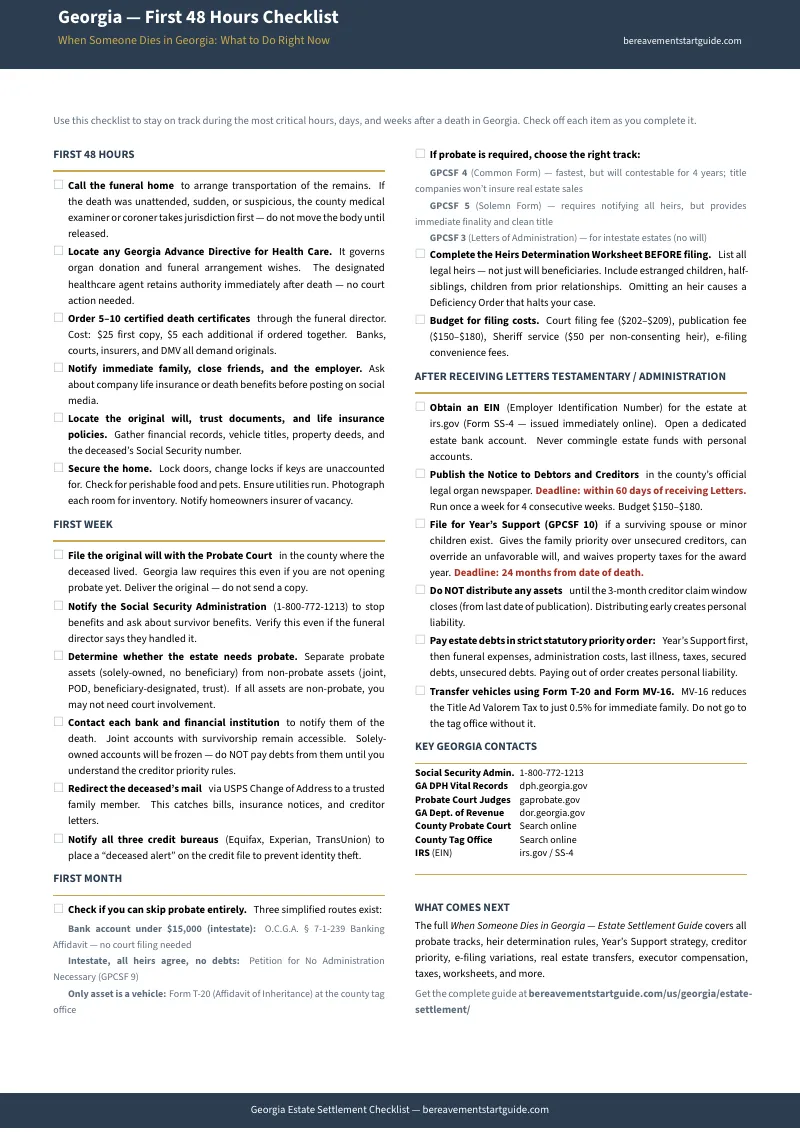
- Georgia Estate Settlement Checklist — a printable, chronological checklist covering the first 48 hours, first week, first month, first three months, and final closing — every action item in the order it needs to happen
- Probate Track Decision Tree — determine whether your situation calls for No Administration Necessary, Year's Support, small estate affidavit, or formal probate administration
- Year's Support Walkthrough — a one-page reference card covering the three powers of Year's Support, who can file, the absolute 24-month deadline, and how it differs from No Administration Necessary
- Creditor Priority Reference — the statutory payment priority under O.C.G.A. § 53-7-40, three practical warnings about personal liability, and what happens if you distribute assets too early
- Vehicle Title Transfer Workflow — step-by-step instructions for the Form T-20 Affidavit of Inheritance, including when the executor must first title the vehicle in the estate's name
- Real Estate Transfer Workflow — the Assent to Devise, Executor's Deed, and county recording requirements for transferring property title after probate
- Banking Affidavit Walkthrough — how to use the O.C.G.A. § 7-1-239 small-account shortcut to access funds without opening formal probate
- Statutory Deadline Calendar — a fillable timeline tracker for every mandatory Georgia estate deadline from the date of death through discharge
- Estate Asset Inventory Worksheet — a printable form for cataloging every asset, marking probate vs. non-probate, and tracking institutions and values
- Executor Compensation Calculator — the statutory commission formula under O.C.G.A. § 53-6-60, with a fillable worksheet to estimate your total compensation
Who This Is For
- Surviving spouses who need to access frozen bank accounts, protect the family home, and understand their Year's Support rights before creditors start calling
- Adult children settling a parent's estate — especially those juggling this alongside a career and family, often from out of state, who need a clear sequence instead of 50 disconnected government websites
- Named executors who accepted the role out of obligation but have no background in law, finance, or court procedure, and are acutely aware of their personal liability as fiduciary
- Families considering whether to hire an attorney who want to understand the process first so they can make an informed decision about what they can handle themselves
Why Free Resources Fall Short
The Georgia Probate Court Standard Forms are free. But the court clerk who hands them to you is legally prohibited from telling you which form applies to your situation, how to answer the questions, or what order to file them in. Law firm blogs provide excellent analysis of Georgia probate law — and every one of them is designed to convince you the process is too complex to handle alone, funneling you toward a $4,000+ retainer. National legal portals reproduce the raw statutory text of the O.C.G.A. with no practical interpretation.
No free resource synthesizes the emotional support of knowing what to expect, the statutory accuracy of current Georgia law (including SB 232 filing fee standardization), and the chronological organization of a project management tool. That is exactly what this guide does.
— Less Than the Filing Fee for a Single Probate Petition
Georgia's base probate court filing fee is $200 under Senate Bill 232. If this guide helps you determine that your estate qualifies for the No Administration Necessary path or the small-account banking affidavit, it has saved you that filing fee entirely. If it prevents one rejected filing, one missed publication deadline, or one out-of-order creditor payment, the return is many times what you paid.
Every purchase includes a money-back guarantee, no time limit. If the guide does not give you the clarity and control you need, email us for a full refund.
The free First 48 Hours Checklist covers the immediate actions — securing the home, ordering death certificates, notifying Social Security, and triaging the estate. The full guide picks up from there and walks you through every step to final discharge, with Georgia-specific forms, deadlines, and workflows.
Frequently Asked Questions
What if the rules change after I buy?
We update the guide when the rules change. Email us any time, even years later, and we'll send you the current edition free.