
Georgia Has No Estate Tax. That Does Not Mean the Taxes Are Simple.
You already know Georgia repealed its state estate tax in 2014. You may even know there is no Georgia inheritance tax. But somewhere between the final Form 1040 and the refund check the bank will not let you deposit, you discovered that "no estate tax" does not mean "no tax obligations."
The Georgia Department of Revenue mailed a refund check in your loved one's name. The bank rejected it. You called the DOR and learned you need a Form GA-5347 — notarized, with the original check, a death certificate, and a certified court appointment letter. You went online to find instructions. The DOR website gave you the form. It did not tell you that the probate court appointment must come first, that the notarization must be done in person, or that mailing an endorsed check instead of the original will add weeks of delay.
That is one form. You still have the final federal income tax return (Form 1040), the final Georgia income tax return (Form 500), potentially a federal fiduciary return (Form 1041) and a Georgia fiduciary return (Form 501), and — if the estate is large enough — a federal estate tax return (Form 706) with a strict nine-month deadline. Each return has its own threshold, its own deadline, and its own Georgia-specific rules that national tax software ignores entirely.
The Georgia Final Tax and Estate Tax Guide
This guide does what scattered DOR pages and generic TurboTax articles cannot: it walks you through every tax obligation that arises after a death in Georgia, in the order you will actually encounter them, with the exact forms, thresholds, and deadlines that apply under 2026 Georgia and federal law.
It covers the taxes. Not the broad probate process, not funeral regulations, not survivor benefits — the taxes. Final income returns, fiduciary returns, the federal estate tax and portability election, step-up in basis calculations, the GA-5347 refund claim process, property tax exemptions through Year's Support, and the vehicle transfer tax trap that costs families thousands of dollars when they walk into the Tag Office without the right form.
The Refund Check That Cannot Be Deposited
When the Georgia Department of Revenue issues a tax refund in a deceased person's name, that check is worthless until you complete the GA-5347 claim process. The form requires four things: the original refund check (untouched — do not endorse it), a certified death certificate, a certified copy of your court appointment as personal representative, and a notarized GA-5347 form. Georgia does not currently authorize Remote Online Notarization for this form, so you must appear before a notary in person. The guide maps every step of this process and tells you exactly what must happen at the probate court before the DOR will reissue the check.
The Form 501 Threshold Nobody Explains Clearly
If the estate earns income after the date of death — interest from bank accounts, dividends from investments, rent from property — you may need to file a Georgia Fiduciary Income Tax Return (Form 501). The trigger: the estate's gross income exceeds the personal exemption plus estimated deductions plus $1,000. If the estate claims Series 100 tax credits, the Georgia Department of Revenue requires electronic filing — paper returns will be rejected. The guide explains the threshold calculation, the deadline (15th day of the 4th month following the close of the estate's tax year), and when to hand this to a CPA versus handling it yourself.
The Step-Up in Basis That Saves Families Tens of Thousands
A parent bought a house in Marietta for $185,000. At death, it appraises at $475,000. The heir sells it three months later for $480,000. Without the step-up in basis, the heir would owe taxes on $295,000 of gain — roughly $58,900 in combined federal and Georgia taxes. With the step-up, the taxable gain drops to $5,000 and the tax to approximately $999. But the step-up only works if you can prove the fair market value on the date of death. The guide explains exactly how to document the date-of-death appraisal, what assets require a formal appraisal versus a brokerage statement, and how Georgia's common-law property rules affect jointly held assets differently than community property states.
The Portability Election Most Married Couples Skip
Under the One Big Beautiful Bill Act, the federal estate tax exemption is $15 million per individual and $30 million for married couples — but only if the executor of the first spouse to die files a complete Form 706 to elect portability. If no Form 706 is filed, the deceased spouse's unused exemption is permanently lost. Filing Form 706 solely for portability typically costs $2,000 to $5,000 in professional fees. Skipping it can cost the surviving spouse's estate 40% on every dollar above $15 million. The guide explains exactly who needs this election and what the nine-month filing window requires.
Vehicle Title Tax: 0.5% or 7%
When an heir transfers a deceased family member's vehicle at the county Tag Office, the Title Ad Valorem Tax (TAVT) rate depends entirely on whether you file Form T-20 (Affidavit of Inheritance). With the form and proof of family relationship, the rate is 0.5% of fair market value. Without it, the default rate is 7%. On a vehicle worth $30,000, that is the difference between $150 and $2,100. The guide walks you through every requirement for the reduced rate.
What You Get
- The Complete Georgia Final Tax and Estate Tax Guide — 17 chapters covering every tax obligation from the date of death through closing the estate, with Georgia-specific form numbers, thresholds, deadlines, and worked examples
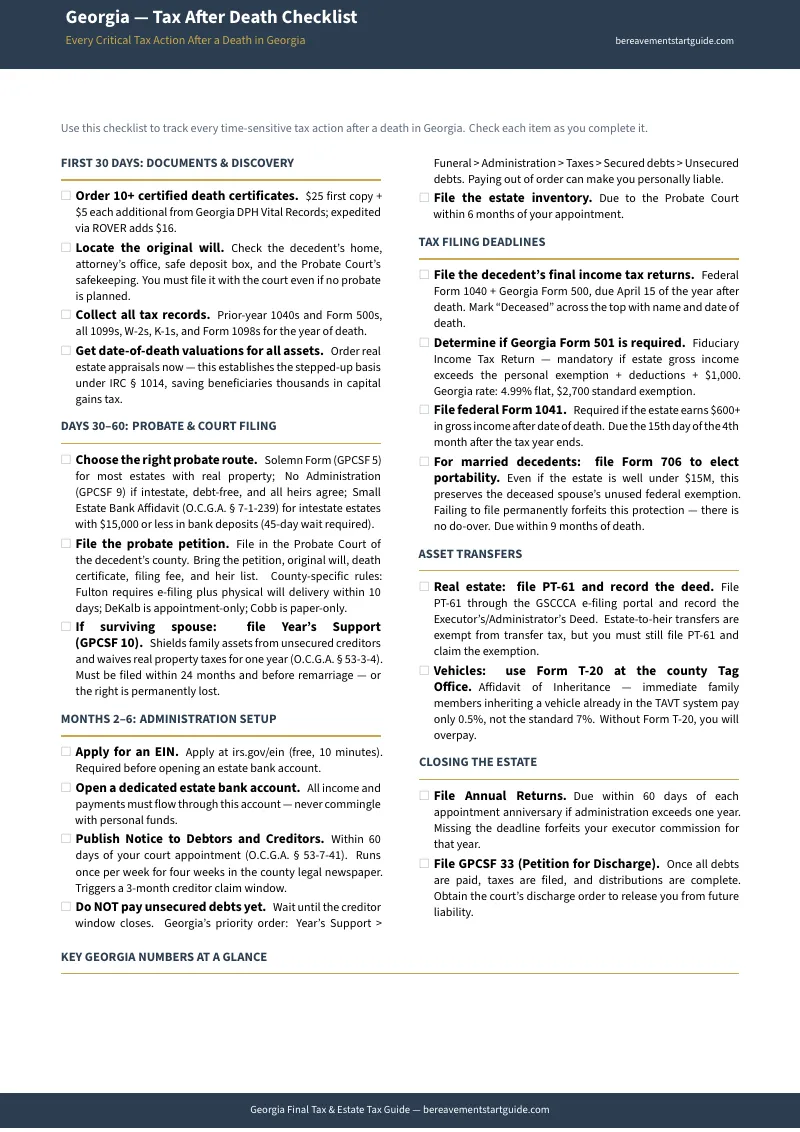
- Georgia Tax After Death Checklist — a printable chronological checklist of every tax-related action item, organized by deadline phase, designed to be handed directly to your CPA
- Tax Filing Summary Table — all six potential tax returns (final 1040, Form 500, Form 1041, Form 501, Form 706, and PT-61) with thresholds, deadlines, and rates on one reference page
- GA-5347 Refund Claim Walkthrough — step-by-step instructions for claiming a deceased taxpayer's Georgia state tax refund, including the exact documents and sequencing required
- Step-Up in Basis Worked Example — a Georgia-specific calculation showing exactly how the basis adjustment works for inherited real estate, with the tax savings quantified
- Creditor Priority Worksheet — the statutory payment order under Georgia law, showing exactly which debts must be paid before others to avoid personal liability
- Vehicle Transfer Tax Reference — TAVT rates, Form T-20 requirements, and the exact steps to qualify for the 0.5% family inheritance rate
- Executor Compensation Calculator — the statutory commission formula under O.C.G.A. § 53-6-60 with a fillable worksheet
Who This Is For
- Executors and administrators who need to know which tax returns to file, in what order, and by what deadline — before they accidentally trigger penalties or personal liability by paying debts in the wrong sequence
- Surviving spouses who need to understand how Year's Support protects the family home from property taxes, how to file the final joint return, and whether the portability election applies to their situation
- Beneficiaries about to sell inherited property who need to calculate their actual capital gains exposure using the step-up in basis, instead of panicking over a tax bill that may not exist
- Families preparing for a CPA meeting who want to walk in with organized records, the right forms identified, and specific questions ready — saving hundreds of dollars in billable hours that would otherwise be spent on remedial education
Why Free Resources Fall Short
The Georgia Department of Revenue will give you a blank GA-5347. It will not tell you that the probate court appointment must happen first, that the check must remain unendorsed, or how long the reissuance typically takes. The IRS website explains Form 1041 in general terms. It does not explain Georgia's Form 501 threshold, the electronic filing mandate for Series 100 tax credits, or the strategic value of electing a fiscal year for the estate.
Law firm blogs provide excellent analysis of the step-up in basis and the absence of a Georgia estate tax. Every one of those articles is designed to end with a consultation request and a $3,000 to $4,000 retainer. If your estate is straightforward — and most are — you do not need a retainer. You need a roadmap.
National tax software handles the federal Form 1040 competently. It ignores the GA-5347 refund claim process, the Form 501 filing threshold, the Year's Support property tax waiver, and the vehicle transfer tax trap entirely. Georgia-specific tax obligations require a Georgia-specific guide.
— Less Than One Hour of a Georgia CPA's Time
Georgia CPAs and estate attorneys typically bill $250 to $400 per hour. If you walk into that meeting with disorganized records, missing 1099s, and basic questions about whether Georgia has an estate tax, you will pay hundreds of dollars for information this guide covers in the first chapter. If the guide helps you claim the 0.5% vehicle transfer rate instead of the 7% default, it has paid for itself on a single transaction.
Every purchase includes a money-back guarantee, no time limit. If the guide does not save you at least two hours of research or reduce your CPA preparation time, email us for a full refund.
The free Tax After Death Checklist covers which tax obligations exist and when they are due. The full guide covers how to handle each one — with Georgia-specific forms, threshold calculations, worked examples, and the exact sequencing that prevents costly mistakes.
Frequently Asked Questions
What if the rules change after I buy?
We update the guide when the rules change. Email us any time, even years later, and we'll send you the current edition free.