
The Funeral Home Appointment Is Tomorrow. Do You Know What You Can Legally Refuse?
Within hours of a death in Georgia, the clock starts running on permits, signatures, and decisions that carry real financial consequences. The funeral home will present you with an itemized price list. Some of those charges are legally required. Many are not. And the person sitting across the table from you has a financial incentive to keep that distinction blurry.
Meanwhile, the county vital records office needs paperwork before they release the death certificate. The crematory needs authorization signatures from the right family member in the right order. And if your siblings disagree about burial versus cremation, the funeral home can legally halt everything while daily refrigeration fees pile up.
Free information exists, scattered across state agency PDFs, FTC pages, and funeral home blogs written by the same people selling you the casket. Pulling it together into something usable takes hours you do not have.
The Georgia Funeral Law Defense System
This guide does one thing: it translates Georgia's funeral statutes, the FTC Funeral Rule, and county-level requirements into a single, plain-English reference you can use at the arrangement table, at the vital records office, and in conversations with family members who disagree about what happens next.
It is not a sympathy card. It is a working document built around the specific legal framework that governs every funeral transaction in the state of Georgia, updated for 2026 including the new Natural Organic Reduction (human composting) law under Senate Bill 241.
What's Inside
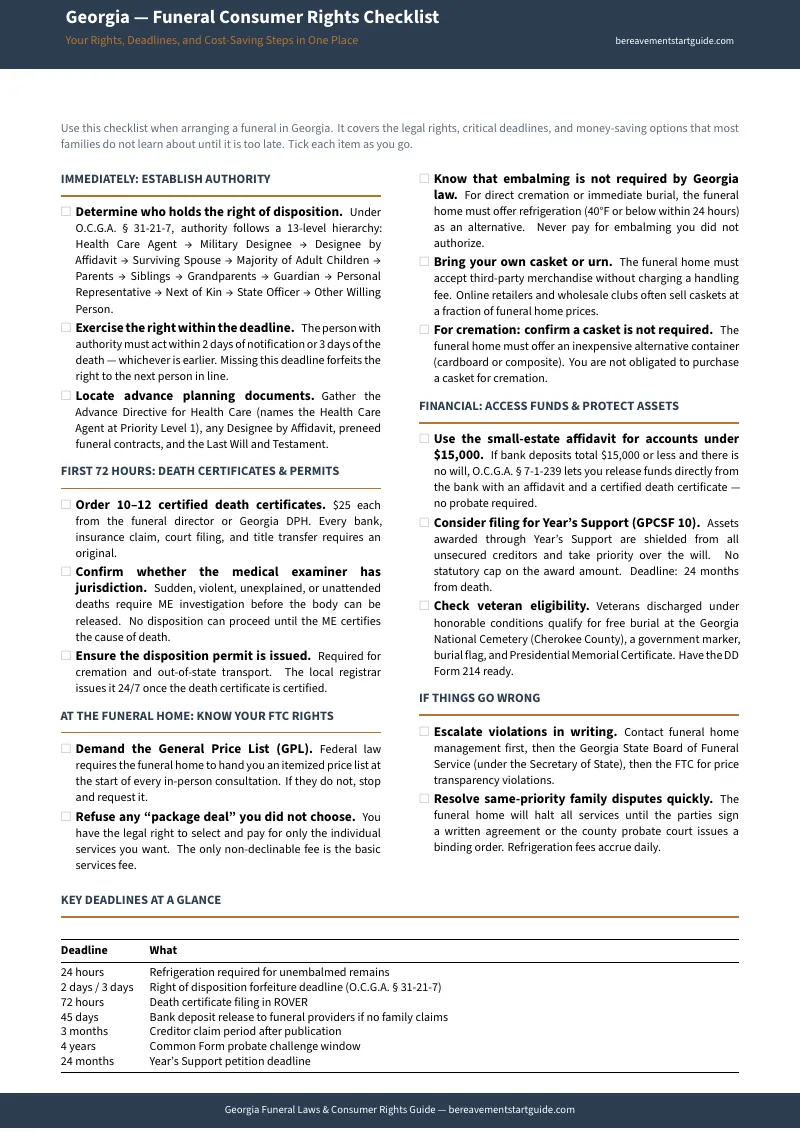
- The complete disposition authority hierarchy under O.C.G.A. 31-21-7, showing exactly who has the legal right to make funeral decisions, in what order, and the 2-day/3-day forfeiture deadlines that transfer that authority automatically
- A line-by-line breakdown of the General Price List, separating the non-declinable basic services fee from optional charges like embalming, cosmetic preparation, and sealed caskets that you can legally refuse
- Georgia's cremation authorization process, including the 24-hour waiting period, medical examiner sign-off requirements, and what happens when next-of-kin signatures conflict
- The burial transit permit sequence, mapping the handoffs between hospital, county vital records (ROVER system), medical examiner, and crematory so you know which office to call when paperwork stalls
- Home funeral and family-directed burial rules, covering what Georgia law actually requires when a family handles disposition without a funeral director, plus county-level exceptions like Bibb County's leak-proof casket ordinance
- Green burial and human composting regulations, including Senate Bill 241 provisions taking effect in 2025 and existing rules for biodegradable shrouds and natural burial grounds
- Prepaid funeral contract protections, explaining how Georgia law prevents funeral homes from pressuring dying persons into canceling existing preneed contracts, and what happens if the funeral home changes ownership
- The FTC Funeral Rule applied to Georgia, covering your right to an itemized price list before viewing merchandise, the prohibition on casket handling fees, and the alternative container rule for direct cremation
- Family dispute resolution pathways, from the majority-rule provision among siblings of equal degree to the county probate court petition process when consensus fails
- Death certificate and permit timelines, including the $25 certified copy fee, expedited processing through county registrars, and the sequential dependencies that create delays
- A printable cost-defense checklist you can take to the arrangement meeting, listing every optional charge you have the legal right to decline
- 6 standalone printable reference tools — the disposition authority hierarchy, permit timeline, funeral funding reference, county filing guide, and common mistakes fridge sheet, each formatted as a one-page PDF you can print and use independently
Who This Is For
- The person who just got the call. A parent, spouse, or sibling died and you are now responsible for making arrangements you have never made before. You need to understand what Georgia legally requires before you sit down with a funeral director.
- The family member trying to settle a disagreement. Your siblings cannot agree on cremation versus burial. You need the exact statutory hierarchy that determines who holds decision-making authority and what happens if no one agrees.
- The executor or estate administrator. You have a fiduciary duty to manage the estate responsibly. That includes not overpaying for funeral services the law does not require.
- The adult child planning ahead. A parent is in hospice or long-term care. You want to understand Georgia's rules before a crisis forces you to learn them under pressure.
- The family on a tight budget. The average Georgia funeral costs $7,000 to $12,000. You need to know which parts of that bill are legally negotiable and which are not.
- Anyone considering a non-traditional disposition. Home funerals, green burials, direct cremation, scattering ashes, or the new human composting option. You need to confirm what is legal in your specific Georgia county.
Why Not Just Use Free Resources?
You can. The Georgia Consumer Protection Division has a page. The FTC publishes the Funeral Rule online. The Funeral Consumers Alliance of Georgia maintains price comparison spreadsheets. County probate courts post petition forms.
The problem is not that the information does not exist. The problem is that it is spread across dozens of sources, written in statutory language, and organized by agency rather than by what you actually need to do next. The FTC page does not explain how Georgia's disposition hierarchy interacts with the cremation authorization process. The state consumer protection page does not tell you what to do when the vital records office delays your death certificate and the funeral home starts charging daily storage fees.
This guide synthesizes all of it into a single document organized around the decisions you face, in the order you face them. That is the difference between having the information and being able to use it.
What This Costs Versus What It Saves
One unnecessary embalming: $600 to $1,000. One "sealed protective casket" upgrade the law does not require: $2,000 or more. Three days of refrigeration fees while a family dispute stalls the process: $150 per day. One consultation with an estate attorney to explain the disposition hierarchy: $250 to $500 per hour.
This guide costs . It gives you the legal knowledge to decline charges the funeral home cannot legally require and the authority framework to resolve family disagreements before they reach a courtroom.
The 72-Hour Clarity Guarantee
If this guide does not save you hours of research or give you the confidence to protect your family's budget at the arrangement table, request a full refund within 72 hours. No questions, no conditions.
Get the Free Checklist or the Complete Guide
Download the Georgia Funeral Consumer Rights Checklist for a one-page summary of what you can legally decline. Or get the complete Georgia Funeral Laws & Consumer Rights Guide for the full statutory breakdown, step-by-step timelines, family dispute resolution framework, and printable cost-defense tools.
The funeral home appointment does not wait. Neither should your preparation.
Frequently Asked Questions
What if the rules change after I buy?
We update the guide when the rules change. Email us any time, even years later, and we'll send you the current edition free.