The Probate Court Gave You the Forms. Georgia Law Says They Can't Tell You How to Fill Them Out.
The bank froze the account. You walked into the county probate court expecting help, and the clerk handed you a stack of GPCSF forms — then told you they are legally prohibited from explaining what to do with them. Unauthorized Practice of Law rules mean the people sitting behind the counter cannot answer your questions, interpret the statutes, or tell you which petition to file.
So now you are holding GPCSF 4, GPCSF 3, GPCSF 9, and a list of filing fees, and you have no idea which form matches your situation. You know there is a sixty-day deadline to publish something called a "Notice to Creditors" and a six-month deadline to file an inventory. You know the estate cannot distribute a cent until a three-month creditor window closes. You know the attorney across the street charges four thousand dollars for uncontested probate. And you know you cannot afford that when the estate barely clears the fifteen-thousand-dollar bank release threshold.
The Georgia Probate Navigation System
This guide bridges the gap between free forms you cannot decode and a legal retainer you cannot justify. It translates every step of Title 53 of the Georgia Code into plain English — the exact instructions the clerk is forbidden to give you — so you can file correctly, meet every statutory deadline, and protect yourself from personal liability without paying thousands for help you may not need.
Four Probate Tracks, One Decision Tree
Georgia does not have a one-size-fits-all probate process. Your estate falls into one of four distinct tracks, and filing the wrong petition wastes months and hundreds of dollars in re-filing fees. The guide walks you through the decision: GPCSF 9 (No Administration Necessary) for estates with no will, no debts, and unanimous heirs. GPCSF 4 Solemn Form for maximum executor protection with formal notice to all heirs. GPCSF 4 Common Form for faster filing when the family is in agreement. GPCSF 3 for intestate estates requiring a court-appointed administrator. You answer four questions, and the correct track is clear.
The Year's Support Strategy Most Executors Never Learn
Georgia's Year's Support provision is one of the most powerful financial tools available to a surviving spouse — and most families have never heard of it. It allows the spouse or minor children to petition for a portion of the estate that jumps ahead of unsecured creditors and waives a full year of property taxes. The guide explains exactly how to petition for Year's Support, when it makes sense, what the court considers in setting the amount, and how it interacts with the rest of the estate distribution.
Creditor Management That Protects You Personally
Distribute estate assets before the three-month creditor claim window closes, and you become personally liable for the deceased's debts. The guide covers the exact publication requirements — once a week for four consecutive weeks in the county's legal organ — the sixty-day filing deadline, the three-month holding period, and the priority order for paying claims so you never put your own finances at risk.
What You Get — 11 Printable PDFs
- The Complete Georgia Probate Guide — 19 chapters covering every step from the day of death to final estate discharge, written in plain English for executors who need instructions, not legal theory
- GPCSF Form-by-Form Instructions — plain-English walkthrough of every Georgia Probate Court Standard Form you need to file, including the fields that trip up first-time filers
- Decision Tree for Probate Track Selection — four questions that determine whether you file for No Administration Necessary, Solemn Form, Common Form, or Letters of Administration
- GPCSF Form Reference Card — quick-reference listing every form number, filing fee, and when each form applies, so you do not have to flip through the full guide at the courthouse
- Year's Support Petition Roadmap — step-by-step instructions for the provision that protects surviving spouses from unsecured creditors and waives property taxes for twelve months
- Creditor Management Timeline — every statutory deadline on one page: the 60-day publication requirement, the 3-month claim window, the priority hierarchy for paying debts, and the safe date to begin distributions
- Deadlines Reference Sheet — one-page fridge sheet with every statutory deadline mapped, from the 60-day publication notice through the final accounting
- Executor Compensation Worksheet — fillable worksheet to calculate your fees under O.C.G.A. § 53-6-60 so you know exactly what you are entitled to claim
- Document Tracker — 49-item checklist organized by category: court filings, financial accounts, real estate, vehicles, tax returns, and creditor claims
- Real Estate Transfer Instructions — how to execute an Assent to Devise or Executor's Deed to clear title, including the county land records filing that prevents permanent title defects
- Vehicle and TAVT Transfer Guide — the specific process for transferring vehicle titles through Georgia's Title Ad Valorem Tax system, including the DOR forms and Tag Office procedures
- Executor Duties Checklist — 20-item printable checklist covering every fiduciary obligation from accepting appointment to filing the final accounting
Who This Is For
- Named executors who have the will but not the instructions — you need to know which GPCSF form to file, what the court expects, and how to avoid rejected petitions
- Surviving spouses who want to understand their Year's Support rights, the bank deposit release process, and how to protect the family home during probate
- Family administrators of intestate estates navigating the appointment process, bond requirements, and Georgia's statutory inheritance hierarchy without a will to guide them
- Out-of-state adult children settling a parent's Georgia estate remotely, especially those who have never dealt with the county probate court system
- Families weighing No Administration Necessary who need to confirm their estate qualifies — no will, no debts, unanimous consent from every heir
Why Free Resources Fall Short
The GPCSF forms are free. The problem is not access — it is interpretation. Court clerks cannot tell you which form to file. Legal aid sites give you an overview but not the sixty-day and six-month deadlines that trigger personal liability. Attorney blogs give you just enough information to justify a four-thousand-dollar retainer. And national legal platforms routinely omit Georgia-specific provisions like Year's Support, the No Administration Necessary process, and the fifteen-thousand-dollar bank deposit release — because they are writing for fifty states, not yours.
This guide covers only Georgia. Every form number, every statutory reference, every deadline, and every procedural step applies to your county probate court and no one else's.
What This Guide Does Not Do
This is an educational and administrative tool — not legal representation. If the family is fighting over the will, the estate is insolvent, or someone has filed a caveat, you need a licensed Georgia estate attorney. When that is the case, the guide tells you exactly why and what kind of attorney to look for. For uncontested estates where the family agrees and you just need to follow the rules, this guide gives you the complete roadmap.
— Less Than the Filing Fee for a Rejected Petition
County probate filing fees in Georgia run between two hundred and three hundred fifty dollars. A single rejected petition means paying that fee again, plus months of delay while your family waits for access to the estate. A probate attorney charges four thousand to six thousand five hundred dollars for uncontested administration. This guide costs less than fifteen minutes of their billable time.
Every purchase includes a money-back guarantee, no time limit. If the guide does not give you the clarity and control you need to navigate Georgia probate confidently, email us for a full refund.
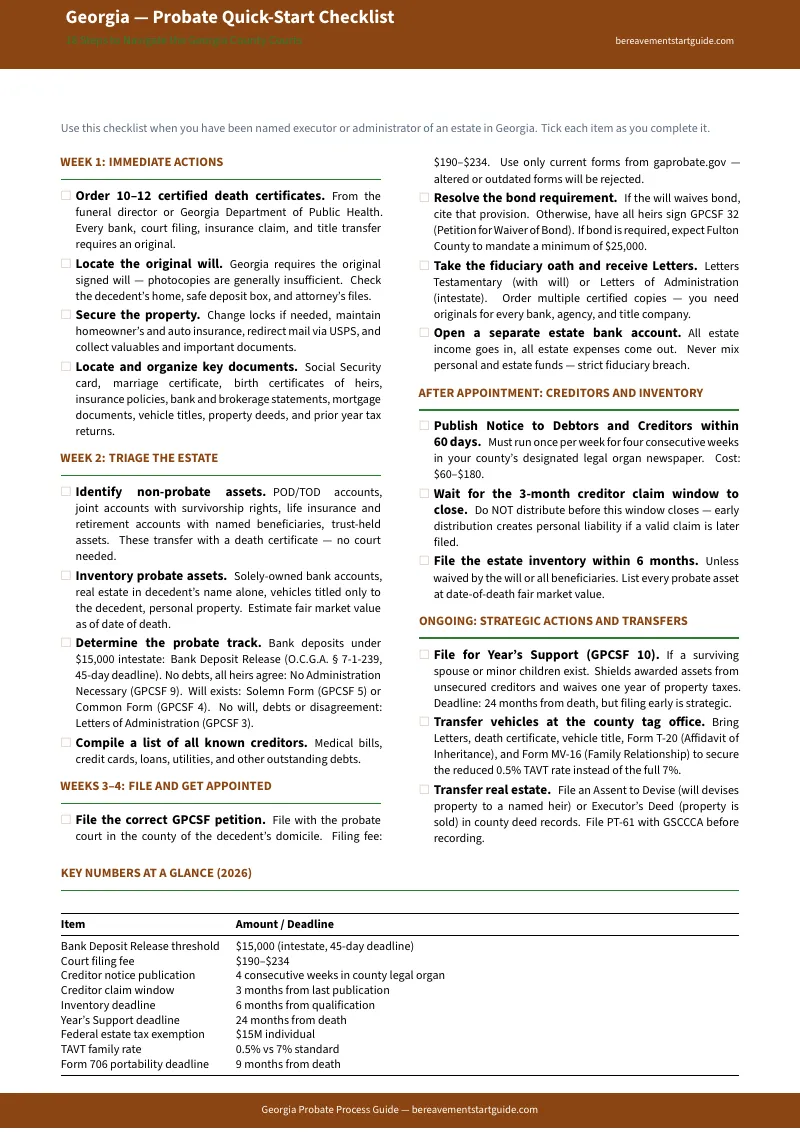
The free Quick-Start Checklist covers the first actions after death — the immediate steps, the track decision, and the critical early deadlines. The full guide covers every step from there through the final estate discharge, with form-by-form instructions, the Year's Support strategy, creditor management timelines, and real estate transfer procedures.
Frequently Asked Questions
What if the rules change after I buy?
We update the guide when the rules change. Email us any time, even years later, and we'll send you the current edition free.