Your Spouse Died in Georgia. The State Has Benefits for You. Nobody Is Going to Tell You About Them.
Within 31 days of your spouse's death, your State Health Benefit Plan coverage can vanish permanently. Within 24 months, your right to claim Year's Support — Georgia's most powerful survivor tool — expires forever. Right now, your county probate court has forms you need to file, your bank may be refusing to release funds you're legally entitled to, and the Department of Community Health could be preparing to recover Medicaid costs from the estate.
None of these agencies will call you. None of them will explain what you're eligible for. And the clock on every single one of them is already running.
The information exists — scattered across Georgia probate court websites, ERSGA retirement portals, county tax commissioner offices, the State Board of Workers' Compensation, and dozens of pages of the Official Code of Georgia. But state employees are legally prohibited from telling you how to fill out the forms. Law firm blogs give you just enough information to scare you into a $300-per-hour retainer. And your county clerk's office will hand you blank paperwork and wish you luck.
The Georgia Benefit Recovery System
This guide consolidates every Georgia survivor benefit, every filing deadline, and every agency procedure into one plain-English manual — organized by urgency, starting with what you must do in the first 72 hours and working through final estate closure. It is designed as a recovery system: you read it once, identify every benefit your family qualifies for, and work through them in order without missing deadlines or leaving money on the table.
The result: you stop guessing which agency to call first, you stop paying debts you may not legally owe, and you stop discovering benefits six months too late because nobody mentioned them.
The $15,000 Banking Shortcut Nobody Mentions
When someone dies in Georgia without a will and their bank account is frozen, most families assume they need a probate attorney. They do not — not always. Under O.C.G.A. § 7-1-239, if the deceased had less than $15,000 on deposit at a specific institution, the surviving heir can claim those funds with an Affidavit of Inheritance. No attorney, no court hearing, no six-month probate wait. The guide tells you exactly what to bring to the bank, what to say when the teller doesn't recognize the statute, and when to ask for the branch manager.
Year's Support — The Tool That Outranks Creditors
Georgia's Year's Support provision (O.C.G.A. § 53-3-1) is unlike anything in most other states. Despite its name, it is a permanent award of property from the estate to the surviving spouse and minor children. It takes priority over unsecured creditors, and in many cases it can override the terms of the will itself. But the filing window is exactly 24 months from the date of death, remarriage voids the claim entirely, and the wrong sequence of filings can undermine your position. The guide walks you through every step — from printing form GPCSF 10 to understanding when Year's Support creates serious problems in blended families.
The 31-Day Health Insurance Cliff
If your spouse was a Georgia state employee covered by the State Health Benefit Plan, you have exactly 31 days to elect continuation coverage through WEX. Miss this window and your eligibility terminates permanently — no extensions, no exceptions. The guide maps the exact notification process, explains your COBRA alternatives, and tells you what to do if the SHBP office hasn't contacted you by day 15.
What You Get — 8 PDFs
- The Complete Georgia Survivor Benefits Navigator (guide.pdf) — 49-page guide covering all 13 chapters from emergency cash access in the first 72 hours through final estate discharge, written in plain English with every relevant Georgia statute cited. Covers Year's Support, probate paths, state pensions, workers' compensation, property tax exemptions, Medicaid recovery defense, vehicle transfers, tax filings, and the 159-county reference appendix
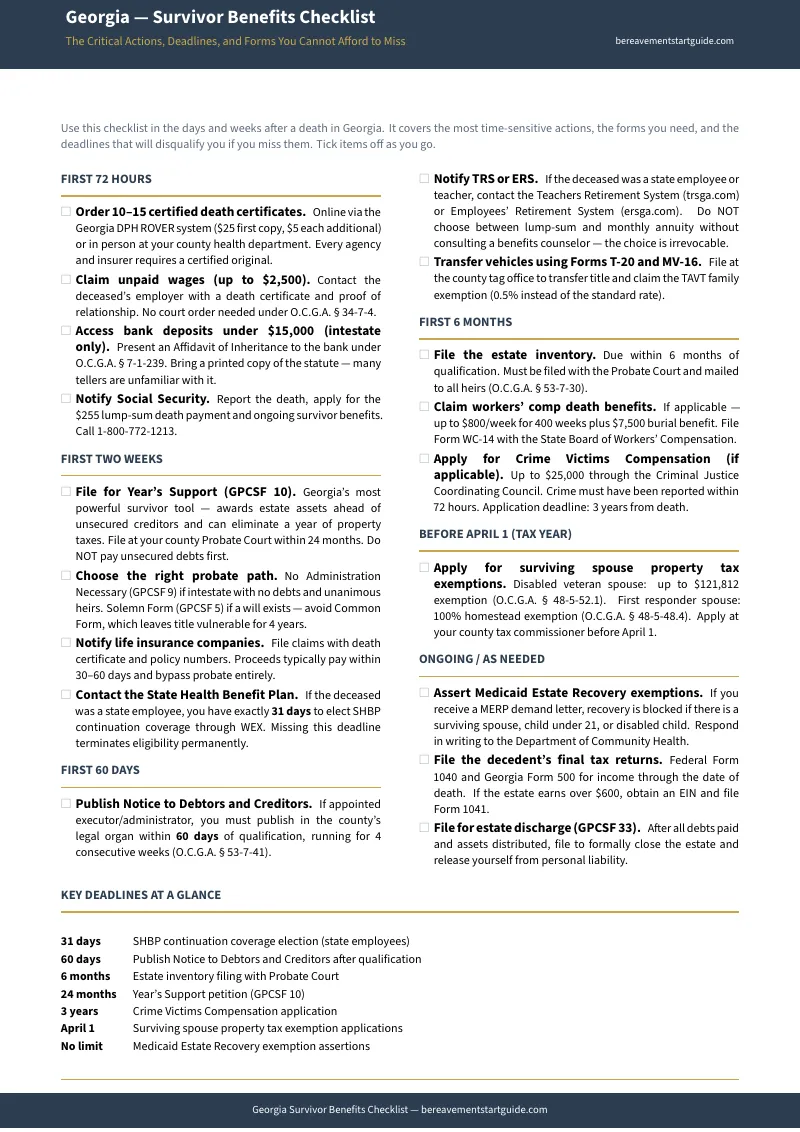
- Quick Start Checklist (checklist.pdf) — printable 2-page checklist with 18 items organized by urgency from the first 72 hours through final estate discharge, with every deadline and every form referenced
- First 72 Hours Emergency Protocol (first-72-hours.pdf) — standalone crisis reference card covering death certificate ordering through ROVER, the $2,500 unpaid wage claim, the $15,000 banking affidavit procedure with the exact language to use at the bank, and the immediate agency notification table
- Year's Support Filing Guide (year-support-filing-guide.pdf) — standalone printable with every step for filing form GPCSF 10, the 24-month deadline, the property tax election, creditor priority rules, and the critical mistakes that forfeit your claim
- Probate Path Decision Tree (probate-decision-tree.pdf) — one-page visual decision tree comparing No Administration Necessary, Solemn Form, Common Form, and Intestate Administration side by side, with the specific scenarios where each one saves you time or costs you years of title vulnerability
- Executor's Compliance Timeline (executor-compliance-timeline.pdf) — standalone desk reference with every executor deadline (60-day creditor notice, 6-month inventory), payment priority order, compensation rates, and county e-filing requirements
- County Filing Reference (county-filing-reference.pdf) — one-page lookup table with metro Atlanta county filing fees, e-filing platforms, legal organ newspapers, and the complete Georgia probate forms quick reference
- Key Statutory Thresholds Fridge Sheet (statutory-thresholds-fridge-sheet.pdf) — one-page reference with every dollar amount and deadline a Georgia survivor needs to know, from the $15,000 banking affidavit to the 31-day SHBP window
Who This Is For
- Surviving spouses trying to access frozen bank accounts and claim benefits — especially those facing the first 72 hours with no idea which agency to call first or which debts they should not be paying
- Adult children serving as executor or informal administrator — navigating probate forms, creditor notification deadlines, and the six-month estate inventory requirement for the first time
- Families of deceased state employees or teachers — dealing with ERSGA or TRS pension elections, the irrevocable lump-sum-vs-annuity decision, and the 31-day SHBP transition window
- Families of deceased veterans or first responders — claiming property tax exemptions worth tens of thousands of dollars that the county will never apply automatically
- Families facing a Medicaid Estate Recovery demand — who need to know which exemptions apply and how to assert them in writing before the DCH begins collection
- Blended families navigating Year's Support — where a surviving second spouse and adult stepchildren from a prior marriage need to understand how the law allocates assets before filing anything
Why Free Information Falls Short
Georgia's probate courts publish free forms — GPCSF 10, GPCSF 9, GPCSF 5 — but court personnel are legally prohibited from explaining how to fill them out or which one applies to your situation. ERSGA publishes retirement handbooks, but they assume you already understand the difference between Option 1, 2, 3, and 4 survivor benefits. County tax commissioners maintain exemption applications, but they do not notify you when you qualify — you have to know to apply before April 1.
Law firm blogs cover pieces of this landscape, but their business model is lead generation. They explain just enough about Year's Support to demonstrate the complexity, then end with a call to schedule a consultation. They are not going to tell you how to file GPCSF 10 yourself, because that would eliminate the billable hours.
This guide exists in the gap between those two worlds — the free forms nobody explains and the professional advice most families cannot afford in the first month after a death.
What This Guide Does Not Do
This is an administrative roadmap and organizational tool — not legal representation. It does not constitute legal, tax, financial, or medical advice, and purchasing it does not create an attorney-client relationship. If your estate involves contested creditor claims, a disputed will, blended family litigation over Year's Support, or complex business assets, the guide tells you exactly when to hire an attorney and what type of specialist you need.
— Less Than One Hour of a Probate Attorney's Time
Georgia probate attorneys typically charge $250 to $400 per hour. If this guide helps you file the $15,000 banking affidavit instead of opening a six-month probate case, or claim a property tax exemption that saves you $2,000 per year, or avoid paying unsecured debts that Year's Support would have eliminated — the return on a single read-through is measured in thousands, not dollars.
Every purchase includes a money-back guarantee, no time limit. If the guide does not save you hours of frustrating research and phone calls in the first week, email us for a full refund.
The free Georgia Survivor Benefits Checklist covers the 18 most critical actions — the ones with hard deadlines and immediate financial consequences. The full Navigator kit includes 8 PDFs: the complete 49-page guide plus 6 standalone printables — a first 72 hours emergency protocol, a Year's Support filing guide, a probate path decision tree, an executor's compliance timeline, a county filing reference, and a key statutory thresholds fridge sheet.
Frequently Asked Questions
What if the rules change after I buy?
We update the guide when the rules change. Email us any time, even years later, and we'll send you the current edition free.