The Bank Froze the Account. The DOH Says Six Weeks. The Deed Has Two Different Stamps.
Someone you love just died in Hawaii. Before the grief has even settled, you're being told to produce "Letters Testamentary," schedule an AlohaQ appointment you've never heard of, and figure out whether the house is in the "Land Court" or the "Regular System" — a distinction that apparently determines whether you file an affidavit or a formal petition, and getting it wrong will cloud the title.
The Hawaii Department of Health needs six to eight weeks to mail death certificates. The bank won't release a dollar without them. The county DMV wants the car title transferred within 30 days or you owe a $50 penalty. And somewhere in the stack of worries, there's a state estate tax that kicks in at $5.49 million — well below the federal threshold — with the highest top rate in the country at 20%.
The free government forms are out there. They're spread across the Circuit Court, the DOH, the Bureau of Conveyances, the Department of Taxation, and four separate county DMVs. None of them explain the sequence. The local probate attorneys explain it clearly, then quote $3,000 to $8,000 or $400 to $800 an hour.
The Hawaii Estate Settlement Roadmap
This guide does what no single government website or attorney consultation does: it puts the entire Hawaii estate settlement process into one chronological sequence, from the hour of death through final distributions and estate closure — with every form name, agency contact, filing fee, and statutory deadline in one place.
It's built specifically for Hawaii's system. Not a generic national probate overview with "check your state laws" footnotes. Every chapter addresses the exact agencies, thresholds, and traps that make Hawaii different from the other 49 states.
What You Get
The Complete Guide
- First 48 Hours protocol — pronouncement of death, advance directives, OCOCA medication disposal obligations (Final Attestation Form, Drug Take Back requirements), funeral home coordination, and the 3-nautical-mile rule for ocean ash scattering
- Death certificate strategy — DOH fee structure ($10 first copy, $4 each additional, $2.50 portal fee per 5 certificates), how many to order, which institutions demand originals versus photocopies, and in-person pickup at 1250 Punchbowl Street in Honolulu when you can't wait 6–8 weeks for mail delivery
- The $100,000 small estate decision — a qualification checklist for the Affidavit for Collection of Personal Property (HRS § 560:3-1201) that lets you bypass probate entirely. Vehicles and certain real property are excluded from the calculation. Plus the Clerk of Court Administration route (HRS § 560:3-1205) where the court handles everything for a 3% fee
- Hawaii probate walkthrough — which of the four Circuit Courts has jurisdiction (Oahu, Maui, Big Island, Kauai), filing fees ($100 base + $65 indigent surcharge + administrative fees), informal vs. formal tracks, Letters Testamentary, and the mandatory creditor publication (two successive weeks, then a 4-month claims window)
- Land Court vs. Regular System — the single most dangerous trap in Hawaii real estate. How to read the stamp on your deed (top left = Land Court, top right = Regular System), the completely different transfer process for each system, recording fees ($41 Regular System, $36 + $50 for new Certificate of Title in Land Court), TOD deed procedures, and Form P-64B for conveyance tax exemption
- County-by-county vehicle transfers — Honolulu (Form CS-L(MVR)39, $10, mandatory AlohaQ appointment), Maui ($20, current Safety Inspection required), Hawaii County ($5, strict 30-day window, $50 late fee), Kauai ($10). Every county's forms, fees, and deadlines in one place
- Bank account procedures — what Bank of Hawaii, First Hawaiian Bank, and other institutions require to release frozen funds. POD vs. non-POD accounts. The 5-year dormancy period that triggers escheatment to the state
- The $5.49 million estate tax trap — Hawaii's frozen exemption catches families who assume the $13+ million federal threshold protects them. Graduated rates from 10% to 20%. Form M-6 filing within 9 months. A worked example showing how a $6.2 million estate generates a $71,000+ state tax bill while owing zero to the IRS
- Act 232 nonresident withholding — if you're distributing Hawaii-source income to a beneficiary on the mainland, you must withhold 11%. Schedule NT, Form N-4T, and how to calculate the exact amount
- HARPTA cash flow planning — selling Hawaii real property as a nonresident estate triggers a 7.25% withholding on the gross sales price at closing. How to file Form N-288B for a refund, and why a $1 million property sale can lock up $72,500 in immediate liquidity even when the actual capital gain is zero
- Creditor priority hierarchy — administration costs → funeral expenses → medical expenses of last illness → federal taxes → state taxes → unsecured debts. Why distributing assets before the 4-month window closes makes the executor personally liable
- Statutory family protections — Homestead Allowance, Exempt Property ($20,000 in furniture, vehicles, and personal effects), Family Allowance, and the Elective Share (up to 50% of the augmented estate)
- When to hire a professional — the exact triggers for an attorney ($400–$800/hr), CPA, title company, or escrow agent — so you don't pay $5,000 for tasks you can handle yourself, but you don't accidentally handle tasks that require a license
Eight Standalone Worksheets and Reference Sheets
- Estate Settlement Timeline — every statutory deadline from Day 1 through final distribution, with space to fill in your own target dates
- Asset Inventory Worksheet — catalog every asset, mark probate vs. non-probate status, and track estimated values in one fillable table
- Notification Tracker — a structured log for every agency and institution you need to notify, with Hawaii-specific contact information
- Creditor Claim Tracker — manage the 4-month creditor window, log each claim, and reference the HRS priority payment order
- Land Court vs. Regular System Reference — a quick-reference sheet for Hawaii's dual real estate recording system so you never file the wrong paperwork
- Small Estate Qualification Checklist — determine in minutes whether the estate can bypass probate using the $100,000 threshold under HRS § 560:3-1201
- County Vehicle Transfer Reference — Honolulu, Maui, Hawaii County, and Kauai forms, fees, and deadlines in one printable sheet
- Estate Tax Worksheet — calculate whether the estate triggers Hawaii's $5.49M estate tax and estimate the liability step by step
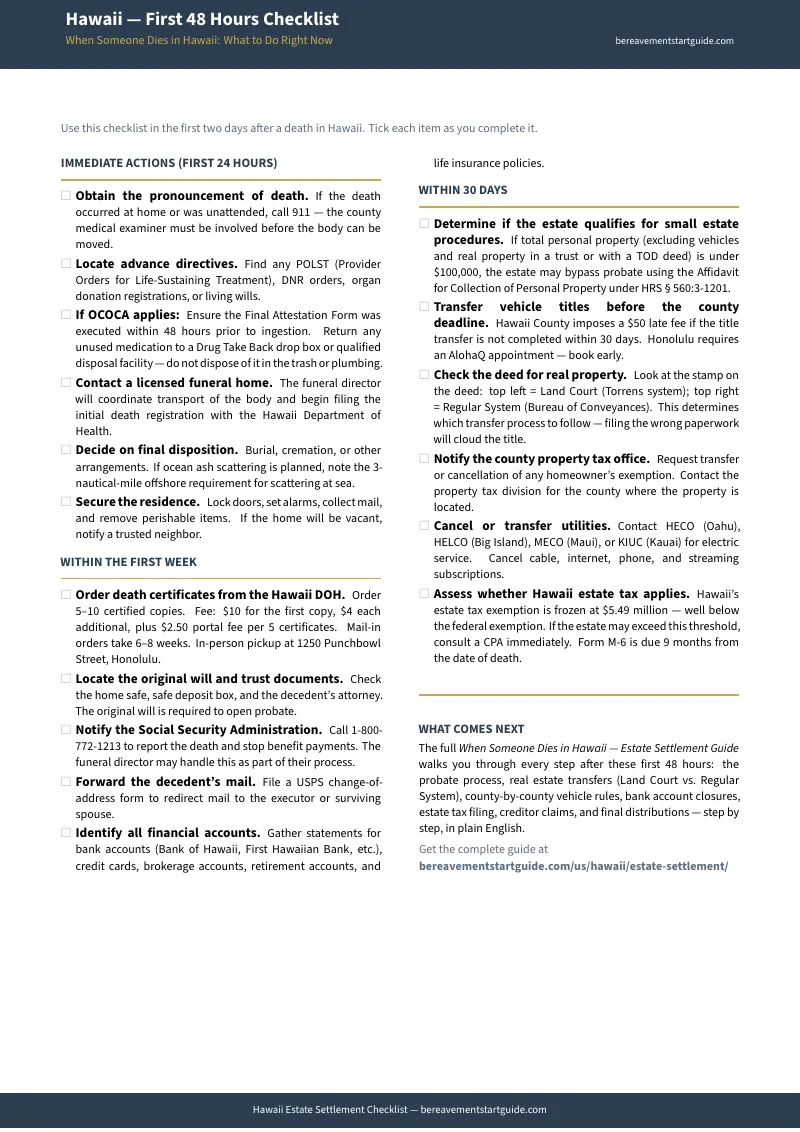
The Free Hawaii First 48 Hours Checklist
A printable emergency checklist covering the 17 most urgent tasks — from pronouncement of death and locating advance directives through ordering death certificates, securing the residence, and identifying all financial accounts. Available as a free download so you can start immediately while deciding whether the full guide is right for your situation.
Who This Is For
- Surviving spouses who need to access frozen bank accounts, understand Homestead Allowance and Elective Share rights, and transfer jointly held real estate without making a Land Court mistake
- Mainland executors managing a Hawaii estate from thousands of miles away — navigating eCourt Kōkua, AlohaQ appointments, and four different county DMVs across time zones
- Adult children settling a parent's estate for the first time, unsure whether to attempt it yourself or hire an attorney, and wanting to understand the full process before committing to either path
- Native Hawaiian families dealing with multi-generational heirs property, undivided interests, and titles that have remained in a deceased relative's name for years
- Anyone named as executor who wants to show up to every conversation with banks, courts, and county offices fully prepared — reducing both stress and billable attorney hours
Why Not Just Use the Free Government Forms?
Every form referenced in this guide is available for free on a Hawaii government website somewhere. The Affidavit for Collection of Personal Property (Form 3C-E-210) is on the Judiciary site. The conveyance tax exemption (Form P-64B) is on the DOTAX site. The vehicle transfer forms are on four separate county DMV sites.
What's not free — and what no government website provides — is the sequence. The DOH site doesn't warn you that banks will freeze accounts while you wait 6–8 weeks for certificates. The Judiciary site doesn't explain that using a Regular System affidavit for a Land Court property will cloud the title. The county DMV sites don't mention that missing the 30-day transfer window on the Big Island triggers a $50 penalty.
This guide puts every form, every deadline, every fee, and every agency into the order you actually need them — so you don't learn about the 30-day vehicle deadline on day 45, or discover the Land Court distinction after filing the wrong paperwork.
— Less Than One Hour of Attorney Time
A single hour with a Honolulu probate attorney costs $400 to $800. This guide covers the administrative fundamentals that would otherwise consume your first several billable hours — ordering certificates, qualifying for the small estate affidavit, identifying your real estate system, understanding county DMV rules, and organizing your documents. Show up to your first legal consultation already organized, and you'll save far more than the cost of the guide in reduced billable time.
If the guide doesn't save you at least ten hours of frustrating research across scattered government websites, email us at any time for a full refund. No questions asked.
Frequently Asked Questions
What if the rules change after I buy?
We update the guide when the rules change. Email us any time, even years later, and we'll send you the current edition free.