The Clerk Handed You the Filing Number. Nobody Told You What Comes Next.
The bank froze the account. First Hawaiian or Bank of Hawaii told you they need "Letters Testamentary" before they will release a dollar. You drove to the circuit court — First Circuit on Oahu, Second Circuit on Maui, Third Circuit on the Big Island, Fifth Circuit on Kauai — and discovered there is no centralized packet of probate forms waiting for you. Hawaii's Judiciary does not provide a plain-English instruction manual for self-represented filers. The JEFS e-filing system was built for attorneys. The clerks are helpful, but they are legally prohibited from telling you which petition to file or how to fill it out.
So now you know the estate needs to go through probate. You know there is a four-month creditor claim window, a 90-day inventory deadline, and something called a "Notice to Creditors" that must be published in a newspaper. You know that hiring a Honolulu probate attorney costs between three thousand and six thousand dollars for a straightforward, uncontested estate. And you know that if you make a procedural mistake — filing with the wrong recording system at the Bureau of Conveyances, missing the vehicle transfer deadline, or miscalculating the small estate threshold — the consequences fall on you personally.
The Hawaii Probate Navigation System
This guide gives you what the court cannot: a complete, plain-English translation of every step in Hawaii Revised Statutes Chapter 560 — from the day of death through the final closing statement. It bridges the gap between free government websites that assume you are an attorney and a legal retainer that depletes the estate before the family sees a cent.
Four Paths, One Decision Tree
Hawaii does not have a single probate process. Your estate qualifies for one of four distinct paths, and filing the wrong petition costs months of delay and hundreds of dollars in re-filing fees. The guide walks you through the decision: the Small Estate Affidavit (Form 3C-E-210) for estates under $100,000 with no real property. Court Clerk Administration when no personal representative steps forward. Summary Administration for insolvent or minimal estates. Standard probate — informal or formal — for everything else. Most Hawaii families own a home, which means the $100,000 small estate threshold is immediately irrelevant, and standard probate is the only viable path. The guide tells you this clearly so you do not waste weeks chasing a shortcut that does not apply.
The Bureau of Conveyances Trap That Ruins Real Estate Transfers
Hawaii has two separate land recording systems — the Regular System and the Land Court system — and they are not interchangeable. Record your deed in the wrong system and the transfer is invalid. The guide explains how to determine which system governs each property, what the Conveyance Tax and Form P-64B require, how to protect the home exemption during transfer, and why the distinction between these systems matters more in Hawaii than in any other state. For estates with property on multiple islands, it covers the ancillary steps for each circuit.
HARPTA — The Tax Trap Nobody Warns Non-Resident Executors About
If the decedent was not a Hawaii resident at death, or if you are a non-resident executor selling Hawaii real estate, the state withholds 7.25% of the gross sale price under the Hawaii Real Property Tax Act. This is separate from federal FIRPTA withholding. The guide explains when HARPTA applies, how to file for an exemption or reduced withholding, and the exact steps to avoid having tens of thousands of dollars held by the Department of Taxation on top of the federal withholding you are already managing.
Creditor Management That Protects You Personally
Distribute estate assets before the four-month creditor claim window closes, and you become personally liable for the deceased's debts. The guide covers the exact publication requirements — once a week for three successive weeks in a newspaper of general circulation within your judicial circuit — the direct notice obligations to known creditors, the priority hierarchy for paying claims, and the safe date to begin distributions. Skip the newspaper publication, and the creditor liability window extends to eighteen months.
What You Get — 10 Printable PDFs
- The Complete Hawaii Probate Guide — 14 chapters and 3 appendices covering every step from securing the estate through final closing, including the four-path decision tree, JEFS e-filing guidance, real estate transfer procedures, and a full forms directory
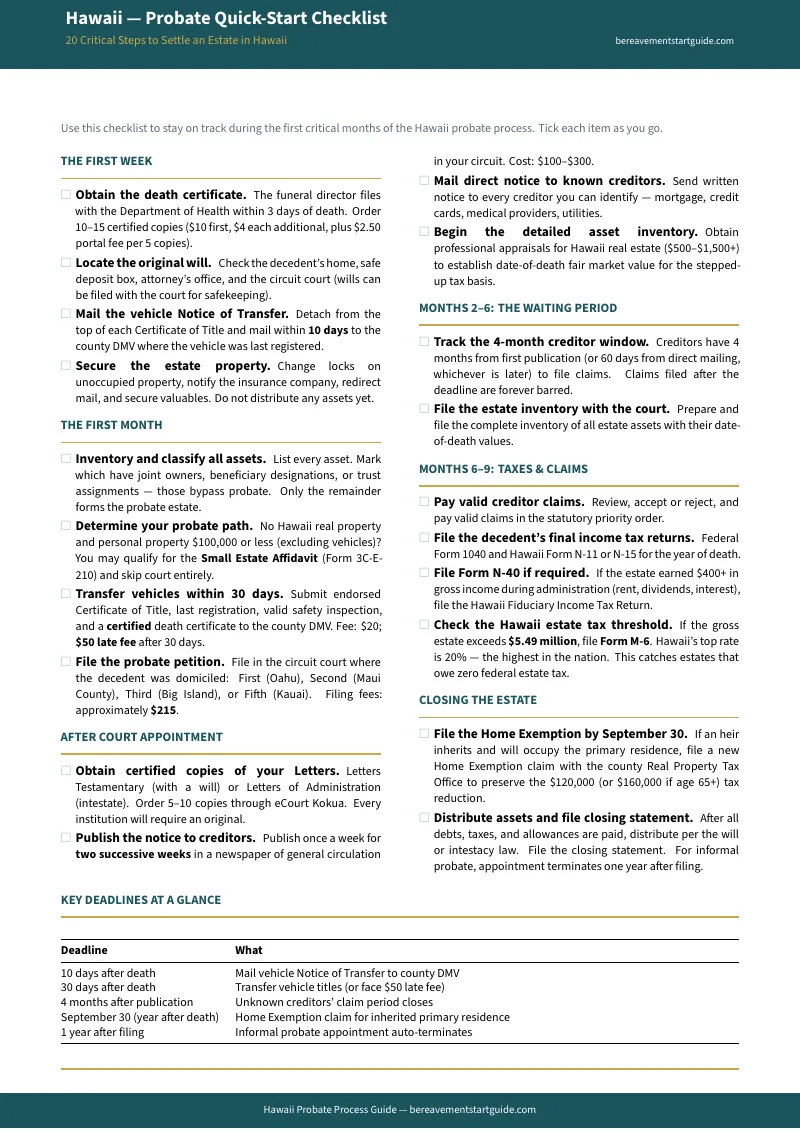
- Hawaii Probate Quick-Start Checklist — 20-item printable checklist covering every action from obtaining death certificates through filing the final closing statement, organized chronologically by deadline
- Probate Path Decision Tree — One-page visual flowchart to determine whether you qualify for the Small Estate Affidavit, Court Clerk Administration, Summary Administration, or standard probate
- Asset Inventory Worksheet — Fillable worksheet for cataloging every estate asset with space for account numbers, values, and beneficiary designations
- Bureau of Conveyances Quick Reference — Side-by-side comparison of Hawaii's dual recording systems (Regular System vs. Land Court) with the conveyance tax schedule and home exemption rules
- HARPTA Withholding Quick Reference — Step-by-step mitigation guide for the 7.25% state tax withholding that catches non-resident executors selling Hawaii property
- Creditor Management Timeline — Fillable tracker for the four-month claim window, newspaper publication dates, direct notice log, and payment priority order
- Estate Tax Filing Checklist — Every tax form, threshold, and deadline for Hawaii executors, including the $5.49 million state exemption trap
- Complete Forms Directory — Printable reference listing every judiciary, tax, vital records, and vehicle form with form numbers and issuing agencies
- Probate Timeline at a Glance — One-page calendar from day one through month twelve with statutory deadlines highlighted and fill-in date columns
Who This Is For
- Named executors who have the will but not the instructions — you need to know which circuit court to file in, which petition form to use, and how to navigate the JEFS system without an attorney
- Surviving spouses who need to understand their statutory allowances, the elective share, how to protect the home exemption during property transfer, and how to unfreeze bank accounts as quickly as possible
- Family administrators of intestate estates who must petition for Letters of Administration, post bond, and follow the statutory inheritance hierarchy when there is no will
- Out-of-state adult children settling a parent's Hawaii estate remotely — especially those unfamiliar with the Bureau of Conveyances, the Conveyance Tax, and HARPTA withholding requirements
- Non-resident executors managing Hawaii real estate from the mainland who need to understand ancillary probate, the Acknowledgment of Authority process, and the HARPTA exemption filing
Why Free Resources Fall Short
The Hawaii State Judiciary website provides raw statutes and access to the JEFS filing system. It does not provide a centralized set of probate forms with instructions. Legal Aid Society services are income-restricted. Attorney blogs give you just enough information to justify a three-thousand-dollar retainer. And national legal platforms routinely omit Hawaii-specific provisions like the dual recording systems at the Bureau of Conveyances, the HARPTA withholding trap, the Court Clerk Administration option, and the unique rules for Hawaiian Home Lands leaseholds — because they are writing for fifty states, not yours.
This guide covers only Hawaii. Every form reference, every statutory citation, every deadline, and every procedural step applies to your circuit court and no one else's.
What This Guide Does Not Do
This is an educational and administrative tool — not legal representation. If heirs are contesting the will, the estate involves complex business structures or Hawaiian Home Lands leaseholds, or a creditor has filed a lawsuit against the estate, you need a licensed Hawaii estate attorney. When that is the case, the guide tells you exactly why and what kind of professional to look for. For uncontested estates where the family agrees and you need to follow the rules correctly, this guide gives you the complete roadmap.
— Less Than Four Minutes of a Hawaii Attorney's Time
Honolulu probate attorneys charge four hundred to eight hundred dollars per hour. A full uncontested informal probate retainer runs three thousand to six thousand dollars. Circuit court filing fees alone are approximately two hundred fifteen dollars. This guide costs less than four minutes of billable attorney time and covers every step of the process those fees are supposed to pay for.
Every purchase includes a money-back guarantee, no time limit. If the guide does not give you the clarity and confidence you need to navigate Hawaii probate, email us for a full refund.
The free Quick-Start Checklist covers the immediate actions after death — securing the estate, obtaining death certificates, determining your probate path, and meeting the early deadlines. The full guide covers every step from there through the final closing statement, with the four-path decision tree, Bureau of Conveyances transfer instructions, HARPTA guidance, creditor management timelines, and tax filing checklists.
Frequently Asked Questions
What if the rules change after I buy?
We update the guide when the rules change. Email us any time, even years later, and we'll send you the current edition free.