Idaho Has No Estate Tax. You Filed the Final Return Anyway. The Bank Still Will Not Release the Account. And the IRS Just Sent a Letter About a Form You Have Never Heard Of.
Someone died in Idaho, and you are the person responsible for the taxes. You searched "Idaho estate tax" and every result said the same thing: Idaho does not have one. You exhaled. Then you discovered that "no estate tax" does not mean "no tax obligations" --- and now you are staring at a stack of forms that nobody prepared you for.
The decedent's final Idaho Form 40 needs to be filed from January 1 through the date of death. The estate earned interest and dividend income after death, which triggers a federal Form 1041 and an Idaho Form 66 if gross income hits $600. There are K-1 forms to issue to beneficiaries. The brokerage sent a date-of-death statement showing a cost basis you do not recognize. Your sister is asking when she gets her share. Your brother wants to sell the house immediately. And nobody can explain whether that house gets a stepped-up basis on half the value or all of it --- because Idaho is a community property state, and the answer depends on how title was held.
The Idaho Final Tax & Estate Tax Guide is a Tax Navigation System for every form, deadline, and financial decision between the date of death and final estate closure in Idaho --- covering the decedent's final income tax, the estate's fiduciary income tax, the community property double step-up in basis, non-probate transfers, and distribution to beneficiaries. Not a blog post that stops at "Idaho has no estate tax." Not a law firm article designed to sell you a $3,000 retainer. A plain-English, Idaho-specific operational guide that tells you exactly which returns you must file, which deadlines will trigger penalties if you miss them, and which Idaho-specific tax advantages could save the estate thousands.
What's Inside the Tax Navigation System
A 13-chapter guide with 4 appendices, plus a printable tax checklist --- covering every tax obligation, administrative step, and financial decision executors and surviving spouses face after a death in Idaho:
Chapter 1: The First 30 Days --- Triage and Stabilization
The foundational steps that every subsequent tax filing depends on. Ordering 10-12 certified death certificates at $16 each from the Idaho Bureau of Vital Records. Securing real estate, vehicles, and financial accounts before banks freeze them. Collecting the last three years of federal and Idaho returns, all W-2s and 1099 forms, K-1s, date-of-death brokerage statements, deeds, and the itemized funeral invoice. Locating the will, any recorded community property agreement, CPWROS deed, or TOD deed. Why third-party vendors like VitalChek add surcharges you can avoid by ordering directly.
Chapter 2: Idaho's Tax Landscape --- What You Owe and What You Do Not
The chapter that clears up the single biggest misconception. Idaho has no state estate tax and no inheritance tax --- regardless of estate value. But three separate tax obligations still apply: the decedent's final individual income tax (Form 1040 + Idaho Form 40), the estate's fiduciary income tax (Form 1041 + Idaho Form 66), and capital gains calculations when beneficiaries sell inherited assets. The current federal estate tax exemption ($15 million per individual, $30 million per married couple for 2026) and why filing Form 706 for portability may still matter for Idaho families holding agricultural land, ranches, or commercial real estate.
Chapter 3: Which Estate Track Are You On?
A decision tree that determines your procedural path in five minutes. Track A: Small Estate Affidavit for estates under $100,000 in personal property with no real estate --- no court filing, no fee, 30-day waiting period. Track B: Summary Administration under IC 15-3-1205 for surviving spouses who are the sole beneficiary --- $130 filing fee, streamlined court process, but the spouse assumes full creditor liability. Track C: Informal or Formal Probate for everything else --- $166 filing fee, 4-month creditor claim window, court-supervised inventory and distribution. Side-by-side comparison table so you can see exactly which track applies.
Chapter 4: Opening the Estate --- Appointment, Creditors, and Inventory
Applying for the estate EIN using IRS Form SS-4 (instant online issuance). Opening the estate bank account. The fiscal year election that can defer tax liability --- and why the decision is irrevocable. Filing Form IUPC008 with the Magistrate Division. Publishing the Notice to Creditors (once per week for three successive weeks, $75-$150). The 3-month inventory deadline. Mailing direct notice to heirs within 30 days. The 4-month creditor claim window and why distributing assets before it closes exposes you to personal liability.
Chapter 5: The Final Individual Income Tax Return
Line-by-line guidance for the decedent's last federal Form 1040 and Idaho Form 40 --- covering income from January 1 through the date of death. Filing jointly as the surviving spouse (write "FILING AS SURVIVING SPOUSE" in the signature block). When to attach IRS Form 1310 to claim a refund. How to handle 1099 forms that arrive months after death. Deducting qualifying medical expenses paid within one year of death. The interaction between the final return and the estate's fiduciary return.
Chapter 6: The Estate's Fiduciary Income Tax
Federal Form 1041 and Idaho Form 66 --- required when the estate earns $600 or more in gross income after the date of death. The income threshold that catches executors off guard: even modest bank interest and dividend reinvestment can trigger the filing requirement. Issuing ID K-1 forms to beneficiaries. The pass-through entity complication: Form PTE-12 and the 5.695% withholding rate for non-resident beneficiaries. Why the fiscal year election matters here --- and the specific circumstances where it saves real money.
Chapter 7: Community Property and the Double Step-Up in Basis
The most financially significant chapter for Idaho families. In common-law states, only the deceased spouse's half of jointly held property receives a stepped-up basis. In Idaho, a community property state, both halves step up to fair market value at the date of death --- potentially eliminating hundreds of thousands of dollars in capital gains when the surviving spouse or heirs sell. How the double step-up applies to real estate, brokerage accounts, and business interests. The critical difference between community property, separate property, and quasi-community property. A printable Step-Up Worksheet (Appendix C) for calculating the new basis on every major asset.
Chapter 8: Non-Probate Transfers --- TOD Deeds, Community Property Agreements, and CPWROS
Assets that bypass probate still have tax implications. The new Transfer on Death Deed (URPTODA) effective July 1, 2026 --- Idaho's first TOD deed for real estate. Community Property with Right of Survivorship (CPWROS) deeds and the $15 recording fee. Pay-on-death bank accounts, retirement accounts with named beneficiaries, and life insurance proceeds. Why bypassing probate does not bypass taxation --- and the specific scenarios where executors get blindsided by fiduciary income obligations on "probate-free" assets.
Chapter 9: Jurisdictional Costs --- Fees, Recording, and County Variations
Idaho has 44 counties, and fees vary. Probate filing: $166 statewide. Summary Administration: $130. Deed recording: $15. Trust deed recording: $45. Death certificate: $16 per copy. Newspaper publication costs for creditor notices: $75-$200+ depending on the county. County assessor procedures for the Property Tax Reduction (Circuit Breaker) program --- up to $1,500 annual reduction for qualifying surviving spouses, income limit $39,130 for 2026, filed between January 1 and April 15.
Chapter 10: Distribution, Closing, and Ongoing Obligations
The debt priority order that must be followed before any beneficiary receives a cent: (1) administration costs, (2) family/homestead/exempt allowances, (3) funeral and last-illness expenses, (4) taxes, (5) general unsecured creditors. Filing the closing statement under IC 15-3-1003 after the 6-month minimum from appointment. Obtaining IRS estate tax clearance if Form 706 was filed. The ongoing obligation for trusts that continue past estate closure. The personal representative's release from liability.
Chapter 11: Common Costly Mistakes --- and How to Avoid Them
The five errors that cost Idaho estates the most: distributing assets before the creditor window closes (personal liability for the executor). Missing the $600 fiduciary income threshold and failing to file Form 66 (Idaho State Tax Commission penalties). Confusing "no estate tax" with "no tax obligations" (the most common and most dangerous misconception). Failing to claim the community property double step-up (overpaying capital gains by tens of thousands). Skipping the portability election on Form 706 (the surviving spouse loses millions in future estate tax shelter).
Chapter 12: Health Directives, POST Forms, and Pre-Planning
For families who want to prevent this confusion for the next generation. Idaho's Physician Orders for Scope of Treatment (POST) form and the Healthcare Directive Registry. Powers of attorney and their termination at death. Why a written Authorization for Final Disposition prevents family conflict. Pre-death tax planning strategies that reduce the estate's eventual burden.
Chapter 13: When to Hire a Professional --- and How to Prepare
The specific situations where a CPA or estate attorney is worth the fee: contested wills, complex business holdings, multi-state beneficiaries requiring PTE-12 withholding, Medicaid estate recovery defense. How to use this guide to prepare for that meeting --- organizing documents, identifying questions, and understanding enough context to evaluate whether the professional's advice makes sense. Why showing up prepared can cut billable hours by half or more.
Appendices
Four printable reference tools: Appendix A --- Complete Form Reference with every federal and Idaho form, the agency, and the filing context. Appendix B --- Key Deadlines at a Glance, a one-page timeline from death through estate closure. Appendix C --- Community Property Step-Up Worksheet for calculating the new basis on every major asset. Appendix D --- Estate Administration Budget Worksheet for tracking costs against estate value.
Who This Guide Is For
- The surviving spouse who just learned that "no estate tax" does not mean "no tax returns" --- who needs to file the decedent's final Idaho Form 40, figure out whether the estate triggers Form 66, and understand how Idaho's community property double step-up could save tens of thousands in capital gains when selling the family home. The guide walks through each filing with the exact forms, deadlines, and signature requirements.
- The adult child executor managing the estate from out of state --- who has Letters Testamentary, an EIN, and a pile of 1099s but no idea how to reconcile the final individual return with the estate's fiduciary return, or whether to elect a fiscal year. The guide provides a chronological operational roadmap from the first week through estate closure, so you work through it in order instead of jumping between disconnected government PDFs.
- The family using a Small Estate Affidavit who thinks they can skip taxes --- who bypassed probate for an estate under $100,000 and now assumes all obligations are settled. The guide explains why the final income tax return is still required, why non-probate assets can still trigger fiduciary income obligations, and the specific scenarios where the Idaho State Tax Commission comes looking.
- The trustee managing a living trust after the grantor's death --- who faces ongoing K-1 distribution requirements, the PTE-12 withholding obligation for non-resident beneficiaries at 5.695%, and the personal liability that comes with mismanaging fiduciary tax obligations. The guide covers the trust-specific tax landscape that generic estate guides ignore.
- The executor trying to decide whether to hire a CPA or handle it themselves --- who knows that Idaho probate attorneys charge $2,000-$4,000 retainers and CPAs bill $150-$300 per hour, but is not sure if their estate is simple enough to manage independently. The guide gives you enough understanding to make that call and --- if you do hire a professional --- to show up prepared enough to cut billable hours in half.
Why Free Resources Leave You Exposed
The information about Idaho's tax obligations after death exists. It is scattered across the Idaho State Tax Commission in dense statutory language, the IRS in forms designed for tax professionals, law firm blogs that deliberately stop short of actionable instructions to funnel you into a consultation, and national financial platforms that cover Idaho as a two-sentence footnote. Here is what you actually encounter when you try to navigate the process using free sources:
- The Idaho State Tax Commission publishes every form you need. It does not tell you which ones apply to your situation. Form 40, Form 66, Form PTE-12, the ID K-1 --- they are all available as downloadable PDFs. But the instructions are written for CPAs, not for grieving family members. There is no narrative explaining the relationship between the final individual return and the estate's fiduciary return, no explanation of how the $600 income threshold works, and no guidance on the fiscal year election that could save the estate real money.
- Law firm blogs explain the concepts beautifully. Then they stop. You will find excellent articles from Idaho firms on the community property double step-up, the Small Estate Affidavit threshold, and the probate filing process. Every single one ends with "Contact us to schedule a consultation." They explain what the rules are. They never explain how to complete the forms, when to file them, or what happens if you miss a deadline. The information gap between their blog post and a $3,000 retainer is where this guide lives.
- National platforms like SmartAsset and TurboTax cover Idaho generically. They will tell you Idaho has no estate tax. They will not explain that the estate's fiduciary income tax kicks in at $600 in gross income, that Form PTE-12 requires withholding for out-of-state beneficiaries, or that Idaho's community property status means both halves of marital assets step up to fair market value. When you are trying to calculate the basis on an inherited home, "Idaho has no estate tax" is not an answer.
- The IRS website covers the federal side. Idaho's state-specific requirements are invisible. You can find detailed guidance on Form 1041, Form 706, and Form 1310. None of it addresses Idaho Form 66, the Idaho-specific income thresholds, the PTE-12 pass-through withholding, or the Property Tax Reduction program that could save a surviving spouse $1,500 per year. Federal guidance and Idaho guidance are two separate tax universes, and no free resource maps the intersection.
- Estate software platforms handle the workflow but cost $199 or more per estate. EstateExec and Trust & Will provide automated task lists and accounting calculators. They are excellent tools for complex estates. For the majority of Idaho families dealing with a standard estate, a house, retirement accounts, and a brokerage, paying $199 for software when a comprehensive guide covers the same ground is the expensive way to solve a straightforward problem.
Free resources give you fragments: a form without context, a concept without a procedure, a deadline without consequences. The Tax Navigation System puts every Idaho tax obligation, every federal interaction, and every financial decision into one document --- organized by the timeline you actually follow, with the forms you actually file, and the mistakes that actually cost money.
--- Less Than One Hour of CPA Billing Time
Idaho CPAs charge $150 to $300 per hour for estate tax preparation. A standard estate with a final income tax return, a fiduciary return, and capital gains calculations typically generates 8 to 15 billable hours. This guide covers the same territory for less than the cost of a single phone consultation --- and for many standard estates, it is everything you need to handle the filings independently.
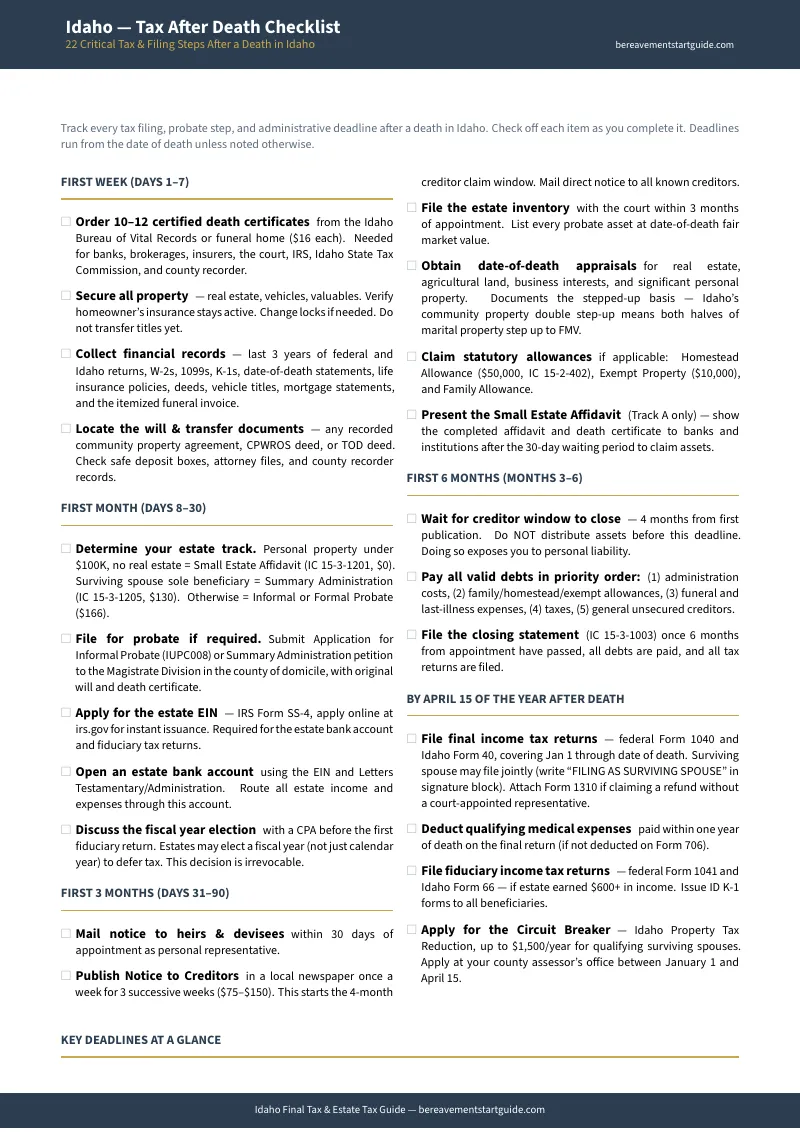
Your download includes the complete 13-chapter guide with 4 appendices, a printable Community Property Step-Up Worksheet, an Estate Administration Budget Worksheet, and the Idaho Tax After Death Checklist --- everything you need to track every form, deadline, cost, and basis calculation from the first week through final estate closure.
Money-back guarantee, no time limit. If this guide does not save you at least three hours of research and give you total clarity on every Idaho tax obligation after a death --- email us for a full refund. No questions asked.
Not ready for the full guide? Download the free Idaho Tax After Death Checklist --- a summary of every deadline, form, and filing requirement so you know exactly what is ahead. Enough to stop guessing and start planning.
You did not choose to become the person responsible for someone else's taxes. But every Idaho tax obligation, every deadline, and every financial advantage is documented in this guide --- so you can handle it with confidence instead of fear.
Frequently Asked Questions
What if the rules change after I buy?
We update the guide when the rules change. Email us any time, even years later, and we'll send you the current edition free.