The Bank Froze the Account. The Court Website Has 200 Forms in Alphabetical Order. Nobody Will Tell You Which One to File First.
You called the bank to pay the funeral bill, and they said the account is frozen until you bring them something called Letters Testamentary. You searched the Idaho Court Assistance Office website and found 200 downloadable forms listed alphabetically with no instructions. You do not know whether you need an Affidavit Collecting Property, a Petition for Informal Probate, a Petition for Formal Probate, or something else entirely. The clerk's office told you they cannot give legal advice. The attorney you called quoted $3,000.
Meanwhile, creditors are sending bills to the decedent's address. You are not sure if you are personally liable for any of them. You know there is a deadline for notifying creditors but you do not know what it is or how it works. And somewhere in the back of your mind, you are aware that the other heirs are watching everything you do and you cannot afford to make a mistake that delays the estate by six months or triggers a lawsuit.
The Idaho Probate Roadmap
Idaho adopted the Uniform Probate Code, which means there are actually three separate legal pathways depending on the size and type of assets in the estate. Choosing the wrong one — or not realizing a simpler option exists — is the single most expensive mistake executors make. This guide maps all three pathways with the specific dollar thresholds, asset rules, and eligibility criteria so you know exactly which one applies to your situation before you file a single piece of paper.
Three Pathways, One Decision — The $100,000 Fork
Idaho allows estates valued under $100,000 to skip court entirely using a Small Estate Affidavit. But the calculation is not straightforward. Vehicles are excluded from the cap. Liens and debts are subtracted before you compare to the threshold. And if the decedent owned any real estate in their individual name — a house, a cabin, a half-acre lot — the affidavit option is completely unavailable regardless of the estate's dollar value. The guide walks you through the exact calculation with examples so you know in 15 minutes whether you qualify.
The Surviving Spouse Shortcut Most Families Miss
Idaho Code Section 15-3-1205 allows a surviving spouse who is the sole beneficiary to use Summary Administration — a simplified process that bypasses months of standard probate, works for real estate, and has no dollar limit. This option is buried in the statute and almost never mentioned on free legal websites. The guide covers exactly how it works, what "sole beneficiary" means in a community property state, and the specific forms and filing steps to execute it.
The Creditor Timeline That Protects You From Personal Liability
Idaho has two separate creditor notification systems, and using the wrong one can leave you personally exposed. Publishing a Notice to Creditors in a local newspaper triggers a 4-month claims window. Sending direct written notice to a known creditor triggers a 60-day window. Medical bills, credit cards, and mortgage servicers all have different rules for what constitutes a valid claim. The guide covers both notification methods, the exact statutory language you need, and the timeline that permanently bars late claims so you can close the estate without worrying that a hospital will come after your personal assets two years later.
The 90-Day Inventory Deadline Nobody Prepares You For
Within 90 days of your court appointment, you must submit a comprehensive inventory of every asset the decedent owned — with fair market values, encumbrances, and descriptions detailed enough to satisfy the magistrate and every heir watching for errors. Miss the deadline and you risk removal as personal representative. Undervalue an asset and you risk breach of fiduciary duty claims. The guide includes an asset-by-asset breakdown of what counts, how to value it, and what documentation the court actually expects.
Real Estate Transfer Without Getting Stuck at the Title Company
Title companies in Idaho will not clear a sale or transfer on inherited property until the probate court formally re-titles the asset. The guide covers Personal Representative's Deeds, Deeds of Distribution, recording fees ($10.00 first page plus $3.00 each additional), and the county assessor process for updating the Homeowner's Exemption — so you do not discover at the closing table that you are missing a document the title company needs.
What You Get
- The Complete Idaho Probate Process Guide — 13 chapters plus 3 appendices covering all three legal pathways, the magistrate court filing process, creditor notification timelines, statutory allowances, real estate and vehicle transfers, tax filing requirements, estate closing procedures, a county-by-county court directory for all 44 Idaho counties, key statutes reference, and a complete forms checklist
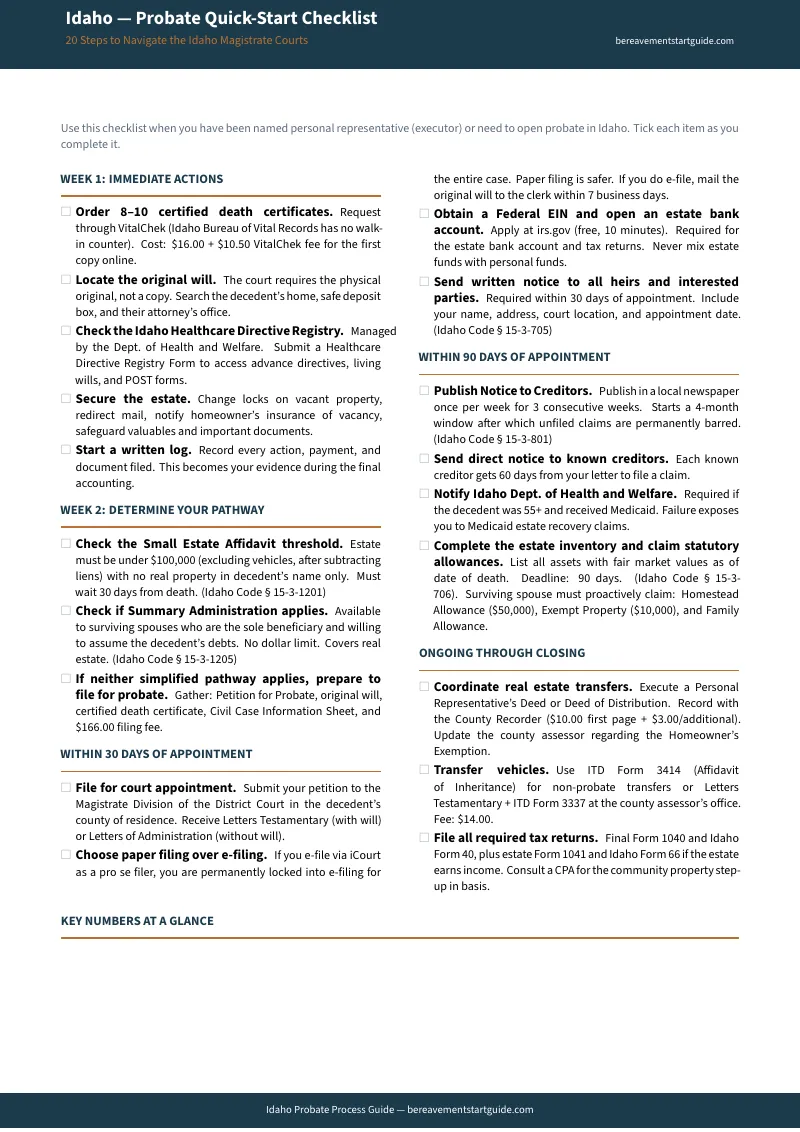
- Idaho Probate Quick-Start Checklist — 20-item printable checklist organized by timeline: Week 1 immediate actions, Week 2 pathway determination, 30-day court filing tasks, 90-day creditor and inventory deadlines, and ongoing tasks through estate closing
- Pathway Decision Worksheet — fillable worksheet that walks you through the estate value calculation and the three-question decision flowchart to determine whether you need the Small Estate Affidavit, Summary Administration, or standard probate
- Estate Inventory Worksheet — asset-by-asset tracker for the 90-day court inventory, organized by category with valuation fields and documentation notes
- Creditor Notification Tracker — tracks both the published notice timeline and individual creditor notices with claim amounts, mailing dates, 60-day deadlines, and allowed/disallowed status
- Statutory Allowances Worksheet — calculates the combined statutory shield: $50,000 Homestead Allowance, $10,000 Exempt Property, and court-determined Family Allowance — the priority claims that must be filed before creditors are paid
- Real Estate Transfer Checklist — step-by-step checklist for recording deeds, title company document requirements, county recorder fees, and Homeowner's Exemption reapplication
- Forms Reference Sheet — every court form, tax return, vehicle form, and agency document in one printable sheet with form numbers, issuing agencies, deadlines, and the fee schedule
Who This Is For
- Named executors who have the will in hand but do not know where to file it, which court handles probate in Idaho, or the difference between informal and formal proceedings — and need a step-by-step path from petition to closing statement
- Administrators without a will who need to understand Idaho's intestate succession rules, how community property versus separate property splits between the surviving spouse and biological children, and what forms to file when there is no will to submit
- Surviving spouses who may qualify for Summary Administration or the Small Estate Affidavit and want to avoid months of standard probate — plus need to know how to claim the $50,000 Homestead Allowance, $10,000 Exempt Property allowance, and Family Allowance before anything else is distributed
- Adult children managing a parent's estate who are handling this for the first time, live out of state, and need a single document that covers every Idaho-specific form, fee, deadline, and court requirement without hiring a $3,000 attorney for routine paperwork
- Executors preparing for an attorney handoff who want to organize the estate's paperwork, understand the process, and arrive at the attorney's office with everything sorted — so they pay for legal strategy, not document assembly
Why Free Resources Fall Short
The Idaho Court Assistance Office provides downloadable forms — but not in any logical order, without instructions on which ones you need, and with the explicit warning that court staff cannot offer legal guidance. National sites like Nolo and FindLaw mention the $100,000 small estate threshold but skip the vehicle exclusion, the real estate prohibition, and the 30-day waiting period. Attorney blogs explain just enough to convince you the process is too dangerous to handle alone, then quote you $2,000 to $3,500 for a standard, uncontested proceeding.
This guide covers only Idaho. Every statute reference, every form number, every court fee, and every deadline applies to Idaho's magistrate court system. It is the missing layer between a pile of alphabetized government PDFs and a $3,000 attorney retainer — the chronological, plain-English roadmap that the state provides the forms for but refuses to explain.
What This Guide Does Not Do
This is an educational resource and administrative organization tool — not legal advice or attorney representation. If the estate involves active litigation, a formally contested will, complex business succession, an insolvent estate where debts exceed assets, or a dispute between heirs that cannot be resolved through conversation, you need a licensed Idaho attorney. When that is the case, the guide tells you exactly why and what kind of professional to hire. For straightforward estates where the family agrees and you need to file the right forms on time without paying thousands for basic administrative guidance, this guide gives you the complete roadmap.
— Less Than 15 Minutes of an Idaho Attorney's Time
Idaho estate attorneys charge $200 to $350 per hour. A full uncontested probate runs $2,000 to $3,500. The magistrate court filing fee alone is $166. This guide costs less than 15 minutes of billable attorney time and covers every form, deadline, and statutory threshold those fees are supposed to pay for.
Every purchase includes a money-back guarantee, no time limit. If the guide does not save you at least ten hours of research and make the Idaho probate process clear, email us for a full refund.
The free Quick-Start Checklist covers the immediate deadlines — ordering death certificates, securing the estate, determining your legal pathway, and identifying the key court filing steps. The full guide covers every chapter from there through estate closing, with creditor notification procedures, statutory allowance calculations, real estate transfer instructions, tax filing requirements, and a county-by-county court directory for all 44 Idaho counties.
Frequently Asked Questions
What if the rules change after I buy?
We update the guide when the rules change. Email us any time, even years later, and we'll send you the current edition free.