Six Agencies. Zero Coordination. Every Deadline Counts.
Someone you depended on just died in Idaho. Within days, you're expected to report the death to Social Security, figure out whether the estate needs probate or qualifies for a Small Estate Affidavit, contact PERSI if they were a public employee, start the 60-day clock on health insurance enrollment, and somehow learn what the state owes you before the state comes asking what you owe it.
The information exists. It's scattered across the Bureau of Vital Records, the Idaho State Tax Commission, the Department of Health and Welfare, the Industrial Commission, PERSI, Your Health Idaho, and 44 county assessor offices. Each agency explains its piece. None of them explain the sequence. None of them warn you that filing for one benefit in the wrong order can complicate another. And the local probate attorneys who could sort it out start at $3,000 for a straightforward estate.
The Idaho Benefits Recovery System
This guide does what no single government website does: it puts every Idaho survivor benefit, deadline, and filing requirement into one chronological action plan -- from the day of death through your final tax filings. Every chapter addresses the exact agencies, dollar amounts, and statutory thresholds that apply in Idaho right now.
It's built for Idaho's specific system. Not a generic national checklist with "check your state laws" footnotes. Every threshold is current for 2026 -- the $100,000 small estate limit, the $39,130 income cap for the Property Tax Reduction program, the $510.75 weekly workers' compensation survivor rate, the $78,000 in statutory allowances that Idaho law shields from creditors before anyone else gets paid.
What You Get
The Complete Guide (15 Chapters)
- Death certificates and vital records -- ordering through the Idaho Bureau of Vital Records ($16 per certified copy by mail, versus the VitalChek markup that pushes a single rush copy past $57), how many to order, which institutions demand originals, and how to check the Idaho Healthcare Directive Registry for advance directives
- Your legal rights as an Idaho survivor -- community property with right of survivorship, the double step-up in basis that can save tens of thousands in capital gains tax, and the three statutory allowances ($50,000 Homestead + $10,000 Exempt Property + $18,000 Family Allowance) that protect your family first
- Three estate administration routes compared -- Small Estate Affidavit (no court, no fee, must wait 30 days, cannot include real estate) vs. Summary Administration for a surviving spouse (Idaho Code 15-3-1205, $130 filing fee, but you assume all debts) vs. formal or informal probate ($166 filing fee). Side-by-side eligibility, timeline, and cost comparison so you pick the right path the first time
- PERSI survivor benefits -- if the decedent was a state or local government employee with 60+ months vested, you choose between a lump sum (2x account balance) or a lifetime monthly annuity. The guide walks through forms RS121 and RS115 (notarized), the notification process, and how the choice interacts with your other income sources
- Workers' compensation death benefits -- the 2026 rate of $510.75 per week for a surviving spouse (45% of the Average Weekly State Wage), funeral reimbursement up to $6,000, the remarriage lump-sum calculation, and how to ensure the employer filed the First Report of Injury with the Industrial Commission
- Health insurance continuation -- the 60-day Special Enrollment Period that starts the day of death, Your Health Idaho marketplace options, COBRA coverage, and Idaho Medicaid eligibility for surviving dependents who qualify
- Property tax relief -- the Property Tax Reduction (Circuit Breaker) program with its April 15 hard deadline, the $39,130 income threshold, and the critical detail that up to $5,000 in funeral expenses can be deducted from qualifying income. Plus the standard Homeowner's Exemption and the reapplication deadline (fourth Monday in June) that catches families off guard
- Real property transfers -- recording an Affidavit of Surviving Spouse for survivorship property, the new Transfer on Death deed law effective July 1, 2026, trust deeds, and the county recording fees
- Vehicle title transfers -- the no-probate path (ITD Form 3414 Affidavit of Inheritance) vs. the probate path (Letters Testamentary + ITD Form 3337), with a county-by-county fee table
- Crime victims compensation -- up to $25,000 per case through the Idaho Industrial Commission, including $5,000 for funeral costs, plus the application timeline and required documentation
- Tax filings -- the decedent's final Idaho Form 40, federal 1040, estate income tax (Form 66 with Schedule K-1), and why Idaho has no state estate or inheritance tax
- Medicaid estate recovery defense -- Idaho's expanded definition of "estate" that reaches joint tenancy property and living trusts, the statutory exemption that absolutely prohibits the state from recovering costs while a surviving spouse is alive, protections for disabled and minor children, and the 90-day hardship waiver deadline
- When to hire a professional -- the exact triggers for an attorney, CPA, or title company, so you don't pay $3,000 for tasks you can handle yourself
- Non-probate asset inventory -- what transfers automatically (joint accounts, life insurance, PERSI with beneficiaries, TOD deeds) versus what requires court involvement
- 180-day action timeline -- every deadline mapped into a week-by-week sequence from day one through estate closure
5 Standalone Printable Worksheets
Every paid download includes these standalone tools -- print them separately from the guide and use them at the kitchen table, the county assessor's office, or wherever the paperwork happens:
- 180-Day Deadline Calendar -- every time-sensitive filing mapped chronologically with consequences for missing each one. Pin it where you handle estate paperwork and check off deadlines as you go.
- Agency Contact Directory -- every Idaho agency phone number, website, and what they handle on one printable page. Includes county assessor contacts for property tax relief.
- Cost Summary Worksheet -- a fillable worksheet for tracking every out-of-pocket cost from death certificates through attorney fees. Estimate before you start, record actual costs as you go.
- Probate Route Decision Flowchart -- three yes-or-no questions that determine whether your estate needs a Small Estate Affidavit, Summary Administration, or formal probate. Includes a side-by-side comparison of all three routes.
- Estate Routes Comparison Card -- the eligibility, cost, timeline, and risk profile of all three Idaho estate routes in one reference table. Includes the Debt Assumption Trap warning for Summary Administration.
The Free Idaho Survivor Benefits Checklist
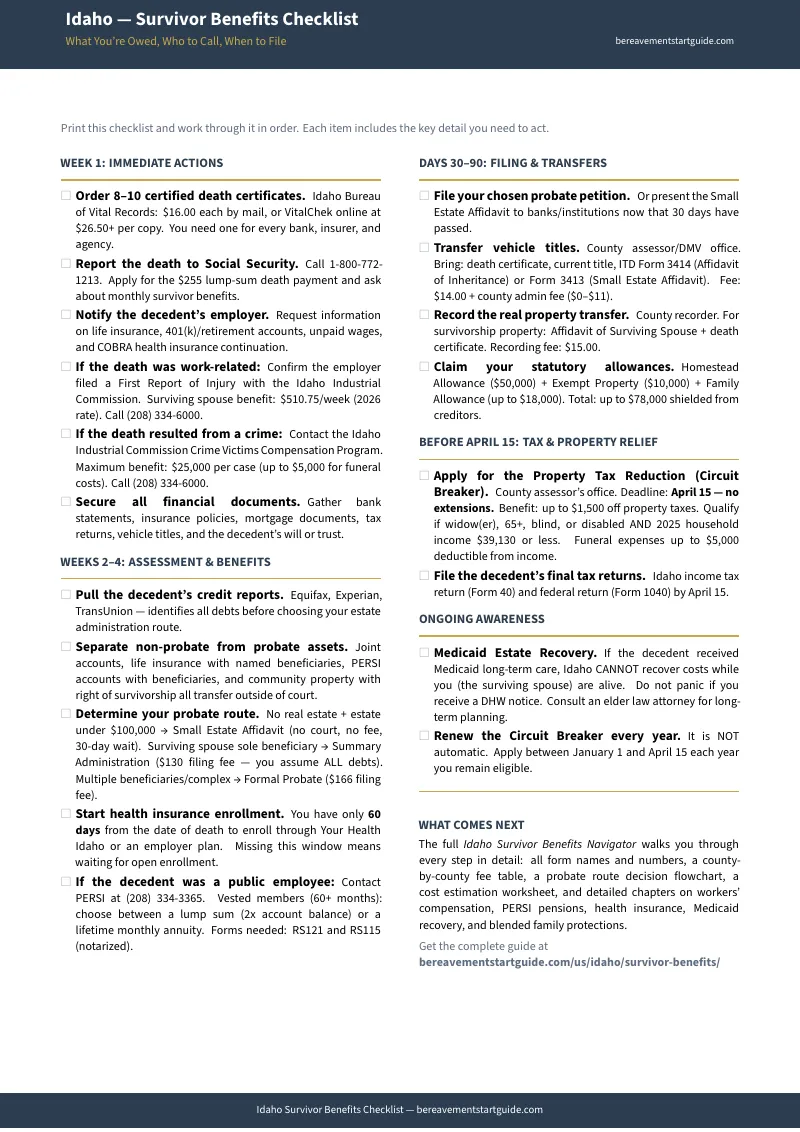
A printable checklist covering the 19 most critical actions -- organized by week with the key details (which form, which agency, what it costs) built into each line item. Available as a free download so you can start immediately while deciding whether the full guide is right for your situation.
Who This Is For
- Surviving spouses who need to access frozen accounts, claim up to $78,000 in statutory allowances, understand community property rules, file for the Property Tax Reduction before the April 15 deadline, and maintain health insurance within the 60-day enrollment window
- Adult children settling a parent's estate for the first time, navigating between doing it yourself and hiring an attorney, and needing to understand the full picture before committing to either path
- Families of public employees dealing with PERSI survivor pension elections -- lump sum versus annuity -- while simultaneously managing Social Security, property transfers, and tax filings
- Families where the death was work-related who need to coordinate Industrial Commission claims with other survivor benefits and understand how workers' compensation interacts with Social Security
- Anyone facing a Medicaid estate recovery notice who needs to understand their legal protections before responding to the Department of Health and Welfare
Why Not Just Use the Free Government Resources?
Every agency mentioned in this guide publishes its own rules for free. The State Tax Commission explains the Circuit Breaker. PERSI publishes brochures on survivor pensions. The Industrial Commission posts the workers' compensation rate tables. The Court Assistance Office offers some forms for small estates.
What none of them do is connect the dots. The Tax Commission doesn't tell you that a PERSI lump-sum payout could push your income above the Circuit Breaker threshold for the following year. PERSI doesn't mention the 60-day health insurance window. The Industrial Commission processes workers' compensation but won't mention the Crime Victims Compensation Program that runs out of the same building. The county assessor handles property taxes but won't explain the $50,000 Homestead Allowance from probate law that protects your household goods from estate creditors.
Each agency handles its mandate. This guide handles the sequence -- putting every benefit, every form, every deadline, and every agency interaction into the order you actually need them.
-- Less Than One Hour of Attorney Time
A single Idaho probate consultation runs $3,000 or more for a straightforward estate. This guide covers the administrative groundwork that would otherwise consume your first several billable hours -- identifying your benefits, qualifying for the right estate track, organizing your documents, understanding your statutory protections, and knowing which deadlines carry real consequences if you miss them.
If the guide doesn't save you at least ten hours of frustrating research across scattered government websites, email us at any time for a full refund. No questions asked.
Frequently Asked Questions
What if the rules change after I buy?
We update the guide when the rules change. Email us any time, even years later, and we'll send you the current edition free.