
The Bank Froze the Account. The Will Has a 30-Day Filing Deadline. The State Wants Its Estate Tax.
Someone you love just died in Illinois. Before you've had time to grieve, the bank locked the checking account the moment they learned of the death. The funeral director is asking how many certified death certificates you want. And somewhere in a drawer is the original will -- which Illinois law requires you to file with the circuit court clerk within 30 days, or risk losing your priority as executor and facing a potential Class 3 felony charge for withholding it.
You start searching for help. The Illinois Courts website gives you forms but no instructions on which order to file them. Illinois Legal Aid Online has excellent information -- scattered across dozens of pages you have to piece together yourself. The Cook County Probate Division charges $479 just to open a case. And every probate attorney you call quotes a $3,000 to $7,000 retainer before they'll explain anything.
Meanwhile, the deceased's bank account has the money you need for the funeral. The Secretary of State wants a VSD-190 and a RUT-50 before they'll transfer the car title. You've heard something about a "Small Estate Affidavit" but aren't sure if the estate qualifies. And if the estate is worth more than $4 million, Illinois is one of only twelve states that will send its own estate tax bill -- separate from the federal one.
The Illinois Estate Settlement Roadmap
This guide does what no single government website, legal aid page, or attorney consultation does: it puts the entire Illinois estate settlement process into one chronological sequence, from the hour of death through final distributions and estate closure -- with every form name, agency contact, filing fee, county variation, and statutory deadline in one place.
It's built specifically for Illinois. Not a generic national probate overview with "check your state laws" footnotes. Every chapter addresses the exact agencies, thresholds, and traps that make Illinois different -- the $150,000 Small Estate Affidavit threshold (raised from $100,000 in August 2025), the new vehicle exclusion from that cap, the 7-class creditor payment hierarchy under 755 ILCS 5/18-10, the $4 million estate tax cliff, Cook County vs. DuPage vs. Will County filing fee differences, eFileIL requirements, and the Bond in Lieu of Probate option that most families never hear about.
What You Get
The Complete Guide
- First 48 Hours protocol -- pronouncement of death, funeral director coordination, Social Security notification, securing the residence, and the one rule that prevents the most common financial mistake: do not pay the deceased's bills from your own money
- Death certificate strategy -- ordering through the county clerk or funeral director, how many to order (8-12 for most families), which institutions demand originals with a raised seal versus photocopies, and the cost differences between ordering at time of death versus later
- The $150,000 Small Estate Affidavit decision -- a qualification checklist for the Small Estate Affidavit under 755 ILCS 5/25-1, updated for the August 2025 threshold increase. The math matters: vehicles registered in Illinois are now completely excluded from the $150,000 cap. Plus the critical limitation most families miss -- the affidavit cannot transfer real estate, and the estate must have no pending probate case
- 30-day will filing deadline -- the exact requirements of 755 ILCS 5/6-1, which county to file in, how to file electronically through eFileIL (and which counties like Will County still require conventional paper filing), and what happens if you miss the deadline
- Three settlement tracks compared -- Small Estate Affidavit vs. Bond in Lieu of Probate vs. formal supervised or independent administration. A side-by-side comparison of eligibility, timeline, court involvement, attorney requirements, and typical costs for each path
- Illinois probate walkthrough -- filing the Petition for Letters of Office, the distinction between supervised and independent administration, how to use eFileIL, county-specific filing fees (Cook County $479, DuPage $388, Will County $341, Lake County $388), the mandatory creditor publication requirement, and the six-month claims window
- Bank account procedures -- what happens when accounts freeze, which accounts transfer without probate (joint tenancy, POD, TOD), how to present the Small Estate Affidavit to release funds, a word-for-word script for your first bank visit when the teller demands "Letters of Office," and how to open the estate bank account with an EIN
- Vehicle title transfers -- the VSD-190 Application for Vehicle Transaction, the VSD-333 Odometer Disclosure Statement, and the RUT-50 Private Party Vehicle Use Tax form. The $15 tax exception for transfers between spouses, parents, and children -- and how most families overpay because they don't know it exists
- Real property transfers -- the Transfer on Death Instrument (TODI) under the Illinois Residential Real Property Transfer on Death Instrument Act (including the 2022 and 2024 expansions to commercial property), joint tenancy with right of survivorship, land trusts, recording requirements, and transfer tax implications
- The 7-class creditor hierarchy -- the exact statutory order under 755 ILCS 5/18-10, from Class 1 (funeral and administration expenses) through Class 7 (all other claims). Why paying creditors out of order exposes you to personal liability, and a worksheet for tracking claims by class
- Spouse's Award -- the statutory award to the surviving spouse under 755 ILCS 5/15-1, how to claim it, and why it takes priority over general creditor claims
- Illinois estate tax -- the $4 million exemption threshold (far lower than the federal $15 million), graduated rates from 0.8% to 16%, Form 700 filing requirements, and the portability trap -- Illinois does not allow portability of the unused exemption between spouses, unlike the federal system
- Federal and state income tax filings -- the decedent's final Form IL-1040, fiduciary income tax, and when a federal Form 1041 is required
- When to hire a professional -- the exact triggers for an attorney, CPA, or title company, including the strict rule that non-attorney executors cannot represent an estate pro se in formal Illinois probate proceedings. So you don't pay $4,000 for tasks you can handle yourself, but you don't accidentally handle tasks that require a license
- Complete forms directory -- every form referenced in the guide (Small Estate Affidavit, Petition for Letters of Office, VSD-190, RUT-50, Form 700, Form IL-1040) with the exact agency, website, and filing context
8 Standalone Printable Worksheets
- Estate Settlement Timeline -- a chronological reference showing every major deadline from day one through final distributions, including the 30-day will filing deadline, creditor publication timing, and the estate tax filing window
- Estate Inventory Worksheet -- a fillable worksheet for cataloging every asset, account, policy, and property with columns for title status, estimated value, and transfer method
- Settlement Track Flowchart -- a visual decision tree that walks you through the three settlement paths (Small Estate Affidavit, Bond in Lieu of Probate, formal administration) and tells you which one applies
- Forms and Agencies Directory -- every form referenced in the guide with the exact agency, website, phone number, and filing context in one printable sheet
- County Fee Reference -- filing fees, recording fees, and publication costs for Cook, DuPage, Will, Lake, Kane, McHenry, Winnebago, and other Illinois counties
- Creditor Hierarchy Worksheet -- a fillable worksheet organized by the 7-class priority order under 755 ILCS 5/18-10, so you pay debts in the exact sequence Illinois law requires and avoid personal liability
- Account Closing Checklist -- a checklist for systematically closing or transferring every bank account, credit card, subscription, utility, and insurance policy
- Creditor Response Scripts -- word-for-word scripts for handling debt collector calls, responding to creditor claims, and sending the formal notice that starts the claims deadline
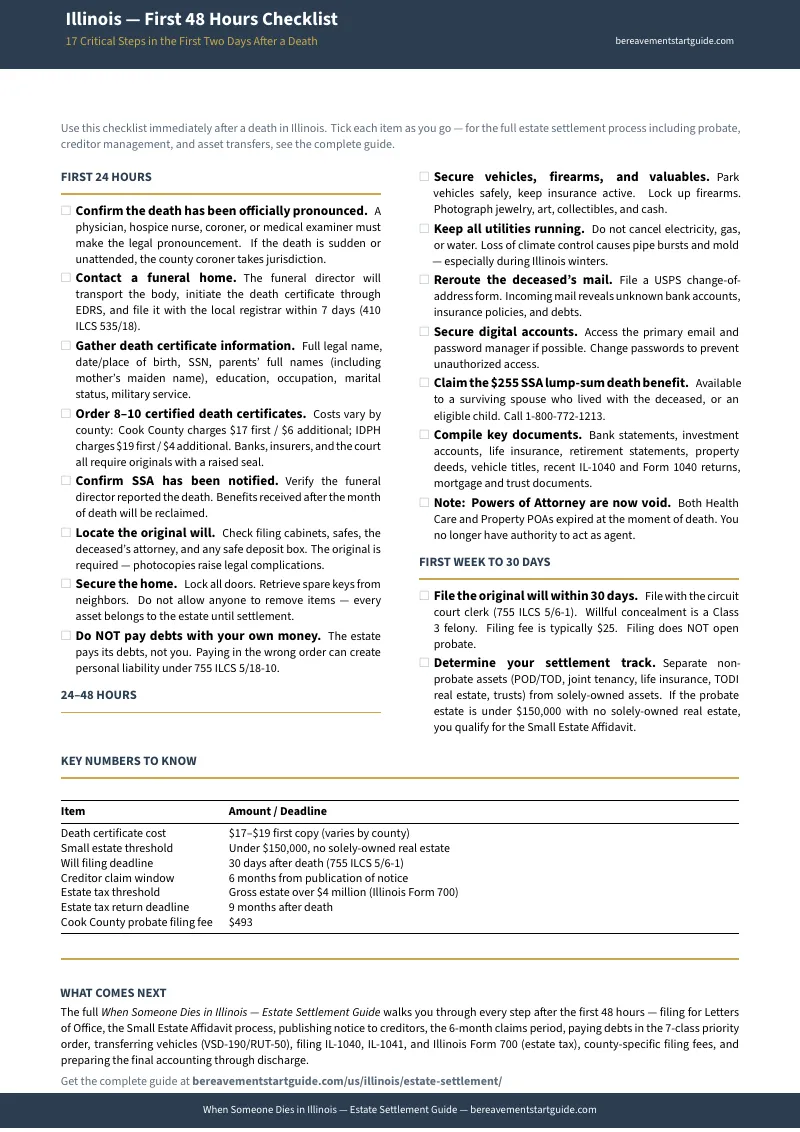
The Free Illinois First 48 Hours Checklist
A printable emergency checklist covering the 20 most urgent tasks -- from pronouncement of death and locating the original will through ordering death certificates, securing the residence, and confirming whether the 30-day will filing deadline applies to you. Available as a free download so you can start immediately while deciding whether the full guide is right for your situation.
Who This Is For
- Surviving spouses who need to access frozen bank accounts, claim the statutory Spouse's Award, understand how the TODI works for the family home, and navigate the Illinois estate tax if the estate exceeds $4 million
- Adult children settling a parent's estate for the first time, unsure whether to attempt it yourself or hire an attorney, and wanting to understand the full process before committing to either path
- Executors and personal representatives who want to fulfill their fiduciary duties correctly -- protecting themselves from personal liability while keeping the family informed and the process on track
- Families dealing with intestate estates where no will exists, co-heirs are asking questions, and someone needs to find the authoritative rules before family conflict makes everything harder
- Anyone confused by the county differences -- Cook County procedures differ from DuPage, Will, and Lake County procedures in filing fees, e-filing requirements, and courtroom expectations. This guide covers the statewide rules and flags the county-level variations
Why Not Just Use the Free Government Forms?
Every form referenced in this guide is available for free from an Illinois government agency. The Small Estate Affidavit is available through the circuit court. The VSD-190 is on the Secretary of State's website. The RUT-50 is on the Department of Revenue's site.
What's not free -- and what no government website provides -- is the sequence. The Illinois Courts won't tell you that you have 30 days to file the will and that missing the deadline has criminal implications. The Secretary of State won't mention that your vehicle transfer also requires a RUT-50 from a completely different agency. The county clerk will process your $479 filing fee but won't explain the Spouse's Award. ILAO has the answers -- spread across 40 different pages you have to find and read in the right order.
Each agency handles its piece. None of them tell you what the next agency in line requires. This guide connects the dots -- putting every form, every deadline, every fee, and every agency into the order you actually need them.
-- Less Than One Hour of Attorney Time
A single consultation with a Cook County probate attorney runs $250 to $450 per hour. A flat-fee retainer for a straightforward estate starts at $3,000 to $7,000. This guide covers the administrative fundamentals that would otherwise consume your first several billable hours -- ordering certificates, qualifying for the Small Estate Affidavit, determining your settlement track, organizing your documents, and understanding your statutory protections. Even if you ultimately hire an attorney, completing these steps first saves the estate hundreds of dollars in billable intake hours.
If the guide doesn't save you at least ten hours of frustrating research across scattered government websites, email us at any time for a full refund. No questions asked.
Frequently Asked Questions
What if the rules change after I buy?
We update the guide when the rules change. Email us any time, even years later, and we'll send you the current edition free.