The Funeral Home Said Embalming Is "Required." The Coroner Has Not Signed the Cremation Permit. Your Sister Wants Cremation, Your Brother Wants Burial, and the 72-Hour Claim Rule Is Already Running.
Someone just died in Illinois, and you are the person making the calls. The funeral home quoted you a "standard service package" and the total sounded high, but you have no idea which charges are required by law and which are optional. You asked about embalming and got a non-answer: "It's standard for this type of service." You asked about cremation and were told the county coroner has to sign off first, but nobody can tell you when that will happen. Your sister wants cremation. Your brother insists on a traditional burial. And the funeral home is not going to settle the argument for you.
Meanwhile, two clocks are running. Illinois requires a licensed funeral director to file the death certificate within seven days of death. And under the Illinois Disposition of Remains Act (755 ILCS 65), if no one formally claims the body within 72 hours, the state assumes jurisdiction and may donate it to a medical school. The funeral home is adding daily refrigeration charges while the county coroner works through the mandatory 24-hour waiting period before cremation can even be considered. Nobody told you any of this. Nobody tells families any of this.
The Illinois Funeral Laws & Consumer Rights Guide is a Consumer Defense Manual for every decision, deadline, and potential overcharge in an Illinois funeral arrangement — from the moment of death through final disposition, cremation authorization, estate access, and regulatory complaints. Not a sympathy resource. Not a blog post written by a funeral home to funnel you into their service packages. A plain-English, Illinois-specific legal reference that tells you exactly what the funeral industry is required to disclose, what they are prohibited from charging, who has the legal authority to make decisions when the family disagrees, and what to do when something goes wrong.
What's Inside the Consumer Defense Manual
A 17-chapter guide and a consumer rights checklist — covering every legal, financial, and procedural question families face during funeral arrangements in Illinois:
Chapter 1: The First 48 Hours After a Death in Illinois
The clocks that start running the moment someone dies in Illinois, and how the decisions you make in the first two days determine the cost of everything that follows. The 72-hour claim rule — if nobody formally claims the remains, the state takes over. The 7-day death certificate filing deadline. The 24-hour mandatory waiting period before cremation. What to do when the death happens at a hospital, at home under hospice, at home unexpectedly, or when the county coroner or medical examiner takes jurisdiction. Ordering certified death certificates — $15 for the first copy, $2 each additional, and why ordering through VitalChek adds processing fees you can avoid by going directly to the county clerk.
Chapter 2: Who Has the Legal Right to Make Funeral Decisions
The chapter that prevents family fights. The Illinois Disposition of Remains Act (755 ILCS 65) establishes a strict legal hierarchy for who controls funeral decisions: a designated agent appointed in writing during life outranks a surviving spouse, who outranks adult children, who outrank surviving parents, who outrank adult siblings. The guide covers why verbal agreements are meaningless in a blended family, what happens when siblings deadlock and the funeral home freezes all action while daily storage fees accumulate, and the single best prevention tool — a written designation of agent that overrides every family member, including a current spouse.
Chapter 3: Your Consumer Rights Under the FTC Funeral Rule
The Federal Trade Commission Funeral Rule (16 CFR Part 453) applies to every funeral home in Illinois. It requires an itemized General Price List at the beginning of any in-person discussion — not after you sit down, not after you express interest. The guide covers every right the FTC guarantees: declining embalming, declining a casket for cremation, bringing your own casket or urn without a handling fee, selecting only the services you want instead of being forced into a package. Illinois-specific cost benchmarks so you can evaluate whether a quote is reasonable. The guide tells you how to call three funeral homes and compare General Price Lists by phone — which federal law requires them to provide.
Chapter 4: Illinois Disposition Options
Every legal method of disposing of remains in Illinois — traditional burial, direct cremation, alkaline hydrolysis (legal since 2021), and why natural organic reduction ("human composting") remains under legislative study (HB4982). The mandatory 24-hour waiting period before cremation. The coroner's permit requirement. Written authorization from the person holding disposition authority under the IDRA. The critical distinction: Illinois law requires a licensed funeral director to oversee disposition and file the death certificate — a fully independent home funeral is not legally possible in Illinois (410 ILCS 535). But families can legally hold a home visitation, transport remains in a private vehicle with a transit permit, and minimize funeral director involvement to the legal minimum.
Chapter 5: Scattering Ashes in Illinois
The rules for scattering cremated remains on public land, private property, and waterways. The Illinois Department of Natural Resources 200-foot setback from waterways. The Ellman water law (SB1793) and its implications for water scattering. What you need to know about scattering in state parks, forest preserves, Lake Michigan, and private land with owner permission.
Chapter 6: The Small Estate Affidavit — Avoiding Probate
When accounts are frozen and you need money for the funeral. The Illinois Small Estate Affidavit works for estates under $100,000 in personal property value — but there is a mandatory waiting period after death. The guide covers the waiting period problem (how to pay funeral costs before the affidavit becomes effective), what the affidavit covers and what it does not, and the vehicle title transfer process that may not require probate. The $150,000 threshold for real property versus the $100,000 threshold for personal property.
Chapter 7: Formal Probate — Independent vs. Supervised Administration
For estates over the Small Estate Affidavit limits or those with real property. Filed in the circuit court in the decedent's county of residence. Illinois offers two probate tracks: Independent Administration (faster, less court oversight, lower cost) and Supervised Administration (court approval required for every action, used for contested estates). The guide covers the Personal Representative's key duties, the creditor claim publication period, the six-month claims deadline, and why paying creditors before the claims window closes can make you personally liable.
Chapter 8: Mandatory e-Filing and Cook County Rules
Cook County — the largest county in Illinois and the jurisdiction covering Chicago — has its own probate division with distinct filing procedures, mandatory e-filing requirements, and processing timelines that differ from downstate counties. The guide covers the Cook County Probate Division's specific forms, the e-filing requirement that catches self-represented parties off guard, and the differences between Cook County and collar county procedures.
Chapter 9: Pre-Need Funeral Contracts — Protections and Refund Rights
Prepaid funeral contracts are aggressively marketed to older adults in Illinois. Under the Illinois Funeral or Burial Funds Act, sellers must deposit funds into regulated trusts. The critical consumer protections: if a family cancels a fully-paid contract before the time of need, the seller must refund 95% of the purchase price for services and 85% for outer burial containers. If the trust has been sold or a third-party seller has declared bankruptcy, families can apply to the Pre-Need Funeral Consumer Protection Fund through the Illinois Office of the Comptroller. The guide covers price guarantee traps, portability problems, and how to demand cancellation terms in writing before signing.
Chapter 10: Advance Directives and Post-Death Powers
The Illinois Power of Attorney for Health Care, the Living Will, and how these documents interact with the Disposition of Remains Act after death. The critical distinction between healthcare powers that terminate at death and post-death arrangements that require separate written designation. The POLST form and its role in end-of-life decisions versus post-death disposition.
Chapter 11: Vehicle Transfers Without Probate
How to transfer a vehicle title after death without going through probate — the specific Illinois Secretary of State forms, documentation requirements, and the process that can save months compared to waiting for a probate court order.
Chapter 12: Filing Complaints Against Funeral Providers
When a funeral home overcharges you, refuses to provide the General Price List, pressures you into unnecessary services, or refuses to release remains. The state complaint path: Illinois Department of Financial and Professional Regulation (IDFPR) for funeral director and cemetery violations. The federal complaint path: FTC at 1-877-382-4357 for Funeral Rule violations. What to do when a funeral home refuses to release remains over an unpaid bill — which is illegal in Illinois.
Chapter 13: Medicaid Spend-Down and Funeral Asset Protection
How irrevocable prepaid funeral contracts serve as exempt assets in Medicaid planning, protecting funeral funds from the spend-down requirement. The guide covers the legal distinction between revocable and irrevocable contracts for Medicaid purposes, and the interaction between the Comptroller's refund rules and Medicaid exemptions.
Chapter 14: The Illinois Estate Tax
Illinois is one of only twelve states that imposes its own state-level estate tax, separate from the federal estate tax. The current exemption amount, the graduated rate structure, and how the Illinois estate tax interacts with federal filing requirements. The "cliff" effect and why estates just over the exemption threshold face disproportionate liability.
Chapter 15: Financial Assistance for Funeral Costs
Every avenue for financial assistance. The Illinois Department of Human Services (IDHS) provides up to $1,370 for a funeral and $686 for burial or cremation if the deceased met specific public assistance criteria. Social Security's $255 lump-sum death benefit. Veterans burial benefits — national cemetery burial at no cost, burial allowance for non-national cemeteries (up to $2,000 for service-connected deaths), headstone, burial flag, Presidential Memorial Certificate. Cook County and other county-level assistance programs.
Chapter 16: Professional Help Boundaries
What you can handle with this guide versus what requires a probate attorney, a CPA, or a licensed funeral director. The guide draws clear lines so you know when to solve it yourself and when to hire professional help — reducing unnecessary legal fees while ensuring you do not miss something that requires expert involvement.
Chapter 17: Quick Reference — Key Agencies, Forms, Deadlines, and Costs
A single-chapter reference consolidating every agency contact, required form, statutory deadline, and typical cost mentioned in the guide. The IDFPR complaint portal. The Office of the Comptroller for pre-need trust disputes. The county clerk for death certificates. The circuit court for probate filings. Every deadline from the 24-hour cremation wait to the six-month creditor claims window, organized in one place.
Who This Guide Is For
- The family member who just got a funeral home quote that feels wrong — who needs to understand exactly which charges are legally required, which are optional, and which may violate the FTC Funeral Rule. The guide gives you Illinois-specific cost benchmarks and a line-by-line framework for evaluating any General Price List.
- The person trying to arrange a cremation when the family disagrees — who needs to know the exact statutory hierarchy under the Illinois Disposition of Remains Act (755 ILCS 65), the mandatory 24-hour waiting period, the coroner's permit requirement, and what happens legally when one family member insists on burial while another insists on cremation.
- The surviving spouse who needs to access accounts and does not know where to start — who has been told the bank accounts are frozen and the Small Estate Affidavit waiting period has not elapsed. The guide covers the affidavit process, the vehicle transfer shortcut, and the financial assistance options that can cover immediate funeral expenses.
- The family fighting a funeral home that is holding remains over an unpaid bill — who needs to know that this practice is illegal under IDFPR regulations, and exactly how to file a complaint that forces the release of the body.
- The person who discovered their parent's prepaid funeral contract has been sold or the trust company went bankrupt — who needs to know the Comptroller's mandatory 95% refund rule, the Pre-Need Consumer Protection Fund, and the exact steps to recover their money.
- The family considering alkaline hydrolysis or green burial options in Illinois — who needs to know that alkaline hydrolysis is legal since 2021, that natural organic reduction is under active legislative study, and that a licensed funeral director is still required for all disposition in Illinois.
- The out-of-state family member navigating Illinois's system for the first time — who has never dealt with mandatory e-filing in Cook County, the IDFPR licensing requirements, or the differences between Cook County and downstate procedures.
Why Free Resources Will Not Protect You
Funeral consumer information exists. It is spread across the FTC website in dense regulatory language, the IDFPR in bureaucratic licensing forms, Illinois Legal Aid Online in scattered FAQ pages organized for indigent populations, funeral home blogs written to generate leads, and national platforms that cover Illinois as a footnote. Here is what you actually encounter when you try to protect yourself using free sources:
- The FTC Funeral Rule pages tell you what your rights are. They do not tell you how to use them. The federal regulation is clear: funeral homes must provide itemized pricing, must allow third-party caskets, must not embalm without authorization. But the FTC does not tell you what questions to ask during the meeting, how to read a General Price List, what a "non-declinable basic services fee" actually covers, or what to do when the funeral director says embalming is "standard practice" for the type of service you selected.
- Illinois Legal Aid Online has the information. It takes hours to assemble. ILAO publishes dozens of separate FAQ pages covering funeral planning, IDHS assistance, the Family Bereavement Leave Act, and small estate affidavits. The content is excellent but designed for people with time to click through page after page. It is heavily skewed toward indigent populations. A middle-class family trying to figure out whether a funeral home quote is legitimate, whether a prepaid contract can be canceled, and who has legal authority over disposition has to piece together answers from a dozen different pages with no clear sequence.
- Funeral home blogs are accurate, detailed, and written by the people selling you services. Every funeral home in Chicago, Springfield, and Rockford publishes educational content. Some of it is genuinely helpful. All of it exists to drive you into that funeral home's service pipeline. The information subtly steers you toward packages, preneed contracts, and in-house merchandise — never toward third-party casket purchases, direct cremation from a low-overhead provider, or the right to decline embalming.
- National platforms cover Illinois generically. Nolo, Ever Loved, and Cake provide useful overviews. None of them cover the Illinois Disposition of Remains Act's specific authority hierarchy, the mandatory 24-hour cremation waiting period with coroner permit, the Cook County e-filing requirement, the Comptroller's 95% refund rule for prepaid trusts, the $100,000 Small Estate Affidavit threshold, the state estate tax that twelve other states do not have, or the IDHS funeral reimbursement amounts. When you are in a dispute with a funeral home, you need Illinois statute numbers, not general guidance.
- An attorney solves the problem but costs more than the information gap. An Illinois probate attorney charges $300 or more per hour. For straightforward consumer rights questions — "Do I have to pay for embalming?" "Can my sister override my cremation decision?" "Is this charge legal?" — a legal retainer is the most expensive possible way to get a yes-or-no answer.
Free resources give you fragments written by different people for different purposes, with no sequencing, no Illinois-specific statute references, and no advocacy for the consumer. The Consumer Defense Manual puts every Illinois funeral law, every FTC protection, every cost benchmark, and every complaint procedure into one document — organized by the decisions you actually face, in the order you face them.
— Less Than One Hour of Funeral Home Overcharges
The average Illinois family spends thousands on funeral costs that include charges they did not know were optional. Embalming that is not required by Illinois law for a standard burial. A casket for a cremation that legally requires only an alternative container. A burial vault the state does not mandate. This guide costs less than any single one of those line items and tells you which ones you can legally refuse.
Your download includes the complete 17-chapter guide, the Illinois Funeral Consumer Rights Checklist, and 8 standalone printable worksheets and reference cards: a Disposition Authority Reference Card (share with family), an FTC Compliance Checklist (bring to the meeting), a Cremation Authorization Checklist, a Funeral Cost Comparison Worksheet (compare three providers), a Small Estate Qualification Calculator, a Complaint Escalation Cheatsheet, a Forms Registry, and a Probate Decision Flowchart. Print what you need, when you need it.
Money-back guarantee, no time limit. If the guide does not give you clarity on your rights, your options, and the specific Illinois laws that protect you — email us for a full refund. No questions asked.
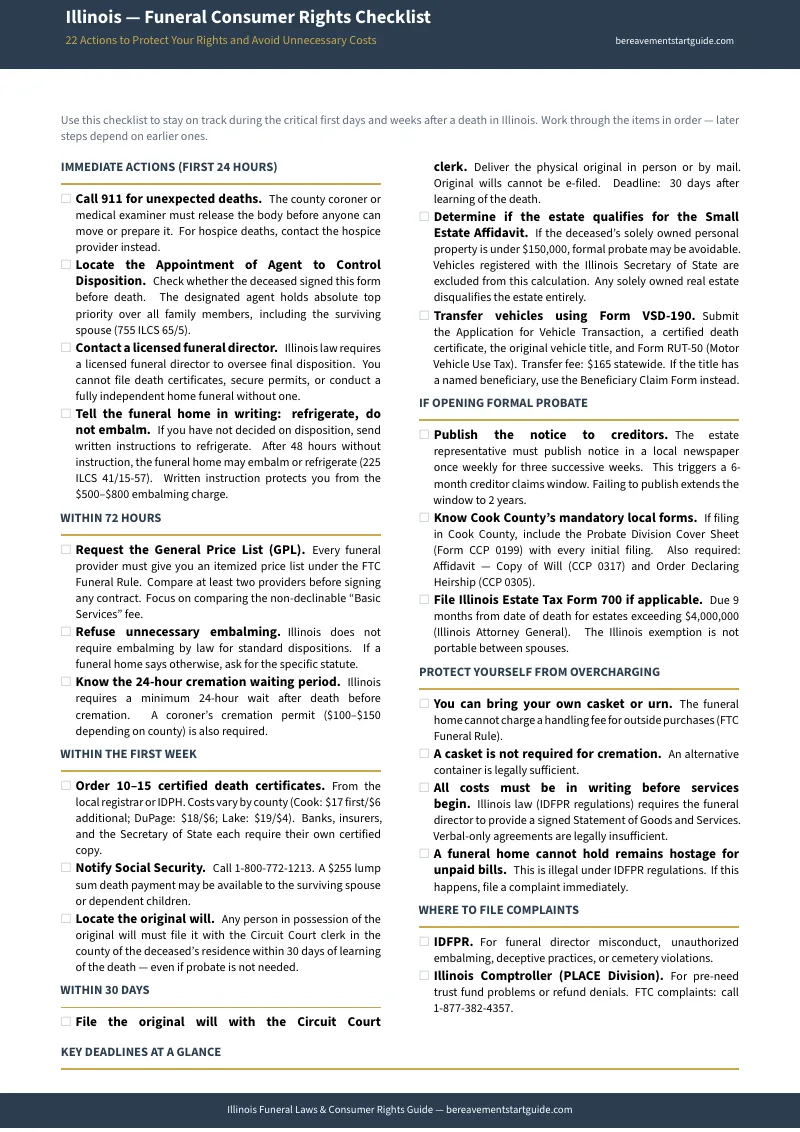
Not ready for the full guide? Download the free Illinois Funeral Consumer Rights Checklist — a summary of the key rights, deadlines, and cost-saving steps that most families do not learn about until it is too late. Enough to walk into a funeral home meeting with your eyes open.
You did not choose this situation. But you can choose to walk into it informed. The guide gives you the laws, the numbers, and the leverage — so the funeral home meeting is a negotiation, not a surrender.
Frequently Asked Questions
What if the rules change after I buy?
We update the guide when the rules change. Email us any time, even years later, and we'll send you the current edition free.