The Bank Froze the Account. The Clerk Said They Cannot Give Legal Advice. The Attorney Quoted $5,000.
You called the bank to pay the funeral home, and they told you the account is frozen until you produce something called Letters of Office. You searched the Cook County Circuit Court website and found a maze of forms behind an electronic filing system called Odyssey eFileIL that looks like it was designed for attorneys, not grieving families. You called the clerk's office and they said they are prohibited from giving legal advice. The attorney you found online quoted a $5,000 retainer before even looking at the will.
Meanwhile, medical bills and credit card statements are arriving at the decedent's address. You are not sure if you are personally responsible for any of them. You heard there is a deadline for publishing something in a newspaper but you do not know what it is, which newspaper, or how many weeks. And the other heirs are asking when they will receive their inheritance, while you cannot even access the checking account to keep the lights on at the house.
The Illinois Probate Roadmap
Illinois probate runs through the circuit court under the Probate Act of 1975 (755 ILCS 5), and it works differently from most other states. The attorney requirement is stricter — under the Mattson ruling and related case law, a non-lawyer executor generally cannot represent the estate in formal court proceedings because the executor acts on behalf of other people's legal interests. The Small Estate Affidavit was recently expanded. And the creditor priority system has seven statutory tiers that determine which bills get paid first when the estate does not have enough money for everyone. This guide maps every decision point, deadline, and filing step so you know exactly where you stand before you spend a dollar on professional fees.
The $150,000 Fork — Formal Probate or Small Estate Affidavit
As of August 2025, Illinois raised the Small Estate Affidavit threshold from $100,000 to $150,000 in personal property — and motor vehicles registered with the Illinois Secretary of State are now entirely excluded from that calculation. An estate with $140,000 in bank accounts plus a $35,000 car qualifies. But if the decedent owned any real estate in their individual name — a house, a condo, a vacant lot — the Small Estate Affidavit is completely unavailable regardless of the dollar amount. The guide walks you through the exact calculation with examples so you know in 15 minutes whether you can skip court entirely.
The Attorney Question — What the Mattson Rule Actually Means for You
Illinois is one of the strictest states on pro se probate. Under the Mattson decision, an executor who appears in court without an attorney is considered to be practicing law on behalf of the estate's heirs and creditors — which is prohibited. But this rule applies to formal court proceedings, not to the Small Estate Affidavit process. The guide explains exactly where the line falls, when you must hire an attorney, and how to use this guide to organize the estate before the first billable hour starts — so you pay for legal strategy, not document assembly at $350 an hour.
The Six-Month Creditor Clock and the Publication Requirement
After opening probate, Illinois law requires you to publish a Notice to Creditors in a local newspaper once per week for three consecutive weeks. That publication starts a six-month claims window. Known creditors must also receive direct written notice. Medical bills, credit card debts, mortgages, and utility bills all have different rules for valid claims — and Illinois uses a seven-tier statutory priority system that dictates the exact order debts must be paid when the estate cannot cover everything. Paying an unsecured credit card before funeral expenses or the surviving spouse's statutory award exposes you to personal liability. The guide covers both notification methods, the exact statutory language, and the full priority waterfall.
The 60-Day Inventory Nobody Warns You About
Within 60 days of your appointment, you must complete and distribute a sworn inventory of every asset the decedent owned — valued as of the date of death. Miss the deadline and you risk removal. Undervalue an asset and you invite breach-of-fiduciary-duty claims from heirs watching for errors. The guide includes an asset-by-asset breakdown of what counts, how to value it, and what documentation the court and the beneficiaries expect.
Real Estate, Title Companies, and the eFileIL System
Title companies will not clear a sale on inherited property until the probate court formally authorizes the transfer. If the will grants Independent Administration, you can sell real estate without per-transaction court approval — but if you are stuck in Supervised Administration, every sale requires a separate court petition. The guide covers when each administration type applies, how to record deeds, and how to navigate the county recorder's office. It also walks you through the Odyssey eFileIL electronic filing system that the Illinois Supreme Court mandates for nearly all civil filings — including the critical exception for original paper wills, which must be physically delivered to the clerk.
What You Get — 10 Printable PDFs
- The Complete Illinois Probate Process Guide — 11 chapters plus 3 appendices covering the Small Estate Affidavit (updated for the August 2025 threshold), the formal probate petition process, Letters of Office, the six-month creditor clock, the seven-tier debt priority system, the 60-day inventory requirement, Independent vs. Supervised Administration, real estate transfers, the Illinois estate tax ($4 million threshold), county-by-county filing fees, common mistakes, key deadlines, a forms reference, and an agency directory
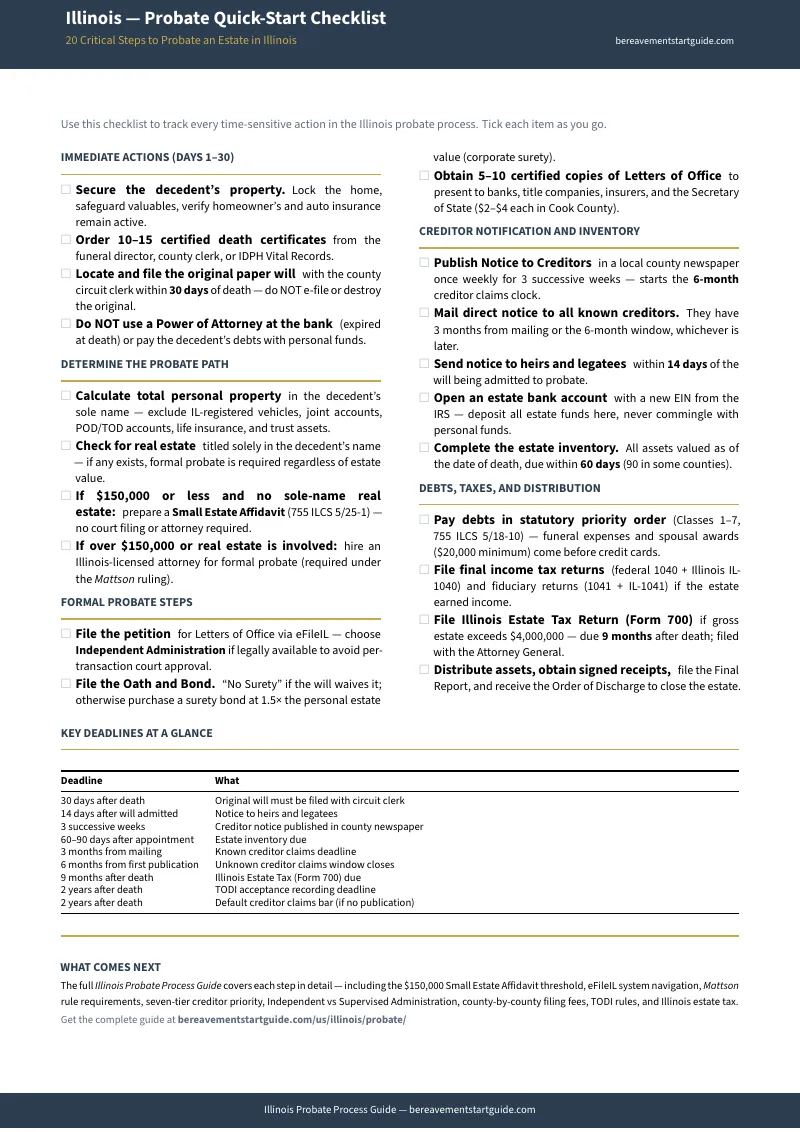
- Illinois Probate Quick-Start Checklist — 20-item printable checklist organized by timeline: Days 1–30 immediate actions, probate path determination, formal probate steps, creditor notification and inventory deadlines, and taxes through estate closing
- Small Estate Affidavit Decision Worksheet — Step-by-step fillable worksheet to calculate whether the estate qualifies under the $150,000 threshold, including the vehicle exclusion and real estate check
- Creditor Notification Timeline — Visual timeline of the six-month creditor claims process, from newspaper publication through claims bar date
- Creditor Priority Reference Card — One-page card with the complete seven-tier statutory payment order (755 ILCS 5/18-10) for desk or folder reference
- Estate Inventory Worksheet — Asset-by-asset fillable worksheet for the 60-day sworn inventory, organized by asset category with valuation columns
- County Fee Schedule — Filing fees, publication costs, and Letters of Office copy fees across Illinois circuit courts
- Deadlines Reference Card — Every critical deadline on one printable page: will filing, inventory, creditor notice, tax returns, and final accounting
- Forms and Agencies Reference — Complete directory of required forms, issuing agencies, and contact information for Illinois probate filings
- Vehicle Transfer Checklist — Step-by-step checklist for transferring vehicle titles through the Illinois Secretary of State
Who This Is For
- Named executors who have the will in hand but do not know where to file it, what Letters of Office are, or the difference between Independent and Supervised Administration — and need a linear path from the first phone call through the Order of Discharge
- Administrators without a will who need to understand Illinois intestate succession rules, how assets split between a surviving spouse and descendants, and what additional forms and bond requirements apply when there is no will to submit
- Families near the $150,000 threshold who want to determine whether the Small Estate Affidavit applies before spending money on an attorney — especially with the August 2025 changes to vehicle exclusions that many attorneys have not yet incorporated into their standard advice
- Out-of-state executors managing a Cook County, DuPage County, or Downstate Illinois estate from a distance who need every filing requirement, fee, and deadline in one document rather than scattered across county clerk websites and the eFileIL portal
- Executors preparing for an attorney handoff who want to arrive at the first meeting with the estate organized, the assets inventoried, and the right questions ready — so they pay for legal judgment, not paperwork at $350 per hour
Why Free Resources Fall Short
The Illinois circuit court system provides downloadable forms — but without instructions on sequencing, without county-specific fee schedules, and with the explicit warning that court staff cannot offer legal guidance. Illinois Legal Aid Online covers the basics for low-income families but does not address the $150,000 August 2025 threshold changes, the vehicle exclusion, or the Mattson attorney requirement. National sites like Nolo and FindLaw describe Illinois probate in generic terms that skip the seven-tier creditor priority system, the mandatory eFileIL electronic filing, and county-level fee differences between Cook County ($479 filing fee) and Downstate courts. Attorney blogs explain just enough to convince you the process is impossible without them, then quote you $3,000 to $7,000 for an uncontested proceeding.
This guide covers only Illinois. Every statute reference, every form number, every court fee, and every deadline applies specifically to the Illinois Probate Act and Illinois circuit courts. It is the missing layer between a pile of government forms and a multi-thousand-dollar attorney retainer — the chronological, plain-English roadmap the state provides the forms for but refuses to explain.
What This Guide Does Not Do
This is an educational resource and administrative organization tool — not legal advice or attorney representation. If the estate involves active litigation, a formally contested will, complex business succession, an insolvent estate where debts exceed assets, or a dispute between heirs that cannot be resolved through conversation, you need a licensed Illinois attorney. Under the Mattson ruling, formal probate proceedings generally require attorney representation. When that is the case, the guide tells you exactly why and what kind of professional to hire. For straightforward estates where the family agrees and you need to navigate Illinois deadlines, forms, and fees without paying thousands for basic administrative guidance, this guide gives you the complete roadmap.
— Less Than 10 Minutes of an Illinois Attorney's Time
Illinois estate attorneys charge $250 to $500 per hour. A full uncontested probate runs $3,000 to $7,000. The Cook County filing fee alone is $479. This guide costs less than 10 minutes of billable attorney time and covers every form, deadline, and statutory threshold those fees are supposed to pay for.
Every purchase includes a money-back guarantee, no time limit. If the guide does not save you at least ten hours of research and make the Illinois probate process clear, email us for a full refund.
The free Quick-Start Checklist covers the immediate deadlines — ordering death certificates, securing the estate, determining your legal pathway, and identifying the key filing steps. The full toolkit adds the complete guide plus 8 standalone printables: the Small Estate Affidavit decision worksheet, creditor notification timeline, creditor priority reference card, estate inventory worksheet, county fee schedule, deadlines reference card, forms and agencies directory, and vehicle transfer checklist.
Frequently Asked Questions
What if the rules change after I buy?
We update the guide when the rules change. Email us any time, even years later, and we'll send you the current edition free.