
The Bank Froze the Account. The BMV Won't Transfer the Car. And You're Not Sure If You Even Need Probate.
Someone you love just died in Indiana. The bank locked the checking account the moment they found out. You need that money for the funeral, but the teller says you need "Letters Testamentary" -- and you don't know what those are or how to get them. The BMV wants paperwork before they'll transfer the car title. There's a house involved, and someone mentioned a "Devolution Affidavit," but nobody can explain what it actually does.
You start looking for help. The Indiana Courts website has forms buried in alphabetical lists with no instructions on which ones apply to you. Hamilton County's local rules look nothing like Marion County's. Indiana Legal Help gives you the Small Estate Affidavit form but doesn't tell you how to calculate whether you qualify. And every probate attorney you call quotes $250 to $400 per hour -- or a $1,500 to $5,000 flat fee -- before they'll explain a single step.
Meanwhile, you've heard Indiana raised the small estate limit to $100,000 in 2022, but you're not sure what counts toward that number. You know the car can supposedly be transferred faster than other assets, but nobody can tell you exactly how fast. And if your loved one received Medicaid after age 55, you're terrified the state is going to come after the house -- even though you might be completely exempt and not know it.
The Indiana Estate Settlement Roadmap
This guide does what no single Indiana government website, legal aid page, or attorney consultation does: it puts the entire estate settlement process into one chronological sequence, from the hour of death through final distributions and estate closure -- with every form name, court requirement, statutory deadline, and agency contact in one place.
It's built specifically for Indiana. Not a generic national probate overview with "check your state laws" footnotes. Every chapter addresses the exact thresholds, timelines, and traps that make Indiana different -- the $100,000 small estate threshold with its specific calculation formula, the 5-day BMV vehicle transfer rule that most families don't know about, the three-track decision framework (small estate vs. unsupervised vs. supervised administration), the $25,000 spousal allowance that takes priority over almost every creditor, and the Medicaid Estate Recovery exemptions that could save the family home.
What You Get
The Complete Guide
- First 48 Hours protocol -- pronouncement of death, funeral director coordination, Social Security notification, securing the residence, and the one rule that prevents the most common financial mistake: do not pay the deceased's debts from your own money
- Death certificate strategy -- ordering through the county health department or funeral director, how many to order (typically 6-10 for most Indiana families), which institutions demand certified copies with a raised seal versus photocopies, and the cost differences between ordering at time of death versus later
- The $100,000 Small Estate Affidavit decision -- a qualification worksheet using the exact statutory formula: Gross Probate Assets minus Liens and Encumbrances minus Reasonable Funeral Expenses. Updated for the July 2022 threshold increase from $50,000 to $100,000, with clear rules on what counts toward the limit and what doesn't -- life insurance with a named beneficiary, retirement accounts with designated beneficiaries, and TOD deeds all fall outside the probate estate
- The 5-day BMV vehicle transfer rule -- Indiana allows vehicle title transfers via small estate affidavit just 5 days after death using State Form 18733, completely bypassing the standard 45-day wait required for other small estate assets. Most families, and many attorneys, confuse these two timelines. This section separates them clearly
- Three settlement tracks compared -- Small Estate Affidavit (under $100,000) vs. Unsupervised Administration (solvent estate, beneficiaries agree) vs. Supervised Administration (disputes, insolvency, or court-ordered oversight). A side-by-side comparison of eligibility, timeline, court involvement, and typical costs for each path
- Unsupervised administration walkthrough -- the path that saves the most time and money for straightforward estates. When the estate is solvent and all beneficiaries consent, the personal representative can act without court approval for every transaction -- selling property, distributing assets, paying creditors -- without a judge's signature at each step
- Indiana probate procedure -- filing the Petition for Appointment, the distinction between supervised and unsupervised administration, obtaining Letters Testamentary or Letters of Administration, the mandatory creditor publication requirement, and the three-month claims window
- Bank account procedures -- what happens when accounts freeze, which accounts transfer without probate (joint tenancy, Payable on Death, Transfer on Death), how to present the Small Estate Affidavit after the 45-day waiting period, and how to open the estate bank account with an EIN
- Vehicle title transfers -- the three distinct methods: Transfer on Death beneficiary already listed on the title, executor transfer using Letters Testamentary, and the 5-day small estate affidavit route using BMV State Form 18733. Each method has different requirements, waiting periods, and documentation
- Real property transfers -- the Transfer on Death Deed under IC 32-17-14 (must be recorded before the owner's death to be valid), joint tenancy with right of survivorship, and the Indiana Devolution Affidavit under IC 29-1-7-23 for intestate estates. Plus the hidden pitfall: title companies remain deeply skeptical of Devolution Affidavits until the seven-to-nine-month absolute claims bar expires, making immediate property sales virtually impossible
- Creditor payment hierarchy -- the exact statutory priority of claims under Indiana law: administration expenses first, then funeral and cemetery costs (priority up to $3,500), then the $25,000 spousal allowance, then federal and state taxes, and only lastly general unsecured creditors like credit card companies. Why paying out of order creates personal liability for the executor
- The $25,000 spousal allowance -- claiming it, understanding that it takes priority over most creditor claims, and how it protects the surviving spouse's immediate financial stability during the estate settlement process
- Medicaid Estate Recovery (MERP) exposure -- what the Indiana FSSA can and cannot recover, including the aggressive recovery from joint tenancy property and annuities purchased after May 2005. Then the critical exemptions most families don't know about: the state is strictly prohibited from recovery if the decedent is survived by a living spouse, a child under 21, or a disabled or blind child of any age. Plus undue hardship waivers
- Indiana inheritance tax confirmation -- the Legislature repealed the inheritance tax entirely for deaths after December 31, 2012. Form IH-14 Consents to Transfer are no longer required. Many older Hoosiers and their children still worry about this -- the guide confirms the repeal and eliminates the confusion
- Federal and state income tax filings -- the decedent's final Indiana IT-40, fiduciary income tax, and when a federal Form 1041 is required
- When to hire a professional -- the exact triggers for an attorney, CPA, or title company, so you don't pay $4,000 for tasks you can handle yourself but don't accidentally mishandle tasks that require professional help
- Complete forms directory -- every form referenced in the guide (Small Estate Affidavit State Form 54985, BMV Affidavit State Form 18733, Devolution Affidavit, Petition for Appointment) with the exact agency, website, and filing context
Standalone Printable Worksheets
- Estate Settlement Timeline -- a chronological reference showing every major deadline from day one through final distributions: the 5-day BMV transfer window, the 45-day small estate affidavit date, the two-month inventory deadline, the three-month creditor claims window, and the seven-to-nine-month title clearance horizon
- Estate Inventory Worksheet -- a fillable worksheet for cataloging every asset, account, policy, and property with columns for title status, estimated value, and transfer method
- Settlement Track Flowchart -- a visual decision tree that walks you through the three settlement paths (Small Estate Affidavit, Unsupervised Administration, Supervised Administration) and tells you which one applies to your situation
- $100,000 Threshold Calculator -- a fillable worksheet that walks you through the exact statutory formula for determining whether the estate qualifies for the small estate process: gross probate assets minus liens minus funeral expenses
- Forms and Agencies Directory -- every form referenced in the guide with the exact agency, website, phone number, and filing context in one printable sheet
- Creditor Hierarchy Worksheet -- a fillable worksheet organized by the statutory priority order, so you pay debts in the exact sequence Indiana law requires and protect yourself from personal liability
- Account Closing Checklist -- a checklist for systematically closing or transferring every bank account, credit card, subscription, utility, and insurance policy
- MERP Exemption Checklist -- a printable reference for determining whether the estate is exempt from Indiana Medicaid Estate Recovery, covering each statutory exemption category
The Free Indiana First 48 Hours Checklist
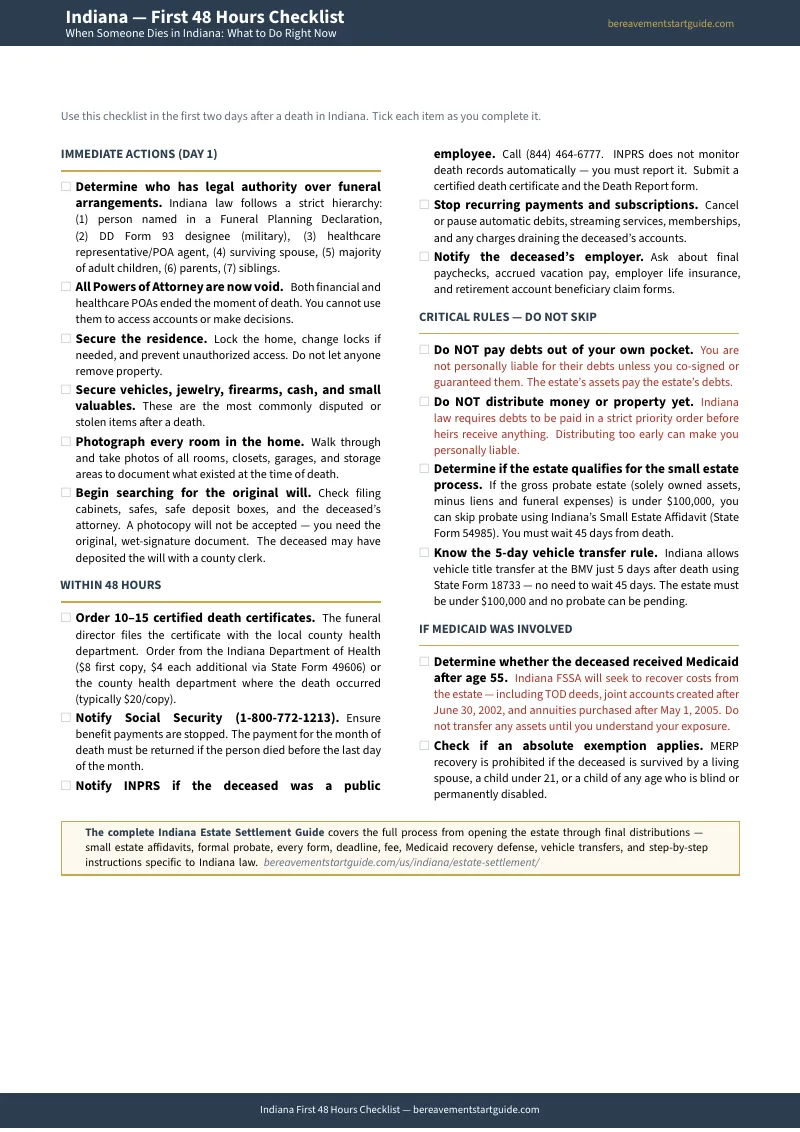
A printable emergency checklist covering the most urgent tasks -- from pronouncement of death and locating the original will through ordering death certificates, securing the residence, and determining whether the estate might qualify for Indiana's faster small estate process. Available as a free download so you can start immediately while deciding whether the full guide is right for your situation.
Who This Is For
- Surviving spouses who need to access frozen bank accounts, claim the $25,000 spousal allowance, understand whether the family home is protected from Medicaid recovery, and transfer the car title without waiting 45 days
- Adult children settling a parent's estate for the first time -- especially those living out of state who need to understand Indiana's county court systems, the Devolution Affidavit process, and whether they can manage the estate remotely through unsupervised administration
- Executors and personal representatives who want to fulfill their fiduciary duties correctly, protect themselves from personal liability for the decedent's debts, and understand when unsupervised administration can save thousands in legal fees
- Families dealing with estates near the $100,000 threshold who need to calculate whether the estate qualifies for Indiana's simplified small estate process -- and who can't afford to get the math wrong
- Anyone confused by the terminology -- Devolution Affidavit, Transfer on Death Deed, Letters Testamentary, unsupervised vs. supervised administration, MERP. This guide defines every term in plain English the first time it appears
Why Not Just Use the Free Government Forms?
Every form referenced in this guide is available for free from an Indiana government agency. The Small Estate Affidavit (State Form 54985) is available from the courts. The BMV Affidavit (State Form 18733) is on the BMV website. The Devolution Affidavit template is available from county recorders.
What's not free -- and what no government website provides -- is the sequence. The BMV won't tell you that vehicle transfers can happen at day 5, while bank account transfers require a 45-day wait. The county court will accept your filing fee but won't explain the difference between supervised and unsupervised administration or tell you which one saves you thousands. Indiana Legal Help gives you the Small Estate Affidavit but doesn't explain the calculation formula to determine whether you actually qualify. And no single state website mentions that a Transfer on Death deed -- the tool many families rely on to avoid probate -- can actually trigger Medicaid estate recovery exposure that a standard probate transfer might not.
Each agency handles its piece. None of them tell you what the next agency in line requires, or warn you about the traps hiding between the steps. This guide connects the dots -- putting every form, every deadline, every calculation, and every agency into the order you actually need them.
-- Less Than One Hour of Attorney Time
A single consultation with an Indiana probate attorney runs $250 to $400 per hour. A flat-fee retainer for a straightforward estate starts at $1,500 to $5,000. And total administrative fees can consume up to 10% of the gross estate. This guide covers the administrative fundamentals that would otherwise consume your first several billable hours -- ordering certificates, qualifying for the small estate process, choosing between supervised and unsupervised administration, organizing your documents, and understanding your statutory protections. Even if you ultimately hire an attorney, completing these steps first saves the estate hundreds of dollars in billable intake time.
If the guide doesn't save you at least ten hours of frustrating research across scattered government websites, email us at any time for a full refund. No questions asked.
Frequently Asked Questions
What if the rules change after I buy?
We update the guide when the rules change. Email us any time, even years later, and we'll send you the current edition free.