The Funeral Director Says Embalming Is "Required." The Casket Costs $4,000. And You Have No Idea What Indiana Law Actually Lets You Decline.
Someone you love just died in Indiana. Within hours, you're sitting across from a funeral director -- the only person who can legally file the disposition permit -- and they're walking you through a price list full of services you don't understand. They mention embalming like it's a given. The casket options start at $2,000 and climb fast. Someone says something about a vault liner being "standard." You're exhausted, you're grieving, and you don't know what's legally required versus what's a profitable upsell.
You start searching for answers. The Indiana Code is written for attorneys, not families. Nolo gives you a generic national overview with "check your state laws" footnotes. The Funeral Consumers Alliance website hasn't been updated since the last decade. And every local probate attorney you call quotes $250 to $400 per hour just to explain what you could decline for free if you knew the statute numbers.
Meanwhile, there are questions nobody is answering clearly. Can you have a home burial in Indiana? (Not for an intact body -- but cremated remains are a different story.) Who actually has the legal right to make funeral decisions when siblings disagree? How do you transfer a vehicle title in 5 days instead of waiting 45? And if the deceased received Medicaid after age 55, is the state really going to come after the house?
The Indiana Funeral Rights Defense System
This guide does what no funeral home brochure, government website, or attorney consultation does: it puts every Indiana funeral law, consumer protection, estate shortcut, and complaint mechanism into one chronological sequence -- from the hour of death through final disposition, asset transfers, and estate closure.
It's built specifically for Indiana. Not a generic overview with "laws vary by state" disclaimers. Every chapter addresses the exact statutes, thresholds, and procedural traps that make Indiana different -- the mandatory funeral director involvement that eliminates independent home funerals, the 48-hour cremation waiting period, the FTC Funeral Rule rights that funeral homes rarely volunteer, the $100,000 small estate threshold with its specific calculation formula, the 5-day BMV vehicle transfer rule, and the Medicaid Estate Recovery exemptions that could save the family home.
What You Get
The Complete Guide (15 Chapters)
- First 48 Hours protocol -- the exact legal sequence depending on where the death occurred (home hospice, unexpected home death, hospital, care facility). Why you must call 911 for unexpected deaths but should not for hospice deaths. The coroner's absolute jurisdiction over the remains. And the single most important instruction to give the funeral home in writing: refrigerate, do not embalm
- Who controls the body -- the statutory priority list -- Indiana Code IC 29-2-19-17 establishes a strict hierarchy for who has the legal right to make funeral decisions. A person named in an Indiana Funeral Planning Declaration holds absolute supremacy over the surviving spouse and all children. This chapter gives you the exact list, in order, so family disputes end with a statute citation instead of a shouting match
- Your FTC Funeral Rule rights -- the federal law that most funeral homes count on you not knowing. They must provide itemized pricing over the phone without requiring your name. They cannot force you into bundled packages. They cannot charge a handling fee for a casket you purchased elsewhere. And they must disclose in writing that embalming is generally not required by law. This chapter includes the exact language to use when requesting the General Price List
- Every disposition option explained -- traditional burial (cemetery required for intact remains in Indiana), cremation (48-hour waiting period, pacemaker removal requirement, no casket required), green burial (specific Indiana cemeteries that accept biodegradable caskets and shrouds without concrete vaults -- Kessler Woods in Indianapolis, Spring Vale in Lafayette, Oak Hill in Crawfordsville, Maplewood in Anderson), scattering ashes (legal on private property with consent, uninhabited public land, and navigable waterways -- plus the 10-day county recorder filing requirement most families miss), and body donation
- The $100,000 Small Estate Affidavit -- a qualification worksheet using the exact statutory formula: Gross Probate Assets minus Liens and Encumbrances minus Reasonable Funeral Expenses. Updated for the July 2022 threshold increase from $50,000 to $100,000, with clear rules on what counts toward the limit and what doesn't. Life insurance, retirement accounts with designated beneficiaries, and TOD deeds all fall outside the probate estate. Plus the critical 45-day waiting period that invalidates the affidavit if you file too early
- The 5-day BMV vehicle transfer -- Indiana allows vehicle title transfers via small estate affidavit just 5 days after death using State Form 18733, completely bypassing the standard 45-day wait required for other assets. Most families, and many attorneys, confuse these two timelines
- Real estate transfers -- the Transfer on Death Deed under IC 32-17-14 (must be recorded before the owner's death to be valid -- a deed found in a drawer is legally void), joint tenancy with right of survivorship, and the Devolution Affidavit for intestate estates. Plus the hidden pitfall: title companies refuse to insure properties until the 7-to-9-month creditor window closes
- Formal probate walkthrough -- supervised versus unsupervised administration, the $177 filing fee, the mandatory creditor publication requirement, the 3-month claims window, and why unsupervised administration (IC 29-1-7.5) saves thousands for cooperative families
- Medicaid Estate Recovery defense -- what Indiana's FSSA can and cannot recover, including aggressive recovery from joint tenancy property. Then the critical exemptions: the state is strictly prohibited from recovery if the deceased is survived by a living spouse, a child under 21, or a disabled or blind child of any age. Plus the 90-day window for undue hardship waivers
- Funeral home complaints -- step-by-step instructions for filing with the Professional Licensing Agency and the Indiana Attorney General, with clear guidance on what constitutes a valid complaint versus a customer service grievance
- Prepaid funeral contracts -- your right to transfer a prepaid contract to any other funeral home at any time under IC 30-2-13. How making the funeral trust irrevocable after 30 days shields those funds from Medicaid asset limit calculations
- Advance directives -- the Indiana Funeral Planning Declaration, health care representative appointments, living wills, and why documenting wishes now prevents family conflict later
- Veterans burial benefits -- federal VA burial allowances ($1,002 to $2,000 depending on service connection) plus the Indiana Veterans Memorial Cemetery in Madison, which provides free grave space, free opening and closing, and a free marker for eligible veterans and their spouses
- Indiana's tax position -- confirmation that Indiana repealed the inheritance tax for deaths after December 31, 2012. No Form IH-14 Consent to Transfer required. Plus federal estate tax thresholds and final income tax filing requirements
- Quick reference directory -- every form, deadline, fee, and agency contact referenced in the guide on one printable page
8 Standalone Printable Tools
Every tool works independently -- print the ones you need and leave the rest for later:
- FTC Rights Card -- Take this to the arrangement conference. Contains the exact language for requesting itemized pricing, declining embalming, and bringing your own casket under federal law
- Disposition Authority Hierarchy -- The complete IC 29-2-19-17 statutory priority list for who controls funeral decisions. Print this when family members disagree
- BMV Vehicle Transfer Sheet -- Step-by-step instructions for transferring a vehicle title using State Form 18733, the 5-day waiting period, and the $15 fee
- Medicaid Recovery Defense Reference -- Every FSSA exemption mapped -- surviving spouse, child under 21, disabled dependent -- plus the 90-day undue hardship waiver window
- Complaint Escalation Cheatsheet -- Who to contact for each type of problem: PLA, Attorney General, or FTC, with specific complaint criteria
- Funeral Cost Comparison Worksheet -- Side-by-side worksheet for comparing itemized prices from multiple funeral homes
- Quick Reference Directory -- Every form, deadline, fee, and agency contact on one printable page
- Small Estate Calculator -- Step-by-step worksheet for determining whether the estate qualifies under Indiana's $100,000 threshold
The Free Indiana Funeral Consumer Rights Checklist
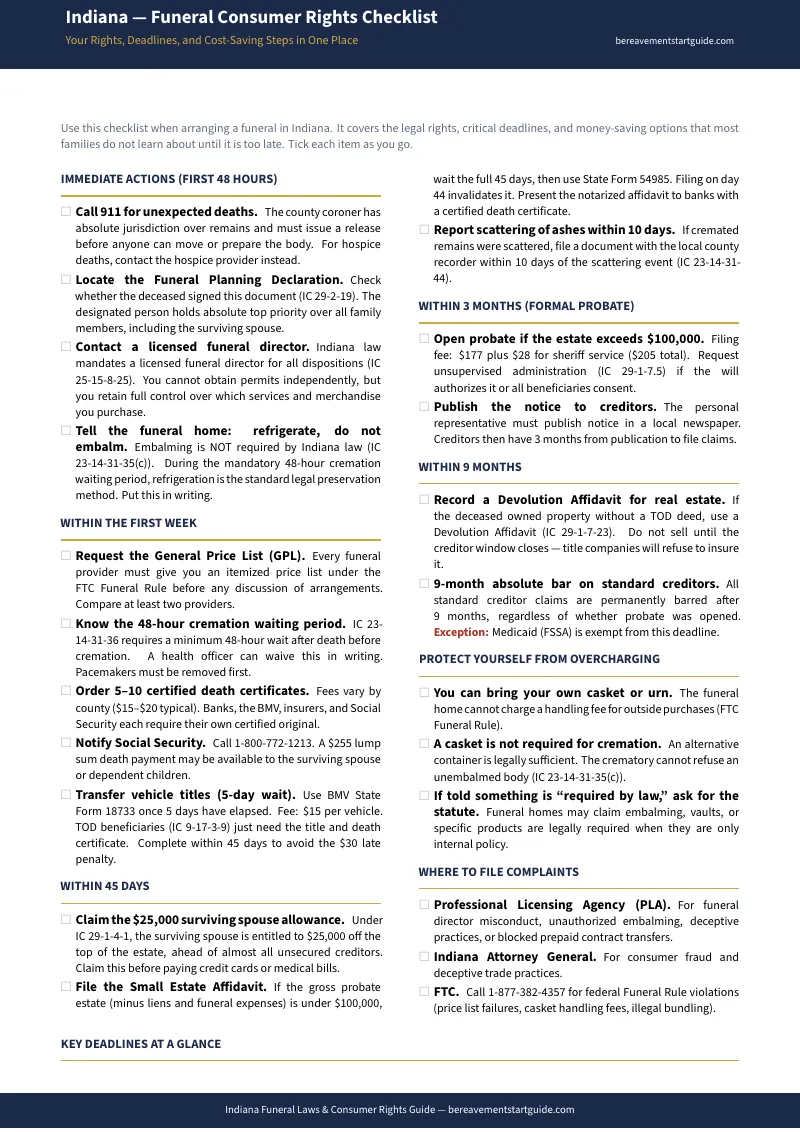
A printable emergency checklist covering the most urgent actions -- from calling 911 versus hospice, locating the Funeral Planning Declaration, giving written refrigeration instructions to the funeral home, through requesting the General Price List, ordering death certificates, and knowing the 5-day BMV vehicle transfer window. Available as a free download so you can start immediately while deciding whether the full guide is right for your situation.
Who This Is For
- Families arranging a funeral in Indiana who want to know exactly what they're legally required to pay for and what they have the right to decline -- before sitting down with a funeral director
- Surviving spouses who need to claim the $25,000 spousal allowance, transfer the car title in 5 days instead of 45, and understand whether the family home is protected from Medicaid recovery
- Adult children settling a parent's estate who need to determine whether the estate qualifies for Indiana's simplified small estate process or requires formal probate -- and who can't afford to get the calculation wrong
- Executors and personal representatives who want to fulfill their duties correctly, protect themselves from personal liability, and avoid paying $300 per hour for tasks they can handle themselves
- Anyone pre-planning their own arrangements who wants to document their wishes in a legally binding Funeral Planning Declaration, understand prepaid contract protections, and ensure their family knows the rules before the crisis hits
Why Not Just Use Free Government Websites?
Every statute and form referenced in this guide is public record. The Indiana Code is online. The BMV forms are free. The FTC Funeral Rule is federal law.
What's not free -- and what no government website provides -- is the translation and the sequence. The Indiana Professional Licensing Agency regulates funeral directors but won't tell you which services you can decline. The BMV website has the vehicle transfer form but won't explain that you can use it after 5 days while other assets require a 45-day wait. The FTC publishes the Funeral Rule but doesn't tell you how it interacts with Indiana's mandatory funeral director requirement. And the courts website posts the Small Estate Affidavit form but doesn't walk you through the calculation formula to determine whether you actually qualify.
Each agency handles its piece. None of them tell you what the next agency in line requires, or warn you about the traps hiding between the steps. Funeral directors provide an essential service, but their primary obligation is to the funeral home's revenue. This guide represents only you.
-- Less Than One Hour of Attorney Time
A single consultation with an Indiana probate attorney runs $250 to $400 per hour. This guide covers the consumer rights, procedural knowledge, and estate fundamentals that would otherwise consume your first several billable hours -- understanding your FTC rights, qualifying for the small estate process, executing the 5-day vehicle transfer, and knowing which services you can legally decline at the funeral home. Even if you ultimately hire an attorney, completing these steps first saves the estate hundreds in billable intake time.
If the guide doesn't save you at least ten hours of frustrating research across scattered government websites, email us at any time for a full refund. No questions asked.
Frequently Asked Questions
What if the rules change after I buy?
We update the guide when the rules change. Email us any time, even years later, and we'll send you the current edition free.