The Bank Froze the Account. The BMV Turned You Away. The Attorney Quoted $3,000.
You called the bank to pay the funeral home, and they told you the account is frozen until you produce something called Letters Testamentary. You drove to the BMV to transfer the car title, and they asked for a court document you do not have. You searched the Hamilton County or Marion County clerk's website and found a stack of blank PDF forms with no instructions and a warning that court staff cannot provide legal advice. The probate attorney you called quoted a $3,000 retainer before even looking at the will.
Meanwhile, medical bills are arriving at the deceased's address. You are not sure which ones the estate must pay and which ones you can safely ignore. The other family members want to know when they will receive their share, and you cannot access the checking account to keep the utilities running at the house. You heard something about a deadline for notifying creditors through a newspaper, but nobody told you which newspaper, how many times, or what happens if you miss it.
The Indiana Estate Settlement System
Indiana probate runs through the county circuit or superior court under Title 29 of the Indiana Code, and the rules changed significantly in 2022. Senate Enrolled Act 67 doubled the Small Estate Affidavit threshold from $50,000 to $100,000 — which means a large share of Indiana estates can now bypass the courthouse entirely. But for estates above that line, Indiana courts enforce one of the strictest unauthorized-practice-of-law rules in the country: a personal representative handling formal probate is legally representing the interests of beneficiaries and creditors, which generally requires an attorney. This guide maps every pathway, deadline, and filing step so you know exactly where you stand before you spend a dollar.
The $100,000 Fork — Small Estate Affidavit or Formal Probate
For deaths after June 30, 2022, if the total value of solely-owned probate assets (minus liens, encumbrances, and funeral costs) is $100,000 or less, you can skip the courthouse with a notarized Small Estate Affidavit under IC 29-1-8-1. Joint accounts, TOD accounts, life insurance payouts, and retirement accounts with named beneficiaries do not count toward the limit. The guide walks you through the exact calculation with examples so you know within 15 minutes whether you qualify — and if you do, you can present the affidavit directly to banks and institutions after the mandatory 45-day waiting period. They must release funds within 3 business days.
The Attorney Question — What Indiana's UPL Rule Actually Means
Indiana is one of the strictest states on unauthorized practice of law in probate. Case law establishes that a personal representative acting on behalf of an estate's beneficiaries and creditors is practicing law — even if they are the sole heir. This applies to formal court proceedings, not to the Small Estate Affidavit process or BMV vehicle transfers. The guide explains exactly where the line falls: when you can handle everything yourself, when you must hire an attorney, and how to use this guide to organize the estate before the first billable hour starts — so you pay for legal judgment, not for someone to sort through your paperwork at $300 an hour.
The 90-Day Creditor Clock and the Publication Requirement
After opening formal probate, you must publish a Notice of Administration once per week for two consecutive weeks in a county newspaper. That publication starts a 3-month claims window. Known creditors must also receive direct written notice within one month. All claims are absolutely barred 9 months after the date of death — but if you distribute assets before that window closes, you are personally liable for unpaid debts the estate should have covered. The guide covers the exact notification process, the statutory priority order for paying debts, and the timeline that protects you from late-filing collectors.
The 60-Day Inventory Nobody Warns You About
Within 2 months of your appointment as personal representative, you must prepare and file a sworn inventory of every probate asset — valued as of the date of death — plus all known liens and encumbrances. Miss the deadline and you risk removal. Undervalue an asset and you invite breach-of-fiduciary-duty claims from heirs watching for errors. The guide includes an asset-by-asset breakdown of what counts, how to value it, what documentation the court expects, and what stays off the inventory because it passed outside probate.
Vehicle Transfers, Real Property, and the BMV Form 18733
Indiana vehicles have their own fast-track transfer process. If the total estate is under $100,000, you can transfer a vehicle title at the BMV using State Form 18733 after just a 5-day waiting period — no court involvement, no Letters, $15 fee. If the car had a Transfer on Death designation, it passes directly to the beneficiary. For real property, the rules depend entirely on how the title was held: joint tenancy with right of survivorship, TOD deed, or sole ownership all produce different outcomes. The guide covers every scenario and the recording requirements for each Indiana county.
What You Get — 9 Printable PDFs
- The Complete Indiana Probate Process Guide — 14 chapters plus 3 quick-reference appendices covering the $100,000 Small Estate Affidavit (updated for SEA 67), formal probate filing, Letters Testamentary and Letters of Administration, the 90-day creditor claims window, the statutory debt priority order, the 60-day inventory requirement, unsupervised vs. supervised administration, vehicle transfers via BMV Form 18733, real property transfers, Transfer on Death deeds, the $25,000 spousal allowance, Medicaid estate recovery rules, Indiana Form IT-41, estate closing procedures, when you need an attorney, key deadlines, fee schedules, and a forms directory
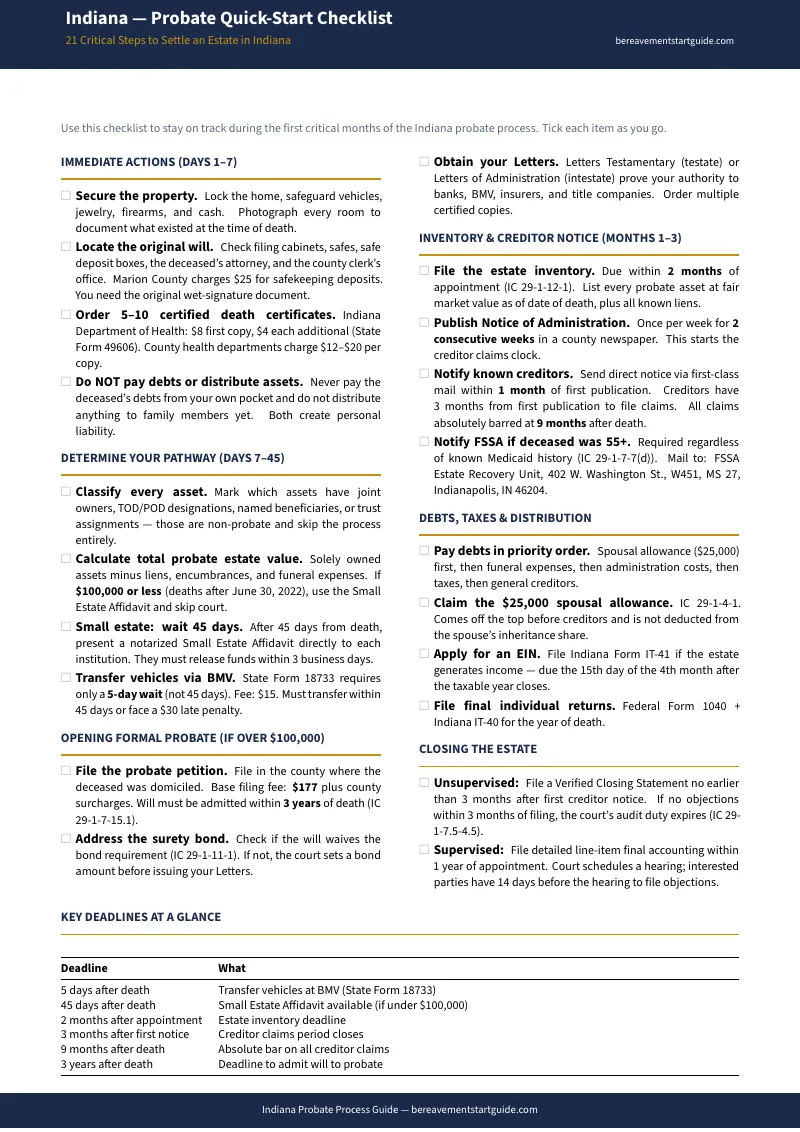
- Indiana Probate Quick-Start Checklist — 21-item printable checklist organized by timeline: Days 1–7 immediate actions, pathway determination (Days 7–45), formal probate opening, inventory and creditor notification (Months 1–3), debts and taxes, and estate closing
- Small Estate Calculator Worksheet — Fillable worksheet for the $100,000 threshold calculation: list every probate asset, subtract liens, encumbrances, and funeral costs, and determine whether you qualify for the Small Estate Affidavit
- Estate Inventory Worksheet — Court-ready fillable inventory covering real estate, bank accounts, investments, vehicles, personal property, business interests, and debts receivable — with include/exclude columns for probate vs. non-probate classification
- Creditor Claims Tracker — Tracks every creditor notification, claim filing date, accepted/rejected status, and payment priority rank using Indiana's 7-tier statutory priority order
- Vehicle Transfer Checklist — Side-by-side requirements, fees, and deadlines for the three Indiana vehicle transfer pathways: formal probate, small estate BMV Form 18733, and TOD beneficiary designation
- Administration Comparison Card — One-page reference comparing unsupervised vs. supervised administration: when each applies, court involvement level, timeline, cost, and reporting requirements
- Deadlines Reference Card — Every critical Indiana probate deadline on one page: 5-day BMV wait, 45-day affidavit period, 60-day inventory filing, 90-day creditor claims window, 9-month absolute bar, and 3-year will submission deadline
- Quick Reference Directory — Combined fee schedule and forms directory listing every Indiana probate filing fee, form number, and purpose
Who This Is For
- Named executors who have the will in hand but do not know where to file it, what Letters Testamentary are, or the difference between unsupervised and supervised administration — and need a linear path from the first phone call through the final closing order
- Administrators without a will who need to understand Indiana's intestate succession rules, how the surviving spouse's share works, what additional bond requirements apply, and what changes when there is no will to submit
- Families near the $100,000 threshold who want to determine whether the Small Estate Affidavit applies before spending money on an attorney — especially with the 2022 SEA 67 changes that many attorneys have not yet incorporated into their standard advice
- Surviving spouses who need to claim the $25,000 spousal allowance, understand how Medicaid estate recovery works (and when it is deferred), and protect their household finances during the settlement process
- Out-of-state executors managing a Marion County, Hamilton County, or Allen County estate from a distance who need every filing requirement, fee, and deadline in one document rather than scattered across county clerk websites
- Executors preparing for an attorney handoff who want to arrive at the first meeting with the estate organized, the assets inventoried, and the right questions ready — so they pay for legal strategy, not document assembly at $300 per hour
Why Free Resources Fall Short
Indiana county clerk websites provide downloadable forms — but without instructions on sequencing, without explanations of what each form does, and with the explicit warning that court staff cannot offer legal guidance. The Indiana BMV site has State Form 18733 for vehicle transfers but does not explain how it interacts with the small estate threshold, the 5-day waiting period, or the 45-day penalty deadline. National sites like Nolo and FindLaw describe Indiana probate in generic terms that miss the 2022 threshold increase, the specific UPL case law, and county-level fee differences. Attorney blogs explain just enough to convince you the process is impossible without them, then quote $3,000 to $5,000 for an uncontested proceeding.
This guide covers only Indiana. Every statute reference, every form number, every court fee, and every deadline applies specifically to Indiana Code Title 29 and Indiana county courts. It is the missing layer between a pile of government forms and a multi-thousand-dollar attorney retainer — the chronological, plain-English roadmap the state provides the forms for but refuses to explain.
What This Guide Does Not Do
This is an educational resource and administrative organization tool — not legal advice or attorney representation. If the estate involves active litigation, a formally contested will, complex business succession, an insolvent estate where debts exceed assets, or a dispute between heirs that cannot be resolved through conversation, you need a licensed Indiana probate attorney. Under Indiana's unauthorized practice of law rules, formal probate proceedings generally require attorney representation when the personal representative acts on behalf of other parties. When that is the case, the guide tells you exactly why and what kind of professional to hire. For straightforward estates where the family agrees and you need to navigate Indiana deadlines, forms, and fees without paying thousands for basic administrative guidance, this guide gives you the complete roadmap.
— Less Than 15 Minutes of an Indiana Attorney's Time
Indiana estate attorneys charge $200 to $400 per hour. A full uncontested probate runs $3,000 to $5,000. This guide costs less than 15 minutes of billable attorney time and covers every form, deadline, and statutory threshold those fees are supposed to pay for.
Every purchase includes a money-back guarantee, no time limit. If the guide does not save you at least ten hours of research and make the Indiana probate process clear, email us for a full refund.
The free Quick-Start Checklist covers the immediate deadlines — ordering death certificates, securing the estate, determining your legal pathway, and identifying the key filing steps. The full toolkit adds the complete 14-chapter guide, 7 standalone worksheets and reference cards — including the small estate calculator, estate inventory worksheet, creditor claims tracker, vehicle transfer checklist, administration comparison card, deadlines reference, and quick reference directory — covering every form, fee, and deadline in the Indiana probate process.
Frequently Asked Questions
What if the rules change after I buy?
We update the guide when the rules change. Email us any time, even years later, and we'll send you the current edition free.