
Your Spouse Died in Indiana. The Bills Keep Coming. And Nobody Will Tell You What You're Actually Entitled To.
The mortgage is due. The health insurance premium just tripled because COBRA charges 102% of the full cost -- and Indiana state employee family plans run over $3,200 a month. The bank won't release the checking account because it was in your spouse's name alone. The BMV says you need "an affidavit" for the car title but won't explain which one. And somewhere in the back of your mind, you're terrified that Medicaid is going to come after the house.
You start looking for answers. The Indiana Public Retirement System sends you a dense PDF about a 30-day review period. The FSSA website buries Medicaid burial assistance under layers of bureaucratic jargon. The county auditor's office has a property tax deduction you might qualify for -- if you can figure out the income limits and file by January 15. And every probate attorney you call quotes $250 to $400 per hour just to tell you things Indiana law already entitles you to for free.
Meanwhile, the deadlines are ticking. Five days for the vehicle transfer. Forty-five days before you can execute the small estate affidavit. Sixty days to elect COBRA. Ninety days for Medicaid burial assistance claims. Ninety days for the spousal allowance in formal probate. Nine months before the absolute creditor bar closes. Miss any of these, and the money stays locked up -- or disappears entirely.
The Indiana Survivor Benefits Claim System
This guide does what no government website, funeral home aftercare packet, or attorney consultation does: it puts every Indiana survivor benefit, financial protection, tax deduction, and asset transfer process into one chronological sequence -- organized by the exact deadlines that Indiana law imposes on your family.
It's built for Indiana. Not a generic fifty-state overview with "check your local laws" footnotes. Every chapter addresses the specific statutes, dollar amounts, forms, and procedural traps that apply in Indiana -- the $25,000 spousal allowance under IC 29-1-4-1 that most families never claim because nobody tells them it exists, the $100,000 small estate threshold with its specific calculation formula, the 5-day BMV vehicle transfer that runs on a completely different timeline than every other asset, the Medicaid Estate Recovery exemptions that could save the family home, and the property tax deductions worth up to $38,960 for surviving spouses of disabled veterans.
What You Get
The Complete Guide (12 Chapters)
- The survivor benefits landscape -- every financial protection available under Indiana law mapped in one place: the $25,000 spousal allowance, the $100,000 small estate threshold, the seven-month real estate safe harbor, the nine-month absolute creditor bar, and confirmation that Indiana has no inheritance tax and no state estate tax for deaths after January 1, 2013
- Days 1-15 action protocol -- the exact sequence of notifications and claims you must start immediately: ordering certified death certificates ($8 first copy from IDOH via State Form 49606), calling SSA for the $255 lump-sum death payment and monthly survivor benefits, reporting to INPRS if the deceased was a public employee, contacting the VA for federal burial allowances plus the county's separate $1,000 veteran burial benefit under IC 10-17-10
- The 5-day BMV vehicle transfer -- how to transfer a vehicle title using State Form 18733 just five days after death, while every other asset requires a 45-day wait. The specific documents required, the $15 title fee, and the $30 late penalty that kicks in after 45 days
- Employment benefits and final wages -- Indiana law permits employers to pay final wages, accrued vacation, and unpaid bonuses directly to the surviving spouse without probate. Plus workers' compensation death benefits (66 2/3% of average weekly wages for up to 500 weeks) and the $10,000 burial allowance for workplace fatalities
- Health insurance survival strategies -- the 60-day COBRA election window, the 36-month spousal continuation period, specific Indiana state employee COBRA rates, the Retirement Medical Benefits Account (RMBA) for retiree spouses, and how to compare COBRA against Marketplace plans using the 60-day Special Enrollment Period triggered by spousal loss
- Life insurance and beneficiary-designated accounts -- step-by-step claims for life insurance, POD bank accounts, TOD brokerage accounts, and retirement accounts. Special section for Indiana state employees covering the 31-day Securian group life conversion window and the INSPD Benefits Division process
- The $100,000 small estate calculation -- the exact statutory formula for determining eligibility: Gross Probate Assets minus Liens and Encumbrances minus Reasonable Funeral Expenses. How to separate probate from non-probate assets. The critical 45-day waiting period. And what to do when a bank refuses your affidavit -- including your right to sue and recover attorney's fees under IC 29-1-8-4.5
- The $25,000 spousal allowance -- how to claim this statutory right that takes priority over credit cards, medical bills, and most unsecured creditors. It applies whether the deceased had a will or died intestate. It must be asserted within 90 days of formal probate administration. This chapter includes the claim process, what it can be satisfied from, and how it interacts with the small estate threshold
- Medicaid Estate Recovery defense -- what Indiana's FSSA can and cannot recover, including the aggressive expansion to joint tenancy property and TOD accounts created after June 30, 2002. The exemptions that block recovery entirely: surviving spouse, child under 21, blind or disabled child of any age. The 90-day window for Undue Hardship Waivers via State Form 48259. And the FSSA burial assistance program (maximum $1,200 funeral plus $800 cemetery via State Form 35937)
- Real estate and property tax protections -- Transfer on Death deeds under IC 32-17-14, the Devolution Affidavit for intestate transfers, the seven-month safe harbor that blocks unsecured creditors, and three property tax deductions: the Over 65 or Surviving Spouse credit ($25,000 income limit, State Form 51781), the disabled veteran deduction (up to $38,960 combined via State Form 12662), and the 2026 Standard Homestead Deduction changes ($40,000 base plus 10% supplemental credit up to $300)
- INPRS pension survivor benefits -- the complete death reporting process for PERF Hybrid Plan, Teachers' Retirement Fund, and 1977 Police/Fire Fund. The mandatory 30-day review period, the documents required (including IRS Form 56), why Power of Attorney becomes instantly void at death, the $150,000 line-of-duty death benefit, and child survivor benefits (20% of monthly benefit until age 18 or 23 if a full-time student)
- Appeals and dispute resolution -- what to do when a claim gets denied: INPRS administrative review by an ALJ under IC 4-21.5, FSSA/Medicaid appeals within 33 days to OALP, workers' compensation disputes via State Form 45442 and the Full Board hearing process
8 Standalone Reference Tools
Each one pulls a critical workflow out of the guide and turns it into a focused, print-ready reference you can use at the kitchen table, in the county office, or on the phone with an agency:
- Deadline Calendar -- every statutory deadline on one timeline: Day 5 BMV transfer, Day 45 small estate affidavit, Day 60 COBRA, Day 90 FSSA burial and spousal allowance, Month 7 safe harbor, Month 9 creditor bar
- Forms Reference -- every Indiana form, agency contact, and filing instruction consolidated in one document so you stop hunting across five different state websites
- Small Estate Calculator -- the exact statutory formula worksheet: Gross Probate Assets minus Liens and Encumbrances minus Funeral Expenses, with line-by-line guidance so you know whether to file an affidavit or open probate
- BMV Vehicle Transfer -- the 5-day transfer process using State Form 18733, the specific documents required, the $15 title fee, and the $30 late penalty that kicks in after 45 days
- Medicaid Recovery Defense -- every FSSA exemption, the 90-day Undue Hardship Waiver window, and which assets the state can and cannot reach
- Property Tax Worksheet -- all three deductions mapped with eligibility criteria, income limits, and filing deadlines: Over 65/Surviving Spouse credit, disabled veteran deduction, and 2026 Standard Homestead changes
- INPRS Survivor Benefits -- the complete death reporting process for PERF, Teachers' Retirement, and Police/Fire funds with the 30-day review timeline and required documents
- Spousal Allowance Claim -- step-by-step instructions for asserting the $25,000 statutory right under IC 29-1-4-1, including what it can be satisfied from and how it interacts with creditor claims
The Free Indiana Survivor Benefits Checklist
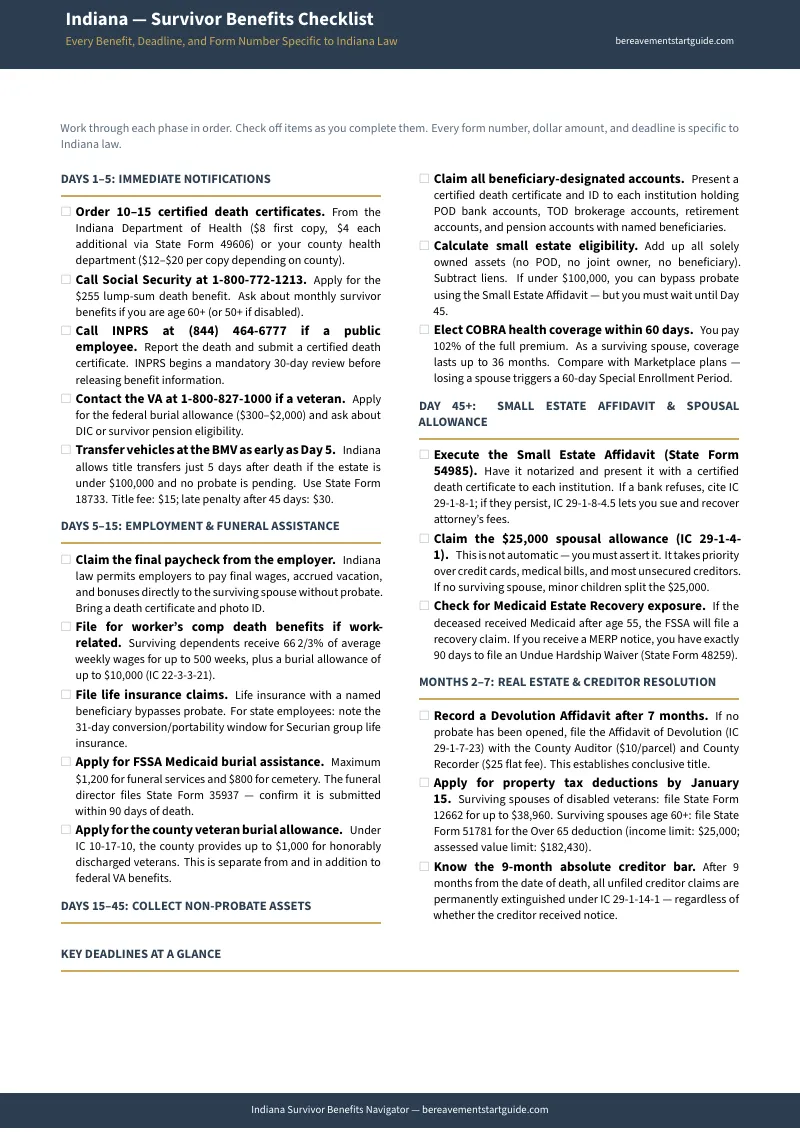
A chronological emergency checklist covering the most critical actions -- from ordering death certificates and calling SSA on Day 1, through the 5-day BMV vehicle transfer, the Day 45 small estate affidavit, the 60-day COBRA election, the 90-day FSSA burial assistance deadline, and the property tax filing deadline of January 15. Available as a free download so you can start immediately while deciding whether the full guide is right for your situation.
Who This Is For
- Surviving spouses who need to claim the $25,000 statutory allowance, unlock frozen bank accounts, transfer the car title, maintain health insurance, and protect the family home from Medicaid recovery -- without paying $300 an hour for information Indiana law already provides
- Adult children settling a parent's estate who need to calculate whether the estate qualifies for Indiana's $100,000 small estate bypass, understand which assets count toward the limit, and execute the affidavit correctly on Day 45 so the bank cannot legally reject it
- Dependents of Indiana public employees navigating the INPRS system -- the 30-day review period, the documentation requirements, and the pension continuation options that differ depending on whether the death occurred in the line of duty
- Families of Indiana veterans who need to claim both the federal VA burial allowance and the separate county burial allowance under IC 10-17-10, plus property tax deductions worth up to $38,960
- Anyone helping a grieving family member who is too overwhelmed to research government websites, call agency hotlines, and track statutory deadlines alone
Why Not Just Use Free Government Websites?
Every statute and form referenced in this guide is public record. The Indiana Code is online. The BMV forms are free. The INPRS death reporting process is documented. The FSSA burial assistance application is available on the state website.
What no government website provides is the sequence and the math. INPRS will tell you what documents to submit but won't explain how the 30-day review period interacts with your health insurance deadline. The BMV will give you the vehicle transfer form but won't mention that you can use it after 5 days while other assets require a 45-day wait. The FSSA website describes Medicaid burial assistance but won't warn you about the 90-day filing deadline that funeral directors sometimes miss. And no state agency will help you calculate whether the estate qualifies for the $100,000 small estate bypass -- or explain which assets to exclude from that calculation so you don't accidentally trigger formal probate for an estate worth $101,000.
Each agency handles one piece. None of them connect you to the next agency in line. This guide does.
-- Less Than One Hour of Attorney Time
A single consultation with an Indiana probate attorney runs $250 to $400 per hour. Formal estate administration can cost 4% to 11% of the gross estate in legal fees. This guide covers the benefit claims, asset transfer procedures, and deadline management that would otherwise consume your first several billable hours -- understanding the small estate calculation, claiming the spousal allowance, executing the BMV transfer, and navigating INPRS and Medicaid recovery. Even if you ultimately hire an attorney, completing these steps first saves the estate hundreds in billable intake time.
If the guide doesn't save you at least ten hours of frustrating research across scattered government websites, email us at any time for a full refund. No questions asked.
Frequently Asked Questions
What if the rules change after I buy?
We update the guide when the rules change. Email us any time, even years later, and we'll send you the current edition free.