
The Inheritance Tax Is Gone. The Deadlines Aren't.
Iowa repealed its inheritance tax in 2025. The federal estate tax now exempts $15 million per person. For most families, the transfer taxes that used to dominate estate planning are simply gone.
But the administrative obligations? Those are still waiting for you. The ninety-day probate inventory. The fiduciary income tax return the court won't let you skip. The Income Tax Certificate of Acquittance you need before the estate can close. The Medicaid recovery claim that can swallow the family home if you miss a thirty-day window.
None of these deadlines pause because you're grieving. And none of them are explained in one place — not on the Iowa Department of Revenue's website, not in the district court's forms, and not in the generic "estate tax" articles that still warn you about an inheritance tax that no longer exists.
The Iowa Estate Settlement Sequence
This guide replaces the confusion with a single, chronological roadmap. Every tax filing, every court deadline, every form — sequenced in the exact order you need to complete them, with the Iowa-specific details that national guides get wrong.
You get the complete administrative pathway from the day of death through estate closing, built specifically for Iowa's current legal and tax landscape — the 2025 inheritance tax repeal, the 3.8% flat income tax rate, the $100,000 small estate affidavit threshold, and the $15 million federal exemption.
What's Inside the Guide
Iowa's Tax Reality — What You Owe and What You Don't
A clear breakdown of which taxes actually apply to your estate. The inheritance tax repeal, the state estate tax (abolished since 2005), and the federal estate tax exemption are explained in plain language — so you stop worrying about taxes that don't exist and focus on the ones that do.
The Fiduciary Income Tax Return (IA 1041) — Start to Finish
If the estate earns $600 or more in income during administration, you need to file this return. The guide walks you through when it's required, how it connects to the federal Form 1041, the electronic filing rules, Schedule K-1 distribution to beneficiaries, and — most critically — how to request the Income Tax Certificate of Acquittance that the probate court demands before it will discharge you.
Three Probate Tracks — Pick the Right One
Iowa offers three tiers of estate administration depending on the value and composition of the assets. The Small Estate Affidavit (Iowa Code 633.356) lets you bypass court entirely for personal property under $100,000. Chapter 635 provides simplified probate for estates up to $200,000. Chapter 633 is the full administration track. The guide explains the eligibility rules, forms, and timelines for each.
The Step-Up in Basis — Your Biggest Tax Advantage
Inherited farmland, homes, and investments get their tax basis "stepped up" to fair market value at the date of death. That means decades of appreciation can pass to beneficiaries tax-free. The guide shows you how to document this with date-of-death appraisals — and why gifting appreciated assets during life costs families far more than inheriting them.
Medicaid Estate Recovery — The 30-Day Window
If the decedent received Medicaid after age 55, the state has a priority claim on the estate. Iowa's definition of "estate" for recovery purposes is broader than the probate definition — it includes joint tenancy property, pay-on-death accounts, and trust interests. The guide explains the mandatory notification process and the strict 30-day hardship waiver deadline that most families don't know exists until it's too late.
Probate Fee Calculator and Professional Referral Guide
Iowa Code 633.197 caps executor and attorney fees at a sliding-scale percentage of the gross estate. For a $400,000 estate, the maximum attorney fee is roughly $8,120. The guide shows you how to calculate this yourself, so you can negotiate a fair rate — or handle the administrative preparation yourself and save thousands.
Printable Tools Included
The guide comes with four standalone printable PDFs you can use right away — no need to flip through the full guide to find what you need in the moment:
- Statutory Deadline Timeline — Every critical deadline from Day 1 through estate closing, with legal citations, on a wall-ready 3-page printout
- Estate Asset Inventory Worksheet — A 4-page fillable worksheet organized by asset category for the 90-day probate inventory
- Iowa Forms Directory — Every required form listed with the issuing agency and where to find it
- Probate Fee Calculator — The Iowa Code 633.197 formula with space to calculate your estate's specific executor and attorney fees
Who This Is For
- Newly appointed executors and administrators — you need a step-by-step sequence, not a stack of government forms with no instructions
- Surviving spouses — the guide covers your elective share rights, the family allowance, and the 4-month deadline to claim both
- Beneficiaries wondering about taxes — especially if you're inheriting farmland, a home, or retirement accounts and want to know what you actually owe
- Families facing Medicaid recovery — the hardship waiver process is explained with the exact criteria and the deadline that matters most
Why This Exists When the Forms Are Free
Every form in this guide is available for free from the Iowa Department of Revenue, the Iowa Judicial Branch, or the IRS. The IA 1041 instructions are online. The probate code is public.
But the forms sit in isolated silos across three different state agencies and the federal government. The Department of Revenue handles income tax. The Department of Health and Human Services handles Medicaid recovery. The Judicial Branch handles probate filings. Nobody sequences them for you. Nobody tells you that the acquittance must come before distribution, that the creditor window must close before final accounting, or that the Medicaid notification must happen before you touch the bank accounts.
This guide is the box cover that shows how the pieces fit together — and the chronological timeline that keeps you from missing the deadlines that carry personal liability.
Your Purchase Is Protected
If the guide doesn't give you the clarity and confidence you need to handle the estate's tax obligations, email us and we'll make it right. No complicated return process.
— Less Than One Hour of Attorney Time
Iowa statutory attorney fees can exceed $8,000 for a standard estate. A single consultation costs several hundred dollars. This guide gives you the complete administrative framework to prepare everything yourself — and approach a professional with an organized file instead of a blank stare.
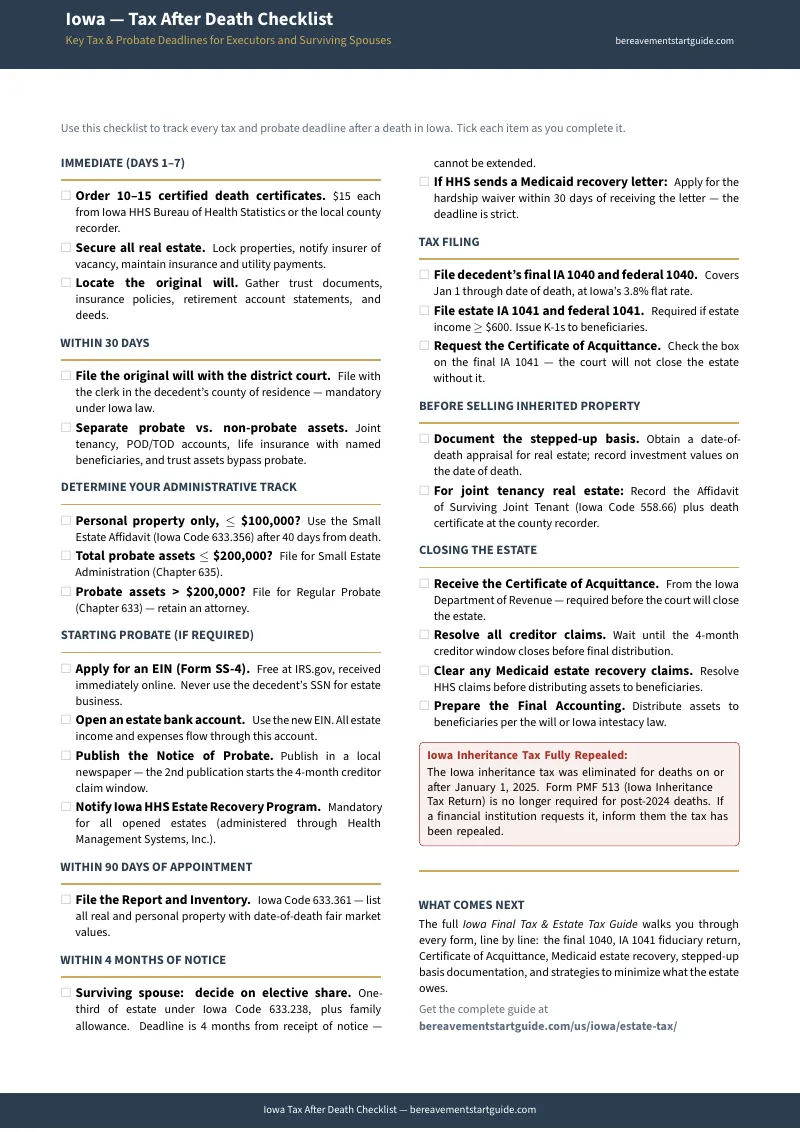
Download the free Iowa Executor's Tax Checklist to see the 20 most critical tasks at a glance. When you're ready for the full roadmap — every chapter, every form, every deadline — the complete guide is here.
Frequently Asked Questions
What if the rules change after I buy?
We update the guide when the rules change. Email us any time, even years later, and we'll send you the current edition free.