The Funeral Director Knows Iowa Law Better Than You Do. That Changes Now.
Someone you love has died in Iowa. Within 72 hours, the body must be embalmed, cremated, buried, or placed in refrigerated storage — that is Iowa Administrative Code, not a suggestion. Before you have had time to process what has happened, you will be sitting across from a funeral director presenting you with a contract for services running $8,000 to $12,000. That person knows every line of Chapter 144C. You are still trying to figure out whether embalming is actually required by law. (It is not.)
This information gap is the foundation of the industry in Iowa. Funeral directors are not required to tell you that embalming is almost never legally mandatory. They will not volunteer that refrigeration between 38 and 42 degrees Fahrenheit extends the disposition window to six full days. They will certainly not mention that Iowa law allows home funerals on private property — or that the 20% deduction clause in prepaid funeral contracts means a fifth of your money may never reach the trust fund.
Free resources exist. The Iowa Code is online. The Department of Inspections and Appeals publishes regulations. The FTC has a one-page fact sheet about the Funeral Rule. But these resources share a common problem: the statutes are dense legalese scattered across Title IV (Public Health), Title XV (Probate Code), and Chapter 523A (Preneed Merchandise). The county medical examiner's office will tell you about the ME-5 cremation permit but will not explain the 40-hour mandatory waiting period that precedes it. A national legal site will tell you home burial is "legal in Iowa" without mentioning the 150-foot water supply setback, the deed-filing requirement, or the three-foot minimum earth cover.
The Iowa Consumer Rights Shield
This guide consolidates every Iowa funeral regulation, federal consumer protection, and multi-agency administrative procedure into one plain-English manual — organized around the decisions you actually face, in the order you face them. It functions as a consumer rights shield: you read it before the arrangement conference, and you walk in knowing exactly what the funeral home is required to provide, what you can legally decline, and which agency to call if they push back.
The result: you stop paying for services you do not need, you stop signing authorizations you do not understand, and you stop deferring to an industry that profits from your confusion during the worst week of your life.
The 72-Hour Clock and the Refrigeration Loophole
Iowa law requires that an unembalmed body must be buried or cremated within 72 hours of death. Funeral homes use this clock as a pressure tool to sell embalming services — often implying it is legally required. It is not. The Iowa Administrative Code provides a critical alternative: if the body is refrigerated between 38 and 42 degrees, the 72-hour clock resets, giving the family up to six days total. The guide maps this timeline, explains what triggers it, and gives you the exact language to use when a funeral director pushes unnecessary embalming — which can add $700 to $1,200 to your bill for a service you have every legal right to decline.
The Chapter 144C Family Dispute Trap
Iowa law establishes a strict legal hierarchy for who controls funeral decisions under the Final Disposition Act, Chapter 144C. A named designee holds top priority, followed by the surviving spouse, then the majority of surviving children. Here is what most families do not know: the Iowa Supreme Court has ruled that a Chapter 144C declaration supersedes the decedent's own written wishes in their will. If the will says "cremation" but the 144C designee wants a traditional burial, the designee wins. When family members disagree and no designee exists, funeral homes freeze all services while the body sits in commercial refrigeration at daily rates. The guide breaks down the entire priority list, explains the majority rule for same-class disputes, and shows how a single Declaration of Designee form could have prevented the standoff entirely.
The 40-Hour Cremation Wait and the ME-5 Permit
If your family has chosen cremation, Iowa law imposes a mandatory 40-hour waiting period after the time of death before cremation can legally proceed. This wait exists so the county medical examiner can review the death and issue an ME-5 cremation permit — which costs $75 and cannot be bypassed. Iowa crematories generally will not accept a body directly from a family, meaning a funeral director must serve as the intermediary. The guide walks you through the exact sequence: who contacts the medical examiner, what the ME-5 permit requires, how to handle pacemaker and medical device removal, and what to do if the 40-hour window falls on a weekend or holiday when the county office is closed.
What You Get
- The Complete Iowa Funeral Law Guide — plain-English coverage of every relevant statute, from the 72-hour disposition clock through filing a complaint, with every Iowa Code section and administrative rule cited
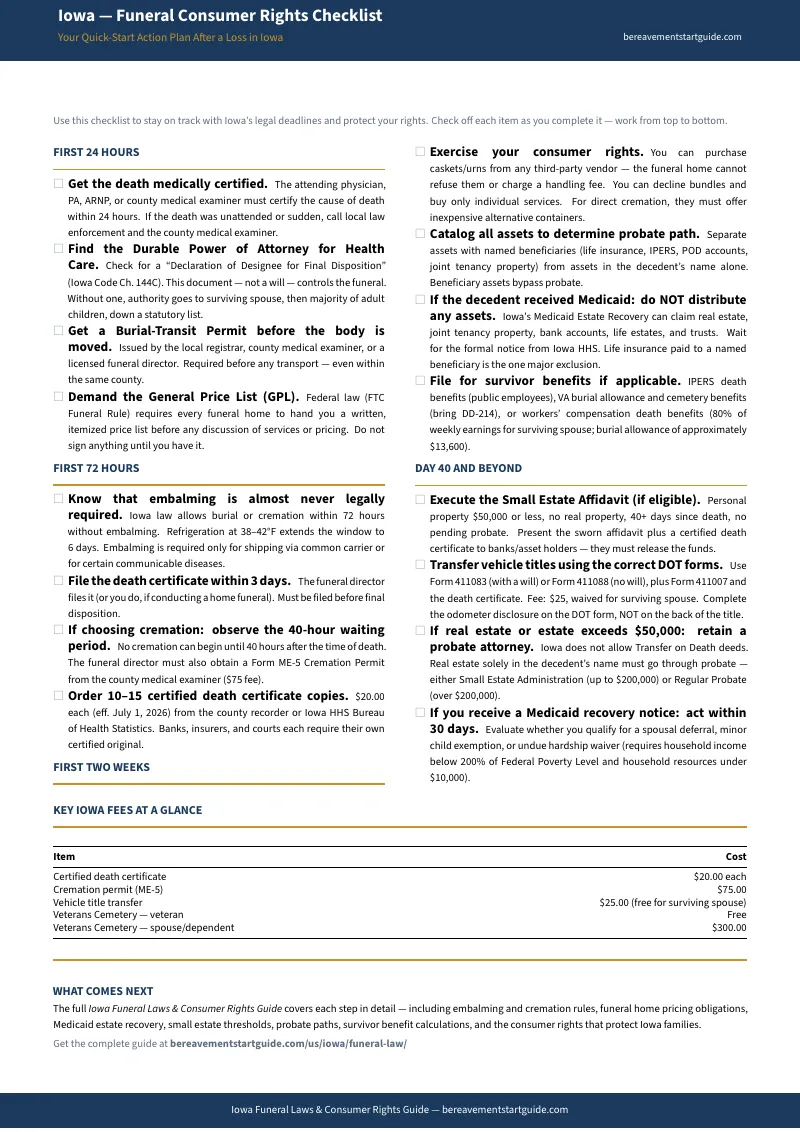
- Consumer Rights Checklist — a printable checklist of every federal and Iowa-specific right you have when arranging a funeral, including the right to decline embalming, receive an itemized General Price List, and use a third-party casket without penalty
- Chapter 144C Disposition Toolkit — the complete priority hierarchy for who controls funeral decisions under the Final Disposition Act, with guidance on the Declaration of Designee form, the majority rule, and resolving family disputes before they escalate
- Cremation Authorization Guide — the mandatory 40-hour waiting period, county medical examiner ME-5 permit requirements, pacemaker removal procedures, and the authorization forms that delay families who are not prepared
- Home Funeral and Green Burial Guide — the legal requirements for caring for the deceased at home on private property in Iowa, including the burial-transit permit process, zoning setback rules, deed-filing requirements, and the 150-foot water supply distance
- Ash Scattering Compliance Guide — Iowa Administrative Code 641-97.13(3) rules on public and private property scattering, aerial scattering regulations, the EPA Clean Water Act three-nautical-mile rule for water burials, and the distinction between state and federal jurisdiction
- Agency Navigation Map — the exact handoffs between the Department of Inspections and Appeals, the Board of Mortuary Science, the Iowa Insurance Division, the county medical examiner, and the EPA, with contact information, form numbers, fee amounts, and deadline windows for each
- Complaint Filing Guide — how to file a complaint with the Board of Mortuary Science for unethical conduct, the Insurance Division for prepaid contract violations, and the federal FTC for Funeral Rule violations, with the exact office, form, and process for each
- Prepaid Contract Risk Assessment — the Chapter 523A trust requirements, the 20% permitted deduction for seller expenses, cancellation rights, and safer alternatives like Payable on Death bank accounts
- Body Transport Guide — burial-transit permit procedures for moving remains within Iowa and across state lines, common carrier embalming requirements, airline cargo rules, and TSA screening for cremated remains
Who This Is For
- Families arranging a funeral right now who need to know their rights before the first meeting with a funeral director — especially those facing an $8,000+ price quote and wondering what they can legally decline
- Surviving spouses or adult children navigating cremation authorization delays, the 144C disposition hierarchy, or pressure to purchase services they suspect are unnecessary
- Families considering a home funeral, green burial, or ash scattering who want to confirm they are meeting every Iowa and federal requirement before proceeding
- Pre-planners evaluating prepaid funeral contracts and wanting to understand the 20% deduction risk, trust account protections, and how to prevent family disputes with a Chapter 144C Declaration of Designee
- Families in blended or estranged-spouse situations where a dispute over burial versus cremation is likely — and where understanding the 144C priority hierarchy is the difference between a resolved decision and a frozen funeral with daily refrigeration charges
Why Free Information Falls Short
The Iowa Code is free to read online. But Chapter 144C alone cross-references the Iowa Administrative Code, intersects with federal FTC regulations and EPA environmental rules, and requires coordination with four different state agencies. The Department of Inspections and Appeals will tell you what licenses a funeral director must hold but will not explain your consumer rights under the Funeral Rule. A national legal aggregator will discuss "Iowa probate" in terms that apply equally to Nebraska, missing the critical 40-hour cremation wait, the 144C hierarchy that overrides wills, and Iowa's prohibition on Transfer on Death Deeds. A funeral home website will walk you through casket selections and floral arrangements without mentioning that you can legally buy both from a third party and they cannot charge you a handling fee.
The guide bridges this gap — not by replacing legal counsel, but by connecting the dots between every relevant agency, statute, and deadline so you can make decisions from a position of knowledge rather than grief-driven urgency.
— Less Than One Hour of Probate Attorney Time
Iowa probate attorneys are statutorily permitted to charge up to 2% of the gross estate for ordinary services. On a $300,000 estate, that is $6,000. If this guide prevents just one unnecessary embalming charge, one pressure-sold package upgrade, or one family dispute that freezes services while daily refrigeration fees accumulate, it has paid for itself many times over. If it gives you the confidence to demand an itemized General Price List before signing anything, the savings compound from there.
Every purchase includes a money-back guarantee, no time limit. If the guide does not give you the clarity and confidence you need to navigate Iowa's funeral system, email us for a full refund.
The free Consumer Rights Checklist covers the most critical actions — the ones with hard deadlines and immediate financial consequences. The full guide covers every chapter in depth: the 144C disposition hierarchy, cremation authorization rules, home funeral regulations, ash scattering compliance, prepaid contract risks, body transport procedures, the complaint filing process, and every Iowa-specific consumer protection that the funeral industry hopes you never learn about.
Frequently Asked Questions
What if the rules change after I buy?
We update the guide when the rules change. Email us any time, even years later, and we'll send you the current edition free.