You Were Just Named Executor. The Court Wants an Inventory in 90 Days. And Nobody Will Tell You Whether You Even Need to Be in Court.
Someone you love died in Iowa, and now you are holding a will that names you as executor -- or you are the closest surviving family member and there is no will at all. The bank froze the checking account the moment they found out. You need money to cover the funeral, but the teller says you need "Letters of Appointment" -- and nobody at the counter can tell you how to get them. The car is sitting in the driveway and you are not even sure if anyone can legally drive it until the title is transferred.
You start searching for answers. The Iowa Courts website has rules spread across Chapter 633 and Chapter 635 with no explanation of which chapter applies to your situation. Iowa Legal Aid gives you general guidance but does not walk you through the calculations. Every probate attorney you call quotes $200 to $400 per hour -- or a $2,000 to $5,000 flat fee -- before they will explain a single step. And the clock is already running: the court requires a full inventory of every asset, valued as of the date of death, within exactly 90 days of your appointment.
Meanwhile, you have heard there is a "small estate affidavit" that might let you skip court entirely, but you cannot figure out whether the $50,000 limit or the $200,000 limit applies to your estate -- or what the difference between them actually is. If the deceased received Medicaid after age 55, you are terrified that the state will file a claim against the estate before the family sees a dollar. And despite Iowa repealing the inheritance tax in 2025, half the legal content online still says you need to file a return.
The Iowa Probate Sequence
This guide does what no single Iowa government website, legal aid page, or attorney consultation does: it puts the entire probate process into one chronological sequence -- from the first 72 hours through the final court discharge -- with every form name, statutory deadline, fee calculation, and agency contact in one place.
It is built exclusively for Iowa. Not a generic national probate overview with "check your state laws" footnotes. Every chapter addresses the exact thresholds, timelines, and traps that make Iowa probate different from every other state -- the $50,000 Small Estate Affidavit with its 40-day waiting period, the $200,000 Small Estate Administration under Chapter 635, the strict 90-day inventory deadline, the four-month creditor claim window, the aggressive Medicaid estate recovery program, and the Certificate of Acquittance that takes 60+ days to process and without which the court cannot close the estate.
What You Get
The Complete Guide (15 chapters)
- Three pathways explained side by side -- the Small Estate Affidavit (under $50,000 in personal property, no real estate, 40-day waiting period), Small Estate Administration (under $200,000, simplified court process under Chapter 635), and Full Formal Probate (over $200,000, full court supervision under Chapter 633). A decision worksheet that walks you through the exact calculation to determine which pathway applies, including what counts toward the threshold and what does not
- First 72 hours protocol -- locating the original will (Iowa presumes a missing original was intentionally destroyed), checking for a Declaration of Designee that overrides even the will on funeral decisions, securing the residence and vehicles, ordering certified death certificates ($20 each from the Iowa HHS Bureau of Health Statistics), and notifying Social Security
- The Small Estate Affidavit in detail -- the exact statutory requirements under Iowa Code Section 633.356, the mandatory 40-day waiting period, what counts toward the $50,000 limit and what does not (life insurance and retirement accounts with named beneficiaries bypass probate), how to prepare the affidavit with the required taxpayer ID numbers, and how to present it to banks and financial institutions so they honor the transfer
- Opening the estate -- filing the Petition for Administration, the Court Officer's Oath, the Designation of Attorney, posting the fiduciary bond, receiving Letters of Appointment, publishing notice to creditors for two consecutive weeks, and mailing notice to every heir including those disinherited by the will
- The 90-day inventory -- exactly what the Report and Inventory must include under Iowa Code Section 633.361, how to value every asset as of the date of death, when you need formal appraisals, and how to file supplemental inventories when you discover additional assets
- Creditor claims and payment hierarchy -- the four-month creditor claim window, the exact payment priority under Iowa Code 633.425 (court costs first, then administration expenses, then funeral expenses, then federal taxes, then medical expenses, then state taxes, then Medicaid recovery, then general creditors), and why paying debts out of order creates personal liability for you as executor
- Medicaid estate recovery -- how Iowa Code 249A.53(2) works, the 30-day undue hardship waiver deadline, deferral criteria for surviving spouses and disabled dependents, the waiver income and resource thresholds, Form 470-4339, and the personal liability warning for executors who distribute funds before clearing the Medicaid claim
- Taxes after the 2025 repeal -- confirmation that Iowa's inheritance tax is repealed for deaths on or after January 1, 2025. The guide clears up the outdated online information that still tells executors to file Form IA 706. Plus fiduciary income tax obligations, the Certificate of Acquittance from the Iowa Department of Revenue (which takes 60+ days to process), and federal Form 1041 requirements
- Spousal protections that override the will -- the elective share under Iowa Code Section 633.238 (one-third of real property, exempt personal property, and one-third of other personal property), the homestead life estate under Section 633.240, family allowances, and the strict four-month election deadline after notice of probate
- Real estate transfers -- Iowa's unique Abstract of Title system, the Iowa Title Guaranty program, recording requirements at the county recorder's office, and why Iowa is one of the few states that does not permit Transfer on Death deeds for real estate
- Motor vehicle transfers -- Form 411083 (Certification of Death Testate) when a will exists, Form 411088 (Affidavit of Death Intestate) when there is no will, the odometer disclosure requirement, why Iowa does not allow vehicle titles in the name of an "estate," and the surviving spouse fee waiver
- What probate actually costs -- the 0.2% court cost calculation, the statutory fee schedule under Iowa Code 633.197 (6% on the first $1,000, 4% on the next $4,000, and 2% on everything above $5,000), worked examples for estates of different sizes, and when hiring an attorney is cost-effective versus when it is not
- Closing the estate -- the Final Report, the three-year statutory time limit, obtaining signed beneficiary receipts, and the Order of Formal Discharge that ends your fiduciary responsibilities
8 Printable Standalone Worksheets and References
In addition to the complete guide, your purchase includes 8 standalone printable PDFs -- each one extracted from the guide so you can print it separately, pin it to your wall, or keep it in your filing folder without flipping through the full document:
- Pathway Decision Worksheet -- walk through the asset classification to determine whether you need the Small Estate Affidavit, Small Estate Administration, or Full Formal Probate
- Asset Inventory Worksheet -- a fillable inventory form organized by asset category for the mandatory 90-day Report and Inventory
- Creditor Priority Reference -- the exact payment hierarchy under Iowa Code 633.425 on a single page you can reference every time a bill arrives
- Medicaid Recovery Worksheet -- the hardship waiver criteria, Form 470-4339 instructions, deferral eligibility, and fill-in fields for tracking the 30-day deadline
- Spousal Rights Reference -- the elective share, homestead life estate, family allowances, and the four-month election deadline on one page
- Vehicle Transfer Reference -- the three transfer paths (testate, intestate, surviving spouse), which DOT form to use for each, and the fee waiver
- Deadline Timeline -- every statutory deadline from day one through estate closure, with the triggering event and consequence of missing each one
- Forms Quick Reference -- all 10 essential forms organized by category (court filings, DOT, HHS, Department of Revenue) with form numbers and where to get them
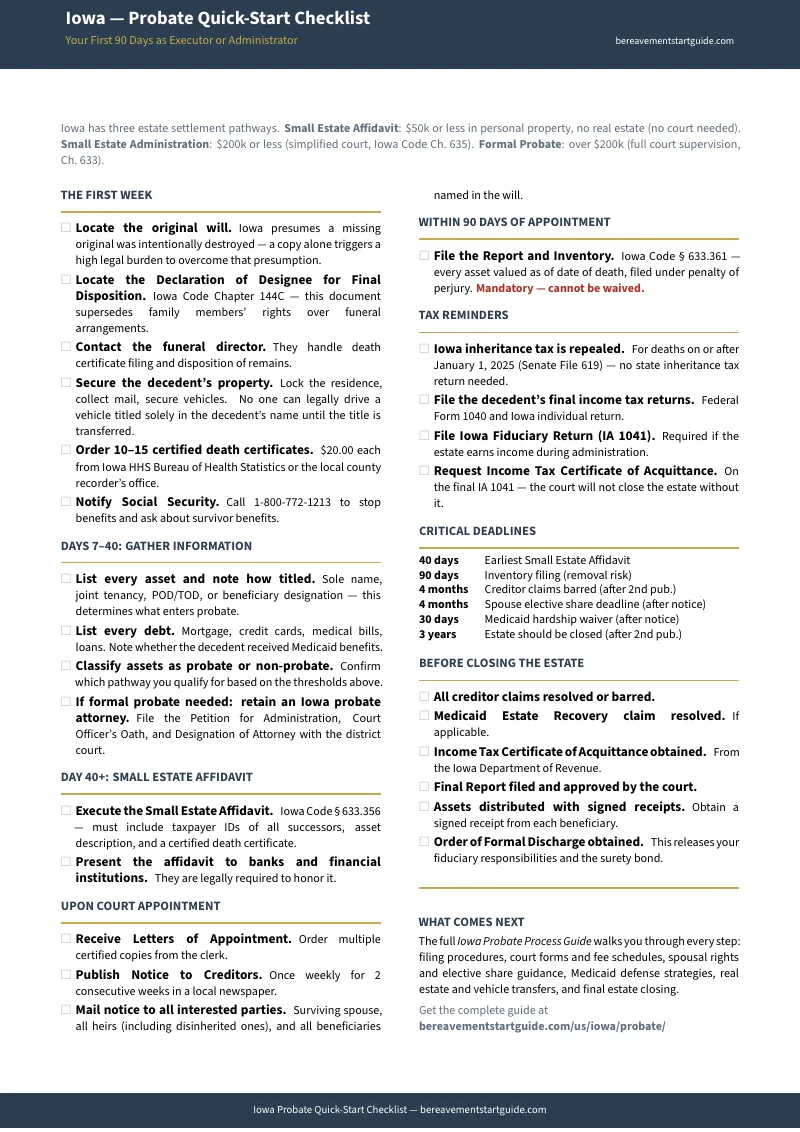
The Free Iowa Probate Quick-Start Checklist
A printable checklist covering the essential steps for the first 90 days -- from locating the original will and ordering death certificates through filing the inventory and calendaring the creditor claim window. Includes the pathway decision table so you know immediately whether you need the Small Estate Affidavit, Small Estate Administration, or Formal Probate. Available as a free download so you can start right away while deciding whether the full guide is right for your situation.
Who This Is For
- First-time executors who have never been through probate and need to know what to file, when to file it, and what happens if they miss a deadline -- especially the 90-day inventory that cannot be waived and the four-month creditor window that determines when you can safely distribute assets
- Surviving spouses who need to access frozen bank accounts, understand the elective share and homestead protections, determine whether the estate qualifies for the Small Estate Affidavit, and transfer the car title at the DOT with waived fees
- Adult children settling a parent's estate -- especially those living out of state who need to understand Iowa's district court system, the three settlement pathways, and whether they can handle the administration without flying back repeatedly
- Families worried about Medicaid recovery who received a notice from Iowa HHS and need to understand the 30-day hardship waiver deadline, what assets the state can claim, and how to protect a surviving spouse or disabled dependent from losing the family home
- Cost-conscious families who want to handle the probate process themselves or reduce attorney fees -- the guide covers the administrative work that would otherwise consume your first several billable hours, potentially saving the estate thousands in statutory legal fees
Why Not Just Use the Free Government Forms?
Every form referenced in this guide is available for free from an Iowa government agency. The Small Estate Affidavit form is available from the courts. The DOT vehicle transfer forms are on the Iowa DOT website. The Medicaid Debt Response Form is available from HHS.
What is not free -- and what no government website provides -- is the sequence and strategy. The court will accept your filing fee but will not explain whether the $50,000 affidavit or the $200,000 small estate process applies to your situation. The Iowa DOT website has two different affidavit forms and does not tell you which one you need. Iowa Legal Aid provides general guidance but does not walk you through the asset classification that determines your pathway. And Iowa court clerks are legally prohibited from giving you legal advice -- they cannot tell you which form to file or when a deadline has passed.
Each agency handles its piece. None of them tell you what the next step is, or warn you about the traps between the steps -- like the fact that distributing assets before the four-month creditor window closes creates personal liability for the executor, or that the Certificate of Acquittance takes 60+ days to process and will delay estate closure by months if you file it late.
-- Less Than One Hour of Attorney Time
A single consultation with an Iowa probate attorney runs $200 to $400 per hour. A flat-fee retainer for a straightforward estate starts at $2,000 to $5,000. And under Iowa Code 633.197, statutory attorney and executor fees can each reach roughly two percent of the gross estate -- meaning a $250,000 estate can incur over $5,000 in legal fees alone. This guide covers the administrative groundwork that would otherwise consume your first several billable hours -- classifying assets, determining your settlement pathway, understanding deadlines, organizing your documents, and knowing your statutory protections. Even if you ultimately hire an attorney, completing these steps first saves the estate hundreds of dollars in billable intake time.
If the guide does not save you at least ten hours of research across scattered government websites, email us at any time for a full refund. No questions asked.
Frequently Asked Questions
What if the rules change after I buy?
We update the guide when the rules change. Email us any time, even years later, and we'll send you the current edition free.