
A Funeral Director Just Told You Embalming Is Required by Kansas Law. It Almost Certainly Isn't.
Someone you love just died in Kansas. You're sitting across from a funeral director who is explaining that the body must be embalmed, that you need a casket for cremation, and that the "standard package" is the way most families handle things. You don't know whether any of this is true, and you're in no condition to argue. You sign what they put in front of you.
Later, you learn that Kansas law does not require embalming for private viewings or direct burials -- it only requires embalming or refrigeration if the body will not reach its final disposition within 24 hours. You learn that federal law prohibits funeral homes from requiring a casket for direct cremation -- a cardboard container is perfectly legal. You learn that Kansas is one of the most permissive states in the country for family-led funerals, home burials, and alternative disposition. But you learn all of this after you've already paid thousands of dollars for services you didn't need and didn't have to buy.
You start looking for answers. The Kansas State Board of Mortuary Arts website has a "Facts About Funerals" PDF buried in bureaucratic language that doesn't tell you what to do first. The Funeral Consumers Alliance of Greater Kansas City is helpful -- but only if you live in the KC metro area, and they don't provide downloadable templates. Kansas Legal Services publishes some articles on TOD deeds and small estates, but nothing that connects funeral rights to estate settlement in one sequence. And every elder law firm you find online writes just enough to convince you that you need to schedule a $300-per-hour consultation.
The Kansas Funeral Rights Roadmap
This guide does what no single Kansas government website, legal aid page, or funeral home brochure does: it puts your full spectrum of funeral consumer rights, disposition options, financial benefits, and estate protections into one chronological sequence -- with every statute, form, fee, and deadline specific to Kansas law.
It's built specifically for Kansas. Not a national funeral planning overview with "check your state laws" footnotes. Every chapter addresses the exact rules that make Kansas different -- the K.S.A. 65-1734 hierarchy that determines who controls the funeral when siblings disagree, the 24-hour refrigeration threshold under K.A.R. 63-3-11 that eliminates the need for embalming in most situations, the coroner's cremation permit requirement under K.S.A. 65-2426a that creates an effective 24-to-48-hour waiting period, the home burial process that requires platting and recording with the Register of Deeds under K.S.A. 17-1302, the prepaid funeral contract trust protections under K.S.A. 16-301, and the KanCare expanded estate recovery program that pursues non-probate assets including TOD deeds and joint tenancies.
What You Get
The Complete Guide (10 Chapters)
- Who controls the funeral -- the exact K.S.A. 65-1734 statutory hierarchy that settles family disputes by law, not by argument: healthcare agent (if the DPOA explicitly grants disposition authority), surviving spouse, adult children, parents, next degree of kinship, and the military exception under DD Form 93 that overrides everyone
- First 24 hours protocol -- filing the death certificate within 3 days through the KDHE Electronic Death Registration System, the 24-hour refrigeration-or-embalming threshold, the religious exception for Sabbath and holy days, and how to navigate the EDRS system without a funeral director if you're conducting a home funeral
- Every disposition option legal in Kansas -- traditional cemetery burial, direct cremation (with the coroner's permit requirement and the prohibition against requiring a casket), home funerals with family-directed body care, private conveyance transport under K.A.R. 63-3-11, home burial on private property (zoning, platting, and Register of Deeds recording requirements), green burial, scattering of ashes, and the 120-day protocol for unclaimed cremated remains
- Your FTC and Kansas consumer rights -- the General Price List you're entitled to before any pricing discussion, your right to purchase caskets and urns from third parties, Kansas's strict anti-solicitation law that prohibits uninvited contact when death is imminent, the coroner steering prohibition that makes it a crime for a coroner to deliver a body to a funeral director over the family's protest, and the step-by-step KSBMA complaint process with the evidence you need to attach
- Financial benefits you must claim -- Social Security's $255 lump-sum death payment, VA burial benefits and Kansas state veterans cemeteries, Workers' Compensation death benefits up to $500,000 with a $10,000 burial allowance, KPERS death benefits with the direct rollover option that avoids the 20% automatic federal withholding, and the funeral assignment form (KPERS-7/99R) that directs the $6,000 retiree benefit straight to the funeral home
- Probate avoidance -- the $75,000 Small Estate Affidavit (K.S.A. 59-1507b) with no mandatory waiting period, Refusal to Grant Letters (K.S.A. 59-2287) that creates marketable title on real estate for a $48.50 docket fee, TOD deeds for real estate, and the three KDOR vehicle transfer forms (TR-82, TR-83a, TR-83b) explained by scenario
- Surviving spouse protections -- the $75,000 family allowance under K.S.A. 59-403 that supersedes creditor claims and includes one automobile, and the elective share sliding scale from 3% to 50% based on marriage length
- Medicaid estate recovery defense -- how Kansas's "expanded recovery" definition under K.S.A. 39-709(g) reaches TOD deeds, joint tenancy, and POD accounts, the deferral rules for surviving spouses and disabled children, the hardship waiver process, and the spousal elective share trap that can force an institutionalized spouse to sue their deceased partner's estate or lose Medicaid eligibility
- Prepaid funeral contracts -- the K.S.A. 16-301 trust requirement that mandates 100% of prepaid funds be held in a federally insured institution, the revocable-vs-irrevocable distinction for Medicaid planning, and what to verify before signing
- Complete forms and fees directory -- every form referenced in the guide (death certificate, coroner's permit, Small Estate Affidavit, Refusal to Grant Letters, TR-82/83a/83b, KPERS-7/99R, KSBMA complaint form, DD Form 93) with issuing agency, purpose, and fee
8 Standalone Printable Tools
- Disposition Authority Reference -- the K.S.A. 65-1734 hierarchy on one page, with the DD Form 93 military override and coroner steering prohibition. Print it and bring it to any family discussion.
- First 24 Hours Checklist -- every time-critical action from the moment of death through the 3-day death certificate deadline, organized by hour window
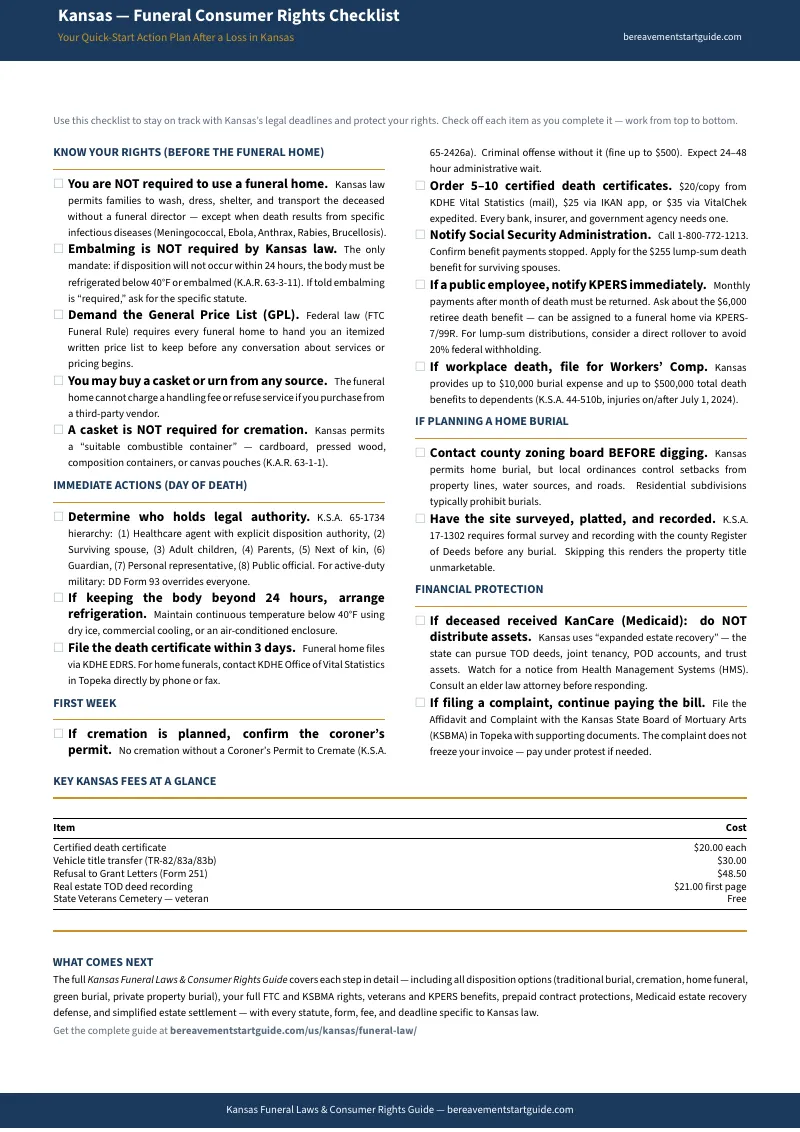
- Disposition Options Comparison -- all seven Kansas disposition paths side by side: requirements, cost ranges, and governing statutes on one landscape sheet
- Consumer Rights Card -- your FTC and Kansas funeral rights on one page, designed to take into the arrangement conference
- Financial Benefits Tracker -- fill-in worksheet tracking every benefit claim (Social Security, VA, Workers' Comp, KPERS) with agency contacts, deadlines, and status columns
- Estate Settlement Decision Tree -- a visual flowchart that walks you from "Did the deceased have assets?" to the exact probate avoidance route and form number
- Medicaid Recovery Worksheet -- asset inventory, federal exemptions checklist, and HMS response protocol for families facing KanCare expanded estate recovery
- Forms and Fees Reference -- every form, issuing agency, purpose, and fee on one landscape sheet. Print it and tape it to the wall.
The Free Kansas Funeral Consumer Rights Checklist
A printable 17-item checklist covering your core legal rights before entering a funeral home, the immediate actions for the day of death, the financial protections you need to invoke, and the home burial requirements if you're considering private property interment. Available as a free download so you can start immediately.
Who This Is For
- Shocked next-of-kin who just received a call and need to know -- right now -- who legally controls the funeral, whether embalming is actually required, and what rights they have before walking into a funeral home arrangement conference
- Budget-conscious estate administrators who want to avoid depleting the estate on attorney fees for tasks that Kansas law specifically designed for citizens to handle themselves -- the Small Estate Affidavit, vehicle title transfers, and simplified probate routes
- Families choosing home funerals, green burials, or direct cremation who need the statutory ammunition to bypass uncooperative hospitals, nursing facilities, and county clerks who misinterpret or are ignorant of Kansas's permissive family-led funeral laws
- Medicaid-affected heirs who just learned that the TOD deed or joint tenancy they were counting on to protect the family home offers no protection from KanCare's expanded estate recovery program -- and need to understand the federal exemptions, deferral rules, and hardship waiver process before responding to the HMS collection letter
Why Not Just Piece It Together From Government Websites?
Every statute cited in this guide is public law. The KSBMA's regulations are online. The FTC Funeral Rule is published. The Kansas Judicial Council forms are downloadable. The KDHE death certificate process is documented.
What's not available anywhere -- from any single government agency, legal aid organization, or consumer advocacy group -- is the sequence. The KSBMA doesn't tell you how to navigate the EDRS system without a funeral director. The FTC doesn't explain the Kansas-specific anti-solicitation rule or the coroner steering prohibition. Kansas Legal Services covers TOD deeds but doesn't connect them to the Medicaid estate recovery program that can override them. The KDHE publishes the death certificate process but doesn't tell you how many certified copies to order or what to do when the attending physician delays signing. And no single website explains how the $75,000 family allowance, the Small Estate Affidavit, and the Refusal to Grant Letters process interact to potentially eliminate the need for formal probate entirely.
The raw statutes are free. The synthesis is not. This guide translates K.S.A. chapters, K.A.R. regulations, KDHE protocols, and FTC rules into a plain-English chronological roadmap -- so you spend your energy on your family, not on deciphering bureaucratic jargon while grieving.
-- Less Than Twenty Minutes of Attorney Time
A single consultation with a Kansas probate or elder law attorney runs $250 to $400 per hour. And most of that first appointment is spent on the same administrative triage this guide covers -- who has legal authority, what the disposition options are, which forms to file, and whether the estate qualifies for simplified settlement. This guide covers those fundamentals in one sitting, so that if you do hire an attorney, you skip the intake and go straight to the issues that actually require professional judgment.
If the guide doesn't save you at least ten hours of frustrating research across scattered government websites, email us at any time for a full refund. No questions asked.
Frequently Asked Questions
What if the rules change after I buy?
We update the guide when the rules change. Email us any time, even years later, and we'll send you the current edition free.